Showing posts with label Campbell. Show all posts

Monday, March 15, 2021

CFH First Draft: Frances Campbell Hoot

 This post is part of an ongoing series, sharing the first draft of my Revised Callin Family History. 

Frances Campbell is the 42nd person in a descendant report beginning with the earliest known ancestor of our Callin family, (1.) James Callin. This descendant report uses the Register Style of the New England Historic and Genealogical Society. 

Please use the Contact Form (at right) to send questions or corrections.

Thursday, March 11, 2021

CFH First Draft: Harrison M Campbell

 This post is part of an ongoing series, sharing the first draft of my Revised Callin Family History. 

Harrison Campbell is the 41st person in a descendant report beginning with the earliest known ancestor of our Callin family, (1.) James Callin. This descendant report uses the Register Style of the New England Historic and Genealogical Society. 

Please use the Contact Form (at right) to send questions or corrections.

Monday, March 8, 2021

CFH First Draft: Cyrus C Campbell

 This post is part of an ongoing series, sharing the first draft of my Revised Callin Family History. 

Cyrus Campbell is the 40th person in a descendant report beginning with the earliest known ancestor of our Callin family, (1.) James Callin. This descendant report uses the Register Style of the New England Historic and Genealogical Society. 

Please use the Contact Form (at right) to send questions or corrections.

Thursday, December 3, 2020

CFH First Draft: Ann Callin Campbell

 This post is part of an ongoing series, sharing the first draft of my Revised Callin Family History. 

Ann Callin is the 12th person in a descendant report beginning with the earliest known ancestor of our Callin family, (1.) James Callin. This descendant report uses the Register Style of the New England Historic and Genealogical Society. 

Please use the Contact Form (at right) to send questions or corrections.

Sunday, April 9, 2017

Update: Lillie and Nellie Campbell

Sometimes, the tiniest of clues can lead to a breakthrough.

Just before Christmas, I received an email from someone who came across this blog while going about her own research. She offered to help me fill in some gaps after the holidays, and even though she only told me that she was the widow of the grandson of Lillie May Campbell, that one fact - that Lillie grew up and married - was enough to open up a whole treasure trove of records on Ancestry. Even before hearing back from my new distant cousin, I was able to add about two dozen missing descendants of James Callin to the tree!

Of course, some of those records only raised more questions; if I didn't have someone to ask, I would have no way of answering them myself. So thank you to Barbara for reaching out to me!

As it happens, I have been able to update two families based on what I've learned, so here we go:

Lillie May Campbell (1871–1946)

Lillie was the eldest daughter and the second child of Harrison M Campbell (1837–1924) and Catherine Hoot (1846–1930), the subjects of the post The Campbells Take Missouri (originally posted in January 2015). The only information I had about Lillie in that post was based on her 1800 U.S. Census record, which gave her name and age: "Lillian, age 9."

At 16 years of age, on 27 December 1887, Lillie married George G Weaver (1858–1918) in Morgan county, Missouri. George was a farmer who was born in Fort Scott, Kansas, before the Civil War, and they settled in Haw Creek, Missouri, where they began their family.

They had a son, Roy, in 1893, followed by their daughters Edith, in 1896, and Gladys, in 1900. Sadly, Gladys died at age four in 1904. Eight years later, they had another little boy, Frank.

Both George and Roy died in 1918. George suffered from heart and kidney failure, likely from untreated kidney disease. He was only 59.

Lillie's parents, Harrison and Kate Campbell, are known to have moved to Oregon in 1919, where Lillie's sister, Mary Hodges, had moved with her family about ten years prior. Lillie seems to have decided to move with them, bringing her two surviving children to Oregon with her, only to lose young Frank in 1921.

Lillie married again before 1930, this time to a doctor named George Thomas Darland (1857–1935) whose first wife had died in 1924. He cared for her in Hillsboro until his death in 1935, and then she moved to be closer to her children and grandchildren in Beaverton. She was living with the Cady family in 1940, and died in Washington county in 1946.

     I. Roy R Weaver (1893–1918) grew up in Haw Creek, Missouri, and was farming there in 1918, when he registered for the World War I draft. He died in 1918, and was buried in Verasailles Cemetery in Morgan county, near his father.

     II. Edith Vivian Weaver (1896–1960) also grew up on the farm in Haw Creek, and served as a nurse overseas during World War I. After the war, she moved with her mother and grandparents to Beaverton, Oregon, where she married  Willis Lawrence Cady (1896–1961) on 7 November 1923. Willis's grandfather, Alonzo B. Cady, was the 1st mayor of Beaverton in 1893; his father also was mayor and built the first brick building in Beaverton, which is still standing.

       A. Maxine Elizabeth Cady (1925–2011) attended Beaverton Schools and University of Oregon (Gamma Phi Beta) graduating from the School of Music. In 1946 she married "the boy I fell in love with in the 2nd grade", Bob Barnes. A piano prodigy, Maxine taught piano lessons, and organized the first high school choir at Bethel Congregational Church, becoming Director of Music and Organist in 1955. In 1956 she began teaching music in the Beaverton School District. There she was famous for her elaborate mini Broadway musicals. In 1973, she was awarded Teacher of the Year honors. As a teacher, director and musician Maxine was admired, respected and loved by her peers, but especially by her students.

Following the passing of her husband, Maxine started a new adventure as real estate broker. After her second career, Maxine directed and played for the Way Off Broadway Singers that toured local Senior Centers. During this time she became a companion of Earl Bolliger, a friend since Beaverton High days; they happily shared life's journey until Earl's passing in 2006.

Maxine is survived by her son, three daughters, 11 grandchildren and 5 great grandchildren.

       B. David Lawrence Cady (1928–2008) was born June 5, 1928, in Portland, Oregon. David was reared in Beaverton and was a 1946 graduate of Beaverton High School. He served in the Army from 1951 to 1952 during the Korean conflict. In 1959 he graduated from the University of Oregon with a bachelor's degree.

He was a CPA, with his own practice in Gladstone. He retired in 2004. He was a member of Beaverton and West Linn Lions clubs, a charter member of South Park Unitarian Fellowship of West Linn, and served Friends of Clackamas Community College for 20 years.

He and his wife lived in West Linn for 46 years before moving back to retire in Beaverton in 2004. She survives him, along with their son and daughter, and two grandchildren.

     III. Gladys M Weaver (1900–1904) died at age four, and was buried in Versailles Cemetery, where her father and older brother would eventually join her.

     IV. Frank E Weaver (1912–1921) was only nine years old when he died from pneumonia after suffering a case of measles. He died in Forest Grove, Oregon, and he was buried in the Forest View Cemetery there.

There you have the update for Lillie - but in the process of digging for those records, I learned more about her sister, who we only knew as "Ella, age 3," from the 1880 Census! We also solved the mystery of the "Deronshire Campbell" who appeared in the 1920 Census as a grandson of Harrison and Kate. 

 Nellie Viola Campbell (1877–1967)

Nellie was the fourth child, and third daughter, of Harrison and Catherine (Hoot) Campbell. She was born 13 April 1877 in Tipton, Morgan county, Missouri. She married a man called Earl C De Avonshire in Morgan county on 31 July 1907, and moved with him to Indianapolis, Indiana, where their son, Campbell De Avonshire was born in 1908.

Piecing together conflicting clues from the records to get a picture of what happened to Nellie and Earl was difficult, but they were living in Ohio when their second son, Wellington, was born in 1911. Their daughter, Lucille, was born back in Tipton, Missouri, in 1913, but Earl's World War I draft registration card showed they were living in Akron, Ohio, in 1918. This record also gave his name as "Edward Clinton Deavonshire" and I might have ignored it as a different person if it hadn't listed his nearest relative as Mrs. Nellie De Avonshire.

(I don't know whether "Edward Clinton" was his given name and "Earl" an actual title of nobility, or if "Earl" was a nickname. One of his daughter's marriage records says he was born in England, but another says he was born in Virginia; and two other records place his origin in Ohio.))

Nellie and Earl seem to have parted by 1920; Nellie and Wellington appeared in the Census in Washington county, Oregon, near the other transplanted members of the Campbell family. Campbell De Avonshire showed up in that Census living with his grandparents, Harrison and Catherine, in their Forest Grove, Oregon, home - but it mistakenly lists his aunt Frances as his mother. (And calls him "Deronshire Campbell.") Earl shows up (as Edward C) in 1930 in Libertyville, Illinois, running a restaurant with a new wife.

Nellie married again about 1927. Her new husband was the recently widowed Jacob H Shearer (1855–1940). She lost Jacob just two years before Campbell died; and later, in 1949, she married
William Oscar McConnahay (1878–1969), who survived her by two years.

     I. Campbell De Avonshire (1908–1942) was born in Indianapolis, and came with his mother and her family to Oregon around 1919. In 1930, at age 22, he was a patient resident at the Oregon State Hospital for the Insane. He died in 1942, and was buried in the Forest View cemetery in Forest Grove.

     II. Wellington De Avonshire (1911–1930) was born in Ohio, and he was living with his mother in the home of his step-father, Jacob Shearer, in Forest Grove in 1930 when he died at only 19 years of age.

     III. Lucille Frances De Avonshire (1913–1992) was born in Missouri, and lived with her mother and brother Wellington in 1930. She married Russell W Craine (1906-1966) on 31 January 1932 in Vancouver, Washington; they were together for about eight years. She was married again, this time to Fredrick Melvin Graham (1920–1993) on the day after the Pearl Harbor attacks, 8 December 1941, in Vancouver. They lived in Portland.

Based on the obituaries for Lucille and her last husband, Howard Verne Busch (1914–1993), whom she married on 5 July 1952 in Vancouver, they were survived by three daughters, but it isn't clear whether they were his daughters from a previous marriage, or hers. Regardless, Lucille and Howard are buried together in Mountain View Memorial Gardens, Forest Grove, Oregon.

 - -- --- -- - 

I've been lying low the past several months, working on bringing the revised Callin Family History to publication. The computer I was using was not powerful enough to produce the manuscript using Family Tree Maker, and when I upgraded to a newer computer, I was not able to download and install Family Tree Maker, despite having paid extra for that feature in 2014, when I bought FTM in the first place.

Since the new company making FTM wants me to pay $40 for an upgrade, and is charging $80 for the new version, I decided to migrate over to RootsMagic. I've been following Randy Seaver's blog for a while, and he writes about his experiences with various software experiments, and with RootsMagic - click here for an example. The price was right, and the features similar.

While I'm learning and churning, I will probably not be posting with any regularity. If anyone is interested in sending in a guest post, I'd be happy to post that!

And, as always, if you're related to anyone in this post (or any of the previous 137!), please drop me a note at callintad at gmail dot com. Descendants of James Callin are invited to join the Callin Family History Facebook group. And I'm always up to something on Twitter.

Friday, January 22, 2016

A Real Hoot

Nathan Hoot came from Pennsylvania and settled on a farm near Reedsburg, Ohio, probably during the 1830s. He later moved to Ashland with his brother and they ran a shoe business for several years before selling their interests. Nathan relocated to Galion, set up shop there, and worked at making shoes the remainder of his life.

John B. Hoot, his son, was born in Reedsburg in March 1839. After finishing his schooling he was apprenticed to William Ilger to learn harness and saddlery. Upon becoming a journeyman saddler, he entered the Union army, serving in the 196th Regiment, Ohio Infantry.

The Regiment was organized at Camp Chase, Ohio, and mustered in March 25, 1865. They left the state for Winchester, Virginia, on March 26, when they were assigned to 2nd Brigade, 2nd Provisional Division, Army of the Shenandoah. In July they were moved to Baltimore, Maryland, and  held garrison duty there and at Fort Delaware till September. They mustered out on September 11, 1865.

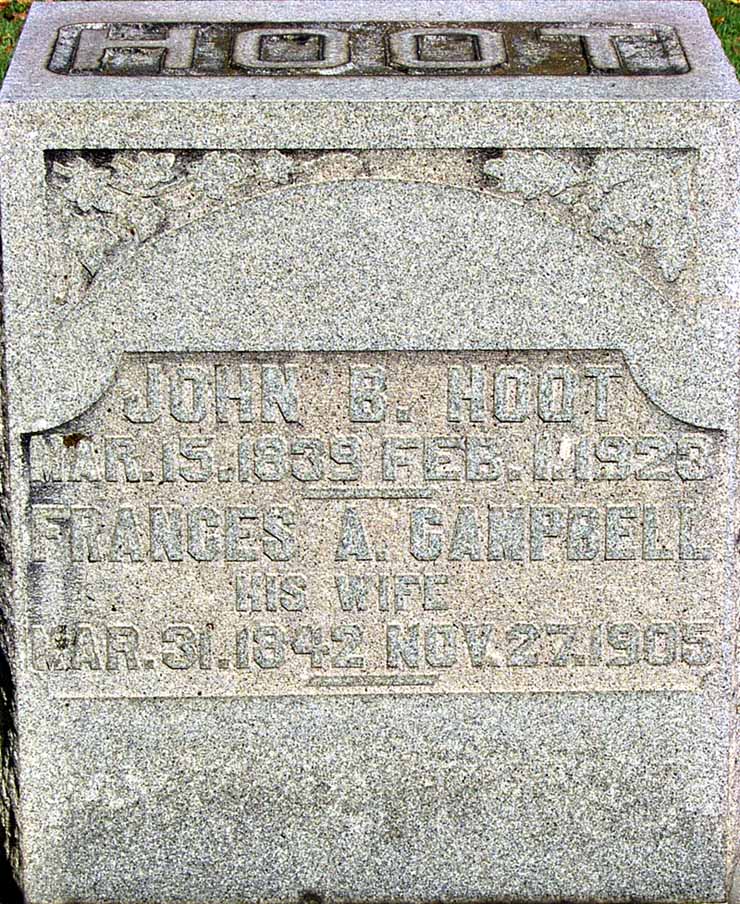
John and Frances (Campbell) Hoot
Frances A. Campbell married John B. Hoot (1839–1911) on 20 February 1862. She was the younger, surviving daughter of Henry and Ann (Callin) Campbell, and the sister of Cyrus and Harrison Campbell, the subjects of our last two posts. Harrison, you might recall, married John Hoot's sister, Catherine Hoot.

Frances was born in Montgomery county, Ohio, on 30 March 1842, and grew up on her father's farm. She married John when she was twenty, and over the following twenty-six years, they had eight children together; two sons and six daughters.

After the war, John moved with his family to Orange, where he rented a saddlery shop for many years, often employing as many as seven men. He was acknowledged throughout the county as being unsurpassed as a saddler and harness maker. His work was reportedly shipped to all parts of the United States. Upon leaving Orange, he removed to Mt. Vernon where he was foreman of a saddlery shop for ten years. In 1903 he retired and moved to Columbus, Ohio, where the family lived on Wisconsin Ave.

Frances died in 1905 at the age of 62, only two years after John retired, and he died in 1923. They were buried together in the Nankin cemetery, Ashland county, Ohio.

1. Agnes Cornelia Hoot (1863–1906)

The eldest daughter, she preferred to go by the name Cornelia, married John Byron Barrick (1858–1935) in 1880. John was a teamster in the Cleveland area for many years. They had a son and a daughter before Cornelia died unexpectedly in 1906 at the age of 43, while visiting in Athens, Georgia. After burying his wife, John moved in with his son, Adelbert, in Ashland, where he lived until his death in 1935.

     a. Adelbert Earl Barrick (1885–1964) worked as a machinist and skilled laborer most of his life. He married Minnie May Mcmurray (1878–1953) on 12 March 1904, and they had four sons. According to his World War I draft registration, Adelbert lost his left leg above the knee in March 1908. The couple remained in Ashland all their lives. Minnie died in 1953 at the age of 75, and Adelbert at 79 years, in 1964. They were buried in the Ashland cemetery.

     i. Charles A Barrick (1908–1969) was a core maker and foundry worker throughout his adult life. He married Velma A Mawhorr (1908–1976) around 1927. Their son, Charles Gaylord Barrick, (1928–2003) was retired pastor of the Sullivan Congregational Church and had taught eighth- and ninth-grade English in the Cloverleaf School District, Lodi, for 30 years.

     ii. Clyde Earl Barrick (1912–1966) was married to Charlotte, though they seem to have been estranged in the 1950s; they had one son and one daughter.

     iii. Ernest Benton Barrick (1920–1977) enlisted in the National Guard on 15 October 1940. He was still living with his parents at that point, but by 1945, he was married to Betty Marken (1918-2014) and living at 30 W Walnut, in Ashtabula. They had four children: three daughters who are still alive, and a son, David Joel Barrick (1951-2013).  David was a U.S. Army veteran and served in the Vietnam Conflict. He and his wife had four daughters.

     iv. Albert Ellis Barrick (1922–1979) was a World War II veteran who served from 26 October 1942 until 15 February 1946. He worked in assembly plants, and never married. He was 57 years old when he died in Ashland.

     b. Rea Barrick (b. May 1890) made one appearance in the 1900 Census, but sadly seems to have disappeared after that. It is possible that after her mother's death in 1906 that Rea might have gone to live with relatives, or gotten married before 1910.

2. Ida N. Hoot (1865–1947) 

Ida was the second daughter of John and Frances (Campbell) Hoot. She married Franklin Pierce Stine (1861–1931) in 1886. Frank was a farmer in Ashland county, and he and Ida had three sons and a daughter.

     a. Leonard Benton Stine (1889–1969), who preferred to be called "Leon," married Norah Wanda Ward (1891-1978). They were a farm family, and lived in Sullivan their entire lives. In 1930, their farm was next door to Leon's brother, Evan's farm. There are no records showing that they had any children of their own.

     b. Evan Francis Stine (1891–1944) married Mary Margaret Gill (1893–1973) around 1918, and began farming in Ashland county. The had seven children (i-vii); four daughters and three sons. Evan died at the age of 53, and Mary at 79.

     i. Mary Lucille Stine (1919–2004) married Paul Eichelberger (1911–1974), and they have four children who are still living: two sons and two daughters, and four grandchildren. Paul and Mary also had twins: a son and daughter born in 1950. The little girl, Carolyn, only lived a couple of weeks, but Carl Harold Eichelberger (1950-2014) was a machinist, like his father, who lived his whole life in Ashland county. Carl left a wife and three daughters.

     ii. Donald F Stine (1921) was born on 30 January and died 7 July 1921. He is buried in the Southview Cemetery in Sullivan township, Ohio.

     iii. Luella Irene Stine (1922–1999) married Donald E Heifner (1911–1960), a farmer from Montgomery township. Don died very young, at 49. Their only child was Kenneth Richard Heifner (1949–1969), a U.S. Marine killed in action in Viet Nam when he was only twenty.

     iv. Walter E Stine (1924–1997) married Mary Ellen Morr (1924–2008) on 13 June 1943, and they had two sons who are still living.

     v. Helen Pauline Stine (1928–1999) was married twice; first to Richard Dale Boales (1927–2009) and then in 1954 to Forrest Milton Fellenbaum (1918–1988).

     vi. Harold Evan Stine (1928–1986) married Martha Irene Johnson (1930–2015) on 25 March 1950. They lost their first two babies at birth (Larry Richard Stine b. 1950 and Stephen Eugene Stine b. 1951), but had a daughter and two more sons, and 36 years together before Harold died at 57. Martha only died last year at 84, having spent her time surrounded by grandchildren and great-grandchildren.

     vii. Phyllis A Stine (1935–1997) married Harold Max Lamb (1934–1992) in 1952, right after she graduated high school. They had a daughter, Mary May Lamb (1953-2003) who married Larry J "Jay" Matthews (1953–2010); the Matthews had three sons, who are still living.

Phyllis and Harold divorced in the early 1960s, and while he remarried later, Phyllis lived out her days in Ashland.

     c. Mary Estella (Stella) Stine (b. 1896), the only daughter of Frank and Ida (Hoot) Stine, grew up on the farm, but in 1920 was living out on her own. She was a factory worker in Ashland, rooming in the home of Rebecca Wood. After 1920, there are no more clues to her whereabouts. I assume she got married and I simply haven't tracked down the record, yet.

     d. Alva Sylvester Stine (1900–1966) grew up farming like his father and brothers, but in 1923 he graduated Ashland University where he was Vice President of his senior class, and he went on to become a school superintendent and administrator. Known as "Alva" throughout his youth, he preferred to be called "Sylvester" later on.

By 1927, Sylvester had married Mary I. Ferrel (1899-1999), and was a principal at a school in Wayne county. Two years after his father died, Sylvester and Mary had their daughter, Miriam Elaine Stine (1933–2000). Miriam grew up in Canton, Ohio, where she married Mr. Cross in 1952. They all relocated to Cass county, Michigan, where Sylvester died in 1966. Miriam was an elementary school teacher there for many years, and she and her husband also had a daughter and two sons who are still with us.

3. Byron A Hoot (1867–1942) 

Byron was one of the leading barbers of Ashland, conducting "a large and elegantly appointed shop" there for many years.

At the age of thirteen years, Byron was apprenticed to a barber. Later he traveled for three years, working as a journeyman in various cities, finally returning to Ashland in 1885, where he opened a shop in the National Bank building. He remained there for eighteen years, becoming popular for his high-class work. After that he relocated to Main street, the third door below Orange street, where he employed three men.

In 1891 Mr. Hoot was united in marriage to Ida Mae Brubaker (1874–1944), daughter of John W. Brubaker and Eliza Barr. Byron and Mae had one daughter and one son.

     a. Glorene Frances Hoot (1895–1977) was the victim of many misspellings in the historical record - "Lorene," "Glarence," and (my least favorite) "Glovine" being just three. She married Harry Eugene Matthews (1895–1976) on 5 October 1916. (He was no relation to the Larry Jay Matthews who married Mary May Lamb as mentioned above.)

Harry was a salesman, worked for a time as a produce manager, and then as an insurance salesman. The couple raised two children:

     i. Rexford Eugene Matthews (1919–2002) enlisted in the U.S. Navy in 1939, and served throughout the war, being discharged in 1946. He married his wife, Virginia Louise Page, in 1948. They had at least one daughter and a son who are still living. Rex worked as a salesman in a shoe store, until he landed a job with the State Highway department; Virginia worked in a pastry shop. They were together for 31 years, until they divorced in 1979, and Rex moved down to Sarasota, Florida. There he remained until his death in 2002.

     ii. Patricia Mae Matthews (1925–2012) was a professional Girl Scout and camp director, then a physical education teacher. Pat also had a beautiful soprano voice, and was a soloist in the Ashland College Choir, as well as a member of the Cleveland Orchestra Chorus in the days of Robert Shaw and George Szell. She performed with that group on the stage of Carnegie Hall.

In 1983 Pat received the "Individual Better Life Award" from the Ohio House of Representatives for being a "remarkable individual, combining humanitarian concern and commitment with selfless initiative to become a dynamic force in behalf of the aged." In 1985, she relocated to Sarasota, Florida - that may have been why her brother moved there, as well.  In Sarasota she volunteered in nursing homes and sang in the Key Chorale for 16 years.

     b. John Weldon Hoot (1902–1950) was a professor who married Evelyn Marie (1902-1969) in Ohio, and took his wife to Upper Darby, Pennsylvania, in the 1930s. After his death at 48 years of age, in Philadelphia, Dr. J. Weldon Hoot was buried back home in Ashland, but Evelyn and their teen aged daughter remained in Pennsylvania. Their daughter is still living in that state, as far as I know.

4. Clara Hoot (1869–1916) 

Clara married Philip Kirsh (also seen as "Kirsch") some time around 1888, and they had three children before Philip's death a decade later. Despite leaving few records behind, it is safe to guess that he died between 1895 and 1900.

     a. Helen G Kirsh (b. 1889) appeared on the 1900 Census in the Mount Vernon, Knox county, Ohio household of her widowed mother. There is a marriage record from Chicago in 1908 showing a Helen Kirsh marrying Harry Schmitz, but the details about her in their 1910 Census record (in Chicago) do not indicate that this Helen came from Ohio, so I can't say for certain that this is our Helen Kirsh.

     b. Arlina A Kirsh (1892–1963) married Ora James Bemiller (1888–1939) in 1910, and moved in with his family. Ora grew up a farmer, then worked for a time as a tobacconist, as a firefighter, and later as a metal worker in Shelby, Ohio. James took ill and died about a month after he and Arlina moved to the Galion area. They had one daughter.

     i. Eva Glorine Bemiller (1913-1956) was partly named after her mother's cousin, Glorene Hoot. She married Daughn D Clow (1913-1987) in Ohio county, West Virginia, in 1936. Some time after Eva's death in 1956, the rest of the family relocated to Florence, South Carolina, where Daughn died in 1987. Daughn and Eva had a son and a daughter, and many grandchildren.

     c. William Frederick Kirsh (1895–1958) married Goldie M Hall (1896–1982) on 30 April 1917. William was a restaurant manager most of his career. He died at home in 1958 at the age of 63. Goldie remained in Ashland the rest of her life.

     i. William Frederick Kirsh Jr (1918–1981) was a stock clerk in Cleveland married to Kathleen Corrine Vessels (1920–2002) when he enlisted in the Army in 1943. After the war, they raised eight children, two of whom have died: William Patrick Kirsh (1953-2000) and Frederick "Fritz" W. Kirsh (1946-2008). Still living are three sons and three daughters.

     ii. Philip Leroy Kirsh (1920–1982) took a engineering degree in metallurgy at Ohio State University in 1941, and a commission in the U.S. Navy, where he rose to the rank of Lieutenant Commander. He was discharged in 1946, and married Elizabeth Axham Keene (1918–2003). They lived for years in Rochester, New York, and retired to Canandaigua in the late 1970s. Their daughter was the late Susan Jean Kirsh Anzalone (1951–2001).

     iii. Jack Loren Kirsh (1927–1973) graduated high school in the class of 1946 and went on to become an educator. He married in 1957 while teaching in Florida, where he was principal of the Greenville Elementary School in 1960. He eventually relocated to Ann Arbor, Michigan, where he died in 1973.

Clara Hoot Kirsh remarried after 1900 to William M Litt (1872–1937), and they had three children in the next few years. Sadly, Clara died in 1916, and William remarried a widow named Edith. (Note: while William's name is clearly spelled "Litt" on his headstone, his sons spelled the name "Lett" - I will leave it to the family to sort that out!)

     d. Benton D Lett (1902–1967) was a fireman in Columbus, Ohio. He married a school teacher named Eva D Eyster (1905–1952) around 1928, and they had one child, Eugene Clay Lett (1929-1995).

     e. Milo F Lett (1905–1967) worked as a truck driver and laborer around Berlin, Knox county, where he grew up. in 1942, he enlisted in the Army and served throughout the war in the 1136 School Squadron. I know from notes in his records that he was divorced, but I have no information about any wife or children.

     f. Catherine Litt (b. 1906) is another mystery - after appearing on the 1910 Census with her family, she is not in the household in 1920. There is an Ohio birth index record, but beyond that, I don't know any more about her.

5. Hattie J. Hoot (1870–1924)

At nineteen, Hattie married Alpheus C. Hamman (1867–c. 1935), and they had one daughter. After Hattie's death at the age of 53, Alpheus seems to have been on his own. His grave marker remains undated.

     a. Emma D Hamman (1905-1985) married Leon Clarence Osborne (1892–1975) on 20 September 1915, and the following year, they went to China as independent missionaries. In 1919, they joined the Church of the Nazarene and served its church at Chao Cheng, Shantung, until 1942.
Leon was detained by the Nationalists in 1928 near the beginning of the Chinese Civil War.

 Found on Newspapers.com

Leon was released, and the couple continued their work in the country until 1942. He published a book about the work in China, Christ at the Bamboo Curtain, (Beacon Hill Press, 1956).

6. Abbey I Hoot (1875–1940)

Abbey stayed in the home of her parents until John's death in 1923, at the age of 83. After that, Abbey took in lodgers at the house on Wisconsin Avenue for a few years, with the help of her niece, Leota Roseberry (Zelpha's elder daughter). Sadly, by 1935, she was unable to continue taking care of herself, and spent the last few years of her life committed to the Columbus State Hospital for the Insane.

7. Zelpha L. Hoot (1877–1951)

Born in Nankin, Zelpha probably met William Crawford Welch (1875-1917) when her father retired and moved the family to Columbus in 1903. Zelpha and William were married about 1906, and had two young daughters when he died at 42. I could not find an explanation of how he died, but he was a railroad man, and he would not be the first person in this family to be killed on the railroad.

Zelpha supported herself by as a dressmaker, and evidence says she married a Mr. Kramer (or Kraner) at some point. While she or her daughters took possession of the house on Wisconsin Ave, Zelpha eventually relocated permanently to San Diego, California, where she died in 1951.

     a. Leota E Welch (1906–1998) married Walter William Roseberry (1904–1990) in 1928, but in 1930, she was still living in the home of her aunt Abbey (see above). It may be that the arrival of their son in 1932 meant that Leota was not able to care for Abbey, and that could be what led to sending Abbey to the state hospital in Columbus.

Walter and Leota did not stay together after their son grew up; Leota remarried Ernest Hamlin (1913-1990) in 1972, and they moved down to Manatee, Florida, where they lived out their retirement.

     i. Kenneth William Roseberry (1932–1991) was an electrician in Columbus, Ohio. He was married in the 1950s, but also divorced by the late 1960s. His wife remarried in 1972. Kenny died the year after his father, and they were buried in the Obetz Cemetery in Franklin county. I do not know whether he left any children behind.

     b. Frances Dana Welch (1909–1963) remained with her mother until she was in her early thirties, accompanying Zelpha as she moved between San Diego and Columbus. Eventually, she seems to have married, probably in the 1950s. She is buried in Union Cemetery under the name Frances Dana Gilmore.

8. Walton Wesley Hoot (1879–1951)

Walton was a barber, like his older brother, and around the time the rest of the Hoot family moved to Columbus, he married Effie Mae Snook (1879–1938) and resided with her family in Ashland. They raised one son, and lived out their days in Ashland.

     a. Forest Emery Hoot (1906–1999) married Helen Louise Pancoast (1906-1993) during the 1930s. Forest was working as a salesman. I have not found any information about this couple to indicate what their business was or whether they had children, but they did leave behind an endowment for a scholarship at Ashland University, so they must have been successful.

-------

And that, good friends, brings us to the end of a very long post about people surnamed Hoot. It also brings us to the end of the descendants of Ann Callin Campbell. I have to say, these last three posts were quite an exercise of my researching abilities, and I am not entirely sure I've done these people justice.

As always, if you are related to any of these families, and can help me identify and fix any mistakes I have made, please do reach out through the comments below, or through my email address, callintad at gmail dot com; there were at least two examples during the preparation of this post that I did "one last search" and found out something revelatory - like a couple I had thought had three children actually had eight children. Or I found an article that revealed a daughter I hadn't known about.

But I'm not complaining. I enjoy the thrill of the hunt, and I love knowing that I've tied together whatever I can for posterity. In fact, for all of the extra work that went into this post, it was, for me...

...a real hoot.

Friday, January 15, 2016

The Campbells Take Missouri

Harrison M Campbell was born in Ashland county, Ohio, on 8 December 1837, and at 23 years old, after the Southern states announced they were seceding, he went off to war.

He first served briefly as a private in Company B of the 16th Ohio Volunteer Infantry before heading east and re-enlisting in Company I, New York 59th Infantry Regiment on 19 October 1861. His unit mustered out on 15 September 1864 at Petersburg, Virginia, having been involved in many of the major battles of the Civil War.

Harrison came home to Ashland county and married Catherine Hoot (1846–1930) on 9 August 1865. Catherine was a younger sister of John B. Hoot. (John Hoot married Harrison's sister, Frances, who will be the subject of next week's post.)

Kate and Harrison moved to Morgan county, Missouri, where they established a farm at Mill Creek. The couple raised a large family of eight children there in Missouri. By 1920 they retired from their farm, probably early in the 1910s, as the Callin Family History reports their location as Tipton, MO. After 1918, they moved far to the west, settling in Forest Grove, Washington county, Oregon. Their daughter, Mary, and her family (the Hodges) were already there, having moved around 1906.

Harrison died 27 December 1924, and Catherine followed a few years later on 21 March 1930. They were buried in the Forest View Cemetery in Forest Grove.

1. Walter Campbell (1867–c. 1946) was born in Missouri, and grew up on his father's farm in Mill Creek. I am reasonably certain that he is the Walter Campbell of Versailles, Morgan county, who married Ida M. Williamson of Todd, Morgan county, on 12 April 1893. If he is, they seem to have settled in Kansas City, Kansas, by 1900, where Walter worked as a clerk for a packing plant. They remained in the same house, at 309 N 18th, from at least 1924 until 1947, when Ida is listed at that address as Walter's widow. There is no indication that they had any children.

2. Lillian Campbell (b. 1871) only appears on the 1880 Census, and after that, I have not been able to find any additional records. She may have married in Missouri before 1900, and any family she had might still be there.

3. Mary C Campbell (1874–1947) married James Aron Hodges (1873–1944) on 25 April 1896 in Jasper, Missouri. They had five sons and a daughter, all but two of whom were born in Missouri. The family relocated to Washington county, Oregon, around 1906, and the two younger sons were born there. Unfortunately, I have been unable to locate their 1910 Census record to demonstrate this!

By 1940, it appears that Mary and James were no longer together. Mary was living in Hillsdale, Multnomah county, and James living in Vernonia, Columbia county, according to their U.S. census records. Mary is listed as "widowed," and James as "divorced." James died in September 1944; Mary in August 1947. Both were buried in the Forest View Cemetery in Forest Grove.

     a. George Hodges (b. 1898) does not appear in any of the records I have been able to locate.

     b. Clarice Hodges (1902–1983) married Paul Alexander Scott Sr. (1898–1969), and they had four sons. Clarice was living in Multnomah in 1970, according to her brother Raymond's obituary.

        i. Paul Alexander Scott Jr. (1932–2007) served as a U.S. Navy Seaman (SN) in the Korean War, then married Lena Ann Sanseri (1937–2001) 31 Oct 1956 in Skamania County, Washington. They had a daughter, Francesca Marie, in March 1957, but the baby only lived a couple of weeks, and the marriage did not survive for long beyond that. Lena was remarried in October 1960 to Richard K. Land (1934-1989) and they died in Colorado Springs.

        ii. Howard Lancelot "Lanny" Scott (1936–1992) was married to Mercedes "Dee" Cameron (1937-1996); they both died in Portland.

        iii. (Living brother) Scott - is still with us! If anyone knows him, please send him the link to this post.

        iv. Leslie Keith "Les" Scott (1940–2002) was born in Portland, and died in Sun Valley, Nevada.

     c. Everett Hodges (1903–after 1970) There were multiple "Everett Hodges" in Oregon, but the one I think is most likely our Everett was in Washington county in 1930 and 1940. I estimate that he married Mabel (b. 1907) around 1927, and they had one son and two daughters. Everett was living in Boring, Clackamas county (that's the name of the town, not a comment!), according to his brother's 1970 obituary.

        i. James Warren Hodges was born May 27, 1928, in Forest Grove, and died April 17, 2008. He served in the Army and was a property manager. Like his parents before him, he and his wife also had two daughters and a son.

     d. Raymond Ernest Hodges (1905–1970) married Roberta Fay Eslinger (1911-1995) in Forest Grove, Oregon, on 13 September 1930. Ray was a meat cutter in the 1930s, until he got a job with Haney Truck Lines, where he worked for 25 years before retiring in 1967. They had a son and two daughters who are still living.

     e. Floyd C Hodges (1907–1985) was living in the home of his aunt, Francis Campbell (see below) along with his brother, Ray, in 1930. Both boys were working as meat cutters. When Floyd enlisted in the Army in April 1942, his enlistment record said he was "single, with dependents," but I haven't found any other mention of him having children.

After the war, he continued working as a meat cutter for a while, then as a restaurant supervisor. He married to Lucille Pauline (last name unknown) (1911–1979) after the war, and they lived in Medford, Oregon, where they appeared in the U.S. City Directories database in 1946 and 1948. By 1970, they had relocated to Eugene in Lane county, and Lucy died there in 1979. When Floyd died six years later, he was married to the former Frances Huntley (1907-1999).

     f. Harold (Harry) Hodges (1915–?) is still a mystery to me, and since he would only be 100 years old right now, he may possibly still be alive. That said, I have not been able to trace his steps past 1940. In 1930, he is the last of James and Mary's children left at home; in 1940, there are three Harold or Harry Hodges listed as living in Oregon; the most likely of these is a single truck driver listed as a lodger in the home of Eldon and Bessie Hoodenpyle.

4. Ella Campbell (b. 1877) was born in Missouri, and after appearing there on the 1880 Census at age three, she is no longer in her parent's household by 1900. As with her older sister, Lillian, the search for information about her fate continues.

5. Francis Campbell (1881–1974) was also born in Missouri, and probably named for her aunt, Frances Campbell Hoot. This Francis stayed home with her parents, going along with them when they moved to Oregon. When Harrison and Catherine died, Francis became the head of her household. In 1930, she is listed as a shop keeper, with her nephews, Ray and Floyd, lodging in her home. (They might even have been working as meat cutters in her store, though it doesn't say that in the Census.)

Some time in the 1930s, Francis married Karl H. Potten (1903–1968), a German immigrant who worked as a greenhouse manager. They lived in Beaverton during the 1940s, and LaGrande during the 1950s. Karl died in Seaside, Clatsop county, and was buried in the Ocean View Cemetery there in Warrenton; Frances joined him a few years later after she died in Portland.

There is one thing that stands out as odd in the records. There is an 11-year-old boy called "Deronshire" (maybe "Devonshire"?) listed in the 1920 Census as the grandson of Harrison and Catherine. I doubt that this is Francis's child, as his birthplace is listed as "Indiana," and she was also in her parents household in Missouri in 1910. I believe he might be the son of one of the remaining brothers.

6. Clyde Cyrus Campbell (1883–1953) was born in Missouri, and was an electrician living in Chicago when he registered for the World War I draft in September 1918. (He listed his nearest relative as his father, and gave a Tipton address--this is how we know that Harrison and Catherine moved to Oregon around 1919.)

The 1920 Census reveals that he was married to Lucy Olive (last name unknown, b. 1896); but the records don't quite show us where he was in 1910. It's possible that he could have been the father of "Deronshire," mentioned above.

Later, on the World War II draft registration, he listed "Mrs. Karl Potten" of Beaverton as his nearest living relative. In 1950, before his death in 1953, Cyrus filed a Life Claim with the Social Security Administration, and because that record gives his full name and birth place (Tipton, Missouri), I'm reasonably certain he is the Clyde Cyrus Campbell buried in Forest View Cemetery in Forest Grove, Washington County, Oregon.

7. Elbert E Campbell (b. 1887) was 13 when he appeared in the 1900 Census, and must have been out on his own by 1910. Like his sisters, Lillian and Ella, I have been unable to find any trace of him.

8. Earnest Harold Campbell (1891–1964) grew up in Missouri, and was still there when he registered for the draft in World War I. Later, in the 1940s, he was working in the Albina Shipyards in Portland when he registered for the World War II draft, he listed "Mrs. Carl Pottem" of Beaverton as his nearest living relative on his World War II draft registration.

Earnest (or Ernest, on several records) died in Portland, and his Oregon Death Index record says he was married to a woman named Ida. In all of the in-between years, where I did not find any definite records for Earnest, I did find an inmate in the Oregon State Penitentiary who was listed as "Harold Campbell" in 1930 and "E.R. Campbell" in 1940; this inmate was born in 1891 in Missouri, and was listed as "married" in 1930, but "widowed" in 1940.

A Little Commentary

As a researcher, I actually enjoy the challenge of finding and filling gaps in my knowledge. But when it comes to a family with a large number of "missing" people, and I have to leave you with incomplete stories as we had in today's post, I feel like I'm leaving the job unfinished.

Facing those missing documents, and missing people, does force me to re-examine my methods, though. In the case of the Campbells of Missouri, I found myself at a loss for tracking down Birth and Marriage records. I've been spoiled by the Ohio databases, and I didn't have anywhere near the same success in Missouri. Partly, I have simply gotten used to the quirks of pulling results out of Ohio. But I think part of the problem is that "Campbell" is a much more common name, and I ran down so many false leads while putting this post together because there was more than one "Everett Campbell" in the database.

But once again, paying attention to the records you do find can be the ticket to making significant progress. Until I opened up and viewed the Word War I and World War II draft registrations for the brothers, Cyrus and Earnest, I had no idea that Francis had been married. Seeing "Karl/Carl Potten" listed for both of them as a point of contact sent me looking to see who Mr. Potten was, and let me finish Francis's story!

I would end this by saying something like, "...and that's why you never give up!" But I've wrung all I can out of this group for now, and I'm going to have to leave a few mysteries to solve later. I don't think that's giving up--that's just putting it off for another day.

Here's to procrastination!

Friday, January 8, 2016

A Family of Respectable Size

Cyrus C. Campbell was born 23 March 1834 on his father's farm in Ashland* county, Ohio. His parents were Henry and Ann (Callin) Campbell, to whom we were introduced last week.

On 4 July 1859 Cyrus married Ursulla Amanda Springer (1839–1924), the daughter of one of Montgomery township's earliest settlers, John Springer. Ursulla's late mother, who died when Ursulla was only eight years old, was Elizabeth Carter, whose family had been among the earliest to arrive in Ohio in 1806. The Carter lineage can be traced back through at least three generations of men named Daniel Carter, to one who is said to have been part of Lord Baltimore's company, which settled the colony of Maryland.

If you seek out Cyrus and Ursulla in the 1860 and 1870 Census records, be aware that between the enumerators and the transcribers who digitized the records, they are probably indexed incorrectly. (Ancestry has them indexed in 1860, in the household next door to Henry and Mary Ann, as "C.C. and Knula Caryatull," for example.)

His father, Henry, worked as a shoemaker, and when Cyrus was young, he was listed as a cobbler, likely repairing shoes in his father's shop. In 1860, he was listed as a clerk; in 1870, he gave no occupation, and had a respectable estate built up. Sadly, he died at age 39 in 1873, of unknown causes, leaving his widow with two sons, thirteen and nine years of age.

Ursulla remarried quickly to Robert Sutton, and they had two daughters; Maud (b. 1874) and Grace (b. 1876). Mr. Sutton appears to have adopted the Campbell boys, who were listed in the 1880 Census with the name Sutton. But after they grew up and left home, they used the name Campbell again. (Note that the brothers also named their first born sons in honor of each other.)

As the 1880 lists the Sutton family in Auglaize county, and identifies Robert's occupation as "Publisher," I think it is safe to conclude that he is the same Robert Sutton who published the History of Auglaize County, Ohio, found here:


   1. Alden W Campbell (1860–1936) married Julia M. Kirkendall (b. 1859) in 1885. The couple was living in Illinois right after their wedding, but moved back to Ohio for a few years, around 1890, before relocating back to Greenup, Cumberland county, Illinois by 1900, where Alden took up farming. By 1910, their older children were out on their own, and Alden had established a farm in Baker, Martin county, Indiana, where he and Julia remained until after 1930.

They had three children, Howard Ernest (1886-1937), Lucille (b. 1888), and Marjorie (b. 1891), and in 1930 their grandson, Colin (b. 1916) was listed in their Indiana home. When Alden died in October 1936, he and Julia were residing in Chicago. Julia was 77 years old when he died, but I haven't been able to find any records to indicate when or where she died.

     a. Howard Ernest Campbell (1886–1937) was born in Illinois, and grew up on his father's farms. In 1900, he was a student living at home in Illinois, apparently studying electrical engineering. Whether he continued his studies or took a job, by 1914 he was living in Brooklyn, New York, where he married Edith Reynolds Whitney (1889-1936).

There are some records hinting that Howard may have had an interesting career; he may have been working aboard passenger ships as an electrical engineer. He doesn't seem to have served in the military, but if he was working aboard ships during World War I, and the 1920s, those were certainly exciting times to be at sea. The only certainty I have is that he traveled from Antwerp, Belgium, to New York aboard the SS Pennland in 1932. My theory is that he spent twenty years working on ships, retired in 1932, and moved his family to Louisville, Kentucky, where he started a new career as an electrical engineer for a company there.

Sadly, Edith suffered an intestinal blockage in 1936, and died that September from complications after the surgery to correct it. Howard died accidentally from carbon monoxide poisoning while working on his car in a closed garage the following November. His Kentucky death certificate names his parents and his wife, Vera N, whom he presumably married in the year after Edith's death.

        i. Colin Wilbur Campbell (1915–1984) grew up in Brooklyn, and at age 16, he was living with his grandparents in Indiana. After that, I can say very little about his life, other than the U.S. Social Security databases indicate that he may have gotten his Social Security number in Colorado, and that he died on 30 September 1984.

        ii. Barbara Lucille Campbell (1917–1992) also grew up in Brooklyn, but unlike her brothers, we do not have a record showing her on the 1930 Census. From the Social Security and Kentucky Death records, we know that she died in Louisville, Kentucky, at age 75, and that her married name was Barbara Campbell Rehm.

        iii. Gordon Whitney Campbell (1918–1982) seems to have led an adventurous life, to say the least. From his home in Brooklyn in 1920, he was sent to a boarding school in Lake Villa , Illinois by 1930. Allendale School was described by some sources as an institution for homeless boys, and was founded in 1897 by Edward "Cap" Bradley, a young Princeton graduate interested in the plight of urban youth and the poor conditions under which they lived. (See a photo of Boys at Drill, Allendale Farm, Lake Villa, Ill. c. 1917.)

Whatever led Gordon there, he grew up to serve in the U.S. Army in World War II and Korea, attaining the rank of Major. His records indicate that he enlisted in November 1940, while living in Pennsylvania. He married in Emporia, Virginia, on 30 August 1941, and he and his wife (who may still be living) had a daughter and a son.

Gordon died in Fresno, California, in 1982, and was buried there under a military headstone.

     b. Lucile Campbell (1888–?) is almost a complete mystery. She appears on the 1900 Census with her parents, brother, and sister, and then vanishes from the record. I suspect that since her brother was listed as "Ernest" on the 1900, she may have been listed by her middle name, too. But until we find a clue...

     c. Marjorie G Campbell (1891– ?) married Arthur Julius Craig (1884–1942) in Martin county, Indiana, in 1915. Arthur soon moved with his wife to Chicago, Illinois, where he was a high school teacher. Aside from a 1920 Census record that places Arthur in Boulder, Colorado, rooming in another household while working as a superintendent in a school there, Arthur and Marjorie seem to have remained in Chicago until Arthur's death in 1942. The couple appears not to have had any children of their own. After Arthur died, there was one more U.S. City Directory listing for a Marjorie Craig, widow of Arthur, listed in Boulder in 1946; but beyond that, no conclusive information about what happened to Marjorie.

   2. Howard W Campbell (1864–1930), Cyrus's second son, was born in Tennessee, and raised in Ohio. His father died when he was nine years old. He struck out from Ohio when he grew up, and settled in Rains county, Texas. There, he married Dora Helen Miller (1878–1960) on 26 August 1896, and took up farming. They had eight children, altogether (a.-h. below). We don't know precisely when he died, but it was before 1930.

     a. Alden Vernon Campbell (1897–1975) married his first wife, Bessie Jewell Day (1903–1935), probably in 1922. They had six children before 1935 (i-vi, below), when Bessie Jewell died unexpectedly. Alden relocated back to Ohio with his children and his widowed mother, Dora some time between 1935 and 1940. Dora died in Ohio in 1960.

Alden later married a second wife named Bessie M. (1900-1980). After they died, they were buried in Collinsville Cemetery, Butler County, Ohio.

        i. Aubrey Julian Campbell (1923–2005) married Jewell Vandeventer on February 22, 1947 in Covington, Kentucky. She was born in Laurel County, Kentucky, on April 9, 1924 the daughter of Charles Woods and Hannah (Durham) Vandeventer. They had three sons and four daughters, all still living. Aubrey died in 2005, and Jewell followed in 2008.

        ii. Thelma Louise Campbell (1925–2013) was born in Tyler, Texas on January 24, 1925.  On August 30, 1944 in Covington, Kentucky, she married Eugene Rogers, and they were married for 63 years before he preceded her in death in 2007. Over her lifetime, she took in approximately 120 foster children.

        iii. Wilma J Campbell (1927–?) was born in Emory, Rains county, Texas on 11 February 1927. We know that she was 13 in 1940, living with her family in Ohio, and we know from her sisters' obituaries that she died before 2011. Her married name was Wilma Davis.

        iv. Pauline R Campbell (1929–2011) was born March 3, 1929 in Mineola, Wood county, Texas, but lived in Middletown most of her life. She married Olney Combs, who died in 1985; her obituary names three sons and two daughters who are still living.

The two youngest children of Alden and Bessie, a girl (v.) and a boy (vi.), are still living

     b. Roy Stanley Campbell (1901–2002) was born 21 April 1901, and he married and had a son before he was twenty. Roy died in 2002 less than one month before his 101st birthday. His son is still living in Texas.

     c. Marion C Campbell (1903–2001) was born in Emory, Texas, on June 27, 1903, and married Elizabeth "Lena" Matlock (1907–2005) on April 26, 1924 . He was a turret lathe operator for Steel Products Engineering Co. in Springfield, Ohio, for 33 years, retiring in 1969. He and Lena had four daughters and two sons, as well as an infant daughter who died in 1933, around the time the family relocated from Texas back to Ohio.

        i. Helen Jane Campbell (1925–2010) was an operator with the Kissell Company, and was married to Roger E. Bayes (1921-2009), a U.S. Postal Service letter carrier for more than thirty years. They have one son and one daughter still living.

        ii. Vernon E Campbell (1926–1984) enlisted in the final year of the second World War, on 7 April 1944. He worked as a machinist in Springfield, Ohio, through the 1950s. I assume from the City Directories that he was married to Florence, though I could not find marriage records or any further information about her. When Vernon died in 1984, at age 58, his wife was one Pansy Ellis (1922-2005), and they seem to have married around 1974.

        iii. Marion Francis Campbell (1927–2013) was a veteran of the U.S. Navy where he served in WWII and the Naval Reserves. He worked for New York Central and Conrail for 42 years. He and his wife (still living) had two sons, the elder of whom was also a railroad worker: Robert Michael Campbell (1947–1989) died at only 41 years of age.

        iv. Shirley Mae Campbell (1930– ?) appears on the 1930 and 1940 Census with the rest of the family, and her father's obituary mentions her as preceding him in death; but I have found no other records to say how old she was when she died.

        v. The fifth child of Marion and Lena was a daughter who is still living in Ohio.

        vi. Infant Daughter Campbell (1933–1933) is buried in Ohio.

        vii. Miriam Colleen Campbell (1939–2012) attended Brown Mackie College in Salina in the early 1990s, and was the owner and operator of DuCharme Tax Services for twenty years. "Mim" DuCharme, as she was known, adopted her granddaughter in 1996, and raised her. Mim died in 2012.

     d. Harold Ellsworth Campbell (1905–1989) was born in Texas, but by the mid-1920s he had relocated to Ohio. He married Doris E. Longbrake (1904–1969) on 23 October 1926, and they had a daughter and two sons before 1940. Their daughter is still living, but their sons are not.

        ii. Fred S. Campbell (1938–2009) married Jeanne E. McCormick (1945–2011) on 22 December 1964 in Melbourne, Florida, and they had three sons and a daughter. Fred was a veteran of the U.S. Air Force, and worked as a senior engineering emissions technician at General Electric for over 35 years, retiring in 2002. He served as Minister of music for 15 years at Ross Avenue Church of God.

        iii. Homer Lee Campbell (1930–2012), apparently named for his uncle, married in Middletown, Ohio, on 21 August 1975 and has two sons still living. He was a veteran of the U.S. Army.

     e. Homer Leonidas Campbell (1907–1987) was born in Rains county, Texas, moved to Ohio, and married Mary E. Kyser (1910-1988) either in 1934 or 1937. They have one daughter, still living.

     f. Grace Dorothy Campbell (1911–1999) married Roger Wynston Longbrake (1901–1981) on 31 August 1928 in Covington, Kentucky, and they relocated to Shelby, Ohio, some time around 1937. Roger was the older brother of Doris Longbrake, wife of Grace's brother, Harold Ellsworth Campbell.

Roger and Grace had six sons, five of whom are no longer with us:

        i. Hugh Roy Longbrake (1929–2010) - married Darlene D Donhow (1929–2007) in 1953.
        ii. Gerald Elsworth Longbrake (1930–2005)
Longbrakes in trouble
"Three Grand Jury Witnesses
Under Arrest" - 7 July 1960
Pasadena, CA
        iii. Howard Mitchell Longbrake (1932–2005) - married MaDonna Accordino (1937–2006). They were survived by two sons. Howard was a 20 year U.S. Marine Corps veteran, serving in Korea and Vietnam.
        iv. Horace Leondis Longbrake (1936–2008)
        v. Wynston Delmar Longbrake (1938–2002)

Their youngest son, George, is presumably still alive. Normally, I wouldn't include information about a living individual, but he and his brothers, Gerald and Wynston, ran into trouble with the law in a 1960 robbery (see linked article to the right). This is probably not something their families want to remember, but it is a matter of public record.

(See "Problematic: Between History and Gossip" for thoughts on the difficulty of documenting uncomfortable truths.)

     g. Daughter Campbell - It is highly unusual to find living relatives born before 1920, but since I can't find any records for this lady, I must assume that she is still alive. Until I know for sure, I will continue to respect her privacy.

     h. Marjorie R Campbell (1919–1998) was a Warrant Officer in the U.S. Navy during World War II, if I'm reading her Find-a-Grave entry correctly. She married Alvie Frank Samford (1912–2004), and they lived in Riverside, California.

Obviously, there is a lot left to learn about the Campbell families. Despite his early death, before turning 40, Cyrus Campbell left a large legacy in his surprisingly numerous descendants. Here's hoping that those still with us are happy and healthy!


* Milton township was originally part of Richland county, until Ashland county formed in 1846.

Friday, January 1, 2016

Meet the Campbells

...our story so far...


Ann Callin was ten years old in 1816 when her family left Pennsylvania for the wild frontier of Ohio. She had two older brothers to look out for her (John and George), two younger sisters to look out for (Sarah and Eliza), and two baby brothers (William and James).

Her father, John, planned to settle on a farm with his older brother, her uncle James. Her cousins were four adventurous boys: Thomas and Hugh, who were older than her, and Alec and James who were younger. Having so many people on one farm meant that there was a lot to do, but there were a lot of hands to do it all, and her mother and Aunt Mary surely kept them all occupied.

Ann's mother, Elizabeth, had two more children after the family arrived in Ohio: Hugh in 1817, and Margret in 1819. As the oldest of the four girls, Ann would have been well schooled in running the household.

Even as the two-family farm expanded, the township was growing rapidly around them. Richland county had no more than 150 people living in it in 1812, but by 1825, there were an estimated 8,000. There were bound to be problems, as in 1820, when uncle James was killed in an altercation with a man named Fowler. But the family was large, and strong, and most of their neighbors were industrious and kind.

Among those neighbors was a young man by the name of Henry Campbell. Henry's father was one of the many early settlers who found success farming in Ohio. He was five years younger than Ann, but he had been born in Pennsylvania, as she had been, and when he acquired land in Milton township, not far from where her brothers were clearing their own farms, he needed someone who could run a household to help him start a family.

And so, on 20 August 1833, at 26 years of age, Ann married Henry and joined him on his farm. Their first son, Cyrus, was born the following March. In those first ten years, the couple had five children. The youngest, Cornelia, was born 13 October 1843, but died before her sixth birthday: 13 March 1849. Their middle child, a daughter named Elizabeth born in June 1840, would stay at home with Ann and Henry, and never marry.

The children of Henry and Ann (Callin) Campbell:
  1. Cyrus C. Campbell (1834–1873)
  2. Harrison M Campbell (1837–1924)
  3. Elizabeth Campbell (1840–1897)
  4. Frances A Campbell (1842–1905)
  5. Cornelia Campbell (1843–1849)

Next week, we'll talk about Cyrus's descendants, followed by Harrison's the next week, and Frances Campbell Hoot's the week after that.

Henry died in Ashland, Ohio, at some point before the 1880 Census was taken; Ann appears there listed as a widow. There is a record for a Henry Campbell in the Headstones Provided for Deceased Union Civil War Veterans, 1879-1903 database, with a death listed as 4 April 1880, but this record lists the receiving cemetery in Zaleski village, Vinton county, which is 155 miles south of Ashland. If he served in the Civil War, Henry would have been in his early 50s at enlistment; that's not impossible, but it is unlikely.

Ann died on 18 March 1889, according to the Callin Family History, and Elizabeth survived until 1897. Elizabeth was buried in the Ashland Cemetery.

Some Tips About Ohio Families

Since Cyrus's family proved to take up a lot of screen, I opted to split them off into their own post, but then I felt bad for making this one so short. To make up for that, here are some things I've observed while researching all of these families.

Michigan: Popular Marriage Get-away? When I want to find marriage records for some of these relatives in the northern part of Ohio, particularly in the decades between 1890 and 1930, I have found that a lot of couples headed up past Toledo and got their licences in Hillsdale or Monroe, Michigan. Those aren't exactly lakeside resorts, as far as I know, but there must have been some reason for so many couples to have gone there to marry. Whatever the reason, if you're researching some people who should have a Richland county or Ashland county marriage license and you can't find it, take a look at Michigan.

U.S. Social Security Applications - This is a relatively new Ancestry database, and it has been a fantastic resource for me - for everyone who applied for a Social Security account, of course. The information is gathered from official forms submitted by the person registered to a particular Social Security Number, and while not every file has every piece of information, you can usually expect to find the following:

  • full name
  • parents' names (including mother's maiden name)
  • birth and death dates
  • married names (and sometimes dates to suggest when the marriage occurred)
  • places - these are tricky, but usually the correct place of birth is listed (it's probably abbreviated in a weird way, thought)

Obituary Blues - There are diminishing returns to searching for obituaries, and different ways to find them depending on when the person in question died. Here's how I usually go about searching.

Step 1: Google. This is my go-to, once I know at least a few facts about someone. I find that if I start with the person's full name (married names for women work best), followed by the word obituary, I usually get the one I'm looking for in the first page of results... if I get anything at all! If not, I add whatever other information I have; names of their parents or spouses can help; birth and death dates can help if you know those.

I'm usually successful with Google when the person I'm looking for has died within the last decade or so. Finding obituaries from further back than 2000 can be dicey.

Step 2: Newspapers.com - I'm paying for the Deluxe Ancestry membership, which includes limited access to Newspapers.com, so if Google comes up empty, I usually go here next. Start your search with the name of your person, and narrow your search using their interface (choose a state, date range, or even a specific newspaper if they have it in their database).

If you have a spouse's name, you can include that - so if you search for "King Kong Fay Wray" you should see results for pages that include all four names. That can help narrow down your search if you're looking for a common name.

Step 3: Rutherford Hayes Presidential Library collection - these folks show up in Ancestry, though if you want to read the obituary, you usually have to order a hard copy from them. At least they tell you which newspapers your obituary appeared in, so you can search for a digital version using Google or Newspapers.com, just in case. Otherwise, the $2.00 may be worth it to you.

Happy Hunting! (And Happy New Year...)

Friday, October 2, 2015

The Distance of Close Connections

For the last couple of months, we've explored the descendants of the man I called Tragic Thomas. Thomas was the son of James, elder of the two Brothers Callin of Ohio, and grandson of the man referred to in the Callin Family History (or CFH) as "James 1st".

I told you what little I know about Thomas's brother, Alec Callin, who felt The Pull of the West and moved further, from Ohio to Iowa. Just to refresh you on the details, the CFH says this of Alec:
"Married and moved with his family and mother to Iowa about the year of 1840. The mother referred to was 'Aunt Mary', wife of James 2nd who was killed with a gun. She sold the farm and went with Alec to Iowa where she died some years later. Nothing has been heard from that branch of the family since 1845."
There are several records of land grants to an Alexander Callin, one identifying him as a resident of Muscatine, Iowa in July 1854, and showing that he purchased a plots of land in the young state. There is also a Mary Callin buried in a Muscatine county cemetery, having died in 1846 at age 77.

Following behind Alec by a year or two, his younger brother, James (3rd), also moved to Iowa. Per the CFH, again:
"James Callin with his wife and baby moved to Iowa where he died in 1844. William Callin, brother of Margret, went to Iowa and brought her and the two above named children home to Ashland Co. after her husband's death." 
The "above named children" are William and Warren on the following chart, which shows the lineage of their parents:

Because it's such a taboo, I hesitate to come out and say plainly that James and Margret were 1st cousins, but clearly, they were. James was the youngest son of James, the brother of John, whose youngest daughter was Margret. 

I don't have any way of knowing what the family might have thought about this arrangement, either. Both fathers were long dead by the time the couple was wed in 1841. Alec had already moved west by this point, taking his and James's mother, Mary, with him; and if Margret's mother, Elizabeth, disapproved of their wedding, it may explain why they decided to make the journey described here. Even today, traveling 435 miles (by modern route estimates) from the frontier of Ohio to the even newer frontier of Muscatine, Iowa with an infant wouldn't be ideal!

But the truth is that we can't know the Truth(tm) - the best we can do is look at what we do know, and try to fill in the blank spots as best we can. We can't know what the people were thinking or what motivated their choices, but we can at least hazard a guess as to what those choices were.

We already know from reading about Tragic Thomas's life that James and Margret were two of at least 13 cousins (including Thomas himself) who grew up together on the farm that their fathers had settled in Milton township. 

We know that when James died (1844), Margret was left with Warren, about age 2, and she was almost certainly pregnant with little William (b. 1845). Since Margret's brother - my own 3rd great grandfather, William - is the one who made the ~870 mile round trip to Iowa to bring Margret back to Ohio, we can assume that Margret either did not want to remain in Iowa or could not, for some reason. Alec had only purchased the first of three recorded properties that we know of, and we have no idea who his wife was or how many children they had; clearing a farm and providing for a large family would have been daunting.

Since "Aunt Mary" (James and Alec's mother) died a year later, perhaps we can guess that she was in poor health. It could be that with her husband dead, Margret simply wanted to return to where she grew up.

Once back in Ohio, Margret herself died in 1847. It is telling that her two small sons - 5 and 3 by that time - were not taken in by any of her siblings' or cousin's families on the 1850 Census. As we will see, at least one of the boys was fostered with a family in New London, Huron county. Of course, for the size of her extended family, Margret's options for finding someone to raise her sons were more limited than you might think.

Consider that Thomas, her cousin/brother-in-law had likely died in 1843, just before she came back from Iowa. His widow, Nancy, had several small ones of her own, two of whom she would lose after 1850; her household may have been stricken with any number of disease outbreaks common at the time, and possibly couldn't have handled the two boys.

Margret's own siblings all had their hands full. The oldest brother, John, died young (23 years old) in 1825, but of the rest:
  • Her oldest brother, George, had six children under 12 in his home; 2 boys, and 4 girls. (The youngest of those, Sabra Ann, was born in 1843 and died in 1849.)
  • Her sister Ann Campbell also had 5 who were 10 and under; 2 boys and 3 girls.
  • Her sister Sarah married John Scott in 1835 and they had moved to Illinois around 1840.
  • Sister Eliza Ferguson and family lived in Auburn, Indiana.
  • Her brother William's third child, a son name James, was born in 1844, and his fourth, George (who grew up to compile the Callin Family History) was born in 1846. The births of these boys bookended his trip to Iowa to fetch Margret, Warren, and little William.
  • Her next eldest brother, James, had two daughters - the younger of whom (born in 1841, and called Sabra Ann) was blind, and likely needed special attention that her parents couldn't spare.
  • And lastly, Hugh had just married Barbara Matthews, and they had a newborn in 1846.
Certainly, each of these families had their own hardships to face, so it wouldn't be charitable to draw any conclusions about them or their sister from the fact that none of them seemed to have room for Warren or William - even William's likely namesake, his uncle.

Wherever he ended up going to live as a boy, we know what eventually happened to Warren:
"Warren enlisted in the spring of 1861 in 25th Regiment O.V.I., and died on Cheat Mt., West Va. Had been on a scout; only sick one hour. It is supposed he died from drinking poisoned milk. He was a musician, and wherever he went his violin went, and when in camp he drew crowds to hear him play. It is said no man in the regiment equaled him in strength, his soldierly qualities won the confidence of his colonel and he was made Scout. His kind heart and sweet disposition endeared him to all his comrades. The whole regiment mourned his death." (CFH - record of Margret, his mother)
As for young William, his first cousin, George, happened to be the author of the CFH, and had this to say:
"Andersonville Prison" by John L. Ransom 
"William Callin was left an orphan in childhood about the age of 3. Was adopted by and raised by a family named Day near New London, O. At eighteen he enlisted in Co. E, 55th Regt. O.V.V.I., was in all of the battles of his Reg't. till captured on Sherman's Atlanta Campaign and remained in Andersonville prison till close of war. He escaped from prison three times but was each time traced by bloodhounds, captured and returned. His prison life resulted in curvature of the spine and he was badly crippled during later life, enduring much suffering and finally death, for the services he rendered his country, to which he gave the full measure of his devotion." (CFH)

I still don't know for certain who the "family named Day" was, though I have a hunch; I will continue that hunt and keep you updated.

After the war, William married Theodocia Johnson (1843 – 1899) 9 August 1868 at age 23, and they had one daughter, Edith May Callin (1872 – 1967). It isn't clear what William did for a living; by the 1900 Census, he was 55 and listed as a "pentioner" (I assume that's just a spelling mistake by the enumerator). Theodocia died in May 1899, and Edith appeared with William on the Census, which says she worked as a seamstress, probably supporting her father.

Just over a year after the death of her mother, Edith married Oley Ray Hanley (1876 – 1953) on 16 August 1900; they had one son: Lyle Elliott Hanley (1902 – 1935). William likely lived with them, until his death in 1907. His brief death notice in the newspaper simply mourns the passing of an "old resident and soldier," and he was buried on a Friday.

Edith divorced Ray around 1912, and moved with 10-year-old Lyle to Toledo. Lyle lived with his mother through the 1920s, and was employed as a clerk, and as a time-keeper by the American Can Co. Lyle died on May 10 1935 in Toledo. He was survived by his young widow, Marie, whom he married around 1930. His obituary did not mention any children.

Edith outlived her son by 32 years. She seems to have made a living taking in boarders, as she did in 1940, judging by the Census, and she died in May 1967 at the age of 94. It's impossible to know whether she ever knew her Callin cousins who also lived in Toledo; Ben Frank and Daisy would have been living there at least until his death in 1953. But it may be that after three somewhat tragic and lonely generations, Edith may not have been interested in her family connections. 

And with that, unless we discover something new, I believe we have officially covered everyone on the "James 2nd" side of the family - from here on, we will look at the descendants of his brother (my 4th great grandfather), John.

Tuesday, February 24, 2015

#NameCollecting - No Relation


A different Howard W. Campbell
Today's featured name is Howard W. Campbell.

He is not to be confused with the main character of the 1961 Kurt Vonnegut novel Mother Night, played by Nick Nolte in the 1996 film. THAT Howard W. Campbell was Howard W. Campbell, Jr., for one thing - and also an American spy in WWII.

My 2nd cousin, 3x removed, on the other hand was Howard W. Campbell, who was born in either Ohio or Tennessee in 1864 and died in Rains county, Texas, in 1930. He was the son of Cyrus Colin Campbell (nephew of my 3x Great Grandfather, William H. Callin) and Ursulla Springer.

I didn't immediately connect the two completely different and unrelated Howard Campbells at first. I had read Mother Night at some point in my youth - probably while I was in college -  and I probably saw the movie while I was stationed in England, staying up to prepare for a mid-shift. When I ran across the name in my research, it seemed familiar, but it took me a while to place where I had heard it before.

I have to admit, even though the character in the book/movie isn't necessarily a very trustworthy narrator (is he telling the truth? Does he dare admit whatever the truth is?), it was a little disappointing to find no connection whatsoever.