Showing posts with label 1770s. Show all posts

Friday, August 3, 2018

A Crash Course in Colonial Geography

There is a lot to learn in pursuit of my most distant Callin ancestor, James Callin.

The Callin Family History places him in Westmoreland County, Pennsylvania, after the Revolutionary War, but I have been unable to locate the land records that might confirm this, or service records that contain any family information.

I have written before, in Lafayette on the Brandywine and A #HamiltonMusical Intermission, about the records showing a James Callin serving in the 4th Virginia Regiment of Foot. So, of course, that raises the question: if our guy lived in Pennsylvania, why did he serve in a Virginia Regiment?

There may be a good answer to that question.
Map of Ohio, Monongalia, & Yohogania Counties.
Yohogania County is in light blue.

Yohogania County was created by the new state of Virginia in 1776, in an area long disputed between Virginia and Pennsylvania. In 1773 the region had been designated Westmoreland County by Pennsylvania, and settlers were moving into the area from both directions. There were two men listed next to each other in the 1773 tax roles of Hempfield, in Bedford County, Pennsylvania: James Callen and Patrick Callen; Hempfield was located in the part of Bedford County that became part of Westmoreland County that year.

The disputed territories included the entire southwestern corner of what is now Pennsylvania, west of the Laurel Ridge (Allegheny Mountains) and south of the Kiskiminetas, Allegheny and Ohio rivers. The disputes over which colony had authority over the area led to overlapping land grants to settlers and battles between Virginians and Pennsylvanians in the period 1774–1775. In 1774, a Virginian militia group even attacked and captured the Westmoreland County seat at Hannastown and arrested three Westmoreland County justices who refused to acknowledge the jurisdiction of Virginia.

On December 27, 1779, a resolution by the Second Continental Congress recommended to the two now-states of Virginia and Pennsylvania that, rather than continue to quarrel with each other as well as fighting the British, they should reach an agreement on the border situation. This was done in theory by an agreement reached by commissioners from both states in Baltimore in 1779 and ratified by the legislatures of both states in 1780. From 1782 to 1786, surveys demarcating the borders of Pennsylvania were completed. The areas of Yohogania County ceded to Pennsylvania included all of present-day Westmoreland County and parts of the present counties of Allegheny, Beaver, Washington, and Fayette.

The take away from this is that the James Callen listed in Hempfield in 1773 would have found himself living on land that was considered to be both Pennsylvania AND Virginia for more than a dozen years.

(There is a rather extensive history of the conflict, including more neat maps, at http://www.virginiaplaces.org/boundaries/paboundary.html).

Prior to the Revolution, the Virginia Regiment had a history of recruiting from Pennsylvania.  The Virginia militia was established in 1607 and the main purpose of the Crown's militia was to repel invasions and insurrections and to enforce the laws of the colony. Militia service in Virginia was compulsory for all free males.

In 1754 the Virginia General Assembly voted to raise a regiment of 300 men and send it to the confluence of the Alleghany and Monongahela rivers to defend the area against encroachment from the French. Most of the recruits were characterized by the commander, a Colonel George Washington, as "loose, Idle Persons ... quite destitute of House, and Home." There were frequent desertions because of poor supplies, extremely low pay and hazardous duty, so Virginia Regiment recruiters went to Pennsylvania and Maryland for men.

In contrast, the Quakers who ran the government in Pennsylvania were pacifists, and were reluctant to support fighting in any way. According to one account, "a wagon load of scalped and mangled corpses was drawn past the State House" and a group of "...Presbyterian Scotch Irish, fortified by whiskey and prayers and armed with long greased rifles, descended with blackened faces and Indian costumes upon Philadelphia," to impress upon the Friends the desperate nature of their situation. "The Quaker utopia by the Delaware (River) finally opened its eyes, a bit, to the terrible glow of burning cabins on the frontier." (The Callen Chronicles*, quoting from Bedford Village, written by Harvey Allen).

If the James Callen who lived in Hempfield did enlist in a Virginia Regiment, that could be a reflection of his feelings about the Pennsylvanian government.

After the French and Indian War, the Virginia Regiment was disbanded in May 1763, but at the outset of the Revolutionary War, less than a decade later, a Congressional resolution passed on 14 June 1775 authorized ten companies of expert riflemen to be raised for one-year enlistments as Continental troops. Maryland and Virginia were to raise two companies each, and Pennsylvania six. Pennsylvania frontiersman, however, were so eager to participate that on June 22 Pennsylvania's quota was increased to eight.

As noted in previous posts, James and Edward Callin appeared in the muster rolls of the 4th Virginia Regiment, from 1777. The Regiment was raised on December 28, 1775, at Suffolk Court House, Virginia, for service with the Continental Army. The regiment saw action at the Battles of Trenton, Princeton, Brandywine, Germantown, Monmouth and the Siege of Charleston. Most of the regiment was captured at Charlestown, South Carolina, on May 12, 1780, by the British and the regiment was formally disbanded on January 1, 1783. Edward was not seen on the muster rolls after 1778, and James had also likely completed his service in 1779, returning to his home in what would soon be undisputably Westmoreland County, Pennsylvania.

Of course, pinning down exactly where he settled is still difficult, because there were many changes in the organization of Pennsylvania's counties both before and after the time we are searching in. What was called "Westmoreland County" depends on when you are asking. The records may simply not be available online, yet.

 - -- --- -- - 

*The 1773 Bedford County tax records for James and Patrick Callen and the muster rolls of James and Edward Callin, as well as a number of other miscellaneous records and the passage from Bedford Village are discussed in the Callen Chronicles, which is available in free/downloadable PDF format at www.callanfamily.net.

For a glimpse of how complicated the evolution of this area was, there are animated maps illustrating Pennsylvania county boundary changes, "Rotating Formation Pennsylvania County Boundary Maps" (1673-1878) which may be viewed for free at the MapofUS.org website.

Thursday, July 14, 2016

A #HamiltonMusical Intermission

I'm waiting for a couple of obituaries to arrive and allow me to finish the next post on our Myers cousins, so... I'm taking another "bye" week on the Callin Family History update - but I still have something interesting to tell you about.
The Marquis de Lafayette

I don't think there are many human beings left who have not been told about this year's Pulitzer and Tony Award-winning Broadway musical, Hamilton. Not only have I fallen in love with the show, my thirteen-year-old and her friends have, too. And some of my son's friends... and most of mine... well, you get the idea. It's kind of omnipresent.

If you managed to avoid hearing about it elsewhere, I'll just tell you that it is the story of America's first Treasury Secretary, Alexander Hamilton--he of the $10 bill--only set to hip-hop music and told in fierce, poly-rhythmic freestyle rhymes. (If you want to know more about how historians feel about it, I can recommend the Backstory episode!)

Among our favorite characters in the show, you family historians might recognize the name of the Marquis de Lafayette. He was the young French aristocrat who fought under General Washington in the Revolution, and the original Callin Family History claimed that our own founding father, James "1st" Callin, served under him at the Battle of Brandywine. (You can read more about that in my post from last March, Lafayette On the Brandywine.)
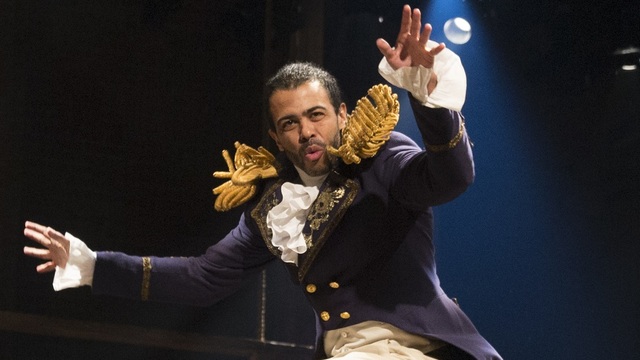
Daveed Diggs as
Marquis de Lafayette

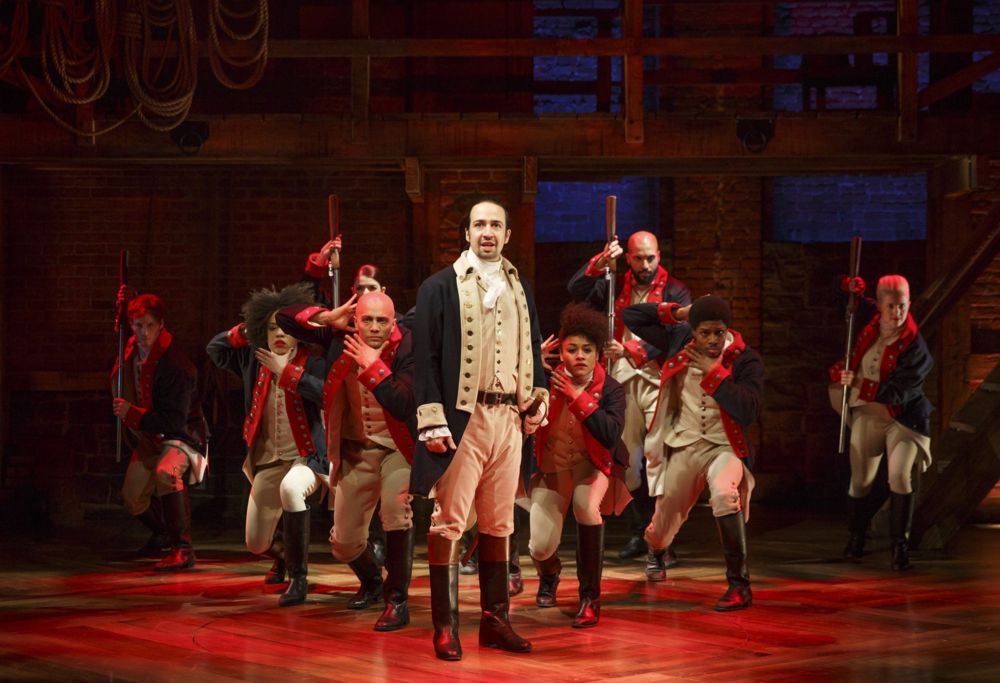
Our forefather may not have made it into the cast of named characters when Lin-Manuel Miranda composed his lauded libretto, but I was curious whether James Callin would have been in the chorus. Or, more accurately, whether his unit fought in any of the battles referenced in the musical.

As it turns out... (if you are put off by strong language, there are two brief, common toilet references that might embarrass you in this song; fair warning. In context, I really don't think you'll notice.)


That song tells the story of the Battle of Monmouth, clearly, which was fought on the 28th of June 1778. That link will take you to the Order of Battle on Wikipedia, which lists the 4th, 8th, and 12th Virginia Regiments under the command of Colonel James Woods as being present on that day. As it happens, the Ancestry database of "U.S., Revolutionary War Rolls, 1775-1783" for those regiments lists James Callin as 51st out of 83 soldiers present during the month of June 1778.

So that means that when Lafayette took command from Charles Lee, "snatching a stalemate from the jaws of defeat," that my 5th great grandfather was almost certainly on the battlefield. And maybe someday, if I get enough tickets to the show, I might spot him among the soldiers behind Hamilton onstage?

Grandpa?

Thursday, March 5, 2015

LaFayette on the Brandywine

Marquis de Lafayette
According to the Callin Family History (and yes, if you're interested in that book, you want to click that link), there were two brothers named James and John who emigrated from Ireland around the beginning of the Revolutionary War.

Our fathers tell us that these two brothers enlisted in the Continental Army and fought under Lafayette at the battle of Brandywine and remained in this army till the close of the war.

I have maintained a healthy skepticism for the early sections of George's book, because there are a number of small errors in it, and he included none of his sources. I have gone looking for proof - one way or the other - that this claim is either reliable or false, but when faced with a source with as many small errors as this one has, it's hard to tell which facts to count on as clues, and which errors are severe enough to cast doubt on the claims.

For years, I've kept an eye out for resources that would give me more information I could use to track these brothers down with no solid leads. I tried the National Archives, since I had such great luck with some of my Civil War folks, but came up empty - they need a state to search in, and the only one I knew for sure a) existed during the Revolutionary War and b) Callins lived in was Pennsylvania. When I subscribed to Fold3, I found some index records for Callin people, but without more detail, there was nothing to investigate.

Then cousin Joan told me she had seen records for brothers James and Edward Callin in a Virginia regiment - that had fought at the Battle of Brandywine. And lo, I found a tranch of them by digging deeply into Ancestry's military records - 39 exhaustive film strips with hits on the name James Callin.

It's important to stress that what I have found is not conclusive proof that I have the right James Callin, but I've looked for others that fit the points that George's statement implies: served throughout the war; served with a brother; fought at Brandywine, in particular, and under Lafayette. This James fits those parameters, assuming that the Edward Callin who spent six months in his unit was his brother.

The red circle is next to "Jas. Callin" - private in
Capt. Lucas's Company of the 4th VA Regt of Foot
I've attached a copy of the muster roll for 1 September through October 1777, and added a subtle red circle to show you where James's name appears. This unit is Captain James Lucas's Company of the 4th Virginia Regiment of Foot, under the command of Colonel Robert Lawson.  The Battle of Brandywine took place on September 11, 1777.

The famous General Lafayette's involvement is interesting. Brandywine was his first battle, so he wasn't yet commanding troops. He was sent with the Third Pennsylvania Brigade under Brigadier Thomas Conway and not even in the same Division as James Callin's 4th Virginia, but both units were under the command of Major General John Sullivan ("Sullivan's Wing").

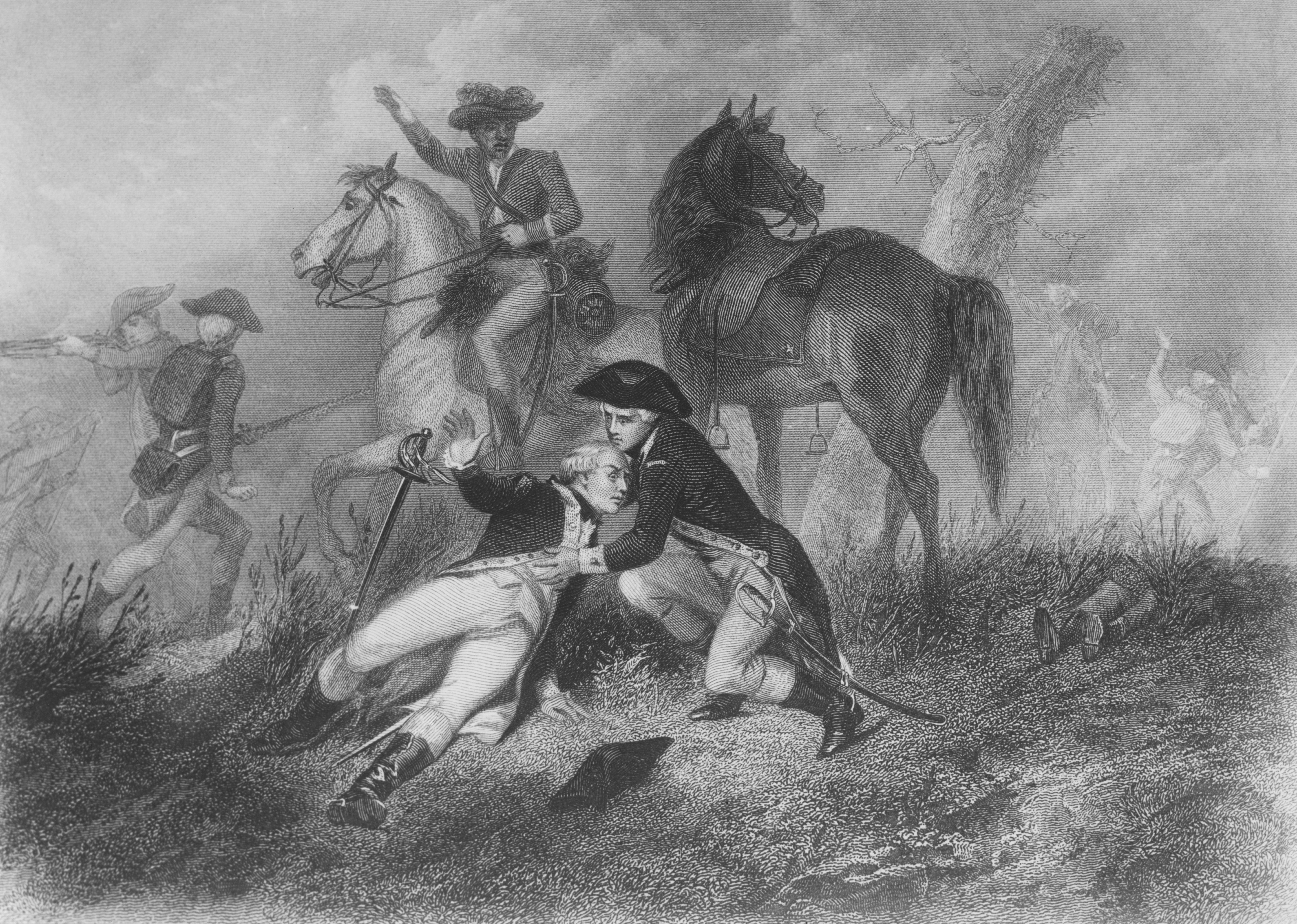
Lafayette wounded at the battle of Brandywine
Lafayette was shot in the leg, and despite his injury, he helped organize an ordered retreat before allowing his wound to be treated, which saved many soldiers and impressed General Washington. Washington wrote to Congress and asked them to give him command of a division.

When Lafayette returned to the battlefield in November, after two months of recuperation from his injury, he took over the Division previously commanded by Major General Adam Stephen - which included two Virginia Brigades - by extension, the 4th Virginia Regiment.

The Battle of Brandywine was not an American victory. To borrow from Wikipedia on the subject: "Washington had committed a serious error in leaving his right flank wide open and nearly brought about his army's annihilation had it not been for Sullivan, Stirling and Stephen's divisions, which fought for time... In his report to the Continental Congress detailing the battle, Washington stated: 'despite the day's misfortune, I am pleased to announce that most of my men are in good spirits and still have the courage to fight the enemy another day'."

If this is our James 1st - and I'm willing to assert that he is, until we turn up evidence otherwise - then my 5th-great grandfather was one of Stephen's troops who made that possible. His (maybe) brother, Edward, shows up on the 4th Regiment's muster rolls with James from November 1777 through February 1778, and James remains in the same unit through at least November 1779.

James's unit would have been involved in the October 4, 1777, Battle of Germantown. Sadly, his unit was the one that veered off course and collided with another American brigade and mistook them for the redcoats, engaging in heavy friendly fire. That winter, he would have been at Valley Forge experiencing the horrible cold, disease, and starvation that we read about in school. After six months, though, the army's effectiveness greatly improved under constant drilling lead by Generals von Steuben and Lafayette, and they were more successful at the Battle of Monmouth in the summer of 1778.

I'll certainly keep digging - there are many mysteries left to solve here. But it's exciting to have some proof in hand that, to quote George again:

...drawing conclusions from what came under our own observation and we know to be true, we may assume that that part of the family history which our fathers told is true also.