Showing posts with label Witter. Show all posts

Tuesday, October 4, 2022

A Time to Regroup

 Hello, cousins!

After the publication of the Callin Family History and John H. Callin's War Poems this spring, I decided to give myself a break from project-focused research. I've still been active, as you can see by my WikiTree edit history, but rather than pushing to reach an end goal, I've been tugging stray threads and exploring rabbit holes. 

Now I'd like to refocus and figure out which branches of my tree need the most attention, and which branches you are all most interested in.

To help with that, I made a list of each ancestor in my tree that represents a "peak" in my research - they aren't necessarily "brick walls," but they are as far back as I've gone using a thorough, evidence-based approach. My goal for each name in this list is to identify that person's parents and siblings and document them as thoroughly as possible with records, obituaries, and whatever stories or artifacts may have been passed down.

I've grouped them based on which of my four grandparents' lines of ancestry they fall into, so if you already know who our common ancestor is, that should help you figure out which Project you will be most interested in. Then, I give the link to that individual's WikiTree profile, and to their page in my publicly-available Ancestry tree.

If you'd like to jump in and help, or if you just have questions, you can use the contact form on the right side of this page to let me know. I'd love to hear from you!

The Robert Callin Project

These are ancestors of my Grandpa Bob:

Elizabeth (Berlin) Callin: my 3rd great-grandmother

William Walker: my 3rd great-grandfather

Lydia (Bowen) Walker: William's wife, my 3rd great-grandmother

Solomon Bollman: my 4th great-grandfather

Eleanor (Waters) Bollman: my 4th great-grandmother

Thomas B Hale: my 3rd great-grandfather

The Nancy Witter Project

These are ancestors of my Grandma Nancy:

Adam Piper Witter: my 3rd great-grandfather

Hannah Jane (Tice) Witter: Adam's wife, my 3rd great-grandmother 

Nancy Ellen (Shriver) Witter: my 2nd great-grandmother

Albert Crydler Huff: my 2nd great-grandfather

Rosa Edith (Murray) Huff: Albert's wife, my 2nd great-grandmother

The Russell Clark Project

These are ancestors of my Grandpa Russ:

Joel Clark: my 2nd great-grandfather


Sarah Jane (Bellamy) Clark: Joel's wife, my 2nd great-grandmother

James Thomas Reynolds: my 2nd great-grandfather

Mary Frances (May) Reynolds: James's wife, my 2nd great-grandmother

The Alberta Tuttle Project

These are ancestors of my Grandma Alberta:

Edmund Tuttle: my 3rd great-grandfather
Josephine Avena (Plumsted) Tuttle: Edmund's wife, my 3rd great-grandmother
Florence Mabel (Hart) Tuttle: my 2nd great-grandmother
Emil Carl Frey: my 2nd great-grandfather
Jacob Edward Opp: my 3rd great-grandfather
Mary Elizabeth (Palmer) Opp: Jacob's wife, my 3rd great-grandmother


Friday, February 27, 2015

Famous Playmates

In 2007 music journalist Andrew Means published Some Memories: Growing Up with Marty Robbins - As Remembered by His Twin Sister, Mamie. Mamie recalled a number of anecdotes about growing up with her famous brother, including a few about a girl she met and befriended after becoming neighbors in Glendale, Arizona - my grandmother, Nancy Witter.

For those who may not be familiar with him, here is a little YouTube introduction to Marty Robbins, performing two of his songs about El Paso in 1965 and 1978:


I remember hearing about grandma's famous neighbor from time to time when I was growing up, but aside from being an interesting thing to mention whenever Big Iron came on the radio, it wasn't something that seemed to have much to do with family history - until my cousin Chad acquired a copy, signed by the author, and sent it to me a few years ago.

Dick Jr. and Nancy Witter, 1930s Glendale
Mamie and Martin Robinson - "Marty Robbins" was his stage name - were twins, born five minutes apart in September 1925 in a two-room house near Glendale, Arizona. The family moved around quite a bit, from that house (which was about 8 miles north of Glendale along what is now 59th Avenue) to Prescott, to Phoenix, north to Cactus (which no longer exists, being absorbed by Phoenix suburbs around the intersection of Thunderbird and Cave Creek Roads) and eventually, back to Glendale.

Dick Witter Sr., my great-grandfather, ran a dairy farm there, and Hannah Merle (whose family helped settle Glendale in the 1910s - which you can read about here) raised their two kids, Dick Jr. and Nancy. Nancy was born in March 1925, and Richard in February 1921.

Around 1932 or 1933, Mamie recalls moving from Cactus, where they attended Sunnyside Elementary (which later became Greenway Middle School), to Glendale, where they enrolled in the Peoria School District. "We walked about half a mile to catch the bus," she says, "and it seemed we rode a long way to Peoria."

I attended Peoria Schools myself, though 50 years later. In high school, I had to ride the bus about 15 miles from my house at 89th Avenue & Deer Valley Road to Cactus High, so I have a pretty good idea what that bus ride might have felt like to Mamie and Martin. And this is where my grandmother comes into the story!

"A little girl named Nancy came over to me and asked me my name. I told her it was Mamie and she laughed, saying it was the funniest name she had ever heard.  I happened to agree with her, but nevertheless I started to cry. Later she became my best friend during the years we went to Peoria School."
Richard and Nancy, c. 1930

That does sound like my grandma, I have to admit. I've inherited a bit of that trait myself - the tendency to notice the odd and call it out without picking up on the social cues that would alert a normal person that they had caused an offense. Nancy probably had no idea that she had caused Mamie any distress! Despite the initial hurt feelings, though, when Nancy invited Mamie to play with her at recess, all was apparently forgiven.

Mamie had a lot to say about her twin brother's antics. He liked to challenge other boys to wrestle, torment her and her friends with taunting nicknames, and he even indulged in the occasional bit of petty shoplifting from the local store - much to Mamie's horror.

She also had some interesting things to say about her friend's family - giving me a view of my grandmother's life I wouldn't have otherwise had:

"These were depression years for everyone, although at the time it seemed as if some were far richer than others in this farming community.  It wasn't until years later that we found out that other families were just as doubtful about making it financially as we were.
"Besides, riches are all a matter of how you see things. I thought my friend Nancy was really rich when I visited her and saw that she lived i a house that wasn't falling down, and that she had her own bedroom with pretty blankets and bedspreads.
"Years later she told me she liked to visit me as a child because I had so much more to play with than she did. By that she meant spaces to roam, trees to climb, and the endless thickets that served us as imaginary rooms and houses in which to play.
"Nancy was from a small family. She had one brother. I thought he was cruel and scary because he was a bully. On the school bus, he would take my nickel away from me. Not even Martin could help me get it back.
"When we had no school, Nancy would often visit with me all day. She would arrive early in the morning and stay until her father came after her.
"When she came to play, there would be a certain amount of jealous rivalry between my cousin Lois - another frequent playmate - and me. But in an effort to outfox Martin, the three of us would usually end up banding together and the visit would turn out well.
"We had to watch continually for Martin and his tricks. Once I thought I had lost Nancy's friendship because of him.  We were playing around a haystack.  It seemed awfully high to me at the time, but in reality was probably only a few feet.  Martin sneaked up on one side of it and jumped down on us, taking us completely by surprise and scaring us badly in the bargain.
"Nancy began crying and wanted to go home right then. She had no way of getting to her house, so instead she went with Lois to her home. I was sure I had lost my best friend, and was really upset with Martin. I began crying and chasing after him. He tried to say he was sorry for scaring us, but at that point it was too late for apologies."
      ("Some Memories", pg. 80-81)

Nancy and Richard, c. 1930
It would seem that the girls were close enough friends to survive these setbacks. As they got older, some of the problems they faced were a little more serious. Martin and Mamie's father had long had a drinking problem, and it either got worse as they grew older, or they simply noticed it more. Either way, after a few years, the family moved out of their house and into two big tents they set up near what is now 59th Avenue and Thunderbird Road.

Life there was busy, and Mamie, her brothers, and their parents seemed to have an increasingly fractious relationship.

"Sometimes I would go to my friend Nancy's house, about five miles away, and play with her in peace. I would be given a ride over there, and we would play house or paddle in an irrigation ditch.
"Even at these times, we did not escape entirely. Often Martin would show up and throw rocks at us. It seemed as if he came from nowhere. When we went after him, he ran away laughing like crazy.
"Needless to say, Nancy didn't like him at all. Telling on him did no good, so we had to suffer. Mom definitely had a blind side when it came to Martin's tricks. The ditch, by the way, is still there. I think of us playing there every time I drive by it."
      ("Some Memories", pg. 94)
In 1937, Emma Robinson took Mamie, Martin, and the other siblings then still living at home, moved into Glendale, and divorced their father. It would seem that Mamie and Nancy saw less of each other after that. A few years later, when things got serious, Martin joined the Navy and went to War. Life moved on for everyone as he returned and eventually became an internationally famous country singer.

As a kid, my dad would always get excited when he heard a Marty Robbins tune on the local country station, KNIX. Sometimes he would allude to grandma's acquaintance with the singer, but it wasn't something the family talked about in great detail - just an interesting fact. For us, it was the beautiful voice, the cowboy tales, and the sense of a local boy making it big that made the songs important to us. But the older I get, the more I appreciate the small ways we are tied to our history and our culture.

Grandma died in 2004, the same year Mamie Robinson died. Without Mamie's recollections, I would only have a vague family legend about their relationship - but thanks to her (and to Mr. Means for making sure those recollections got published!), I have something small and precious to remember about the woman who painted this sunset, and a reason to hum a certain cowboy's tune while looking at it.


Thursday, February 26, 2015

Photo Feature: Faces of Nancy

Today's feature is all about one special person - my grandmother, Nancy Witter Callin.

The Witter family, c.1931
Glendale, Arizona
Grandma was born and raised in Glendale, Arizona, and spent most of her life there and in the neighboring town of Peoria. She was an art teacher, traveler, souvenir collector, and notorious pack rat, so she left a lot of photographs and other visual artifacts behind to document her life. Most of the photos in these regular Photo Feature posts are here because of her.

Here she is in a rare snapshot of her whole family - her daddy, Dick Witter, her momma, Hannah Merle Huff (who preferred to go by "Merle"), and her brother, Richard (usually referred to as Dick Jr.). I say rare because Merle did not seem to be as fond of getting her picture taken as she was of having pictures of her kids. Her family, the Huffs, displayed a fondness for keeping and sending photos to each other, so I imagine she was motivated

Dick Sr. with
Dick Jr and Nancy
c. 1936
Nancy as a young teenager
Most of the family are familiar with Harper Lee's classic To Kill a Mockingbird, and when we look at pictures of Nancy as a little girl with her big brother Richard, we see a real-life Scout and Jem Finch. I don't think Nancy was ever quite the tomboy that Scout was, but I'm willing to bet that growing up on a dairy farm in Depression-era Arizona gave her plenty of opportunity to get a little dirty from time to time.

(Check out tomorrow's post for a look at what young Nancy was like, and how she got on with one of her most famous neighbors!)

Scout Finch wasn't the only literary comparison we made to young Nancy. I remember the first time I saw this portrait of her as a a girl thinking that it looked like my cover of The Diary of Anne Frank:

Nancy (right) and her best friend Bobbe
visiting Rosa Murray Huff, c. 1940
In high school, Nancy's best friend was Bobbe Harris, and it seems they did just about everything together. Here we see them visiting Nancy's grandmother, Rosa Murray Huff. (Rosa and I share a birthday - only separated by 111 years!)

I don't recall any details, but I got the impression that Nancy inherited her passion for traveling the country from her Huff grandparents. The Huffs were the adventurous early settlers from Kansas, as you might recall from an earlier post.


Bob and Nancy - 1940s newlyweds
There isn't much story behind most of these portraits.


I have grandpa with his rakish Casablanca hat...


The Witters at home - Dick Sr., Nancy, Merle, and Dick Jr.
...and the Witter family relaxing on the couch.


These three are school photos, presumably from Nancy's long career as an art teacher with the Glendale Union School District:


Nancy, Bob, Vicki, Ted, and Barbara


And this one can only be explained by the 1960s!

Grandma Nancy and Grandpa Bob with my mom and dad (and aunt Vicki peeking out in the middle).


But this is the lady I remember most - another school photo, this one probably from the early to mid-1980s.

This is the Grandma who babysat my sister and I on occasion, letting us watch The Dukes of Hazard and play with her art supplies. This is the Grandma who let us come swim in her pool all summer long, and who fed us iced oatmeal cookies (Grandma's brand, naturally) before bed.


Thursday, February 12, 2015

Photo Feature: Valentines and Cradle Robbers

Something a little different this week, in anticipation of Valentine's Day.

Here are three couples with a few things in common:
  • They all married young
  • The grooms (and one bride) were all in the service
  • Not only were did all six of these people share a surname (after their respective weddings), the grooms share their given names, as well!
  • The brides were all VERY young

February 1995, Monterey, California
How young were they? Well, that's the basis for our trivia question - "which of these brides was the youngest at her wedding?"

Obviously, you'll need some dates to make an educated guess, but what with this being the open internet, you'll excuse me for being coy about just posting them here.

First up, you can see a happy young pair of airmen getting their engagement picture taken. Tad was a mature (ahem) 22 years, and Kate was a Bicentennial Baby. They took a lot of ribbing over their age difference, but when they married after a brief, six-week romance, she was 18 - and only just a few months shy of 19.

c. 1968, Glendale, Arizona

Our next couple could hardly wait for high school graduation to set their wedding date, but wait they did. Teddy was a mature (I am certain) 22 years, and Barbie was a true child of the 1950s. They married in 1968, just one month after her 18th birthday.

c.1942, Phoenix, Arizona
 Ted went on to join the National Guard and trained to be a medical technician, then tried his hand at teaching before settling on his career as a firefighter.


And finally, we have the dashing couple straight out of Casablanca, the heroine and hero of When Things Got Serious. Bobby was a 21-year-old Army airplane mechanic, and Nancy was in high school when they met - and the outbreak of the Second World War lent some urgency to their decision. And so they married in 1942 - about 8 months before her 18th birthday.

So there you have it - I come from a long, well established line of young men who married young brides and survived to tell the tale. I think I can safely claim that none of us has regretted it for a moment.


However old or young your sweetheart is, here's hoping you're as happy as we were - and are.

Friday, January 23, 2015

The Immigrants, Part I: The Germans

The more things change...


Growing up in Arizona, issues surrounding immigration have always been bubbling in the background - occasionally erupting onto the national stage. The arguments that get thrown around during those eruptions tend to follow familiar patterns. Any objective analysis of those arguments can see that the root cause of the controversy is always about the same thing: Fear of the Other. Whether the specific conversation is about trade, possibility of war, or even policies based in outright racism, the arguments revolve around the definition of the divide between  "Us" and "Them".

Growing up in the 1980s & 1990s, there was also an ever-present, underlying tension between two cultures living side by side and vying for the right to define who "Us" and "Them" might be. The first was the inclusive, celebratory culture of the post-1960s; these were the people who came of age during the Civil Rights era and who embraced the notion of the "melting pot". Their attitudes were evident in the school curricula I remember from early public school days and in the PBS children's programming (especially from the Children's Television Workshop) - and in my church, in the form of songs like "Jesus Loves the Little Children" and lessons about mission work in Asia and Africa.

The second culture was less noticeable in my childhood. It really came to my notice when I got to college, and saw the rise of 24-hour news cycle and growth of the talk radio media market giving a platform to people who had long existed on the fringes. These figures questioned ideas of "multiculturalism" and "diversity" that I personally had always taken for granted as a common part of American culture. They forced me to question my assumptions, and I quickly determined that they were conflating the notions of equality and fair treatment with something called "political correctness" in order to demonize those ideas. They championed the notion that rather than being a sign of common decency, celebrating different cultures was some kind of progressive plot to erode the primacy of "real" Americans.

It probably goes without saying, but this was not a new idea. It is even older than the concept of a "real American". These ideas and arguments are just a restatement of the "us vs. them" attitude that has plagued Americans since colonial times.

Words and Identity

Though the first permanent settlement in the New World was English, all of the major players in Europe began setting up colonies along the Atlantic coast. The Dutch, French, Spanish, and Germans all sent people over in the first century or two after Columbus's journey.  Whether they were sent as explorers, settlers, prisoners, refugees, governors, traders, or even as military forces, it is critical that modern readers understand that those people would not have necessarily identified themselves with a nation the way we label them today.

Not only were the boundaries between German territory and French territory (just for one major example) very fluid, but the very definition of what these territories were was evolving as the feudal system decayed. The concept of a "nation" was still new, and not broadly well understood even by those who championed it. The New World colonists who spoke German didn't identify with a concept of "Germany" - not as a national identity - and once they settled throughout the New World, tending their new homes and raising their families was their main concern. They tended to keep to themselves as much as possible as political control over their communities shifted from the French to the British and back.

There are a number of parallels between the way English colonists viewed these German people and the way modern Americans view Hispanic and Latino neighbors. The most visible divide, then as now, seemed to be along language boundaries.

Benjamin Franklin wrote of the German-speaking settlers in the Pennsylvania, after he began serving in the Pennsylvania legislative assembly:

"Few of their children in the country learn English; they import many books from Germany... The signs in our streets have inscriptions in both languages, and in some places only German. They begin of late to make all their bonds and other legal writings in their own language, which (though I think it ought not to be) are allowed good in our courts, where the German business so increases that there is continual need of interpreters; and I suppose in a few years they will also be necessary in the Assembly, to tell one half of our legislators what the other half say."
In other places, he wrote of the impossibility of the two cultures mixing, and contrasted the German standards of beauty for their wives against that of the English in terms which, if he were saying them about Latinos today, would have likely scuttled his political career. And yet, two things stand out to me about this:

  1. The same Ben Franklin who held and expressed these opinions, and predicted what seemed like increasing enmity within his own colony, went on to champion the fundamental idea of unity between the colonies that allowed the Continental Army and Congress to force the break with Britain and found the United States.
  2. He was wrong about the future. When Franklin writes of the "continual need of interpreters" he seems to forecast an untenable, unbridgeable split between English and German speakers - which clearly did not come to pass.
The lesson I take from this is that arguments warning of seemingly permanent, trending, and eternally intolerable differences between groups of people should not be treated with the weight that people give them. They are specious arguments that assume people aren't capable of growing, changing, or of setting aside their differences to come together for their common good when necessary.

Or, to put it another way - the words we use to identify ourselves are always just words. When it comes to how we live and how we treat each other as neighbors, words aren't what matters.

Melting Pot


As for the mixing of cultures, I think it's evident that our past (Franklin's future) demonstrates how just a few short generations can change the entire social landscape. The Germans that Franklin was writing about almost certainly included my own German ancestors. The Witters (probably originally a variation of "Weider") who came to Arizona via Kansas after the Civil War migrated from Fulton county, Pennsylvania, where they were married to Pipers (Pfeiffers), Volkman, Shrivers (Schreibers), Zollingers, Howers, and Kerschners.

As I said in "Faiths of Our Fathers", most of them were probably Lutheran. Like other communities formed around religious ideas, they struggled with finding the right balance between orthodoxy and heterodoxy. And the dismay that Franklin expressed over the character of new immigrants wasn't expressed only by Englishmen. Henry Muhlenberg, Lutheran pastor, and immigrant from Germany (arrived 1742, writing in the 1750s):

"It is almost impossible to describe how few good and how many exceptionally godless, wicked people have come into this country every year. The whole country is being flooded with ordinary, extraordinary and unprecedented wickedness and crimes... Our old residents are mere stupid children in sin when compared with the new arrivals! Oh, what a fearful thing it is to have so many thousands of unruly and brazen sinners come into this free air and unfenced country!"
But for every example of conflict and discomfort with the Other, there are also stories of acceptance and tolerance in abundance.

Take the story of my ancestor, Leopold Zindle, a Hessian soldier during the Revolutionary War who spent his four years as a prisoner of war winning friends and earning a place in his New Jersey community. The rhetoric people today throw around about being "invaded" from our neighbor to the south looks rather silly in comparison to actual soldiers sent here to subdue the rebellion - and yet Leopold was accept and honored as a citizen here.

Sadly, the story doesn't end there. American immigration problems continued as different groups "threatened" to swarm in and "overrun" the place. Happily (for me, anyway) we've never successfully fenced ourselves off from Them, or many of Us wouldn't exist!

Sunday, December 7, 2014

When Things Got Serious

Reposting to mark Pearl Harbor Day - for those who have read this before in my other blogs, I added some details and photos.

Bobby enlisted in the Army 26 July 1941 at Camp Blanding, near his hometown of Winter Park, Florida.

Sgt. Bob Callin, c.1944
He did well in training, and ended up applying for a special school, hoping to become a pilot. The Army being the Army, he had to agree to taking a bunch of tests and special classes to qualify, and there was a pretty good chance he wouldn't be selected for pilot school... but he decided to go for it.

The specialty training include aircraft engine mechanic courses at Luke Field, located southwest of Phoenix, Arizona. The class was difficult, but Bobby was smart, and he didn't spend a lot of time and energy getting wasted after hours and on weekends, like some of his friends did. He preferred spending time at a church he had found. A church that hosted "mixers" on Friday and Saturday nights. Church mixers that had girls at them.

That is where he met Nancy.

Bobby and Nancy went out a few times, usually with Nancy's best friend -- whose name was Bobbe! -- and one of her boyfriends. Nancy was only 17, but Bob (it was too confusing having two "Bobbies") had also met her parents at the church, and they trusted him. Bob had even been to their house for Sunday dinner a few times.

Things were going just swell (his words, not mine). Bob and Nancy liked each other quite a lot, but she was still in high school. And being in training for the Army, he didn't know for sure where he would end up next. It was technically peacetime, but the Army was building up. There was talk of the trouble across the Atlantic, even though most Americans thought it was best to stay out of it.

They decided not to worry about it, and to take their time. It was a mature decision. And then Bob was selected for a special class he in California. He would be back after a few weeks, but maybe this meant he would get to learn to fly! So, he said goodbye to Nancy and promised to write to her often.

Not long after that, America was attacked, and everything changed.

Nancy's brother, Richard Witter -
a TSgt in the Philippines
There was confusion; there was fear. There were a lot of things happening all at once. Nancy's letters to Bob were frantic; she didn't know where he was, or if the rumors were true that California was next. She hadn't heard from her brother, a Technical Sergeant stationed in the Philippines. All she knew was that she loved Bob, missed him fiercely, and wanted him to be back safe with her.

By the time Bob managed to get a letter through, things had calmed somewhat. People at least knew the basics: the Japanese had attacked Pearl Harbor; the U.S. had declared war. The West Coast was not under attack. Nancy's brother, Richard, was safe for the time being, though he would be wounded in a sniper attack and end up the war as a guard at the POW camp in Papago, AZ.

Bob had also been turned down for officer training and pilot school. But this would turn out to be good news, because, as a high-scoring mechanic, Bob would spend the rest of the war at Luke Field, maintaining the trainers for the pilots of the P-38's.

The AT-6 - training aircraft like those
Bob worked on at Luke Field.
And so, on the 28th of June, 1942, Bob and Nancy were married.

You could argue that without December 7, 1941, they might not have decided to wed. It's possible that without the shock of war, and the fear of losing each other, they might have drifted away and only been pen pals. But some things are meant to happen. After all, Bob did eventually learn to fly.

But that's another story altogether...

Friday, December 5, 2014

Sample-More Meats - a Businesswoman's Story

Note: I'm making some assumptions to turn all of these disparate facts I have into a story. If you find mistakes, comment or email me, and I'll update it!

Albert C. Huff was born in Ohio just 6 years before the beginning of the Civil War. His father moved the family to Savonburg, Kansas, not long after it was founded in 1879. There, Albert met and married Rosa Edith Murray. They raised seven children in Savonburg, but somewhere around 1905 or so, the family felt the pull to move to the Arizona territory. Based on the post cards and letters between Glendale, Arizona and Savonburg, they didn't all move at once, but by 1910, most of the clan appeared on the federal census records in Glendale.

Perry Huff was the eldest of Albert and Rosa's seven children. He and his wife, Pearl, along with two of his three sisters, Bertha and Iva, and their husbands, were the probably the first to relocate. Perry started a meat market on Glendale Avenue in partnership with his brother-in-law, Bertha's husband, Roy Sample. It was one of the first businesses in the young town: the Huff/Sample Meat Market.

This post card addressed to "Miss Merl Huff" (my great-grandmother!) appears to have been written by Perry - based on the greeting "Hello Sis" - it shows the meat market, and possibly its owners. The "R.S." at the bottom may refer to Roy Sample, on the left; Perry ought to be the other man in white to the right of the slicer; and "Bill" might refer to the other man to the far right. [1]

Sadly, Perry's young wife, Pearl, did not survive to see his success. She died in 1907, possibly in Las Vegas, New Mexico, during the move from Kansas. Perry and his infant daughter, Doris, were living in his parents' new Arizona home by the time of 1910 Census, but the family's correspondence indicates that his health was giving out, too. When Perry died in 1911, Doris was sent back to Kansas where she was raised by Pearl's mother, Lucy Enos.

Harry More and Iva Huff
possibly a wedding photo
After Perry's death, Perry's other brother-in-law, Harry More, took over the business. The Sample & More Meat Market thrived, and so did all of the young Huff families living there in the young state of Arizona.

Harry and Iva had a son, Phil, who was born in 1909. Roy and Bertha had Thelma in 1909 and a boy named J.L. in 1914. By this period, Albert Burton Huff (everyone called him Burt) had moved to Glendale, and he and his wife Mary had four little girls: Maurine (1908), Maxine (1910), Bruce (1917), and Ezell (1919) - who would grow up to have quite a few adventures of her own!

After President Taft signed the bill establishing Arizona's statehood, Phoenix became the new state capital, which spurred growth in the surrounding towns, as well. Glendale grew, along with the Huff families, and they were all part of what changed the area from a wild frontier into something more like a city.

Scan of original "meat tray" - order form
for Sample & More meat market [3]
It might not seem that wild when you're looking at some old photos of a butcher shop and reading a list of babies' birthdays, but it's worth remembering that between the births of young J.L. Sample and Bruce Huff, General Pershing spent a year trying to catch the Mexican outlaw, Pancho Villa - and there was every chance that chase could have turned north into Arizona. The migrating Huffs also had to come past the famous Fort Apache on their 1,200 mile journey from Kansas. Located not quite 200 miles to the east of Glendale, it operated until 1924, when the native Americans were granted U.S. citizenship - even after that, the possibility of unrest and some kind of "Indian attack" of Old West lore was a real, potential threat in the back of their minds.

In spite of the risks of frontier life, Arizona was also a place that was looking ahead. After having removed parts of their original constitution - containing things like direct election of senators, womens' suffrage, and other reforms - things which were delaying the passage of their statehood bill, Arizonans turned around and put those parts right back in a referendum election, effectively making the Huff sisters voters earlier than many of their contemporaries in the rest of the country.
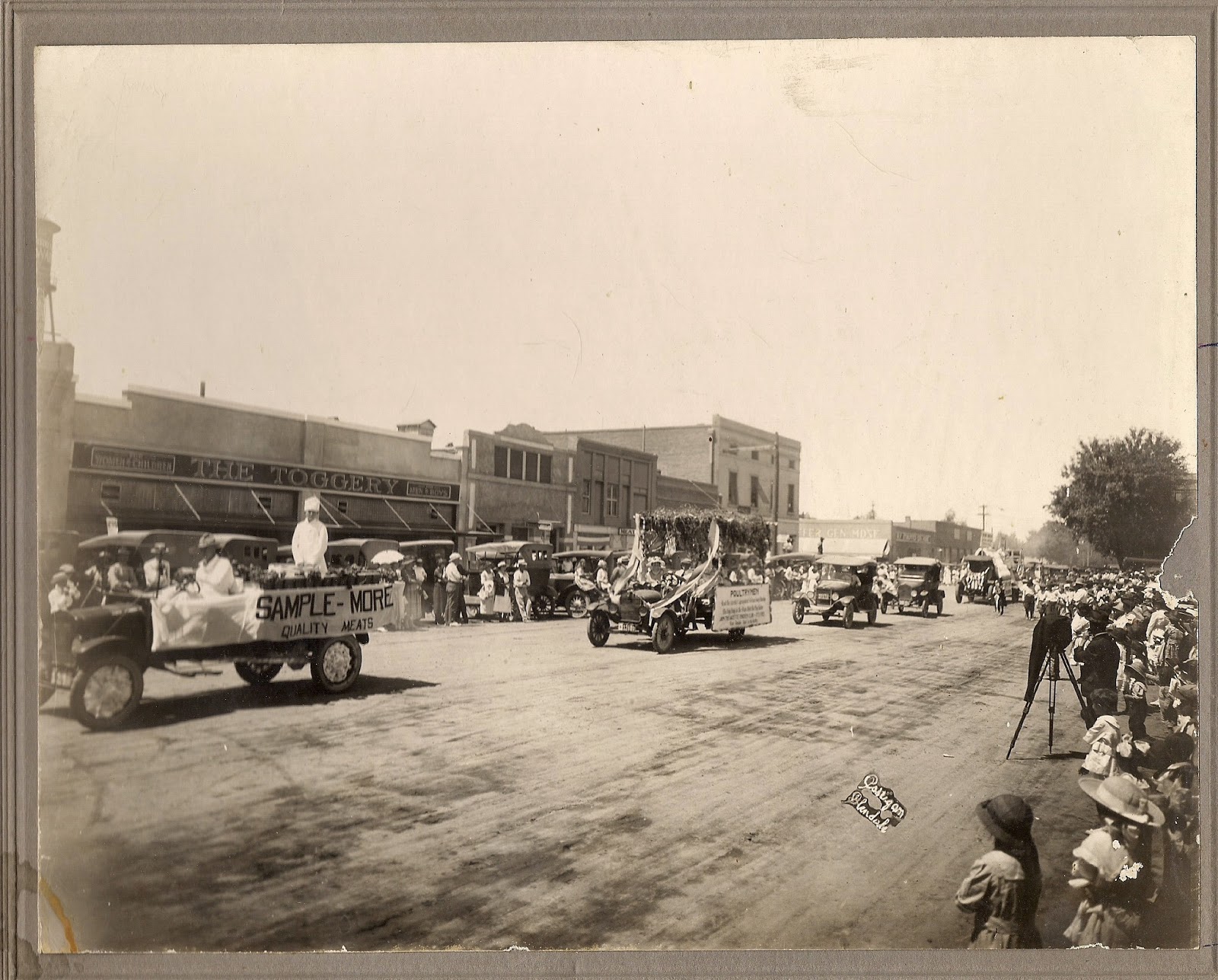
Parade down Glendale Ave. c. 1915
And so it goes - a simple photo of a parade of old cars down an empty street under a big desert sky turns out to be a story about brave, ordinary people, carving a home out of the dirt, setting up shop, and trying out the wonders of a new age while living in the setting of the old one. Knowing that these people came to the area in covered wagons barely a decade before, and built all of this in the heat and the dust, with the possibility of death from outlaws, displaced indigenous people or unnamed diseases around every corner makes this a triumph.

Bertha, Thelma, and J.L. at Roy's gravesite
Life being what it is, though, Bertha and her two youngsters lost Roy just before Christmas in 1918. [2] This seems to be when Bertha began to take charge of more of the business, and by the time she re-married in October of 1920, she was described in the local newspaper article about the event as, "a well-known business woman and property owner in Glendale,"

The man she married, Earnest Kinman, was a well-liked and outgoing friend of the family. His best friend was my great-grandfather, Dick Witter, who had only married Bertha's little sister, Merle, a couple of years before - before getting himself drafted and going off to join the Army, of course.

Harry More would pass away in 1925, and after that, his widow Iva moved on to California with Phil, leaving the meat market to Earn and Bertha to run. By the time Bertha died in 1965, the wild west was 100 years in the past, the pioneer families were all but gone, and meat markets were being replaced by supermarkets. But along the way, the family had grown, loved, lost, fought, and eventually become a small background part of history.

As we all do, if we're lucky enough.

Aunt Bertha and Uncle Earn


Albert C. Huff

1. My identifications of the men in the post card of the Meat Market are pure speculation. I am guessing based on what is on the back of the post card. The Glendale Arizona Historical Society has a photo of Roy outside the market with an Albert Huff, but they identify Albert as Roy's father-in-law. I think the man in the photo is actually his brother-in-law, Albert Burton (who went by "Burt"); Burt's father was Albert C Huff, and this is what he looked like:


2. Despite the timing of Roy's death, and his eligibility for the draft, I don't have any indication that he served in the war. Of course, his brother-in-law, Dick Witter, did - but that's a different post!


3. The scanned "meat tray" above is of an original sheet saved by my great-grandmother, which was photocopied by her daughter, Nancy Witter Callin, and annotated with the historical notes you see in this picture. I used her notes as a sort of timeline for putting this essay together, and filled in other facts based on official records, post cards, and letters.

Tuesday, November 11, 2014

Twice Honored

Another revised repost from the original Mighty Acorns blog; this one in honor of Armistice Day.


When I was a kid, I had a plague on my wall that my father had made. It was a dark piece of wood with the newspaper obituary of his grandfather, Dick Witter Sr., held in place by heavy layers of shellac. He had also mounted grandpa Dick's pocket watch and a silver dollar, along with a photograph.

I must have read this clipping a million times while I was supposed to be doing homework:


"Live and Let Live" by a Friend*

It is not entirely accidental that Dick Witter Jr. is one of the most respected citizens of Glendale. After serving as traffic cop, meter minder and in other capacities, he was promoted to City Magistrate, Judge no less, a position which he carries on with dignity and honesty.

One of the main reasons, we believe, that he is what he is today, belongs to the upbringing by his mother and father. We have known them both for nearly 30 years. No finer, more industrious people ever lived.

His dad, Howard R., also called Dick, and known to many of the older residents of Glendale, died Sunday and what a pity. Not because he has gone to his last reward as all of us must but because such a fine image of a man has to disappear from the every day world as we know it.

Possessed of that rarest of human blessings, a sense of humor, he never laughed at others but always at himself. And we cannot think of an unkind word that he ever uttered against anyone. That, in itself, is a rare gift indeed. So many of us, myself included, often belittle and revile others, perhaps as a defense against our own foibles; who knows? But Dick Sr. never did.


This world would be a better place in which to live if more of the people emulated the Witter family with their unsaid but sincere code: "live and let live."

*Written by Tommy Anderson; appeared in the April 5, 1963 "Glendale Herald", Glendale, AZ


When I used to read that plague as a boy, I didn't attach the importance to it that I do today. I don't think I realized it was an obituary for a long time, since the first paragraph is about my great-uncle Dick, who I actually knew and who, at the time, was still alive.

I did think a lot about "live and let live" and what it meant, though. When I would read about that sense of humor, that tendency to laugh at himself, I recognized the same trait in my dad and grandma. I saw how I learned it from them, and without realizing it, reading and re-reading that old plaque made me feel closer to the old dairy farmer in that photo who died nearly a decade before I was born.

Coming from Kansas to raise a family on a hot, dry dairy farm in Glendale, Arizona; building a life in a corner of the infant state; surviving World War I, the Great Depression, and seeing a son through World War II - these were the people in the background of history. He was the "Over There" of song; they had the pot that Roosevelt promised to put a chicken in; and later, they were "back home" to their soldier in the Philippines.

People like these don't expect high honors or recognition; maybe it is the humility passed down from the Witters who came from Germany with the other Pennsylvania Dutch. Maybe it is just a realistic outlook that says, "Don't attach too much importance to yourself." It could have something to do with that self-deprecating sense of humor Mr. Anderson described. I imagine my great-grandmother's reaction when she received the condolences of friends and family after Dick Sr. passed away in March of 1963: the stoic widow's pride at the honors and sympathies, and then the quiet packing away of the memories. No need to fuss, now. Tidy up, and move on.

When we visited Arizona for Christmas in 2005, Grandpa Bob took me to his garage and offered me several boxes of "old junk". He knew I was interested in all this family history stuff, and I knew that he wasn't able to bring himself to throw away everything that Grandma, a notorious pack rat, had held onto over the years. These boxes had been sitting for a couple of years in this garage, a storage unit for a few years before that, and their old house on Gardenia Avenue for some fifty years before that.

Digging through, I found that picture of Dick Sr. and that eulogy I recognized from the plague. I found a letter of condolence from their U.S. Congressman, and in a large manila envelope postmarked February 7, 1964, I found this certificate:


I suppose all the veterans' widows were receiving these, but it was still a thrill for me to find something with my great-grandfather's name on it, signed by President Johnson:


Looking at the postmark, I was struck by how strangely history folds around us. When Dick Sr. died in March 1963, President Kennedy was still alive. It's petty of me, but my first thought was to curse the timing that put one man's signature on a document instead of another's. That moment passed, though, as I thought about how these things must work.

I imagined that certificate would have waited for a break in the busy schedule of a President for his signature while the events of that year played out. The Birmingham Campaign, followed by the March on Washington. The end of Project Mercury, and the first woman in space. The Supreme Court forbids mandated school prayer; and a Partial Nuclear Test Ban treaty is signed and ratified.

And that November surely changed a lot of plans.

Who knows how long it took for someone from a protocol office to get these certificates printed for the heroes of a fifty-year-old war, how many there were in the stack, or how long it sat waiting for the pen stroke of the mighty. Assuming those letters were still being physically signed by the President himself, I imagine how a still-stunned and grieving Mr. Johnson might have felt, sending condolences to my great-grandmother. Considering he was certainly still grappling with the circumstances under which he had just come into office, I like to think that a duty like this, while sad, would be of some comfort to him.

And I can imagine how she, a farmer's widow, reacted when she saw it arrive in the mail - nearly a year after she lost him. I can almost see her face when she opened it; the pang of being reminded of her loss followed by a wry smile of appreciation. That familiar combination of humor and humility that helped her maintain her husband's "live and let live" attitude over all those hard years.

I wonder, if I could go back in time and ask her what she felt, what she would say about that honor? Did it bring her any joy? Did she show it to anyone? She kept it, so it would seem she accepted it as the honor it was intended to be. Did she smile when she saw it, or cry, or simply nod as she slipped it back into its envelope and laid it in a drawer on top of the other one - the one that I found later, as I kept combing through Grandpa's old boxes. The one with the 1963 postmark and that other certificate, identical to the first except for the signature:

John F Kennedy