Showing posts with label 1930s. Show all posts

Friday, January 13, 2017

Architects, Tailors, and Wanderers

 As we read last week, Rosalina Bedora Davenport (1848–1876) married James Monroe Callin, and had four children before her death in 1876 at only 28 years of age. Today, we will focus on their sons. Even though only their eldest left descendants for us to trace, there is still a lot to tell you.

Albert Clifford Callin (1869–1933) was seven years old the year his mother died. That was 1876, the same year the telephone was patented, and also the year that the Battle of the Little Bighorn saw 300 men of the U.S. 7th Cavalry Regiment under Lieutenant Colonel George Armstrong Custer wiped out by 5,000 Lakota, Cheyenne, and Arapaho led by Sitting Bull and Crazy Horse. Fresh reminders of the Civil War, threats of conflict with Europe, and personal tragedies combined with the tremendous technological and economic progress of those years must have had an impact on Albert, his brother, and his sisters.

The extended family of Callins and Davenports seem to have come together and helped ease the loss of Rosalina, and the children were able to grow up in Bowling Green, for the most part. The children were surrounded by Civil War heroes and strong pioneer men and women, and they all chipped in to make sure they were educated and safe. Even so, there is only so much protection family can offer.

Mamie Walker, c. 1895
 Mary Gertrude "Mamie" Walker (1868–1932) was the daughter of Joseph Walker (1827-1871) and Ellen Beswick “Nellie” Ruth. Nellie's father was Peter Stout Ruth, an Episcopal minister (who earned an early post on this blog due to his fantastic beard); and she was born in Delaware, before he began to move the family westward founding churches.

Joseph married Nellie in June 1866, in Zanesville, Muskingum county, Ohio. I believe Joseph's parents were Andrew and Agnes (Blakely) Walker of Muskingum county; if they were, then they brought Joseph from his birthplace in Pennsylvania around 1828, and settled in the village of Dresden.

Joseph died when Mamie was three, and Nellie remarried Samuel Kiser in January 1874; she died in December of that same year, when Mamie was six years old, but Samuel raised Mamie as his own. Samuel remarried, and lived in Anderson, Madison County, Indiana, where he died on 27 July 1895.

Mamie and Albert were married on 11 December 1895, in Anderson, Indiana. In 1900 Albert was a carpenter, was living at a house that he owned at 3140 Glenwood Ave, Toledo, Ohio, with Mamie and their first child, Ralph. Though they lost their twin infant daughters in January and February of 1899, they were financially doing all right at this time. Albert's brother, Arthur, was also in Toledo.

The family story is that Albert, as the architect and builder, and a partner who acted as salesman and business manager, were engaged to build an early subdivision in Toledo. At the time, this was done by selling the plots before any houses were built — rather than building on speculation — and then using the sale money to do the actual construction. But when the money was in possession of the business partner (perhaps with materials ordered and not yet paid for, and no homes yet built) the partner absconded with the money, never to be heard of again. The story was that he “ran off to Mexico.”

Albert was left holding the empty bag in Toledo. He may have declared bankruptcy; in any case, he was left virtually penniless. He was a stern, righteous Methodist, and he vowed to pay the home purchasers and creditors back if it took him the rest of his life. He and his little family sold their home and left Toledo for Texas, where he’d heard they needed builders in Galveston.

About this time, his brother, Art, also decided to leave Toledo. As he was a tailor, it's not likely that Art was involved in the housing project, but he may have felt unwelcome in town after that incident. In any case, neither brother knew where they would end up. Albert was going to Texas, probably Galveston, but anywhere he could find construction work as quickly as possible, and Art said he was “going West” somewhere. They arranged that Art would write to a particular Post Office (possibly Galveston) care of General Delivery, on a certain date, to give his own new “Western” location.

Albert at his drafting table, c. 1927
While working his way to Galveston, Albert took on a number of small jobs to pay his way. On one occasion, he undertook to repair a cotton gin that had jammed or broken. While he was working, someone accidentally turned it on, catching his left arm. He retained consciousness, and directed his own extraction from the gin. However, the doctors were unable to save the mangled, filthy arm, and it was amputated above the elbow.

The appointed time to look for Art’s letter came and went while Albert was hospitalized, recuperating from his injury somewhere in mid-Texas. When Albert arrived at the designated Post Office, the Postmaster told him that yes, there had been such a letter, that he had kept it well beyond the required month, but, not knowing who Albert Callin was, he eventually had to return it to sender.  He, of course, had no record of the sender’s address. Thus, the brothers lost contact and never saw each other again.  This was a great loss to Albert and his family, and everywhere they went, they checked phone books for Callin to try to find a trace of Art. Albert’s granddaughter, Joan, used to look for Callin in her western travels. We have no idea why Art apparently didn’t keep in touch with the rest of the family, as Albert did. But Albert and his descendants never found Art until census records became generally available.

Albert and Mamie stayed some time in Galveston. Their son, Eugene Walker "Gene" Callin, was born there, 18 April 1901. After the destructive 1903 hurricane, there was an urgent demand for housing and skilled builders were in high demand; Albert did well as a building contractor, but, as he had vowed, he sent every penny he could spare back to the defrauded home buyers in Toledo.
Ralph (l), John (c), and Gene (r)
Victoria, Texas; about 1907

John Albert was born in 1904, probably in Galveston, and some time before 1908, Albert and his family moved to Victoria, Texas, where their last child, Clara Ruth, was born on 21 October 1908. Albert was successful in his business; however, he still sent every spare penny back to Toledo. He was listed as an architect, and they owned a mortgaged home. Though this made them personally poor, they were content.

The family was devastated by John's death in 1914 (see below); having lost three of six children, they felt they could no longer live in Victoria. Mamie’s half-brother offered them an asylum, and they moved to Pittsburg, Kansas, to be near him.

     I. Ralph Clayton Callin (1896–1955) was about five years old when his father took the family from Toledo to Galveston. As a young man, he served in the 280 Aero Squadron, Rich Field, Waco, Texas, during World War I. He received an abdominal injury while in the service, not in flight, but in a roll-over automobile accident. After his discharge, he went to work for a man he’d met while serving at Waco: D. W.  Baker.

Baker had a guest ranch in Wetmore, Custer County, Colorado. He was an Easterner, and was ill with tuberculosis, so he had come to this high mountain valley for his health. He needed help to run the ranch. The 1920 census shows Baker, 41, his sister and her two young sons, and Ralph, aged 23.

After a time, Gene joined Ralph on Baker's ranch, and the two surviving Callin brothers and Baker ran the business; maintaining a guest ranch, and raising wheat and horses. Eventually, Albert and Mamie came to live there as well. Albert liked it, but Mamie apparently was homesick for city life in this empty ranch land at the base of the Rockies.
Ralph C. & Margaret (Dunbar) Callin
Wetmore, Colorado; c. 1926

Harris Dunbar was the owner of an adjacent large ranch. He was a mostly absentee owner from Buffalo, New York. Harris liked Baker’s little ranch, and wanted to annex it to enlarge his spread and influence in the sparsely settled county. Harris’s youngest daughter, Margaret Dunbar (1908–1966) married Ralph Callin about 1927.

Baker became very ill while on an extended visit to Palm Springs, California, and Harris took over Baker’s ranch, installing Ralph and Margaret as the operators. The 1930 census shows Ralph (farm owner) and Margaret, with their two daughters, Patricia, 2, and  Marjorie, 2 months. Just up the road are Albert Callin, 63, general farmer, and Mamie, 62.

Baker died in October of 1930, and was buried in Pueblo, Colorado. He was mourned by the Callin family, who owed so much to him. Albert became a foreman on the ranch, which was now owned by Ralph and his wife after Baker’s death. Mamie died October 9, 1932, and Albert died seven months later, May 6 , 1933. They are buried together in New Hope Cemetery, Fremont County (just north of Custer County), Colorado.

Ralph’s and Margaret’s marriage was stormy. She left him twice, but came back pregnant; and he took her back both times.  Although these last two children were not Ralph’s, he loved them and raised them on the ranch as his own. They bore the Callin name, and although originally the other Callin children did not know that they were half siblings, they eventually found out. Of the four children, one is still living.

Ralph and Margaret were divorced at some point in the 1940s, and both remarried. Ralph married Alice (last name unknown); she had two young sons from her previous marriage, who were born about 1940, and lived with Ralph and Alice. Alice had been an Indian Agent, possibly with the Jicarilla Apaches. Ralph and Alice lived in Cortez, Montezuma county, Colorado, where they owned and operated a liquor store, and later an adjacent lovely little Indian store, selling beautiful jewelry, ceramics, blankets, and other native crafts. Ralph died in Cortez on 23 April 1955, aged 58, and was buried in Cortez Cemetery.

Margaret’s story was more tragic. She married Russell Ball Rose (1900-1963), a neighboring rancher. She was his second wife, and they lived in Canon City, Colorado. He died in 1963, leaving her a relatively wealthy widow; she then moved to Pueblo, Colorado.

In the evening of 5 October 1966, she was brutally attacked by a 17-year-old neighbor boy, who was burglarizing her home. He knew her because he used to mow grass and shovel snow for her. She heard him in her house; he stabbed her, stole her car, and drove out of town. A gas station attendant called the highway patrol, reporting a stressed boy, with bloody clothes, driving an expensive car in the wee hours of the night. He confessed after he was stopped; the highway patrol asked the Pueblo police to check on Margaret, but by that time, early next morning, it was too late. She had bled to death. She was buried with Russell Rose in Canon City.

       A. Patricia "Pat" Dunbar Callin (1928–1990) was born 2 March 1928, in Custer County, Colorado. She married Ralph Williams Ball (1919–2009) on 5 April 1952, in Denver, Arapahoe County, Colorado. They were divorced before 1985. Pat was an antique dealer in Denver. She died 16 September 1990, in Denver, Arapahoe Co., Colorado, aged 62. Pat and Ralph had three children, all still living, and five grandchildren.

       B. Marjorie "Marge" Callin (1930–1995) was born 30 January 1931, in Custer County, Colorado. She was married very briefly to Dudley Harding Van Buskirk (1916–1991), with whom she had a daughter. She married Robert Victor Becco (1932–2008) about 1954, and they had five children before they divorced about 1981.

Bob Becco was raised on his family’s apple farm and in his younger life worked at Hill Top Market, a Canon City grocery store his parents co-founded. He retired as an Assistant Superintendent of Maintenance from Colorado Fuel & Iron mill after 45 years of service. During his time at the CF&I, he was foreman of the scale, machine and central shops, and was the 1959 Apprentice of the Year. Bob was a talented machinist with an aptitude for invention; many of his creations are still operating at the Rocky Mountain Steel Mills today.  Marge was an antique dealer in Pueblo, Colorado, and she died there on 6 April 1995, aged 65. Bob died in 2008; they left behind their son and four daughters, and nine grandchildren.

       C. John Harris Callin (1932–1996) was born 26 July 1932, in Colorado. John was an officer in the Air Force. He was married twice, and had four children with his first wife. So far as we know, both wives and his children are all still alive.

       D. Jean Callin (abt. 1935-) was named after Ralph's brother, Gene, and I believe she is still living.

     II. & III.  On 13 January 1899, twin girls, Mary Kiser Callin and Nellie Ruth Callin were born. These babies died in infancy, Mary on January 29, and Nellie on 22 February 1899.

     IV. Eugene Walker "Gene" Callin (1901–1973) was born in Galveston, and moved with his family to Victoria, Texas, then to Pittsburg, Kansas. After his brother Ralph moved to Colorado, Gene joined him in operating the guest ranch belonging to D.W. Baker. Among the guests were a New York City widow Adele Merritt and her daughter Louise, who spent two summers there. By the end of the second summer, Gene and Louise were engaged; they were married 26 May 1926, in a Quaker ceremony at the bride’s home in Brooklyn Heights, Kings County, New York, leaving Ralph to care for Baker.

Eugene W. & Louise (Merritt) Callin
New Mexico, 1926
Louise was the daughter of James Haviland "Jim" Merritt and Adele (Ovington) Merritt, born 27 March 1894. Jim was an architect in Brooklyn, New York. He had died in 1914. Louise was a graduate of Smith College, Northampton, Massachusetts. Gene and Louise decided to settle in Santa Fe, New Mexico, and spent the remainder of their lives there, raising two children.

Gene developed a prosperous plant nursery on property he purchased near Santa Fe. He was a landscape architect; many of the gardens in Santa Fe during those years were designed and planted by him. The garden at his Santa Fe home was filled with experimental plantings, as he sought out and tested plants for Santa Fe’s climate.

Gene was a gifted artist and craftsman. He was deeply interested all his life in learning new techniques and using new materials. He was a master woodworker, making furniture and smaller pieces. He learned blacksmithing on the ranch, and wrought handles and hinges for some of his furniture. He learned to work with gold foils while framing his paintings and decorating small wood pieces. He loved working with unusual painting media. He was always whittling and carving. He taught himself lapidary work, and created small treasures combining stones and metal and wood. If he could imagine it, he could create it with his gifted hands. He was directly responsible for his daughter’s teaching herself cloisonné enameling, a craft she pursued for many years. Gene’s and Louise’s home in Santa Fe became a gem, filled with his work and hers; she was a needle worker and embroiderer.

Gene Walker Callin, 1950
Baja California, Mexico
Gene was seriously ill for a time. About 1936 he contracted diphtheria on a visit to Texas. He nearly died, and was in a vegetative state for over a year as a result of its brain-damaging high fever. Louise gradually nursed him back to health, though he suffered some after-effects the rest of his life. Later, Louise began her many-year battle with breast cancer. In those days, treatments for these illnesses were difficult. Despite this, their Santa Fe home was filled with happiness before Louise died in Gene’s arms at home on their 23rd anniversary, 20 May 1949, age 55.

On 16 October 1951, Gene married Henriette “Henri” Harris (1901–1987), an antique dealer in Santa Fe, daughter of Nathan and Rose Harris of St. Louis, Missouri. Their marriage ended in an amicable divorce about twelve years later, and they remained great friends the rest of their lives.

Gene died 2 May 1972, age 72, in Santa Fe, New Mexico. Henri died there 9 July 1987, age 86. Gene is buried between his two wives, Louise and Henri, in Memorial Gardens, Santa Fe.

       A. Charles Ovington Callin (1929–2005) was born 10 November 1929, to Gene and Louise Callin. Though he was born in New York City, he was raised in Santa Fe, New Mexico.

Charles & Diane (Tomcheff) Callin
Chicago, 1964
His schooling was interrupted by service in the army. He served in the Korean War, drafted as a private, and discharged as a sergeant at the end of the war. He then attended and graduated from Pomona College, California.

In 1960, in Laguna Beach, California, Charles married Diane Jean Tomcheff (1935–1995), daughter of Demetre Stephen “Jim” Tomcheff, and Frosa Buteff, immigrants from Macedonia to the Chicago area, Illinois. Diane was working in California at the time, but about 1962, Charles and Diane moved to Chicago, which she considered her home.

Charles was a cartographer. He worked for the Chicago and Northwest Railway, later becoming land manager of their multiple properties. Diane, a teacher, became an English professor at Harper College, Palatine, Illinois. Diane died suddenly on 1 June 1996, age 60, of an accidental overdose of prescription pain medication. Charles was on a visit to their daughter in Las Vegas when she died. Charles then retired and moved to Las Vegas to be near his daughter and her family. Charles died 12 May 2005. His daughter, son-in-law, and their five children are still living.

       B. Joan Callin (1931-) was born 30 June 1931, in New York City, although she was raised in Santa Fe, New Mexico. She attended Radcliffe College, which has since been fully absorbed into its parent Harvard University.

On 10 September 1951 in Santa Fe, she married Robert John Foster, son of John Thomas and Margaret G. (Loftus) Foster of Arlington, Massachusetts. Bob Foster was a graduate of Massachusetts Institute of Technology in geophysics.

Bob obtained a PhD in geology from the University of Washington, Seattle, while Joan worked at Boeing, doing data management from flight testing and the wind tunnel; later she was writing test reports for a company engaged in manufacturing instrumentation for planes and missiles. Bob taught geology, and was the author of a number of textbooks. Joan was his illustrator for most, and helped see them through press.

Joan and Bob have a daughter, a son, and three grandsons. Joan and Bob and their family are all still living.
John Albert Callin
Victoria, Texas, 1914

     V. John Albert Callin (1904–1914) Just after Christmas, on 29 December 1914, tragedy struck. Gene and John and their two best friends, brothers Beau and Val Harris, were playing in some small caves they had dug in the bank of the Guadalupe River near their homes. One cave collapsed, burying John and Beau, and partially burying Gene. Val extracted Gene, and they ran for help. When the neighbors succeeded in digging the boys out an hour after the collapse it was too late. John and Beau were dead, and Gene and Val had witnessed the failed rescue.

     VI. Clara Ruth "Ruth" Callin (1907–1985) was born to Albert and Mamie on 21 October 1908, in Victoria, Texas, the last of their six children. She was named both for Mamie's half-sister, Clara Kiser, and the Ruth family surname.

Clara Ruth Callin
Kansas
After her brother John died, the family went to Kansas, first to Pittsburg, then to Wichita, where Ruth spent the majority of her life. When Albert and Mamie left Kansas permanently to live with Ralph in Colorado, Ruth stayed behind alone in Wichita. She was a musician, a violinist, and she made her living teaching violin. Her brother Gene always prided himself that he had given her her first violin with his first earnings.

On 15 August 1945, Ruth married James Franklin Powell (1880–1951) when he was 65, and she 36. They had one child, before James Powell, Sr., died 19 October 1951, aged 71, leaving Ruth to raise their five-year-old son.

Ruth was severely crippled with arthritis, and she spent much of her later years in a wheelchair. This was doubly hard as she became unable to play the violin she so loved. She also became estranged from her son for many years, and she lived alone. She and her son maintained a better relationship late in her life.

Ruth died 25 October 1985, aged 77,  in Wichita, Sedgewick County, Kansas. She was buried in White Chapel Memorial Gardens, along with her husband.

Arthur K Callin (1871–1957) was the lost brother who left Toledo when Albert and his family moved to Galveston. Judging by the City Directory entries and Census records, he went to Gray's Harbor, Washington, where he worked as a tailor; then in 1910, he moved about 45 miles inland to Olympia, Washington, where he remained for a few years.

By 1918, however, Art moved to Portland, Oregon, where he worked as a janitor for many years. He seems to have done well enough for himself to have a house on Southwest Madison street, where he eventually retired. He died in Portland on 29 January 1957 at the age of 85.

 - -- --- -- -

Enormous thanks to cousin Joan, for the amazing detail and permission to include her photos here. As I've said before, if you see anything you like here, she deserves full credit; if you find any mistakes, those are all mine!

As always, if you're related to any of the folks in this post, then you're family! Please do drop me a note at callintad (at Gmail.com), or in the comments below; or follow this link to send a request to join the Callin Family History Facebook group.

Saturday, November 19, 2016

Tales of a Prentice

The middle son of John H. and Amanda (Walker) Callin, Prentice George Callin was born in Middleton, Ohio on 22 September 1887.
Prentice & Hattie Callin
wedding - 1910

Prentice grew up as the middle child in a family that valued both learning and adventure. He grew up and attended school in Fostoria, Ohio, and he may have been a student in Detroit in 1910, when he and his bride acquired their marriage license.

Harriet Ellen "Hattie" Owen (1891–1991) was born in Fostoria, Ohio. She was the daughter of Joseph Russell Owen (1866–1941) and Grace Shoemaker (1871–1964). Her father was a railroad man who later ran his own seed supply business.

Hattie and Prentice were married on 15 June 1910 in Fostoria, and the next few years saw the birth of their two sons, Owen and David. In 1915, they moved to Otsego county, New York, where Prentice's brothers, Byron and John, were living and working as teachers. When John enlisted in the Ohio guard, Prentice did, too; and by 1920, he had moved his family back to Bowling Green, where Prentice established himself as a farmer.

Prentice farmed and did clerical work during the 1930s, and worked in the post office in the 1940s. Later in his life, Prentice retired from his farm, and he and Hattie moved to California to be closer to their children and grandchildren. Prentice died in San Diego in 1960, on his 50th wedding anniversary. Hattie followed David and his family when they moved to Washington state, and she died in Shelton, Mason county, Washington on 1 October 1991.

Owen, c. 1912 with
Prentice and Hattie
     I. Owen Prentice Callin (1911–1965) graduated from Ohio State University and began his journalism career on the Lorain (Ohio) Journal in 1936. Later he was employed by the Ohio State Journal in Columbus, the Tampa (Fla.) Times and the Toledo (Ohio) Blade.

Owen married Vivien June O'Hara (1912–1999) in 1937, and in 1943 they moved to California, where Owen worked for International News Service. He later joined the old Los Angeles Herald-Express, and moved to the Times in 1963. He was working as a Los Angeles Times copy editor and former wire service reporter when he died at the age of 53.

Vivien, also a newspaper editor, remarried on 25 October 1969 to Arnold Theodore Fitzmier Sr (1916–1985), and they lived in Long Beach.

       A. Thomas Owen Callin (1941–2008) made the newspaper as a toddler, notable for having grown in his adult molars at only 2 years of age. He was a lifelong resident of Long Beach, California, and left behind his wife, son, and two daughters; all of whom are still living.
David Warren Callin
c. 1935

     II. David Warren Callin (1914–1983) married Helen Ruth Grant (1911–2003) in Auburn, Indiana, on 10 April 1936.

Helen was born in Vermillion, Ohio, to William Graden Grant (1887–1967) and Estella E Westbrook (1884–1986). The Callins lived in Ohio and California before moving to Port Angeles in 1970 and Sequim in 1984. Judging by their frequent appearances in the Daily News of Port Angeles, the couple were adept bridge players during the 1970s.

       A. Michael Prentiss Callin grew up in Los Angeles, and lived for many years in Woodinville, Washington. He worked for Qwest Communications, and moved to Oregon after he retired. He and his wife had one son and one daughter, and as of this writing, they have four granddaughters.

       B. Helen and David's daughter lives with her family in the Pacific Northwest.

       C. Grant David Callin is a science fiction author and retired Air Force officer. He published two novels in the late 1980s, Saturnalia and A Lion on Tharthee, as well as several short stories. During his Air Force career he set a record for human endurance as part of the U.S. space program's tests of human tolerance for designing spacecraft. In 1971, he appeared on a Flip Wilson TV special featuring "Record Makers" which included fellow guests Charles M. Schulz (creator of the Peanuts comic strip) and baseball legend Willie Mays.

Grant and his first wife raised three daughters. He retired to Sammamish, Washington, where he lives with his second wife.

Grant's daughter, Kari, was a public figure for a brief time, when she appeared on season 4 of the show America's Got Talent in 2009. She has several videos on YouTube performing some of her favorite songs (like My Immortal).

 - -- --- -- -

As you can see, we have some celebrities in this branch of the family! I'm still getting to know some of these folks, and I hope to be able to add to what I have here, but this was a fun start.

I'm reminded, though, of the over-arching theme of the blog - the idea that we are all minor celebrities in our own stories, and that every one of us is important to telling those stories. At a time when a lot of us are worried about the future, it's vital that we remember that - just being who we are and taking care of each other is at least as important as being famous, or being successful.

As always, drop a note if you spot any errors or omissions - as we get closer to the end of the two-year effort to document all of James Callin's descendants, the next step will be getting all of this information together for the book. I will need all the help I can get!

Friday, October 7, 2016

The Sly Family in California

After just a few weeks, we have reached the last of the Sly family (and the end of my bad puns on their distinguished name). Today we'll look at the two youngest children of William and Harriet (Callin) Sly:

Eugene T. Sly was born on October 31, 1866, in Ohio. His father, William, was 40 and his mother, Harriet, was 28. He married Anna Barbara Gano (1871-1895) on December 25, 1888, in Ohio. Anna was born on November 20, 1871, in Wood County, Ohio, when her father, Charles M Gano (1831–1910), was 40 and her mother, Julia E Weigel (1842–1925), was 29.

Eugene and Anna had two children before Anna died on October 13, 1895, in Wood County, Ohio, at the tender age of 23. She was buried in Rudolph, Wood county, Ohio.

Eugene then married Lillian Mae Swindler (1878-1947) in 1897, when Lillian was 19. They had three children together in Bowling Green, where they lived until at least 1920. In the 1930s, the Sly family moved to Los Angeles. It is not clear whether all of these families moved at the same time or for the same reasons, but many of them end up on the west coast.

Lillie died in 1947, but I have not found a burial record for her. Eugene died on December 20, 1951, in Los Angeles, California, at the age of 85, and was buried in Inglewood, California.

     I. Julia H Sly (1889–1983) the daughter of Eugene and Anna Gano Sly grew up to marry Russell K Garnes (1889–1946) on 15 June 1909 in Plain City, Ohio. After living in Bowling Green, where their daughters were born, and then in Toledo for a time, this family was in Alameda county, California, by 1930.

       A. Della Leannah Garnes (1910–1988) married Floyd Hazen Gelvin (1912–1981) 31 March 1934. Floyd clerked for the railroad office, and later worked as an underwriter. Leannah raised their son. The family moved to Covina (later West Covina) about 1947.

     1. William Barton Gelvin (1937–1972) was married for only one year before his death at age 35. His wife remarried a few years later, and is still living.

       B. Martha Launita Garnes (1912–2005) married John James Hamilton (1911–1993) around 1939; they had one son, still living, and the family lived in Los Angeles, California. Records have been hard to find, but it would seem the couple did not stay together, as Launita remarried in 1976. Her second husband may still be living, as well. They lived in Pismo Beach in the 1980s, and when Launita died, she was living in Lake Havasu, Arizona.

     II. Clarence Jefferson "Jack" Sly (1893–1987) was the son of Eugene and Anna Gano Sly. He served with the Army Engineers in World War I and was a commander of two Seabee battalions in World War II, retiring with the rank of commander. For 35 years he maintained a consulting and structural engineering business in San Francisco. He was a past president of the San Francisco Architectural Club and former chairman of the San Francisco Building Industry Conference Board.

Jack married Dora Mae Morris (1896–1978) in California after the First World War, and they were together for nearly 60 years. They were survived by their two sons, 10 grandchildren, eight great-grandchildren and two great-great-grandchildren.

       A. Clarence Jefferson Sly II (1920–2002) married when he was in his 60s, and his wife is still living. I believe he was an architect in the Bay Area, living in Oakland and San Francisco until his retirement. He settled in Baldwin City, Kansas, where he died at 82.

       B. William Thomas Sly Sr (1922–1999) who married Charlotte J Dudek (1922–1999) before enlisting in the U.S. Army and serving from 1943 through 1945. After the war, he was a civil engineer working in the San Francisco bay area, and living in Berkeley. They had three sons and two daughters, all but one of whom are still living.

     1. Clarence Jefferson "Jeff" Sly III (1954-1992) was the middle child of William and Charlotte, and was named after his uncle, Clarence II. He died at only 38 years of age. He was a resident of Riverside, California.

     III. Doris D. Sly (1898–1977) was the elder daughter of Eugene and Lillie Swindler Sly. She grew up in Bowling Green, and married George Earl Irwin (1899–1980) in Toledo on 21 September 1921. They had two daughters and a son in Wood county, Ohio; then they moved their family to Los Angeles in 1930, where Earl worked as a truck driver until he established himself as a real estate broker.

       A. Marjorie Helen Irwin (1922–2012) married Raymond Nathaniel Urick (1922–2007) in Yuma, Arizona, on 1941, while he was stationed at Camp Callan in La Jolla, California. The couple had two children: a daughter, still living, and a son.

     2. Daniel Raymond Urick (1942–1994) was born in Riverside, and died in Los Angeles. I have California Birth Index and Death Index records for him, but nothing else.


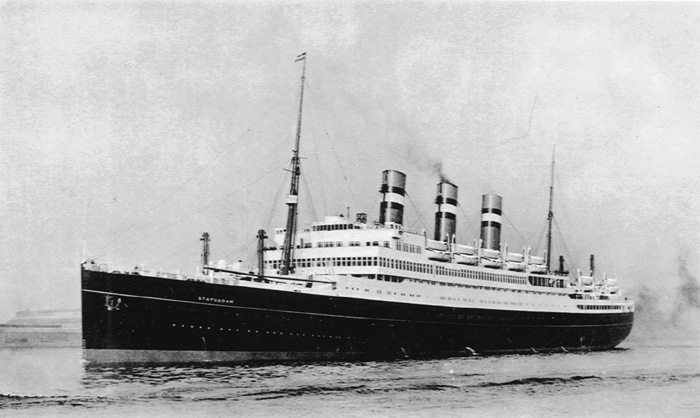
The SS Statendam - from
The World Ship Society
       B. Madelyn Marie Irwin (1924–2006) married Johan "Joe" Jansen (1912–1998) in 1942, and they were together for 56 years. Joe was born in Holland, and immigrated to America in 1930 aboard the SS Statendam. He was naturalized after living in Los Angeles for a number of years. He enlisted in the U.S. Army on 10 December 1942, and served through 1945.

Coincidentally, Madelyn and Joe died on each other's birthdays - Joe on 28 January 1998, and Madelyn on 26 August 2006. They are survived by a son, a daughter, four grandchildren, and two great grandchildren. Two of their sons have died.

     1. Jerrold Johan "Jerry" Jansen (1946–2013)
     2. Thomas William Jansen (1949–2005) both brothers lived in Stanislaus county, California, for most of their adult lives. Their obituaries ran in the Modesto Bee, which locks its obituaries up behind a paywall; so if anyone has them to share or barter, please let me know!

       C. Donald Earl Irwin (1926–2003) served in the U.S. Navy during World War II, enlisting from 1943 through 1946. He died in Norwood, Missouri, and was buried in the Missouri Veterans Cemetery in Springfield.

     IV. Leona Minnie Sly (1899–1930) was the younger daughter of Eugene and Lillie Swindler Sly. She married Raymond Earl Balyeat (1897–1961) before 1920 (other researchers say on 16 November 1918), and they lived in Toledo, where they had a son. By 1924, the family had moved to Long Beach, California, where Raymond's father died.

In April of 1930, Leona was listed in the Census as a patient at the Dore Sanitarium in Monrovia, California. She died in July that year, probably from tuberculosis. Raymond remarried Joanna Wilma Woods (1908–1987) sometime during the 1930s. (She apparently went by "Wilma," at least in the city directories.)

       A. Ray Earle Balyeat Junior (1920–1984) was in Toledo in 1937 and 1938, attending the Macomber Vocational High School. In 1940, he was back in Los Angeles, living with his grandmother, Lillian Sly. He enlisted in the U.S. Army in 1942 and served through 1946.

     V. Alvah Eugene Sly (1906–1978) was the son of Eugene and Lillie Swindler Sly. He married Mabel I Harris (1902–2001) in the first half of the 1930s. They lived in the home of Mabel's parents in 1940, but later lived in Laguna Hills, where Alvah died in 1978. I have not found any evidence that they had any children.

Harriet May Sly (1877–1949) was the youngest of William and Harriet (Callin) Sly's five children. She married Arthur C Solverson (1891–1941), and they lived in Dayton, Ohio, near her brother William James Sly and his wife, Sadie. Hattie Mae worked as a clerk in a dry goods store, and Arthur listed his occupation simply as "inspector," which could mean any number of things. I do not see any evidence that the couple had any children.

 - -- --- -- - 

Once again, we have reached the end of one line, and my branch is up next! If any of you new Sly cousins would like to suggest any corrections or additions, I'd be happy to hear from you. Please drop a note in the comments below, email my callintad Gmail address, or drop by the Callin Family History group on Facebook. It is for family only, so please don't be upset if I ask how you're related.

Happy Hunting!

Friday, September 23, 2016

William James Sly

William James Sly (1859–1931) was the eldest son of William and Harriet (Callin) Sly of Bowling Green, Ohio. Here is his record from the Callin Family History:

Record of William Sly, who was the eldest son of Harriet Callin Sly, who was the eldest daugther of William Callin, who was the 3rd son of John Callin, who was the 2nd son of James 1st.
Born in 1859.
Married Jan. 13, 1881, to Ada Avery.
To this union six children were born:
  • Wm. Zardie, born Sept. 20, 1882.
  • Sanford, born Jan. 25, 1884.
  • Fern, born Oct. 13, 1889.
  • Homer, born Dec. 20, 1885.
  • Helen, born Aug. 23, 1892.
  • Fay, born Feb. 22, 1905.

William was born 15 October 1859, when his parents were living in Erie county, Ohio. They relocated to Plain township, Wood county, sometime in the following year or two, and William married Ada Avery (1860–1926) there on 13 January 1881. She was a daughter of Gilbert Zardius Avery (1816–1906) and Eliza Jane Meeker (1824–1906).

The couple started out well enough, having three sons in the first four years of their marriage. 1888 was a dark year, though - they lost their two smallest children, an infant named Blanch (4 months) in July, and Homer (age 3) in December. Without records to say for sure, I would guess that they were most likely lost to an outbreak, possibly of typhoid, which was common enough in those days.

I mentioned in last week's post that William's father singled him out in his will, leaving $50 to him while dividing the profits from the Sly family's oil royalties among William's siblings. This is wild speculation on my part, but I suspect that William and Ada may have had trouble recovering after the deaths of two of their children in quick succession. The will may have been the senior Sly's way of expressing disapproval; but he also added a codicil to his will, dated May 1894, which gave William a full share of the inheritance (while giving William youngest sister the $50).

Whatever family drama may have been going on, William and Ada had another daughter just one year after their loss: Fern was born in 1889. Helen was born a few years later in 1892. William worked as a fireman on locomotives for the Cincinnati, Hamilton and Dayton Railroad (C.H. & D.), which was succeeded by the famous B. & O. Railroad. His run was between Tontogany and North Baltimore for sometime and later he ran on the main line.

Sadly, Helen died in 1900 at age 8, and while they had one more daughter, Fay, in 1905, William soon left the family behind. In 1910, William was living in Indianapolis and working as a carpenter in a car shop. He married Sadie E (1873–1953) and moved back to Ohio, living out his days with his new wife in Dayton where he worked as a foremen in a tire shop, dying in 1931.

Ada lived with Sanford, who was then 25, and little Fay; she then took in lodgers and worked as a janitor in the telephone office to support herself. Over the years, she also took in and raised six other children, named in her obituary. She died in 1926 after suffering from heart trouble for two years.

     I. William Zardie Sly (1882–1954) took his middle name from his maternal grandfather, Gilbert Zardius Avery; most of the references I have found refer to him as "Zardy," or by his initials "W.Z." which probably served to distinguish him from the generations of William Slys related to each other and living in Wood county, Ohio.

Zardy married Jessie Stockstill (1882–1966) in 1903, according to the CFH (which called her "Jessie Stockwell"), but they soon divorced. By 1910, Jessie had taken custody of their daughter, and was living back with her grandfather in Henry, Wood county. She moved to Toledo, probably in 1914, where she raised her daughter and supported herself as a dress maker and as the manager of a rooming house.

Zardy, who only appeared in the 1900 Census and was mentioned (as "W.Z.") on his daughter's birth and marriage records, seems to vanish from the public records altogether after his divorce. When his mother died in 1926, her obituary implied that he was living in Bowling Green; when his father died in 1931, it placed Zardy in Chicago, Illinois. Newspaper items from 1906 and 1907 indicate that a brakeman for the railroad, a W.Z. Sly, lived in Garrett, De Kalb county, Indiana during those years, before moving on to Detroit and then Denver, to work as a conductor.

It may be that "W.Z. Sly" changed his name when he moved to Chicago, but further investigation is needed to say for sure.

     A. Lulu Venora Sly (1903–1981) would have been about nine years old when she and her mother moved to Toledo, Ohio, where Lulu grew up. She attended the Morrison Waite High School, graduating in 1921. She lived on Summit Avenue with her mother until she married Lacey Edward Houts (1901–1973) on 17 July 1924.

Venora and Lacey had a son, who is still living, but they divorced in the 1930s, and Lacey moved to Louisville, Kentucky. Venora worked in a beauty shop and presumably stayed in Toledo until she eventually retired to Florida. In 1961, she married Wyndham Robertson Mayo Jr (1904–1963). She survived him by nearly 20 years.

     II. Sanford Lloyd Sly 1884–1962) Lucy Alice Long (1888–1980) in 1913. In the early 1930s, Sanford and Lucy moved to Arizona, where they settled in the little desert town of Buckeye.

     A. Alice I Sweet (1910–1938) was Lucy's daughter from her first marriage; Sanford adopted Alice, and raised her along with her step-siblings. Alice was married to Cleveland Charles Bierman (1886–1951) when she died in Tucson, Arizona, at only 27 years of age.

     B. Helen Frances Sly (1914–1990) married James Osborne Lashuay (1909–1944), a truck driver for Wood county, who was killed in an accident in 1944. They had one daughter, who is still living.

In 1946 Helen married Jacob Paul Businger (1918–1994), who had just served in the Second World War from 10 March 1942 to 5 December 1945. Helen and Jacob were together for more than forty years, and were buried in the New Weston Cemetery, in Weston, Wood county, Ohio. They left behind two daughters and a son, still living, but tragically lost one son when he was 6 years old.

Found on Newspapers.com

     i. Robert Henry Businger (1956–1962) was riding double on a bicycle with his friend Charles, when they were struck head on by a car coming the opposite way down the road. Charles was 9, and died before they arrived at the hospital; Bobby was 6, and died two hours later.

     C. Marie Ardinel Sly (1915–1998) married Clarence Eugene Baker (1910–1987) in 1934, and they lived in Bowling Green and Weston in Wood county, Ohio. They are survived by four sons and two daughters.

     D. William Harvey "Bill" Sly (1923–2005) was around 10 years old when his parents moved to Arizona. He married his high school sweetheart, Lettie Bertha Zellner (1925–2005) in 1946, and they lived in Phoenix. They had two sons, still living, but later divorced. Lettie remarried to the late Ted R. Pierce, and after his death, she moved back to Phoenix.

     III. Homer J. Sly (1885–1888)
     IV. Blanch Sly (1888) - as mentioned above, Homer and Blanch died a few months apart in 1888.

     V. Fern Sly (1889–1965) married Cassius Caleb "Cash" Elder (1888–1966) in Toledo, Ohio, in 1907. Cash ran a farm and a livestock business, and the couple was together for 10 years before they had their first child.

     A. Eldon Edison Elder (1917–2006) worked with his father in C.C. Elder and Son livestock hauling, driving trucks; he also farmed for many years. He was a member of the Wood County Genealogy Society and its First Families of Wood County, through his Avery and Meeker ancestors.

Eldon married Clarice M. Simon (1917-2003) on July 28, 1938 in Plain City, Ohio, and they raised their family in Ohio. In 1974, they were living in Mission, Hidalgo county, Texas; and they later settled in Mesa, Arizona. Clarice died on 6 June 2003 in Mesa. They left behind one daughter, a granddaughter, and five great-grandchildren.

On 1 May 2004 Eldon married Ellen Decker Tharp in Mesa; she died February 6, 2006. Eldon followed on the 23rd of July. He was buried with Clarice in Weaver Cemetery in Bairdstown, Wood County, Ohio.

     B. Margaret Marzelle Elder (1919) died in infancy of unknown causes.

     VI. Helen Sly (1892–1900) died at only 8 years of age.

     VII. Fay Sly (1905–1980) graduated Bowling Green High School in 1922. She married a man named Young after her mother's death in 1926, but they were divorced by 1930, and Fay was listed as "divorced" and living in the household of her sister, Fern Elder.

Fay married Coy Benard Baumgardner (1895–1985), also of Wood county, and they moved out to San Diego, California, where they were listed in the 1940 Census. Coy was a wholesale coal salesman, and at some point he retired, and the couple moved to Florida. Fay died there in 1980, and Coy in 1985, and they were buried together in the Weaver Cemetery.

- -- --- -- -

That about covers this clan of the Sly family. I'm sure there are lots of cousins out there who may know a bit more about some of these folks, and as always, I look forward to hearing from you with feedback!

You can feel free to comment below, email callintad at Gmail, or click through to the Facebook group.

Friday, April 29, 2016

Indiana Ettingers

Mildred Ferguson was born to James and Eliza (Callin) Ferguson in 1837. She was the third of what would be eleven children.

That was the year Martin Van Buren succeeded Andrew Jackson as President of the United States. It was also the year that an 18-year-old Queen Victoria took the throne in England, beginning the 63-year reign that we call the Victorian Era today. Closer to home, Michigan was admitted as the 26th state that January, and the city of Chicago was incorporated.

It is unlikely that baby Mildred knew all of this was happening. Her life would have been that of the pioneer farmer's daughter. She and her two older sisters would have surely been busy with chores and tending the growing number of siblings around the farm. At some point, though, her life was uprooted along with all of those brothers and sisters, as the family moved west to Auburn, Indiana.

In 1850, Mildred would have been 13 years old. That year, Vice President Millard Fillmore was sworn in as President after the death of Zachary Taylor. California was admitted as the 31st state. And the "Compromise of 1850" forestalled a civil war, to the relief of many.

The Ettinger family was a numerous bunch, with many branches throughout the Midwest, including a large number who lived in Richland county, Ohio. The family we are looking at today originated in York county, Pennsylvania and came to Scott township in Sandusky county, Ohio, in 1837.

Daniel Ettinger and his wife, the former Catherine Jacobs, arrived in Ohio in time for the birth of their youngest son, William J Ettinger (1837-1920). Daniel eventually settled in Lexington, and taught school in Troy township. He was considered a very intelligent and communicative teacher, and an above average mathematician.

William would have grown up mainly in Lexington. Some time between 1850 and 1860, he left Ohio for Indiana. He would have turned 18 in 1855; perhaps he knew some of the people who had moved west, as the Ferguson family had done just before 1850. However he got there, and whatever motivated him to go, on 8 March 1860, William Ettinger married Mildred Ferguson in DeKalb county, and they set up a home in Auburn before they moved to Waterloo, where he worked as an undertaker and cabinet maker.

Over the following twenty years, the family lived in DeKalb county, and William and Mildred raised eight children; three sons and five daughters:


  • John Clark Ettinger (1860–1927)
  • Clara Ettinger (1862–1931)
  • Flora Ettinger (1866–1941)
  • Lyda Ettinger (1868–1950)
  • Catherine "Cassy" Ettinger (1870–1959)
  • George Daniel Ettinger (1873–1961)
  • William Hurben Ettinger (1879–1933)

The two eldest children did not leave any surviving children of their own, but they led interesting lives. In fact, I found the Indiana newspapers to be very well represented in the Newspapers.com database, which is where I learned a great deal about this family.

In January 1911, Mildred was reportedly very ill, and the family gathered together - but I don't know precisely when Mildred died. Years later, in 1920, William's health also failed, and he died in the home of his daughter, Cassy Faucett, at the age of 83, hailed as one of the oldest citizens of Waterloo. 

     1. John Clark Ettinger worked in Waterloo as a boy, and was a fireman in the grist mill operated by Duncan Bros, at the corner of Van Vleck and Sheridan streets.  He left home and began working as a fireman on the Chicago and Alton railroad, until he became an engineer. About 1917 he developed diabetes, but he lived a careful life and regained his health and was able to run on the railroad until a few weeks before his death in January 1927.

John married Mary Magdalene Schlemm (1870–1936) on 26 February 1890, in Sangamon county, Illinois. John and Mary lived in Springfield, Illinois, and she remained in their home after he died. 

     2. Clara Ettinger grew up in Waterloo, and married in June of 1893, at the age of 21. Her husband was Charles H. Rude, who ran a business in Tecumseh, Michigan, about 100 miles away. The young couple moved to Tecumseh, and two years later, they had a son: Harry Ettinger Rude (1895-1918).

Lightening strike at the Rude house
"LIGHNING STRIKES HERE"
The Waterloo Press, 18 Aug 1910
According to newspaper accounts, Charles abandoned his family when Harry was only six weeks old. In 1900, their family still appeared in the U.S. Census, living in Tecumseh; but in 1910, Clara Rude appeared in Grant, De Kalb county, Indiana, with Harry and her widowed uncle: William's older brother, Reuben Ettinger. At that time, she apparently worked as a dressmaker, but later accounts indicate that Clara and Harry had to rely on relatives for their support, with Harry living for a time with Clara's sister and brother-in-law, Cassy and Dexter Faucett. (This may have been related to the 1910 lightning strike that hit the house Clara, Harry, and Reuben were living in!)

Harry was actually born September 30, 1895, in Pawtucket, Rhode Island, but there is some question as to when his parents returned to Michigan and when they separated. He grew up in Indiana, for the most part, attending high school in Waterloo. After completing a course in civil engineering at what is now Northwestern University, he was employed as civil engineer on Chicago, Burlington and Quincy Railroad. He enlisted on November 5, 1917, in Chicago, and was assigned to the Medical Corps and was sent to training at Ft. Riley, Kansas. He contracted pneumonia and died on January 5, 1918. He was buried in Waterloo.

Clara eventually moved in with her sister's family, and died at the Faucett home in November 1931. After Clara's death, the Faucetts and her brother, William Hurben Ettinger, sued Harry's estate for $2,000 and $1,500, respectively, to compensate for their expenses incurred over the years. Harry's estate was an insurance settlement from the government.


Next week, I'll look at the Faucett family in more detail, show that their home was used for more than hosting funerals, and see how many Ettinger descendants we can fit into one post!

Friday, April 22, 2016

The Reubenites, part 6: Finally!

At last, after many weeks of searching, we arrive at the end of the McNabb line...only to find more mysteries!


Mary Ellen McNabb (1871-1940) was not named in the Callin Family History. There is a possibility that this could be the person I was looking for in the post from a couple of weeks ago; the "Ella, married, dead" who is mentioned in the CFH. (After all, I never found a birth record for "Nancy Ellen" and can't be sure that the record of her marriage to Frank E Hazard is connected to our family of McNabbs.)

For now, I'm sticking with the assumption that "Nancy Ellen" is the four-year-old Ellen listed in the 1870 Census, and that Mary Ellen is another person.

Here's what I know:

  • Michigan Birth and Christenings Index lists "Mary E McNabb" born on 2 February 1871 to Reuben McNabb and Mary.
  • Michigan Death Records list "Mrs. Mary M Streeter" born Febraury 1871 (in Indiana), parents Reuben McNabb and Mary Ferguson; death occurred in Battle Creek, Michigan on 21 April 1940.

Some other interesting things about the Death Record:

The information was provided by Mary's "niece," Mrs. Clarence Hyde. You might remember her as Mary Mable McNabb, the daughter of James M. McNabb from The Reubenites, part 1. She probably knew that her father had been born in Indiana, and that Reuben had moved the family to Michigan after most of the children were born, which would make listing Indiana as Mrs. Streeter's birthplace an understandable mistake.

It also lists Mary as the widow of Lewis Streeter, and states that Mary had been a member of the Battle Creek community for 10 years. I was not able to find any evidence to say when Lewis died, or how long they were married. Mary is described as a retired actress, and there is no evidence that she had any children.

But there's more!

Some other researchers claim that Mary was married in December of 1900, in Waukesha, Wisconsin, to a Charles W. Menges (1875-1915). There is a family by that name living in Milwaukee in 1900, with a son named Charles who is the right age. There is a couple by the name of Charles and Mary Menger (sic) living in Milwaukee in 1905 (with a 14-year-old Charles Menger, who might be Charles's son from a previous marriage), as well as a Charles and May (sic) Menges living in Chicago in 1910.

When I went looking for an obituary for a Charles Menges in 1915, I found several newspapers describing a massive steamboat accident (the Eastland) which killed about 1,200 people. One of those identified was a "Lieut. Chas. W. Menges":

Found on Newspapers.com

I'm going to have to leave things there, for now, but if any of you has a marriage certificate that could tie this story together, I'd love to know about it! Until I see evidence that Mary Menges was the former Mary McNabb, I won't know for certain.


Oliver Otis McNabb (1874-1931) presents his own set of questions. The record of his birth I found was only an index record in the Michigan, Births and Christenings Index, 1867-1911. It says his mother's name was Rebecca, but since I can't examine the original, I don't know where that comes from. It could be anything from an awkward family secret to a misprint.

Oliver grew up in Grand Rapids, and as a young man he worked as a teamster and a porter. In 1898 he enlisted in the U.S. Army, and served in Company L of the 19th Infantry Regiment. His records indicate that he served during the first part of the Spanish-American War.

According to An Abbreviated and Incomplete History of the 19th Infantry Regiment:

During the Spanish-American War, the 19th was one of the first units dispatched. Transported by train to Mobile and then Tampa, on July 21st the regiment boarded the USS Florida and USS Cherokee to set sail for what was then called "Porto Rico." They spent a year in Ponce performing guard and provost duty, then sailed to New York where they boarded trains to the west coast. On July 27, 1899 they sailed for Manila.
The regiment was broken into company-sized units and participated in many battles with the Insurgents before returning to the U.S. in 1902. 
Oliver was discharged in April of 1899, which probably means he saw duty in Ponce, but got out of the service before the Regiment shipped to the west coast.

A few months after his discharge from the Army, on July 4, 1899, Oliver married Margaret Maud Schravenrand (1875–1953) in Grand Rapids. The marriage did not last long, as Oliver moved to Detroit in 1902, and the couple's divorce was granted in Kent county on 16 January 1903.

The Michigan Divorce Record indicates that the couple had one child at the time of the divorce. Maud remarried in September 1904 to John E Nieboer (1870-1936), and according to the 1910 U.S. Census record for their family, they had two daughters: Margarett (age 4) and Hellen (age 9). There are no records which state plainly that Helen is the daughter of Oliver McNabb, but the evidence strongly suggests that she is. It is also apparent that John Nieboer raised her, and that Oliver was probably not part of her life.

Oliver moved out to California, where he can be found in the 1910 Census married to Elizabeth (b. 1876) and living in San Francisco. In 1920, they had several boarders lodging in their home, but no children; and in 1922, 48- year-old Oliver's health had deteriorated to the point where he was moved to the Sawtelle Veteran's Home in Los Angeles. Records show he had partial paralysis in his right leg. By 1930, he Elizabeth were divorced, and the following year, he died, and was buried in the San Francisco National Cemetery.

(One more tantalizing clue: Oliver's obituary mentions his "loving sister, Mrs. Mary Streeter" - which implies that her acting career may have unfolded in San Francisco. No evidence to support that, though, I'm afraid.)

Maud and John had remained in Grand Rapids with Helen and Margaret. They had three more daughters; one of whom died in infancy in 1910. John died in 1936, and Maud in 1953.

     1. Helen J. Neiboer (1900-1988) was born 28 September 1900 in Grand Rapids. When her mother married John Neiboer, he evidently adopted Helen. She married Ralph David Wheat (1897–1991) on 6 October 1920. Ralph was a core maker in a steel foundry in the 1930s. They raised a family of four children: two sons and two daughters.

     a. Marjorie Elaine Wheat (1921–1998) married Alvin F Hayward (1920–1999) on 17 June 1944. He was a World War II veteran, having served from  22 July 1942 to 4 December 1945.

     b. Donald C. Wheat (1924-2013) married in 1946, and at the time of his death, he and his wife had two sons and a daughter, eight grandchildren, and eight great grandchildren (with two on the way).

     c. Joyce Carolyn Wheat (1927-2011) married John Milo Maat (1920–2002) on 24 January 1948. John was a farmer all his life, and was a veteran of World War II. They have three sons, still living, and had a daughter, Carol Jean Maat (1950–2001).

     d. Karl David Wheat (1931-2004) was a veteran of the Korean war, having serving as a Private First Class in the Marine Corps. He was buried at the Ft. Custer National Cemetery in August, Michigan. His wife survived him.


And there you have it: the last of our McNabbs (that we know of)! There are a lot of gaps I wish I could have filled in, but the records either weren't where I expected them to be, or had mistakes that I couldn't trust. Maybe one of you lovely readers will recognize someone from these posts and drop a note to help me sort it all out. You can comment below or email my Gmail (callintad at gmail dot com).

Next week, we'll be back in Indiana with Mary (Ferguson) McNabb's younger sister, Mildred (Ferguson) Ettinger.


Friday, November 27, 2015

Putting On the Ritz


Grace Callin Ritz's
family tree
Frederick William Ritz was born 28 March 1821 in the German state of Hesse. Twenty-five years later, on 31 December 1846, there is a record of his marriage to a Catherine Freeman in Huron county, Ohio. She was born 25 March 1826 in Bavaria, and her maiden name was more likely Freimuth, though the records can't agree on a spelling of the original German.

Twenty-five years is a big gap, but the story of these German immigrants is not completely unknowable. We know that after the Revolution, German immigration to America grew steadily; and after the War of 1812, life in Ohio was definitely safer for settlers and land could be had if one was industrious. We also know that life in the German states during that time was difficult. Economies were wracked by shifting borders, wars, and religious strife. America's First Amendment created a place where one no longer had to worry which side of the Schism the current leaders were on, where one could worship as one pleased, or not at all, without fear of being arrested or killed for it.

We don't know how many of those pressures affected the Ritz and Freimuth families, but whatever their motivation, they came. The records for William Ritz's family that are available on Ancestry aren't as complete as they are for many of the people I research. They must have arrived in Ohio by the mid-1840s, but William and his family don't appear in the Federal Census records where I would expect them to in 1850, 1860, or 1870. Instead, he shows up in alternate enumerations like the Non-Population Schedules or the Indexed County Land Owner Maps. They show a "Wm. Ritz" in Norwalk Township, Huron County, Ohio. Naturally, they spell his name with a bewildering variety: Reitz, Retz, and Ritts among the alternatives.

William and Catherine had a son right on schedule in September of 1847 (almost exactly nine months after their wedding!) and named him George William Ritz. They would also have at least three daughters, though with the gaps in the records, they might have had more children than that. Catherine died at the age of 64, and was buried in the Trinity Lutheran Cemetery in Willard; William lived another 16 years, and died in George's home in 1906 after a two month illness. He was known as "Grandpa Ritz" in Willard.

George worked as a farmer in Huron county, as his father had before him; and like his father, he was married on 31 December. George married Mary Ann Resh (1849 – 1883) at the very end of 1871 and in 1873 they had their first child: a son they named William Henry. Over the next ten years, the couple had three more sons and two daughters. The last of these, a baby girl they named Amy Catherine, only lived a couple of weeks, and died in October 1882. Mary Ann followed in July 1883.

Widowed and with five children aged ten and under, George married Johanna Kleinknecht the following year; they had three more children together between 1885 and 1900.

The Callin sisters (from left):
Lydia, Lillian, Anna, Grace (in back)
William Henry grew up on the farm, and entered the family profession. He stayed on with his father until his twenty-eighth year, when he married Grace Mable Callin, the youngest daughter of William and Ellen (Channing) Callin in 1901.

Grace was born 5 January 1880 on the Callin farm in Richmond township, so it would stand to reason that she and her future husband might have seen each other around Willard, as both families attended churches in town. The Ritz family were members of the Trinity Lutheran Church, and the Callin family were likely members of the United Brethren Church.

William and Grace raised two daughters, who were born almost eight years apart.

William died in 1952, having retired from farming. His death certificate (witnessed by R.V. Conkle) attributed his death to "chronic myocarditis." Grace died 4 February 1978 and was buried in the Trinity Lutheran Cemetery in Willard, next to her husband.

1. Gertrude Louisa Ritz (1905 – 1995) grew up on the family farm, and on 12 June 1922 she married Wade Monroe Smeltz (1901 – 1960). Wade was a plumber, employed at Hunter Hardware Store for 35 years. They lived on Park street in Willard, where they raised their only daughter.

Wade died of a heart attack at only 58; Gertrude survived him by 35 years, and survived their daughter, as well. Gertrude and Wade were buried in the Trinity Lutheran Cemetery in Willard.

a. Marjorie J Smeltz (1923 – 1994) married Leland E. Stein (1923 – 1987) and they had 5 daughters and a son. Two of their daughters died in 2004 and 2005, at 52 and 45 years of age, respectively; their other children and grandchildren are still alive.

2. Vera Lucille Ritz (1913 – 1998) married Richard Vance Conkle (1911 – 1990) in about 1931. Vance was from DeKalb county, Indiana; the son of Frank P Conkle (1884 – 1964) and Goldie Kelham (1887 – 1971).

Vera and Vance had three children; their elder daughter is still living, but their younger daughter and son are not.

b. Janice Arlene Conkle (1935 – 2000) married in August 1951, but later divorced. She then married Robert Charles Remmy (1940-1996).

c. William Frank Conkle (1940 – 1998) graduated from Willard High School, Class of 1958 and attended Capital University for two years. He married before 1965, and his wife is still living as of this writing. They had two sons who are still living, and a daughter, Jennifer Leigh Steingass, who died in 2009 from malignant melanoma. Jennifer left behind a husband and two sons.

Bill served in the Army Reserves, and was employed as an offset artworker by R.R. Donnelley and Sons for 37 years. He retired in 1997 after a stroke, and died the following year at 58 years of age.

*       *       *

That brings us to the end (for now!) of William and Ellen Callin's descendants. It feels like a sad way to end, with so many of the people in this post dying so young, but it may help to point out that there are a dozen or so still living, and who knows how many of their grandchildren or great-grandchildren we may still find!

That's actually a large part of why I am putting all of these blog posts together here. I hope that one day we (and I say "we" because there is no way I'll have the time or energy to do it by myself) will be able to find and contact all of these family members, and show them what we know about our shared history.

My hope is that when I am done running down the list of descendants of James Callin that I will be able to include more of the living people who are hidden from view, and share their stories. Whenever I do hear from a cousin, however distant, they always bring their grandparents and parents to life in a way that I can't, just relying on records and newspapers.

But whatever may come, and however long it takes, I'm enjoying this process. So, on we press!

Next week, we'll begin with the Daughters of Great Uncle George!


Photos posted with permission of Ancestry user meganoneill10.

Friday, October 2, 2015

The Distance of Close Connections

For the last couple of months, we've explored the descendants of the man I called Tragic Thomas. Thomas was the son of James, elder of the two Brothers Callin of Ohio, and grandson of the man referred to in the Callin Family History (or CFH) as "James 1st".

I told you what little I know about Thomas's brother, Alec Callin, who felt The Pull of the West and moved further, from Ohio to Iowa. Just to refresh you on the details, the CFH says this of Alec:
"Married and moved with his family and mother to Iowa about the year of 1840. The mother referred to was 'Aunt Mary', wife of James 2nd who was killed with a gun. She sold the farm and went with Alec to Iowa where she died some years later. Nothing has been heard from that branch of the family since 1845."
There are several records of land grants to an Alexander Callin, one identifying him as a resident of Muscatine, Iowa in July 1854, and showing that he purchased a plots of land in the young state. There is also a Mary Callin buried in a Muscatine county cemetery, having died in 1846 at age 77.

Following behind Alec by a year or two, his younger brother, James (3rd), also moved to Iowa. Per the CFH, again:
"James Callin with his wife and baby moved to Iowa where he died in 1844. William Callin, brother of Margret, went to Iowa and brought her and the two above named children home to Ashland Co. after her husband's death." 
The "above named children" are William and Warren on the following chart, which shows the lineage of their parents:

Because it's such a taboo, I hesitate to come out and say plainly that James and Margret were 1st cousins, but clearly, they were. James was the youngest son of James, the brother of John, whose youngest daughter was Margret. 

I don't have any way of knowing what the family might have thought about this arrangement, either. Both fathers were long dead by the time the couple was wed in 1841. Alec had already moved west by this point, taking his and James's mother, Mary, with him; and if Margret's mother, Elizabeth, disapproved of their wedding, it may explain why they decided to make the journey described here. Even today, traveling 435 miles (by modern route estimates) from the frontier of Ohio to the even newer frontier of Muscatine, Iowa with an infant wouldn't be ideal!

But the truth is that we can't know the Truth(tm) - the best we can do is look at what we do know, and try to fill in the blank spots as best we can. We can't know what the people were thinking or what motivated their choices, but we can at least hazard a guess as to what those choices were.

We already know from reading about Tragic Thomas's life that James and Margret were two of at least 13 cousins (including Thomas himself) who grew up together on the farm that their fathers had settled in Milton township. 

We know that when James died (1844), Margret was left with Warren, about age 2, and she was almost certainly pregnant with little William (b. 1845). Since Margret's brother - my own 3rd great grandfather, William - is the one who made the ~870 mile round trip to Iowa to bring Margret back to Ohio, we can assume that Margret either did not want to remain in Iowa or could not, for some reason. Alec had only purchased the first of three recorded properties that we know of, and we have no idea who his wife was or how many children they had; clearing a farm and providing for a large family would have been daunting.

Since "Aunt Mary" (James and Alec's mother) died a year later, perhaps we can guess that she was in poor health. It could be that with her husband dead, Margret simply wanted to return to where she grew up.

Once back in Ohio, Margret herself died in 1847. It is telling that her two small sons - 5 and 3 by that time - were not taken in by any of her siblings' or cousin's families on the 1850 Census. As we will see, at least one of the boys was fostered with a family in New London, Huron county. Of course, for the size of her extended family, Margret's options for finding someone to raise her sons were more limited than you might think.

Consider that Thomas, her cousin/brother-in-law had likely died in 1843, just before she came back from Iowa. His widow, Nancy, had several small ones of her own, two of whom she would lose after 1850; her household may have been stricken with any number of disease outbreaks common at the time, and possibly couldn't have handled the two boys.

Margret's own siblings all had their hands full. The oldest brother, John, died young (23 years old) in 1825, but of the rest:
  • Her oldest brother, George, had six children under 12 in his home; 2 boys, and 4 girls. (The youngest of those, Sabra Ann, was born in 1843 and died in 1849.)
  • Her sister Ann Campbell also had 5 who were 10 and under; 2 boys and 3 girls.
  • Her sister Sarah married John Scott in 1835 and they had moved to Illinois around 1840.
  • Sister Eliza Ferguson and family lived in Auburn, Indiana.
  • Her brother William's third child, a son name James, was born in 1844, and his fourth, George (who grew up to compile the Callin Family History) was born in 1846. The births of these boys bookended his trip to Iowa to fetch Margret, Warren, and little William.
  • Her next eldest brother, James, had two daughters - the younger of whom (born in 1841, and called Sabra Ann) was blind, and likely needed special attention that her parents couldn't spare.
  • And lastly, Hugh had just married Barbara Matthews, and they had a newborn in 1846.
Certainly, each of these families had their own hardships to face, so it wouldn't be charitable to draw any conclusions about them or their sister from the fact that none of them seemed to have room for Warren or William - even William's likely namesake, his uncle.

Wherever he ended up going to live as a boy, we know what eventually happened to Warren:
"Warren enlisted in the spring of 1861 in 25th Regiment O.V.I., and died on Cheat Mt., West Va. Had been on a scout; only sick one hour. It is supposed he died from drinking poisoned milk. He was a musician, and wherever he went his violin went, and when in camp he drew crowds to hear him play. It is said no man in the regiment equaled him in strength, his soldierly qualities won the confidence of his colonel and he was made Scout. His kind heart and sweet disposition endeared him to all his comrades. The whole regiment mourned his death." (CFH - record of Margret, his mother)
As for young William, his first cousin, George, happened to be the author of the CFH, and had this to say:
"Andersonville Prison" by John L. Ransom 
"William Callin was left an orphan in childhood about the age of 3. Was adopted by and raised by a family named Day near New London, O. At eighteen he enlisted in Co. E, 55th Regt. O.V.V.I., was in all of the battles of his Reg't. till captured on Sherman's Atlanta Campaign and remained in Andersonville prison till close of war. He escaped from prison three times but was each time traced by bloodhounds, captured and returned. His prison life resulted in curvature of the spine and he was badly crippled during later life, enduring much suffering and finally death, for the services he rendered his country, to which he gave the full measure of his devotion." (CFH)

I still don't know for certain who the "family named Day" was, though I have a hunch; I will continue that hunt and keep you updated.

After the war, William married Theodocia Johnson (1843 – 1899) 9 August 1868 at age 23, and they had one daughter, Edith May Callin (1872 – 1967). It isn't clear what William did for a living; by the 1900 Census, he was 55 and listed as a "pentioner" (I assume that's just a spelling mistake by the enumerator). Theodocia died in May 1899, and Edith appeared with William on the Census, which says she worked as a seamstress, probably supporting her father.

Just over a year after the death of her mother, Edith married Oley Ray Hanley (1876 – 1953) on 16 August 1900; they had one son: Lyle Elliott Hanley (1902 – 1935). William likely lived with them, until his death in 1907. His brief death notice in the newspaper simply mourns the passing of an "old resident and soldier," and he was buried on a Friday.

Edith divorced Ray around 1912, and moved with 10-year-old Lyle to Toledo. Lyle lived with his mother through the 1920s, and was employed as a clerk, and as a time-keeper by the American Can Co. Lyle died on May 10 1935 in Toledo. He was survived by his young widow, Marie, whom he married around 1930. His obituary did not mention any children.

Edith outlived her son by 32 years. She seems to have made a living taking in boarders, as she did in 1940, judging by the Census, and she died in May 1967 at the age of 94. It's impossible to know whether she ever knew her Callin cousins who also lived in Toledo; Ben Frank and Daisy would have been living there at least until his death in 1953. But it may be that after three somewhat tragic and lonely generations, Edith may not have been interested in her family connections. 

And with that, unless we discover something new, I believe we have officially covered everyone on the "James 2nd" side of the family - from here on, we will look at the descendants of his brother (my 4th great grandfather), John.