Showing posts with label New Jersey. Show all posts

Friday, August 17, 2018

A Ferrell Child

Standards of proof are very important.

When you do any kind of research, it's important to understand not only what you know, but how you know it, and how confident you are in your sources. Of course, sometimes you simply don't have sources - records are non-existent, or at least not online, and all you can do is document what you do have, and make a note of where you think you need to look for more information.

There is a very good essay about evaluating "proof" at DNA Explained which has some advice I suggest you keep in mind as you read this post because much of the information I'm putting together here today is definitely not proven.

If you read my previous posts, Echoes & Rhymes and The Montgomery Connection, you know that I'm already on shaky ground when I assert that Elizabeth Callen is the daughter of James Callin of Milton Township, Richland County, Ohio. I think I made a strong case that she is, but now I'm going to make a much weaker case that we know who Elizabeth's daughter is.

This is as much as I can prove:

Mary Montgomery

James Ferrell and Mary Montgomery were married in Rochester, Fulton County, Indiana, on 23 March 1843. We know this much from the marriage record in Indiana, Marriages, 1810-2001.

That's not a lot to go on when you consider the standards of proof I just made such a big deal about!

We do know that Elizabeth had a daughter named Mary, because there is a mention of a Mary Montgomery in the biographical sketch of Caleb and Elizabeth (Callen) Montgomery's son, Theodore found in the Fulton County, Indiana Handbook (published by Tombaugh House, and available on the Fulton County Public Library's website): "To these parents were born five children--Mary, now deceased; Sarah, now the wife of Henry Davidson, living in Halsey, Oregon; Theodore, of whom this sketch is concerned..." I have not found records to prove the relationship of the Mary Montgomery in that Fulton County marriage record to Caleb and Elizabeth, but it seems like a reasonable "right place/right time" guess to make.

I have also found no birth records or death records that prove the relationship of James and Mary (Montgomery) Ferrell to the Sarah Ferrell who appears in the household of Sarah (Montgomery) Davidson on the U.S. Census records for 1850 and 1860, but it seems reasonable that if her parents died before 1850, the Davidson family might have taken in their orphaned niece.

Based on the scant evidence, my guess is that James and Mary were married (1843), had a daughter (1846), and at least Mary died before 1850 - probably all in Fulton County. There are records for men named James Ferrell (spellings can vary) in Indian and Ohio after 1846, but my hunch is that the one we are interested in might have died before the 1850 Census. I can't really rule out any number of other scenarios - including one in which the Davidson family simply adopted an orphan from another family. But for now, I'm going to assume that Sarah Elizabeth Ferrell (1846–1916) is the granddaughter of Caleb and Elizabeth, and the orphaned daughter of James and Mary.

Sarah Elizabeth Ferrell (1846–1916)

Whatever her true origins, "Sarah E. Faroll," age 4, was living in the home of her aunt, Sarah (Montgomery) Davidson, in Newcastle, Fulton County, Indiana, according to the 1850 U.S. Census. The Davidson family, along with many others, took the Oregon Trail west in 1852 and 1853, and in 1860 "Sarah Ferrell", now age 14, appeared listed in their household in Linn County, Oregon, near the Harrisburg post office.

By the time of the 1870 Census, Sarah was newly married to her third husband and living with him, his four children, and her son and daughter from her two previous marriages in Lancaster, Lane County, Oregon. That is a lot to deal with in ten short years.

Her first husband was Josiah S Powell (1839–1865), son of Noah Powell (1808–1875) and Mary E. "Polly" Smith (1812–1893), and he died at 26 years of age on 21 November 1865. Since Joe and Sarah's son, Glenn O. Farrell Powell (1865–1948), was born on 19 March 1865, I calculate that they were married in the spring or summer of 1864.

Sarah married her second husband, E. J. S. Page, on 4 August 1867, in the home of her father-in-law, Noah Powell, according to Marion County, Oregon, Marriage Records, 1849-1900. Their daughter was Sarah Olive Page (1868–1968). We know precious little about Mr. Page, not having any birth or death records to refer to. We don't even know his full name, or whether he died or simply moved on; I'm inclined to think that he probably died.

Sarah Ferrell's third husband was a widowed banker named James Addison Bushnell (1826–1912). They were married 2 April 1870 in Lynn County, Oregon, after the death of his first wife, Elizabeth Crowley Adkins (1831–1868) on 2 January 1868 in Lane County, Oregon. To everyone's relief, they survived their second year of marriage, and each lived until the 1910s.

James was the son of Daniel Bushnell and Ursula Griswold Pratt (1789–1883). He and his first wife, Elizabeth, had seven children before her 1868 death:

  • Charles Alvah Bushnell (1851–1874)
  • Lucy G Bushnell (1854–1937)
  • Ursula Josephine Bushnell (1857–1859)
  • Mary Elizabeth Bushnell (1859–1859)
  • William Francis Bushnell (1860–1865)
  • Helen V. Bushnell (1862–1935)
  • George Addison Bushnell (1867–1882)

In addition to the seven children from his first marriage, James and Sarah had five children together:
  • Henry Clay Bushnell (1871–1933)
  • Walter Scott Bushnell (1874–1881)
  • Albert Bushnell (1876–1876)
  • Mary Bushnell (1879–1881)
  • Gertrude E Bushnell (1883–1977)
James died on 8 April 1912 in Lane County, Oregon. He was 85 years old, and  Sarah was 70 years old when she died on 29 January 1916 in Lane County, Oregon. They are buried Luper Cemetery.

We'll get to Sarah Page and the others in a later post, but for now, let's look at:

I. Glenn O. Farrell Powell (1865–1948), was born on 19 March 1865 in Albany, Linn County, Oregon, to Joe and Sarah Powell. As discussed above, his father died when Glenn was barely two years old; and a step-father also came and went before he turned five. But Glenn grew up in the home of James Addison Bushnell.

Glenn married Arvilla Howard (1869–1918) in 1887. Arvilla was born 28 July 1869 in Lane County, Oregon. Her parents were Royal Varney Howard (1833–1916) and Eda Jane Smith (1841–1919). Glenn and Arvilla raised four children: a son (Noble) and three daughters (Ada, Claudia, and Pauline). Arvilla died at only 48 years of age on 17 February 1918 in Portland, Multnomah, Oregon, and was buried in Lincoln Memorial Park in Portland.

Glenn farmed and supported his family as a carpenter. After Arvilla's death, he was remarried to Alice Jane Waud (1862–1942) on 18 December 1920 in Lane County, Oregon. He was the last of her five husbands. She died on 30 October 1942 in Renton, King, Washington, where she was living with one of her children from a previous marriage. Glenn died on 17 April 1948 in San Francisco, California, where he was living with his daughter, Pauline.

     A. Ada Gertrude Powell (1888–1975) was born in Oregon on 9 October 1888. She married Leon Leroy Myers (1886–1991) in 1910 in Multnomah County, Oregon.

Leroy was born 24 January 1886 in Morganville, Clay, Kansas. His parents were Conrad Myers (1855–1943) and Anna Augusta Roenigk (1860–1895). Augusta was born in Bremen, and Conrad was born in Iowa to John and Catherine Meyer/Myers, who were both born in Bavaria; so these Myers are probably not related to other Myers families in the Callin Family History.
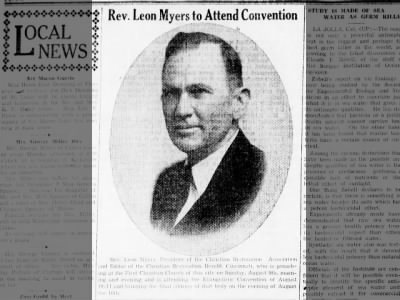
Rev. Leon Myers photoRev. Leon Myers photo Tue, Aug 4, 1936 – Page 4 · Macon Chronicle-Herald (Macon, Missouri) · Newspapers.com

The Reverend Leon Leroy Myers took his degree in May 1913 from the Eugene Bible College, and after a few years in Oregon, the family moved down to Redlands in San Bernardino. Leon became a prominent member of the Ku Klux Klan in Anaheim, and he was a crusader against liquor during the 1920s. In January 1925, after Rev. Myers was rebuked for making allegations against police and local officials that turned out not to be true, he was targeted by an anti-klan assassination plot. Later that spring, he was attacked and beaten by a citizen he had accused from the pulpit.

The Myers moved to Kansas in 1927, and to Cincinnati, Ohio, in the 1930s. Leon was frequently invited to speak at revivals.

Ada and Leroy had six children together, including twins, Leroy and Leon. But in 1954 she sued Leon for gross neglect and was awarded alimony. She did not sue for divorce, but it seems clear that they were no longer together after that.

When Ada died on 25 March 1975 in Half Moon Bay, San Mateo, California, she was survived by Paul, Eugene, Elizabeth, and James, as well as 12 grandchildren and two great-grandchildren. Leroy lived to be 105 years old, dying on 22 November 1991 in Calaveras County, California.

     i. Paul Addison Myers (1911–2002) was born on 19 July 1911 while his father was leading his first congregation at the Christian Church in Dallas, Polk County, Oregon. By 1920, the family was living in Redlands, San Bernardino, California. In 1930, the 19-year-old Paul was enlisted in the U.S. military and stationed in the Panama Canal Zone with his unit at Fort Clayton.

After his enlistment ended, Paul married and became an accountant in San Francisco. His wife was Esther O'Dell (1913–1954), daughter of the Reverend Charles Norman O'Dell (1883–1973) and Ione Grundy (1887–1968). The couple lived in San Francisco until after the war began, and Paul enlisted in the U.S. Marine Corps. On 7 December 1942, he entered boot camp as a private first class at Quantico, Virginia, and by October 1943 he had received his commission as a Second Lieutenant. He was wounded at Iwo Jima, and hospitalized at Guam in 1945.

After the war, Paul and Esther were living in San Pedro in 1949, but I get the impression from the records that the separation of the war took a toll on their marriage. I don't see any evidence that they had children, and Paul was living in Seattle with his second wife already when Esther died on 25 February 1954 in Stanislaus County, California.

Paul's second wife was Janet Kathrine Lynch (1927–2000); they probably met during their service, as she was a member of the Cadet Nursing Corps from 1945 to 1948. I wonder if they didn't meet at the hospital when he was wounded - but that's pure speculation on my part.

Janet died 9 April 2000 in Kirkland, King, Washington. Paul also died there on 11 August 2002.

     ii. Eugene Powell Myers (1913–1998) was born in Silverton, Marion, Oregon on 19 December 1913. When he was 8 years old, and his family was living in Redlands, he and his little sister created a stir in the local community when they tried to run away and "see the world"!
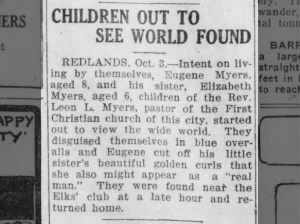
Myers children Myers children "see the world" Mon, Oct 3, 1921 – Page 12 · Santa Ana Register (Santa Ana, California) · Newspapers.com
In 1930, Eugene was 16 and residing at the State Juvenile Training School in Gatesville, Texas.

He enlisted in the U.S. Marine Corps on 20 March 1942, and by the end of the war, he had achieved the rank of technical sergeant, having spent 20 months in the Pacific theater. He was discharged on 19 March 1946.

On 31 July 1951, he married Joyce Emily Hughes (1925–2009) in Alameda County, California. They had five children, four sons and a daughter; three of whom are still living.

Eugene died on 15 July 1998 in Grosse Pointe, Wayne, Michigan, survived by Joyce and four of their children. Joyce died there on 12 March 2009.

     a. Wayne Leon Myers (1953–1995) was born on 23 June 1953, in Berkeley, California, and died on December 27, 1995, in New Orleans, Louisiana, at the age of 42. Dr. Wayne L. Myers was listed in the City Directory of New Orleans in 1992.

     b. Dana O'Farrell Myers (1961–2011)  was born on August 9, 1961, in Detroit, Michigan, and he worked for the United States Postal Service in St. Petersburg, Florida, from 1986. His passions were sports, the beach, and camping. He never married, but he spent 24 years with his companion (she is still living) and their cat, Smokey. He died in Sunset Beach on 1 December 2011.

     iii. Elizabeth Jane Myers (1915–1989) was born in The Dalles, Wasco, Oregon on 30 December 1915. She grew up in Redlands, San Bernardino, California (surviving her adventure with her brother, Eugene, when she was six), and followed her family to Kansas in the 1930s. Her father was a pastor in Cincinnati, Ohio, when Elizabeth probably met and married Norman B Hallenback (b. 1904).

Norman was born in Brooklyn, New York, on 30 May 1904. His parents Bert Cornelius Hallenbeck (1875–1954) and Edith Testut (1878–1944), moved the family to New Jersey by 1920. He married Helen J Frank (1908–1985) on 14 Aug 1926 in Bridgewater, Somerset, New Jersey, and in 1930, Norman left her with three small children when he disappeared from the movie theater where he worked with $1600 and a pretty, young cashier. Helen officially divorced him in 1932.

Norman turned up in Cincinnati in 1938, where he was charged with forgery. This arrest led to the alerting of authorities in New Jersey to his whereabouts. Elizabeth probably met Norman in Cincinnati, as that's where her father was preaching. They were married and living in Caldwell, Essex, New Jersey, in 1940, with a daughter (still living) and a son.

Unfortunately, 1940 is the last we see of Norman. He left his second family and disappeared from view; and he is almost certainly deceased. (If he is still alive, he should appear on this list!) Elizabeth remarried in New Jersey in 1945, and divorced in 1951 in Florida. In 1962, she married
Raymond Edwin Hebeler (1914–2005), and they lived in Calaveras County, California, where she died on 12 March 1989. Elizabeth was buried in Mokelumne Hill Protestant Cemetery.

     a. Robert Norman Hallenbeck (1940–2001) was born on 3 September 1940, in Montclair, New Jersey. He was married in 1961, in Los Angeles, California, and again in 1974, in Clark County, Nevada. He died on 13 June 2001, at the age of 60, in California.

     iv. Leroy J Myers (b. 1921) and his twin brother Leon David were born on 21 February 1921, in San Bernardino, California; Leroy was not a healthy child, and while records have not been identified, he is said to have died while his family was living in Dodge City, Kansas, where he appeared on the 1930 Census.

     v. Leon David Myers (1921–1944) was quite an accomplished young man. He was a Master Councilor of the Cincinnati Chapter of DeMolay, and graduated from Withrow High School. He was employed by the American Surety Co. and attending evening college at the University of Cincinnati when he enlisted on 25 April 1942.

Leon received a commission and acheived the rank of Captain. He was flight leader of the 396th Fighter Squadron of the 368th Fighter Group (a Thunderbolt group), serving in the Ninth Air Force. He received the Air Medal, 12 Oak Leaf Clusters. Distinguished Flying Cross and Purple Heart. He was killed in action over Saint-Lô, France, 26 July 1944, near the end of the invasion of Normandy, leaving behind a young widow.

In 1949, he was returned to the U.S. and buried in Golden Gate National Cemetery, San Fransisco.

     vi. James Conrad Myers (1924–1986) was born on 10 Oct 1924 in Orange County, California, and was very small when his father moved the family to Kansas. He enlisted in the U.S. Army on 3 July 1943 in Cincinnati, and served with the Chinese Combat Command.

James married after the war, on 9 October 1949; his wife and son are still living. James died on 14 September 1986 in Pacifica, San Mateo, California.

     B. Noble Glenn Powell (1890–1936) was born on 7 April 1890, in Oregon, the only son of Glenn and Arvilla Powell. He established himself as a professional driver in 1910, at a time when chauffuers were transitioning from horse-drawn carriages to motor vehicles. He appears in the Oregon Motor Vehicle Registrations database as early as 1912.

He married Bertha Ann Johns (1896–1980) around 1913; she was the daughter of Oliver Troy Johns (1862–1908) and Ella Francis Elliott (1872–1966). They had a son and daughter in Portland. Bertha also worked as a waitress.

Noble died on 14 February 1936, in Portland, at the age of 45, and was buried there. Bertha was remarried twice, but died on 9 September 1980 in Eugene, Lane, Oregon.

     i. Noble Glenn O Powell II (1914–2015) was born in Portland, Oregon to Bertha and Noble Powell. As a teen, he served in the Civilian Conservation Corps at Mt. Hood. He served in the U.S. Navy in WWII in the Pacific theater. He moved to Eugene in 1951.

On 25 July 1936, in Portland, Noble married Mary Trofimenko (1915–2008), and they enjoyed traveling the world together for 73 years. Mary was born 1 December 1915, in Killdeer, North Dakota, to Wasyl and Anna Procentko Trofimenko. She attended Girls Polytechnic School in Portland. She worked as a retail clerk for Eugene Toy and Hobby.

Mary died in Eugene on 7 October 2008. Noble spent his final years at Gateway Living in Eugene, and died on 26 January 2015, four months after his 100th birthday celebration. He was survived by his two children, 7 grandchildren, 8 great-grandchildren and, 3 great-great-grandchildren.

Two of his grandchildren are deceased:

  • Noble Glenn O. "Bo" Powell IV (1966–2017) was born on May 28, 1966, in Eugene, Oregon. He graduated from Willamette High School in 1984 and joined the U.S. Navy, where he excelled as a boatswain's mate. He deployed for operations Desert Shield and Desert Storm, Enduring Freedom, and Iraqi Freedom, earning multiple Navy and Marine Corps Achievement Medals and Commendations along the way. After 26 years, Senior Chief "Bo" Powell retired from the Navy with honor in 2009.

    Bo was married in 1991, and he is survived by his wife and two sons, as well as his parents and a sister. He died on 13 September 2017, after a long battle with multiple myeloma cancer.

  • Leslie Gayle Powell Daum (1970–1997) was born on 16 February 1970, in Eugene, Oregon. She was killed in a car accident on 24 August 1997, at the age of 27. She was survived by her ex-husband and two sons, as well as her parents, brother Bo, and her sister.

     ii. Arvilla Powell (b. 1920) born just before the 1920 Census, Arvilla did not appear in any other records with her family. Presumably, she died as an infant.


     C. Claudia Mae Powell (1891–1974) was born on 14 November 1891, in Oregon. She married Joe Mulholand on 19 October 1910, in Marion, Oregon; however, they seem to have been separated by 1916, when she appeared in the Portland city directory alone as "Claudia Mulholland."

Claudia lived in Portland and San Fransisco, where she operated a candy shop; she moved to Stayton, Marion, Oregon, in 1951. She died on 15 July 1974, in Stayton, at the age of 82. Private interment was in Rose City Cemetery, Portland.

     D. Pauline B Powell (1892–1970) was born on 31 December 1892, in Oregon. She married George O Greybrooke (1888–1961) around 1920, and they lived in San Fransisco for about 30 years. George was born in the Dakota Territory, and served in the U.S. Army from April 1918 to May 1919, at the end of World War I.

Pauline died Saturday, 14 November 1970 in a Salem nursing home at the age of 78 years. She was survived by her sisters, Claudia Powell, also of Salem, and Mrs. Ada J. Myers, of Half Moon Bay, California.

 - -- --- -- - 

 Family can be hard.

When you start digging into the history of any family, there are stories that can be hurtful or embarrassing to uncover. And when, like me, you are so distant a relative that you might as well be a random stranger, you don't know any of the people who might be hurt or embarrassed by the stories you uncover. That means being extra careful, not only to do thorough research and adequately document what you know, but also to reach out to the survivors of those stories in a way that represents them well.

There were several examples here of (potentially) messy divorces, family abandonment, and the impossible-to-ignore involvement with the Klan. Fortunately for me, I have found the other researchers I've met over the years to be pragmatic about confronting these stories. People who get into this hobby seem to become accustomed to the idea of accepting "black sheep" and scoundrels into their family tree along with the upstanding pillars of the community.

After all, it's not like we have much choice in the matter by the time we come along!

Of the living people mentioned in this post, it looks like I may have found at least one candidate to look for in the DNA database. Once I find a match, I'll be sure to post an update.

Until then, if you recognize yourself in this family, and want to fill in gaps or make corrections, please don't hesitate to reach out to me. I'm on Gmail as "callintad," or you can comment below. You can also follow the link above, on the right, to the Callin Family History Facebook group, which is a private group for descendants of James Callin. (Be prepared to tell me how you're related to this family, so I know to let you in!)

I'll be working hard to get as much of this branch documented before I start school in a couple of weeks, so stay tuned!

Friday, August 25, 2017

When Grandma Played the Organ

In his 1995 book, The Five Love Languages, pastor Gary Chapman outlined five ways to express and experience love that he called "love languages": gift giving, quality time, words of affirmation, acts of service (devotion), and physical touch. Everyone expresses themselves in each of those five languages to some extent, but almost everyone favors one above the others. The morning of August 21st, at age 91, my family lost someone who expressed herself through acts of service more than almost anyone else I have ever known.

When Alberta Jane Tuttle was born on August 29, 1925, in Summit, New Jersey, her father, Alfred, was 32, and her mother, Edna, was 30. Alberta and her big sister, Lyle, were raised in New Jersey. Their father, who had served as a bugler in the infantry for three years before World War I, worked as a manager for a chemical plant during the Depression. Their mother was a tough-but-sweet homemaker who had supported her five sisters before marrying Alfred; I wrote a bit about Edna's family in an earlier post.

Alberta "Bert" Tuttle
Columbia H.S.
1943
Alberta graduated from Columbia High School in Maplewood, New Jersey, Class of 1943. The Second World War was well underway, and a number of her classmates and faculty enlisted; the school yearbook was full of advertisements for war bonds and calls for victory.

At the end of World War II, Alberta married a tall, handsome sailor named Russell Hudson Clark on March 2, 1946, in Irvington, New Jersey, in a service held at the Reformed Church in America by Rev. Harry A. Olsen. The young couple honeymooned in Washington, DC, before moving out to Middletown, Ohio, but they soon moved back to New Jersey.

In fact, movement would turn out to be a defining characteristic of the household of Bert and Russ Clark.

When I showed an interest in family history, Grandma sent me a partial list of all of the places they had lived. She could only remember 33 moves between 1946 and 1984, but she assured me that there were more. They moved from New Jersey to Texas, to Arkansas, back to Texas; to California, Arizona, back to California; to Colorado, followed by a trip to visit New Jersey before moving back to Little Rock, Arkansas - and that only brings us up to 1962!

Alberta & Russ
2 March 1946
Somewhere between the end of the war and becoming a father, Russ became a preacher, and many of these moves were to follow his calling. I have written before about him, describing him as A Fire in the Desert. Bert went with him everywhere he traveled. Along the way, they had three children together, and I am sure that they have stories to share about growing up in so many places.

Russ would find work in a place, and settle for a while. He might find a church that was looking for a pastor, and they might go live in that community. Alberta could play the organ, and so she would accompany the choir or the congregation, and he would preach.  But there was always another call from elsewhere that he needed to follow, and she would go with him. Eventually, the kids grew up and it was just the two of them, always traveling.

It didn't matter where they were, whether you were in their home or they were in yours; Grandma would be busy. She loved to take care of her family. She was forever bustling around the kitchen, cleaning up, playing with the children, singing - always showing us all how much she loved us through those acts of service.

I discovered a few years ago that one of Grandma's ancestors, a surgeon named John Green, was a founding member of the First Baptist Church of Providence, along with the famous Roger Williams, who also established the colony that would become Rhode Island. Baptists place the conscience of the individual at the center of their faith, and Williams's conscience drove him to avoid organized religion - even if he was the one who organized it. In many ways, I could see Grandpa as a spiritual successor to Williams, always seeking, always following his calling. Grandma, as a committed Christian wife, following her own conscience just as fiercely as he followed his.

I know how important it is to my surviving family to mention the fact that Grandma was a strong Christian. She certainly was that, without question. A few years ago, I was going through some intensely difficult troubles, and she called me to make sure I was okay. I could tell that it broke her heart that we were 3,000 miles apart and that she couldn't come over and help with the children or do something to show her love. All she could do was ask, "Have you considered just giving the problem to Jesus?" Being a humanist who has no belief in the supernatural, I couldn't honestly tell her that I had. But being a humanist also means that I treasured the fact that she would dive in and exhaust herself trying to make things better for everyone around her before finally accepting that there were some things she could not fix.

That ferocious, patient love was what made her a great lady.

That philosophical stuff would have all been beyond my understanding when I was young. All I knew when I was a kid was that seeing Grandma and Grandpa Clark was an adventure. They always had a new house in a new place, or if they were between houses, they would have a different motorhome or trailer to live in. As we got older, we learned what they meant by "disability" and "fixed income" when they talked with the other adults at dinner.

She wouldn't complain, but sometimes we could tell that all of the moving around was hard on her. She would talk about finding a church home, putting down roots, and having a house she could call her own. Sometimes they even stayed on a piece of property long enough to build a house, and she could get her organ out of storage and set it up in her living room. I particularly loved the visits when she had room for her organ because she would play and sing those old revival hymns that made such a grand first impression on the churches they visited.

After Grandpa died in 2002, Grandma's life was not the same. How could it be after 54 years of life together? There was a brief time when we wondered what she would do next, and how she would adjust. We worried, but we should have known that she would find a way to feel useful.

Alberta and Sherwin, 2004
In September 2004, she then married Sherwin Nichols. In many ways, Sherwin reminded me of Grandpa; he had mobility issues, and some severe health problems, but he loved my Grandma, and most importantly, he gave her someone to take care of again with her ferocious intensity. She finally had a home where she could install her organ in a front room. By this time, it was old and the circuitry inside was fragile, so it didn't get played much, but at least it had a stable place to rest.

When Sherwin died in 2008, he and his family were generous enough to leave her his house and enough to live on. Grandma married a third time, once again choosing a preacher, but this time, she joked, she was marrying a much younger man - he was only 85! They were planning to buy a house and move to the north of Phoenix to get away from the heat and the city.

In 2011 her sister, Lyle, died after battling dementia for several years. Having watched Grandpa battle with Alzheimer's Disease before his death, Grandma told us that biggest fear was that she would lose her mind and not know who any of us were before she died. She worried that any time she forgot a name or misplaced something that it was a sign, but as far as I know, she was still fully herself when she began suffering from an elevated heart rate last week and went to the hospital.

She died at four o'clock in the morning on August 21, 2017, in a hospice in Surprise, Arizona, at the age of 91 years, 11 months, and 21 days. I will always remember her for her music, her laughter, and her constant, steady service to everyone she loved.

Grandpa & Grandma Clark, bound for their D.C. honeymoon

Sunday, July 16, 2017

James C. Palmer and Martha Peterson

James C Palmer was born in April 1814 in New York. He married Martha Peterson (1815–1882) around 1836; they are my 4th-great grandparents. Our previous post focused on Martha's father, Samuel Peterson, and on his descendants.

I know very little about James Palmer, as the earliest record I have found online that identifies him is the 1860 U.S. Census. He appears in four of the U.S. Census records (1860, 1870, 1880, and 1900), three state census records (two for New Jersey, and one for New York), and about 16 city directories, so we know that he was born in New York state (the minority of records say New Jersey), that he worked as a shipwright, like his father-in-law, and that from 1871 forward, he and his family lived in Jersey City, New Jersey.

The family's first documented appearance was in Washington, Middlesex county, New Jersey, in 1860, according to the U.S. Census. The household in that record included Martha's father, niece, and nephew. Sam Peterson died in 1862, and in 1865, the remaining Palmer family (plus two Petersons) lived in Brooklyn, New York, according to that year's State Census. By 1870, they were in Jersey City, and all of the subsequent records show James living there.

James and Martha had four daughters, spread out over 19 years. When Martha died in 1882, at age 66, James lived on his own for about ten years, but eventually went to live with his second-youngest daughter, Sarah Decker.  He died in 1904 at the impressive age of 90.

I. Mary Elizabeth Palmer (1837–1889)

Jacob E. Opp, about 1910
Sources are pretty evenly split on the subject of where Mary was born; most records say New York, a few say New Jersey. As with her father, the earliest record I have that lists Mary is the 1860 U.S. Census. She appears three times in the U.S. Census (1860, 1870, and 1880) and once in the New York State Census (1865). The only other records I have is of her death, in the New Jersey, Deaths and Burials Index, 1798-1971.

Mary Elizabeth married Jacob Edward Opp (1842–1913) about 1867. (They are my 3rd-great grandparents.) Jacob was a Civil War veteran and railroad engineer from North Dansville, Livingston county, New York, and his pension record from the National Archives was very helpful to me when I began researching this branch of the family. I'll talk more about him and his ancestors in future posts.

Mary and Jacob had three children, two daughters and a son. They raised their family in Paterson, Pasaic county, New Jersey, but also appear to have been close to the Opp family in Dansville. After Mary died in 1889, Jacob relocated from Paterson to his daughter's home in Newark, but still appeared in the U.S. Census in his mother's household in Dansville on the 1900, as did his daughter's family (the Freys).

The records imply that Jacob never stopped working as an engineer, driving trains right up until his death from pneumonia on 17 July 1913.

     A. Lillie May Opp (1868–1881) died young, only aged 13 years 6 months. She is buried in Green Mount Cemetery in Dansville, Livingston county, New York.

     B. James Henry Opp (1870–1941) married three times, and had a total of eight children. Because marriage and birth records were sparse, I can't be sure that I correctly associated children with the correct mother, so please let me know in the comment section at the bottom of this post if I need to make any updates.

James was born in Dansville on 11 March 1870, and grew up in Paterson. His first marriage was on 14 July 1889, when he married his cousin, Evelyn Stevens (b. 1870). His mother died in September of that year.

James and Evelyn had two children together, but did not stay together for very long. Evelyn remarried in 1900, and we will discuss her later in this post.

     1. Richard Dana Opp (1890–1944) was born 11 August 1890 in Jersey City, and married Helen Platt (1886–1965) in 1913. A few years later, he joined the New York National Guard in 1917, where he served in the 7th Infantry as a corporal. A couple of years later, he joined his father in relocating to Elmira, New York, where he worked for the Aluminum Ware Manufacturing Company.

I don't know when they were married, but in 1920, he was listed in the U.S. Census with his second wife, Anna S Klein (1890–1973), and in 1922, Helen Platt Opp took her father-in-law, James H. Opp, to court over an unspecified debt.

     a. Richard Dana Opp Jr. (1917–1991) was born on July 22, 1917, in Bronx, New York. He entered the Naval Academy at Annapolis in 1937, and would eventually retire from the U.S. Marine Corps at the rank of Lt. Colonel. He and his wife, Ruth O'Connor (1913–2002), had one son and one daughter, both of whom are still living. He died on February 13, 1991, in Fort Belvoir, Virginia, at the age of 73, and was buried in Arlington, Virginia.


     b. Edna Mae Opp (1920–1993) was born on March 28, 1920, in Elmira, New York. She worked in a credit union until World War II broke out, and she then enlisted in the Women's Army Corps (W.A.C.). After the war, her arthritis forced her to move to a hot, dry climate, and so she relocated to El Paso, Texas. She lived there with her mother until Anna's death in 1973. Edna died on June 2, 1993, in El Paso, Texas, at the age of 73, and was buried there.

     2. Lillian Elizabeth Opp (b. 1893) married William Corwin Johnson Jr (b. 1888) in 1916, and we know they had a son (possibly still living), and two daughters: Charlotte Elaine Johnson Bloch (1917–1989) and Lillian Joy Johnson  Franklin (1921–2003).
   
James married his second wife, Lillian Jones (1871–1915), on 20 January 1896.  James worked in New York City, and the family lived in Newark, New Jersey. In 1900, James's company, Opp & Grundy, went into bankruptcy. Still, he worked hard and eventually got back on his feet.

They had five children before Lillian's death in 1915.

     3. Julian Theyer Opp (1899–1978) was a mechanic who lived in Union county, New Jersey. He married Charlotte L Jacques (1913–1997) around 1930, and they had two daughters, who may still be living.

     4. Lucinda Opp (1901–1902) died before her first birthday, and was buried in the Sleepy Hollow Cemetery in Westchester County, New York.

     5. Emily A Opp (1904–1917) was born on 23 February 1904 in Kings county, New York. She died just over a month before her thirteenth birthday on 15 January 1917, and was also buried in Sleepy Hollow.

     6. Stanley Walter Opp (1912–2001) was born in New York City, and grew up in Newark, where he met his wife, Eleanor Bertha Ficke (1915–2004). They married around 1937, then lived in Denville, New Jersey, from 1944 until 1973. He was a warehouse supervisor at Bendix Corp. in Teterboro for 29 years, retiring in 1971. They had two children, one son, Stanley Charles Opp (1938–1993), and a daughter, still living.

Stanley and Eleanor then moved to Tuckerton, New Jersey, where he was a licensed optician. They lived there from 1973 until 1989, and retired to Mount Bethel, Pennsylvania. He received his optician degree from Camden Community College in 1980. He also owned and operated, with his late son, the Stanley Shell, later known as Stanley's Sunoco, in Denville.

     7. Dorothy Opp (b. 1915) remains a bit of a mystery; her brother Stanley's 2001 obituary mentioned her (as "Dorothy Campbell") and said she died previously, but did not say when. And she appeared in the 1940 Census in her younger brother James's household in Hillside, New Jersey, where her surname looks like "Comboy" (possibly a mis-hearing of "Campbell").

After the 1915 death of Lillian, James H. Opp's third marriage was to Jessica Viola "Jessie" Owens (1896–1987). They had one son in 1917, and then about a year after that, in 1918, James and his business associates took over the Aluminum War Manufacturing Company headquartered in Elmira, New York. James and his family all relocated to Elmira, and James purchased the famous Glove House there.

James's oldest son, Richard D., worked for him at this company, and James soon took over as president of the company from his partners. But within a couple of years, questions over the company's finances led to the Opps giving up control of the company, and moving back to New Jersey. It isn't clear that anyone did anything wrong, but the newspapers of the time implied that this was a local controversy.

     8. James Henry Opp Jr (1917–2010) married Shirley Cole (1920–1986), and they had two children: a daughter, still living, and a son, James Michael Opp (1956–1989). The family lived in Southern California from the mid-1950s, and James and Shirley are buried in Pierce Brothers Valley Oaks Memorial Park, Westlake Village, Los Angeles county.

     C. Emily Amelia Opp (1871–1913) married Emil C Frey; they are my 2nd-great grandparents, so I will cover their family in more detail in future posts. I told much of Emil's story here on the blog a few years ago in Love and Loss in Old New York (and New Jersey).

II. Emily M. Palmer (b. 1842)

Emily married Alexander Charles Radcliffe (1819–1900)  on November 5, 1871, in Jersey City, New Jersey. They had one son, Loder B Radcliffe born and died in 1873. After Alexander's death, Emily was living in Philadelphia, where she was last seen in 1912. I have not found any record of her death.

III. Sarah D. Palmer (b. 1854)

Sarah was born in May 1854 in New Jersey, and she married James L W Decker (b. 1858) on October 9, 1884, in Jersey City, New Jersey. They had four children in 11 years. They appeared together with their children in the 1900 and 1910 U.S. Census, and on birth and death records for the three younger children; there is also a marriage record for them in the New Jersey, Marriage Records, 1670-1965 database.

I don't know precisely when Sarah or James died, but she is listed in a U.S. City Directory at their home on Graham St. in 1918 as "wid. Jas. W." - and she appears in the 1930 Census in the household of her son-in-law, John T. Denmead.

     A. Theresa Decker (b. 1885) last appears in her parents' home on the 1910 U.S. Census, where they lived on Graham St. in Jersey City. She is single and 25 years old, with no listed occupation.

     B. Gordon Thayer Decker (1888–1952) married Marie Augusta Harnisch (1892–1972) on 21 December 1915, and they lived in the house on Graham St. with his parents. Gordon and Marie soon had their daughter, and they moved to East Orange around 1920. Gordon worked as a machinist and engineer until the 1940s, when he and Marie appear to have retired, either to San Diego, or to New York. Marie appears in both New Jersey and San Diego on the 1940 Census; in New Jersey, she lived with Gordon and her elderly parents, and in San Diego, she lived with her daughter and son-in-law.

Gordon died 8 April 1952, and was buried in San Diego, and Marie died there in 1972.

     1. Lois Decker (1917–1977) married Robert Edward Cullmer (1911–1968) of Montclair, New Jersey, probably in 1935. They moved to San Diego, California, where their son was born: Robert Morrison Cullmer (1937–2001).

     C. Grace P Decker (1889) died in June 1889 at five months of age.

     D. Caroline C Decker 1897–1993) was born on March 10, 1897, in Jersey City, New Jersey. She married John Tennant Denmead, Jr. (1894–1939) about 1921. They had six sons between 1922 and 1939, when John died. One son is still living.

Caroline remarried Julius Leo Briegel (1898-1977), and lived in Netcong, New Jersey, for many years. She was an assistant librarian at the Netcong Library from 1957 to 1967. She was a member of the Netcong Board of Education from 1950 to 1967, and served on the Juvenile Conference Committee of Morris County Juvenile Court from 1960 to 1965. She was a World War II Gold Star Mother and a past president and member of the Veterans of Foreign Wars Lakeland Post 2347 Ladies' Auxiliary of Netcong.

She died in 1993 in Passaic, New Jersey, at the age of 96, and was buried in Netcong, New Jersey.

     1. John T Denmead III (1922–2013) was born in Jersey City, New Jersey, and lived most of his life in the Netcong/Stanhope area. He served in the U.S. Army Air Corps. during WW II as a water survival instructor in Fresno, California. After the war, Jack worked as a salesman for Vita Frost Frozen Foods until it closed. He then worked as Superintendent of Building and Grounds with Lenape Valley Regional High School for over 25 years before retiring in 1987.

Jack was well known in his community for his historical knowledge of lakes Musconetcong and Hopatcong. He conducted water safety instruction for the Sussex County American Red Cross, certifying lifeguards in the area.

Jack married Patricia Jane Black (1923–1993) in 1943, and was survived by his brother, three children, four grandchildren and two great-grandchildren.

     2. Donald R Denmead (1923–1943) enlisted in the Army Air Corps, and served as a ball turret gunner on the B-17 #4230872, 'Ole Puss,' which collided with another aircraft on 16 December 1943. The plane crashed into North Sea, and Sgt. Denmead was lost with the rest of the crew.

     3. James G Denmead (1928–2013) James served in the Marine Corps during World War II, and married Doris Louise Tobin (1923–2002) on 11 October 1952. He worked for Fablock Mills in Berkeley Heights, New Jersey, as a computer data and construction manager. He was a member of the Warren Township American Legion Post 293. In his spare time he enjoyed oil painting, and sang with  the Hounds for Harmony Barbershop Chorus in Plainfield, New Jersey.

James and Doris are survived by their daughter.

     4. Bruce P Denmead (1933–1991) was born on June 12, 1933, in Dover, New Jersey, and lived in Phillipsburg, New Jersey, much of his life. He was a dispatcher at Jersey Central Power & Light Co. in Phillipsburg for 28 years before retiring in 1986. He was a member of Westley United Methodist Church in Phillipsburg. He also was a Cub Scout Webelos leader for Pack 62 in Budd Lake.

He died on January 20, 1991, at the age of 57, and was buried in Easton, Pennsylvania. He is survived by his wife, a son, four daughters, and seven grandchildren.

     6. Harry Wadsworth Denmead (1939–2008) was born on April 21, 1939, in Dover, New Jersey. He married Mary Ann Parliment (1940–2013) on 24 October 1958 in Vance, North Carolina, and enlisted in the U.S. Army from 1963-1965. They resided in Netcong prior to moving to the Budd Lake section of Mount Olive Township, New Jersey, in 1965.

Mary Ann was a nurse, working for many years at Dover General and Karen Ann Quinlin Hospice. Harry retired in 1998 after 38 years as a production planner with Westinghouse in Randolph. He was a life member of Stanhope United Methodist Church in Stanhope, and he was a member of the Barber Shop Harmony Society for 50 years.

Harry died on Wednesday afternoon, Oct 1, 2008, at St Clare's Hospital, Denville, after a short illness. MaryAnn died on Friday morning, April 19, 2013 at her home in Netcong after a long illness. They were survived by a son, two daughters, and two grand-children.

IV. Carrie W. Palmer (b. 1856)

When Carrie Palmer married Charles H Stevens (1840–1921) on October 8, 1879, in Jersey City, New Jersey, she was 22 years old. He was a boot & shoe maker with two children from a previous marriage. They had two more children.

Carrie's new step-children were William A. Stevens (b. 1866) and Evelyn Stevens (b. 1870). She is the Evelyn Stevens who married her step-cousin, James Henry Opp (1870–1941). After they divorced, Evelyn remarried George W. Gifford (b. 1868) on 11 August 1900.

Carrie died in 1931 in New Jersey at the age of 75, and was buried in Morristown, New Jersey.

     A. Charles H Stevens Jr. (1882–1923) married Jeannette "Jennie" Kalshoven (1886–1979) in 1908. He worked as a bank clerk, and died at only 41 years of age. They were survived by a son, Charles H Stevens (1910–1985).

     B. Clara R H Stevens (b. 1892) married William Fredrick Wing (1889–1942) on 22 December 1912, and they appeared together in her parents' household on the 1920 U.S. Census - but by 1922, William was no longer listed in Jersey City with Clara. He seems to have remarried by 1925. The last record I have of Clara is her listing in the 1922 U.S. City Directory for Jersey City, living in her parents' home on Grant St.

 - -- --- -- - 

As you can imagine, this is a very time consuming project! I'm planning to continue, but it certainly won't be a weekly exercise.

If you're a relative of any of the people named here, I am always eager to hear from cousins - especially if they can help me fix any mistakes I might have made in the course of my research.

If you've had your DNA tested through FTDNA.com, look for me in your Matches; you can reach me through my "callintad" Gmail address (listed there on my profile, too) or you can drop a comment below.

Friday, June 30, 2017

Samuel Peterson: New Jersey shipwright

After spending two years focused on my paternal line, I've been eager to look at the other branches of my family. Since the Callin Family History started with my 5th great-grandfather on the paternal side, it seemed inevitable that I should re-start this blog project by going to the exact opposite end of the tree: my 5th great-grandfather through my maternal line. Records are still sparse online, but perhaps one of these days I'll get the chance to visit the places that have the records that might fill in the blanks. 

Tracing back from my maternal grandmother's mother, Edna Lyle (Frey) Tuttle, here's what I can tell you about her great-great grandfather:

Samuel Peterson (1783-1862) - my 5x-great grandfather

Sam Peterson was a New Jersey shipwright who was born in 1783 in  Cape May, New Jersey. He had three sons and three daughters with his wife Mary between 1814 and 1830. He died on July 9, 1862, in Middlesex county, New Jersey, having lived a long life of 80 years.

Edna Lyle Frey (1895-1985) pedigree chart
click for full size version
There is a great deal that I don't know, and even some of the facts I have may be wrong. I had to make some educated guesses from the available records, but here's a breakdown of the evidence I have.

U.S. Federal Census records for 1830, 1840, 1850, and 1860 show a Samuel Peterson residing in Middlesex county, New Jersey. The first three place him in North Brunswick, presumably in his home with his wife and children; the 1860 places him in the town of Washington (the borough of South River, today), where he is living with the Palmer family.

I believe that James and Martha Palmer are Sam's daughter and son-in-law. There are also two children with the surname Peterson in the household that year: Samuel (14) and Annie (12); other records for Martha and James identify them as a niece and nephew, which I'll talk about in more detail later.

In addition to the four census records, I have an index record from the New Jersey, Deaths and Burials Index, 1798-1971. That record identifies Samuel Peterson, born about 1782 in Cape May, New Jersey; died 9 July 1862 in Washington, Middlesex, New Jersey at 80 years of age. Occupation: Shipwright; marital status: Widowed.

I have not found any records, local histories or old genealogy texts with any information about Sam's parents, but several Peterson families were listed in the New Jersey Tax Lists in Upper Township, Cape May county, during the 1780s and 1790s. (I found records for Aaron, Isaac, Hance, Joseph, Thomas, and a Samuel Peterson - any of whom might be Sam's father.)

Mary Peterson (1782-1852) - my 5x-great grandmother

Mary was born in 1786 in New Jersey. Other researchers give her maiden name as Hoffman, but I have not been able to confirm that with the available records. I only have two records that name her: the 1850 Census, where she is listed in Sam's household in North Brunswick, and the record of her death in the New Jersey, Deaths and Burials Index, 1798-1971. She died on February 17, 1852, in South River, New Jersey, at the age of 66.

Their Children

This section should be considered a work in progress. I had to piece together clues from a lot of different records, some of which contradict each other. There are several common names used across several generations, and children who seem to have lived with aunts and uncles while their parents were still alive, but I'll do my best to piece things together.

Assuming that the children living in their household in 1830 and 1840 were their sons and daughters, I expect to someday find all six of them. There were three boys and three girls in 1830; one girl and two boys in 1840; and one of each in the household in 1850 (the first year that named all household members). Here is the current list of Sam and Mary's descendants, as best as I can prove:

I. Thomas Peterson (1814–1880) - since none of the records I have found online identify Thomas as the son of Sam and Mary, there was a son listed in the "age 15-19" block of the 1830 Census. Also, the 1860 Census shows the Thomas Peterson family living next door to the James C. Palmer family, where Sam Peterson was also living. This is probably the strongest evidence I have to suggest that Thomas is related to our Sam Peterson. So, while I offer the caveat that he may not be a member of this family, the facts that follow are supported by five Census records (1840 through 1880), which place him in the area of East Brunswick, as well as his death record in the New Jersey, Deaths and Burials Index, 1798-1971, and memorials in the U.S. Find-a-Grave database.

Thomas Peterson was born on August 8, 1814, in New Jersey. He had two sons with his wife, Sarah Eliza, between 1838 and 1843. He was listed as a "waterman," "boatman," and "master sloop" in the various census records. Thomas died on October 26, 1880, in East Brunswick, New Jersey, at the age of 66, and Sarah Eliza died January 31, 1906, at age 88. They are both buried in the Washington Monumental Cemetery in South River, New Jersey.

On the 1870 Census, two young men, Perry (age 22) and Isaac (21) are listed as "farm servants" - their race is listed as "black" and their birthplace as "Virginia." They are indexed as Perry Peterson and Isaac Peterson, but the original census does not actually indicate a surname for them, so I'm not sure whether they used the name or not. 

     A. William H Peterson (b. 1838) married Mary F Reid (b. 1839) in 1858. They had one child during their marriage, Martha R Peterson (b. 1860). In addition to six U.S. Census records (1850-1910) that place him in East Brunswick and South River, William is recorded in U.S., Civil War Draft Registrations Records, 1863-1865. 

     B. Theadore F Peterson (1843–1877) was born in 1843 in East Brunswick, New Jersey. He his wife, Louisa, had one daughter, whom they named Carrie, in 1869. He died at age 35 on April 1, 1877. All we know about Louisa and Carrie comes from the three Census records that feature Theadore.

II. Unknown sister - born between 1816-1820, she only appeared on the 1830 Census in the "Females aged 10 thru 14" block.

III. Martha Peterson (1815–1882) - is my 4x-great grandmother; we will go over this family in more detail in a later post. She married James C. Palmer in 1836, and they had four daughters. This family took in Martha's nephew Samuel and niece Annie when Martha's sister-in-law died; and Martha's father, Samuel, lived with them after Mary died in 1852. In 1860, Samuel was listed in the Palmer household with the occupation constable.

IV. James H. Peterson (1821–1900) - was born in January 1821 in New Jersey. He had one son and two daughters with his wife, Sarah A, between 1847 and 1848. He died in 1900 having lived a long life of 79 years. You will notice a significant gap there, as I only have two Census records for James - one from 1850 that shows him, Sarah, and two of their children living in North Brunswick, and then 1900, living with his niece (Martha's daughter), Sarah Decker, and his brother-in-law, James Palmer.

While I have not been able to find James in the Census between 1850 and 1900, two of his children appear in the records consistently. I haven't been able to find records that would explain what happened, but I suspect that Sarah and one of their daughters, Martha, died during the 1850s. That said, there could be any number of explanations for these patterns.

     A. Martha L Peterson (b. 1847) was three years old in 1850, according to the 1850 Census; after that, I have not found records to indicate her fate.

     B. Samuel H. Peterson (b. 1847) was five years old on the 1850 Census, but later records peg his birth date closer to Martha's. On the 1860 Census, Samuel and his other sister, Annie, appear listed in the same James Palmer household as their grandfather, Sam Peterson (the same Sam we started with). According to a newspaper obituary for his wife, he married Amelia J. Opp in 1873, and they moved to New York state.

Samuel and Amelia were in Deerpark, New York, according to the 1875 New York State Census, and they were in North Dansville with their daughter and three sons in 1880. When Amelia shows up in 1900, she is listed in North Dansville as a widow, but I have not been able to find Samuel's death records. Amelia lived in North Dansville until her death in 1922, and she was buried near two of her sons in Green Mount Cemetery.

Because Amelia Opp is the sister of my 3x-great grandfather, Jacob Edward Opp, I plan to explore this family in a future post - there are a lot of Peterson descendants in this branch!

     C. Annie E. Peterson (1848–1880) presents a few tragic puzzles. She does not appear on the 1850 Census, but she and her brother Samuel appear on the 1860 in the home of the Palmer family. Annie apparently married a man named Eugene Morter, and they both appear in the Palmer household on the 1870.

According to the New Jersey, Marriage Records, 1670-1965, she married John A. Darlington on 11 December 1871, and they lived in Brooklyn, New York, according to the 1875 New York State Census. That marriage record names her parents as "James H. Peterson and Sarah Peterson." In 1880, John and Annie lived in Brooklyn with their three sons: James (b. 1872), John (b. 1877), and Orrin (b. 1879).

Tragically, Annie died on 17 June 1880 - there is a record that attributes her death to "consumption," but it also gives her race as "mulatto" (all other records that list race describe her as "white") and the date of death as June 1879, so that may be a different Anna Darlington. Whatever the cause of Annie's death, little Orrin also died a few weeks later on 14 July 1880.

Her husband and two surviving sons remained in Brooklyn, none married or left any children as far as I have been able to determine. The younger John died in 1902 at age 25; his brother James died in 1924. Their father traveled to England, and returned to New York in July 1886. The most recent record I see for him is the 1900 Census.

V. Larisa Peterson (b. 1826) - appeared in her parent's home in 1850.

VI. Samuel Peterson (b. 1830) - like his sister, appeared at home with his parents in 1850.

 - -- --- -- - 

As always, I would be eager to hear from anyone who might be related to any of the families mentioned here. It is a real challenge to research a surname as common as "Peterson," especially when everyone marries someone named either "Sarah" or "Mary" and then names their sons Samuel, James, or John!

But that is the challenge, I suppose, and I wouldn't really have any fun without the challenge.

I can be reached through my Gmail address, which is "callintad" and I will be notified if you comment below. My DNA is in the FTDNA.com database, if you are looking for genetic connections.

And happy hunting!

Friday, December 4, 2015

A Tragic Beauty

George's tree
(click for a closer look)
We have spent the last several weeks talking about descendants of George and Polly Ann (Lewis) Callin, starting with the post, Uncle George and the Underground Railroad.

Next we looked at the family of his eldest son, John Callin (1832–1906), and his second son, William H Callin (1834–1919), followed by four weeks of posts covering each of William's daughters and their families.

George and Polly also had four daughters:

  • Minerva Callin (1836–1911)
  • Lavina* Callin (1839–1877)
  • Sabra Ann Callin (1837–1849)
  • Amelia A Callin (1849–1899)
While their birth and death dates are recorded in the Callin Family History, some of the information there is wrong or missing. The CFH does not have Minerva's date of death, for example; it just says "died," and since it was published in 1911, we have to guess that she died before then. It also lists Lovina's* death date as "July, 1880" and Amelia's as "Nov., 1875," both of which turn out to be incorrect.

Sabry A. Callin
(memorial on Find A Grave)
Sabra Ann's short life was apparently not as short as the CFH would have us believe. While Find A Grave does confirm the date of her death as February 11, 1849, her headstone gives her age as "12y 1m" making her birth date January 1837.

Minerva's story is harder to tell, as the CFH gives us surprisingly little to go on. That book tells us that she married a "John Smith," and lists four children, two of whom it says "died," leaving us to assume their deaths occurred some time before 1911. Their names were given as Frank (died), Flora, Willie, and Helen (died).

There is a record in the 1860 Federal Census for a family that fits this limited information rather well. They were listed in the village of Harrison, Winnebago county, Illinois. The head of the household is a blacksmith (aptly named) John N. Smith, age 28, born in Ohio. His 26 year old wife, Minerva, and 4 year old son, Frank, were also born in Ohio; 3 year old William J and 1 year old Hellen A were born in Illinois.

Thanks to the detailed enlistment records kept by Illinois, we know that John enlisted in the 74th Regiment of the Illinois Infantry, Company A, in September of 1862. That record confirms his name and middle initial, his occupation, and his 1860 residence, and it describes him as being 5'6", with black eyes, black hair, and a "dark" complexion. He mustered out of the unit in Nashville in 1865.

Unfortunately for us, in 1870 and 1880, the only John Smith family listed in Harrison, Winnebago county, is that of an English husband and wife, Mary, with children who are decidedly not named Frank, Willie, Helen, or Flora. Searches for each of the people we know to be in our John Smith's family turn up very little convincing evidence. There is a 1900 Census record in Columbia, Whitley county, Indiana which lists a Helen Hudson, living with her husband and children, and her mother: one Minerva Smith. Sadly, there are enough "Minerva Smiths" in the United States during the late 19th Century that without more clues, I can't say for sure that this is the same one.

The name "Smith" is far too common, even when paired with the other details we have, to zero in on the clues we would need to say anything more certain about Minerva and her family.

Lavina married Edward C. Rickey (1831–1896) on 24 October 1855, when she was only 16 years old. Ed was a farmer by trade, born in New Jersey to John and Bertha (Howell) Rickey. His family had moved to Ohio around 1845 and settled in Huron county. Ed enlisted in the 192nd Regiment, Ohio Infantry, in 1865 spending the final six months of the war on duty in the Shenandoah Valley.

We know from Ed's obituary that the couple had a daughter who died in infancy, and three sons; the youngest of those also died in infancy. We do not know the cause of Lavina's death, but she died in July 1877, only a month after the birth of that youngest son. She was 38 years old. Two months later the baby died, too.

Ed remarried to Anna Salome Tessler, on 8 May 1879; they had a daughter they named Florence (1884-1969). Ed died 23 October 1896, and was buried next to Lavina in the Cogswell Cemetery in Bridgewater Twp, Williams county, Ohio.

     1. Clayton E Rickey (1858–1930) was eighteen when his mother died in 1877. He left Ohio, worked as a farm laborer for a time in Michigan, and then married Sadie Taylor (?–1892) on 1 October 1887 in Fort Wayne, Indiana. In 1888, they had a son, Roscoe; but Sadie died in 1892 leaving Clayton and four year old Roscoe on their own. After Sadie died, Clayton married Ellen Teeple (1866–1934), and they had five more children.

The records tell an unusual story, because while the Census records show Clayton and his family living in Indiana, most of his children's birth records placed them in Williams county, Ohio. The two places were about 80 miles apart, and it may simply be that Clayton's family remained close to the rest of the Rickeys living in Ohio; I suppose that could account for a family traveling 80 miles each time they have a baby.

We know that Clayton died some time before 1930, but I have been unable to find any records or memorials to provide more detail. Part of the problem lies in the fact that he tended to use his initials, "C.E." on most official records, and part of the problem lies in the bewildering variety of ways the records list Ellen's name; Ellen, Ella, Lydia E., and Temple, Tebel, or Topple, just to name a few.

     a. Roscoe Leroy Rickey (1888–1917) grew up in his father's household with his step-mother and half-siblings, and they were living in Elkhart, Indiana, in 1900. There is a death record for a Roscoe Rickey who died in Detroit, Michigan, in 1917, and while there is a Roscoe Ritchey in Kokomo, Indiana in 1910 with a wife, Lizzie, it is not certain that our Roscoe Rickey had a family of his own when he died.

     b. Marguerite Rickey (1893–??) married William Harry Heidrick, Jr. on 28 August 1915, and the license was recorded in Hillsdale, Michigan. They lived in Fort Wayne at first, and apparently moved with their two young daughters (Alice V., b. 1917 and Jeanette M., b. 1918) to Sioux Falls, South Dakota, by 1920. After that, I have been unable to find any further records.

There are numerous records for different spellings of "Marguerite Heidrick" -  Margaret, and Headrick being most common - but where they list a husband, the names do not match. As with the Smith family above, we will have to keep hunting to find these descendants.

     c. Paul Edward Rickey (1897–1940) fought in World War I, and served in the 81st Company of the Transportation Corps in 1918 & 1919. His residence was listed on his draft registration as Stutsman, North Dakota, where he was employed as a farm laborer. After the war, there are several records in the 1920s listing his address in Indianapolis, and in 1930, the Census shows him in Marion, Grant county, Indiana. That Census record says he is married, though that is the only record that says so.

Paul was buried with military honors in Portland, Oregon, after he died there on 25 October 1940.

     d. Hugh Rickey (1899–1904) five-year-old Hugh died in December 1904, almost a year after the birth of his sister, Florence. He died in Indiana, and was buried in the Riverside Cemetery in Montpelier, Ohio.

     e. Florence Anola Rickey (1904–1923) may have been named after her father's half-sister, who would have been twenty years old in 1904. Florence Anola married Leonard Christian Roebel (1901–1970) on 11 August 1923, but was taken by typhoid fever in November that year.

     f. Arlo R Rickey (1905–1988) was born on September 20, 1905. He married Fayma Kleber (1909 - 1980) on 27 June 1936, and they lived most of their lives in Fort Wayne, Indiana. He was 37 years old when he enlisted in the U.S. Army after the beginning of World War II.

Fayma died in 1980, and Arlo died on June 13, 1988 at age 82. They were both buried in St Joseph's Catholic Church & Cemetery in Marion Township, Indiana.

     2. Willis L Rickey (1864–1935) married Cora Shoffer (1865–1903) in 1888. She died when their son was only eight years old, and Willis remarried Hannah Drusilla Crouse (1872–1938). Drusilla was the recent widow of Ambrose Stroh (1863–1903), and Willis adopted her four-year-old daughter, Vera I Stroh (1900–1973).

Willis was the proprietor of hardware stores in the towns the family lived in. Over the years, they lived in Madison, Ohio (1900), Wilmington, Indiana (1910), and Detroit, Michigan (1920). Willis died in Parker City, Indiana, in February 1935.

     a. Earl Glenn Rickey, Sr. (1895–1959) married Alma Miller (1897–1983) on 5 May 1914. They had one son, Earl G Rickey Jr. (1915–1986), a lifelong resident of Fort Wayne, Indiana, who served in World War II.


Amelia was the youngest daughter of George and Polly Callin. She was born at their home in Monroeville on 16 March 1849. She married Mr. Charles Henry Horton on 8 November 1875, when she was 26 years old, and they lived in Wellington for 20 years before moving to Painesville.

Charles was born in Holley, Orleans county New York, on 25 April 1845, to Chauncey and Nancy (Masten) Horton. He served as a sergeant in the 55th Ohio Volunteer Infantry for the four years of the Civil War. According to his biographical sketch in the Commemorative Biographical Record of the Counties of Huron and Lorain, Ohio, he "was in the battles of Chattanooga and Buzzard's Roost, and was severely wounded at Resaca, but [after] recovering rapidly rejoined his company, and was with Sherman on his march to the sea." After the war, he invented a threshing machine and a brick making machine, which made his fortune.

The Hortons did not have children of their own, likely owing to Amelia's delicate health. She was known to have a chronic digestive disorder, and her obituary noted that her health prevented her from participating in church activities.

On 3 December 1899, after recovering from a severe attack of typhoid fever, she died from that chronic digestive disorder.

--     ---     --


This was a difficult post to write, as you can probably imagine. It is rare to find so much information about a family and still be left with so much untimely death and so many loose ends. I hate having to leave loose ends. Usually, the untimely deaths keep us from having the loose ends, but this family was special!

I will, of course, keep looking for more clues to finish the story, but for now, aside from the seven or so great-grandchildren of George and Polly whose fates we do not know, this is all there is. Arlo and Fayma may have had some children we did not discover; Paul may have had a family in the twenty years between Indiana and Oregon; and the Smiths and the Heidricks may yet turn up in some unexpected place.

Until they do, we will have these stories of lives lived with their tragic beauty in the middle of America.
--     ---     --

*Note that the CFH spells Lavina/Lovina with both spellings in different places; her husband's obituary spells it "Lavina" but her headstone spells it "Lovina."

Portrait of Amelia Callin Horton is of unknown origin, and is assumed to be in the public domain.

For more information about the Rickey family, visit the Rickey Family Association's Rickey Database (rickeyfamily.org).

Friday, December 12, 2014

Love and Loss in Old New York (and New Jersey)

Joseph Frey led a short but interesting life.

Born in Germany, in the mid-1820s, he came to settle in New York, probably during the 1830s or early 1840s. His birthday is listed on various documents as ranging from 1823 to 1828, and his birthplace is usually listed as either "Baden" or "Wurttemberg", but other sources say his parents may have been from a small French town near the Swiss border, or that he was born in Switzerland.

These were very difficult times for working class people in Europe. Between successive revolutions in France, uneasy relations amongst the old Empires, and terrifying epidemics - particularly cholera - sweeping through the increasingly crowded and unsanitary cities, a young man looking across the ocean might have been strongly attracted to the relative prosperity and peacefulness of the United States.

Once settled in one of the German speaking neighborhoods around New York, that young man would have become part of the story of that young, still experimental nation. He would have seen the growing stream of immigrants from Ireland pouring through New York Harbor during the so-called Potato Famine of the 1840s; he would have seen politicians arguing about Westward expansion; and and he would have heard about threats of war from Britain, France and Mexico. Without records or writing from Joseph's point of view, I have to assume from the evidence available that he found his place in America, and decided to invest himself in it.

When President Polk maneuvered the U.S. into war with Mexico, Joseph enlisted as a private in Company A, 5th Regiment of Infantry, New York Volunteers. He signed up for a 5 year term on 3 December 1846, but was discharged honorably after 11 months and 24 days on 27 November 1847 after the relatively quick American victory at Mexico City.

On March 11, 1849, he married Elizabeth Horn in the Lutheran church in Williamsburg, New York, and they began raising their family; Frederick (1851), Maggie (1853), William (1856), Theodore (1858), and the twins, Edwin August and Edward (1859).

As a veteran soldier, and a member of a close-knit community in a burgeoning New World city, I like to imagine that this would have been a happy and hopeful decade for Joseph and Elizabeth. Despite the growth of the anti-immigrant sentiment in the 1840s and 1850s, people like the Freys were learning how to thrive in the "melting pot" of New York. Joseph was listed in the 1860 census - along with Elizabeth and the children listed above - and identified as a brush maker, which implies that he was literate and educated, and moderately well off.

And then there came another war.

Enlisted in Captain Robinson's Company of New York Volunteers on 6 September 1861, Joseph re-enlisted 15 November 1863, and was discharged and mustered out with the Company on 21 June 1865. His pension records say he contracted seriously debilitating rheumatism during his time in service, and while he and Elizabeth had two more children - Augusta ("Gussie", b. 1865) and my great-great grandfather, Emil Adolph Carl (1869) - his health would never fully recover.

In 1870, Joseph had taken his brush making profession back up, and his older sons and daughter seem to have been helping with the house and the business in the Flushing neighborhood of Queens, New York. But his condition seems to have deteriorated so that some time around 1876, he had to move into the Soldier's Home in Washington, DC - where he died in February 1877, barely 50 years of age.

Frey family, about 1903
from left: Edna, Emil, Bessie, Amelia
(front) Grace, Marjorie
By 1880, Elizabeth had moved the family to Newark, New Jersey, probably to be near her brother's family, and the Freys lived at 103 Congress Street for many years. Young Emil met Miss Emily Amelia Opp, whose family split their time between a cottage in nearby Paterson (about 15 miles from Newark) and Dansville, in upstate New York.

Emil and Amelia were married around 1894 in Dansville, and settled back in Newark. They had six daughters: my great grandmother, Edna (1895), Elizabeth "Bessie" May (1897), Blanch (1899-1900), Marjorie (1900), Grace (1902), and Theresa "Tessie" Decker (1908).

I have the impression that Emil found a second family in the Opps.
Jacob Opp

Amelia's father, Jacob, was a veteran of the war, just like Emil's father. He worked as a locomotive engineer, which might account for his family seeming to simultaneously live in two towns separated by nearly 300 miles. For example, in 1900, Emil and Amelia and their girls show up twice in the Census records - once in the home of Susan Opp (Jacob's widowed mother) and once in their own home in Newark. Interestingly, the two records were enumerated only about a week apart - one on the 1st and one on the 9th of June - suggesting that they were recorded both while visiting Dansville AND after their return home to Newark.

These years seem to have been happy ones for Emil. He worked as a grocer and (according to a Frey family tradition) as a Borden's milk delivery man. It isn't clear what caused the tragic loss of little Blanch before her second birthday, but the other girls seem to have all been healthy and the family seems to have prospered. Sadly, Emil and Amelia would not see their twentieth wedding anniversary.

Frey daughters, about 1909
(clockwise from left) Edna, Theresa,
Elizabeth, Marjorie, Grace
In 1910, Jacob was listed in the Census records as living in Emil's household, where he apparently lived out his days. He succumbed to pneumonia in July 1913, only a few months after Amelia died, in March of that year. At this writing, I am just shy of my twentieth anniversary myself; I know how I would feel if I lost my lovely bride right now. If my impression of their relationship is correct, Emil then immediately lost someone who may have been like a surrogate father for an even longer time. Then, as if that weren't enough, Emil's mother, Elizabeth, died in 1914 of Bright's disease at the age of 86.

This all seems to have been too much for him. Emil's older daughters, Edna and Bessie, began working to support the family, and they took care of the younger girls. By 1920, Edna was married to Alfred Tuttle; Bessie was working as a legal clerk, living with the other girls in a rented house on Fourth street in Newark while they attended school; and Emil was an inmate in the Essex County Hospital Center (also called Overbrook hospital) in Cedar Grove.

My grandmother, Edna's younger daughter, recalls visiting Emil in the hospital. She told me, "We used to visit him every Sunday, and take him fruit and treats. I was very young then of course." She would have been 11 years old when he died of pneumonia in February 1936.

Today, approaching 2015, I have to wonder if it might have been possible to do more to treat Emil; if we could go back armed with a better understanding of the mind and brain, would we be better equipped to help him, and get him back home with people who loved him? It's hard to know what his life was like those last 16 years; I haven't found records that could describe his condition or diagnosis, and the hospital itself shut down in 2007. It is now a favorite haunt for so-called urban explorers and ghost hunters - thrill seekers more interested in playing up the "spookiness" of old buildings than understanding what life was like for the patients.

At least his life was bookended by heroic people. From his father, the devoted soldier, to his self-sufficient daughters, Emil Frey seems to have been surrounded by love, strength, hope, and joy for most of his life. I will leave it to you to decide whether that lessens or sharpens the tragedy of those last years.