Showing posts with label 1920s. Show all posts

Friday, June 21, 2019

The First Life of Mrs. Reed

If you hearken back almost three years to a post titled The Mysterious McNabbs, we left a mystery unsolved about Elizabeth Ferguson McNabb (1835-1898). Here's what I said about her back then:
     Mystery #2: Mary Ferguson's sister, Elizabeth (1835-1898) also married a McNabb. The Indiana Marriage Index helpfully tells us that a James McNabb and Elizabeth B. Ferguson were married in DeKalb county on 8 February 1858. The CFH tells us that they had six children:
  •     Ella McNabb 1859–
  •     Margret McNabb
  •     Mary McNabb
  •     Charles McNabb
  •     Eliza McNabb
  •     Emma McNabb
But... after finding what I believe to be the only appearance of this family in the 1860 Census (with James, Elizabeth, and 1-year-old Ella), they seem to fall between all of the cracks in the databases. I have not been able to find them in 1870 or 1880, even with very broad searches.

Looking at the data again, there are some details in the original Callin Family History that were hard for me to interpret. This was one of several records in the CFH that could be read in more than one way, and without source citations, it's hard to check the information great-uncle George drew from or figure out what he meant to communicate to us. Here's what his record actually said:
Record of Elizabeth Ferguson who was the 2nd daughter of Eliza Callin Ferguson who was the 3rd daughter of John Callin who was the 2nd son of James 1st.

Born about 1836, died about 1898.

Married to James McNabb.

To this union seven children were born:

Ella, married, has five children living.
G.W. Reid (by 2nd marriage), married, two children living.
Emma, married.
Eliza, married, five children living.
Charles, unmarried.
Margret, married, two children living, three dead.
Mary, died at one year old.

It's pretty clear now that I should have interpreted this as telling me after Ella, the other children listed were from Elizabeth's second marriage. It's an understandable mistake, and since I didn't know to look for people named "Reed" instead of "McNabb," I missed a lot of clues.

The CFH also gave us some of the vague information Great-Uncle George had about Ella:

Record of Ella McNabb, eldest daughter of Elizabeth Ferguson McNabb, who was the 2nd daughter of Eliza Callin Ferguson, who was the 3rd daughter of John Callin, who was the 2nd son of James 1st.

Born ----.

Married ----.

To this union were born five children.

Record of Alta McCorse, eldest daughter of Ella McNabb, eldest daughter of Elizabeth Callin Ferguson, 3rd daughter of John Callin, 2nd son of James 1st.

Born ----.

Married ----.

To this union were born four children.

For years, I misread this as saying that Ella married someone named "McCorse," when it turns out that "McCorse" is similar to her daughter Alta's married name...but we'll get to that next week.

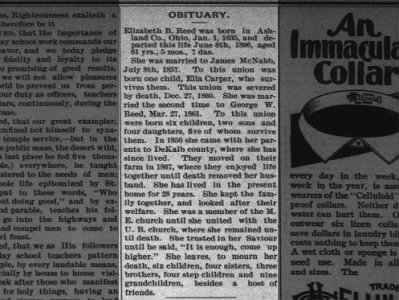
In 2016, I didn't have access to Newspapers.com, so I didn't find Elizabeth's obituary until recently. It still wasn't easy to track down (I had to open my search parameters and dig through a lot of results), but as you can see, this find fits with what we already know from the CFH and the 1860 Census.


Elizabeth McNabb, wife of James McNabb, obituaryElizabeth McNabb, wife of James McNabb, obituary Thu, Jun 18, 1896 – Page 8 · The Waterloo Press (Waterloo, DeKalb, Indiana) · Newspapers.com
Here's the first part of the obituary:

"Elizabeth B. Reed was born in Ashland Co., Ohio, Jan. 1, 1835, and departed this life June 8th, 1896, aged 61 yrs., 5 mos., 7 das.
"She was married to James McNabb, July 8th, 1857. To this union was born one child, Ella Carper, who survives them. This union was severed by death, Dec. 27, 1860. She was married the second time to George W. Reed, Mar. 27, 1861. To this union were born six children, two sons and four daughters, five of whom survive them. In 1850 she came with her parents to DeKalb county, where she has since lived. They moved on their farm in 1867, where they enjoyed life together until death removed her husband. She has lived in the present home for 28 years."

Elizabeth's place in the tree
That confirms enough of the details we already know and gives us some insights we didn't know so we can start tracing Elizabeth's children.

As with previous breakthroughs, this one document allowed me to find a large number of previously unknown descendants of our common ancestor, James Callin. For the next few weeks, we'll look at the members of this branch of the family.

We'll visit Elizabeth's second husband, Mr. Reed, and their children in future posts, but today we'll look at Ella, the daughter born from her tragic first marriage. There are a lot of folks to cover, and I'm researching as I go, so I'm going to break these down into smaller posts so I can better stick to a weekly schedule.


James McNabb (1834–1860)

James was the first husband of Elizabeth Ferguson. Despite learning his date of death, I haven't been able to dig up anymore about his origins. As the first mystery in the original post on The Mysterious McNabbs concluded, this James McNabb is not obviously related to the other McNabbs who married people in our Callin/Ferguson tree. All we really know about him are these three vital facts:
  • Born about 1834 in Pennsylvania (according to the 1860 Census)
  • Married Elizabeth Ferguson on 8 February 1858 (according to two records in the Indiana, Marriages, 1810-2001 and the Indiana, Marriage Collection, 1800-1941, respectively)
  • Died in Allen County, Indiana (according to the above obituary - I didn't even find an official death record!)
There is a discrepancy between the marriage date in the Indiana marriage records (8 February 1857) and the obituary (8 July 1858), but that's close enough to be either a clerical error or the time between registering for the license and the actual wedding. Either way, before he died, he left behind one child:

I. Ella Florence McNabb (1859–1929)

Like a few other people in our family tree, Ella seems to have shifted from using her first name to going by her middle name as she got older. She first appears as "Ella McNabb" in 1860 and as "Ella F Reed" in 1870. After she married Jacob Carper she appeared on the Census in 1900 as "Ellen Carper" and in 1910 as "Ella Carper;" but on the various marriage and death records of her children, and on the 1880 Census, her name is recorded as either "Florence Carper" or "Florence E. Carper." I surmise that her parents named her "Ella Florence McNabb," but she started using "Florence" later in life. Her eldest daughter and some of her grandchildren were apparently given that name in her honor.

Ella grew up in the home of her mother and step-father in De Kalb County, Indiana, and in 1875 she married the son of Adam Carper (1795–1877) and Ann Elizabeth Cobler (1812–1886). Jacob Carper was born in Indiana in June 1853, the youngest of ten siblings.

Between 1879 and 1891 Jacob and Ella (or Florence, as she got older) had four children in Jackson Township, De Kalb County:

     A. Alda Florence Carper (1879–1970)
     B. Howard Leroy Carper (1882–1948)
     C. John D Carper (1886–1964)
     D. Callie Bell Carper (1891–1980)

Jacob underwent some minor surgery in late July 1927 which resulted in his health quickly deteriorating; he died on 6 August 1927. Florence died just two years later in 1929, and they are buried together in Roselawn Cemetery in Auburn, Indiana.
- -- --- -- -

We'll end there for now, but continue next week with the descendants of Jacob and Ella. There's a lot of them, so be prepared to take thorough notes!

You may notice a few changes around here at Mightier Acorns - we have:
  •  a Twitter feed - @MightierAcorns 
  •  a Facebook page - facebook.com/MightierAcorns/ (for everyone, not just proven relatives!)
  •  and if you like the work I'm doing, you can "buy me a coffee" using the Ko-fi button:
I also set up an email address - mightieracorns@gmail.com - so if you have a question or comment, you can send it there.

Friday, August 25, 2017

When Grandma Played the Organ

In his 1995 book, The Five Love Languages, pastor Gary Chapman outlined five ways to express and experience love that he called "love languages": gift giving, quality time, words of affirmation, acts of service (devotion), and physical touch. Everyone expresses themselves in each of those five languages to some extent, but almost everyone favors one above the others. The morning of August 21st, at age 91, my family lost someone who expressed herself through acts of service more than almost anyone else I have ever known.

When Alberta Jane Tuttle was born on August 29, 1925, in Summit, New Jersey, her father, Alfred, was 32, and her mother, Edna, was 30. Alberta and her big sister, Lyle, were raised in New Jersey. Their father, who had served as a bugler in the infantry for three years before World War I, worked as a manager for a chemical plant during the Depression. Their mother was a tough-but-sweet homemaker who had supported her five sisters before marrying Alfred; I wrote a bit about Edna's family in an earlier post.

Alberta "Bert" Tuttle
Columbia H.S.
1943
Alberta graduated from Columbia High School in Maplewood, New Jersey, Class of 1943. The Second World War was well underway, and a number of her classmates and faculty enlisted; the school yearbook was full of advertisements for war bonds and calls for victory.

At the end of World War II, Alberta married a tall, handsome sailor named Russell Hudson Clark on March 2, 1946, in Irvington, New Jersey, in a service held at the Reformed Church in America by Rev. Harry A. Olsen. The young couple honeymooned in Washington, DC, before moving out to Middletown, Ohio, but they soon moved back to New Jersey.

In fact, movement would turn out to be a defining characteristic of the household of Bert and Russ Clark.

When I showed an interest in family history, Grandma sent me a partial list of all of the places they had lived. She could only remember 33 moves between 1946 and 1984, but she assured me that there were more. They moved from New Jersey to Texas, to Arkansas, back to Texas; to California, Arizona, back to California; to Colorado, followed by a trip to visit New Jersey before moving back to Little Rock, Arkansas - and that only brings us up to 1962!

Alberta & Russ
2 March 1946
Somewhere between the end of the war and becoming a father, Russ became a preacher, and many of these moves were to follow his calling. I have written before about him, describing him as A Fire in the Desert. Bert went with him everywhere he traveled. Along the way, they had three children together, and I am sure that they have stories to share about growing up in so many places.

Russ would find work in a place, and settle for a while. He might find a church that was looking for a pastor, and they might go live in that community. Alberta could play the organ, and so she would accompany the choir or the congregation, and he would preach.  But there was always another call from elsewhere that he needed to follow, and she would go with him. Eventually, the kids grew up and it was just the two of them, always traveling.

It didn't matter where they were, whether you were in their home or they were in yours; Grandma would be busy. She loved to take care of her family. She was forever bustling around the kitchen, cleaning up, playing with the children, singing - always showing us all how much she loved us through those acts of service.

I discovered a few years ago that one of Grandma's ancestors, a surgeon named John Green, was a founding member of the First Baptist Church of Providence, along with the famous Roger Williams, who also established the colony that would become Rhode Island. Baptists place the conscience of the individual at the center of their faith, and Williams's conscience drove him to avoid organized religion - even if he was the one who organized it. In many ways, I could see Grandpa as a spiritual successor to Williams, always seeking, always following his calling. Grandma, as a committed Christian wife, following her own conscience just as fiercely as he followed his.

I know how important it is to my surviving family to mention the fact that Grandma was a strong Christian. She certainly was that, without question. A few years ago, I was going through some intensely difficult troubles, and she called me to make sure I was okay. I could tell that it broke her heart that we were 3,000 miles apart and that she couldn't come over and help with the children or do something to show her love. All she could do was ask, "Have you considered just giving the problem to Jesus?" Being a humanist who has no belief in the supernatural, I couldn't honestly tell her that I had. But being a humanist also means that I treasured the fact that she would dive in and exhaust herself trying to make things better for everyone around her before finally accepting that there were some things she could not fix.

That ferocious, patient love was what made her a great lady.

That philosophical stuff would have all been beyond my understanding when I was young. All I knew when I was a kid was that seeing Grandma and Grandpa Clark was an adventure. They always had a new house in a new place, or if they were between houses, they would have a different motorhome or trailer to live in. As we got older, we learned what they meant by "disability" and "fixed income" when they talked with the other adults at dinner.

She wouldn't complain, but sometimes we could tell that all of the moving around was hard on her. She would talk about finding a church home, putting down roots, and having a house she could call her own. Sometimes they even stayed on a piece of property long enough to build a house, and she could get her organ out of storage and set it up in her living room. I particularly loved the visits when she had room for her organ because she would play and sing those old revival hymns that made such a grand first impression on the churches they visited.

After Grandpa died in 2002, Grandma's life was not the same. How could it be after 54 years of life together? There was a brief time when we wondered what she would do next, and how she would adjust. We worried, but we should have known that she would find a way to feel useful.

Alberta and Sherwin, 2004
In September 2004, she then married Sherwin Nichols. In many ways, Sherwin reminded me of Grandpa; he had mobility issues, and some severe health problems, but he loved my Grandma, and most importantly, he gave her someone to take care of again with her ferocious intensity. She finally had a home where she could install her organ in a front room. By this time, it was old and the circuitry inside was fragile, so it didn't get played much, but at least it had a stable place to rest.

When Sherwin died in 2008, he and his family were generous enough to leave her his house and enough to live on. Grandma married a third time, once again choosing a preacher, but this time, she joked, she was marrying a much younger man - he was only 85! They were planning to buy a house and move to the north of Phoenix to get away from the heat and the city.

In 2011 her sister, Lyle, died after battling dementia for several years. Having watched Grandpa battle with Alzheimer's Disease before his death, Grandma told us that biggest fear was that she would lose her mind and not know who any of us were before she died. She worried that any time she forgot a name or misplaced something that it was a sign, but as far as I know, she was still fully herself when she began suffering from an elevated heart rate last week and went to the hospital.

She died at four o'clock in the morning on August 21, 2017, in a hospice in Surprise, Arizona, at the age of 91 years, 11 months, and 21 days. I will always remember her for her music, her laughter, and her constant, steady service to everyone she loved.

Grandpa & Grandma Clark, bound for their D.C. honeymoon

Friday, January 13, 2017

Architects, Tailors, and Wanderers

 As we read last week, Rosalina Bedora Davenport (1848–1876) married James Monroe Callin, and had four children before her death in 1876 at only 28 years of age. Today, we will focus on their sons. Even though only their eldest left descendants for us to trace, there is still a lot to tell you.

Albert Clifford Callin (1869–1933) was seven years old the year his mother died. That was 1876, the same year the telephone was patented, and also the year that the Battle of the Little Bighorn saw 300 men of the U.S. 7th Cavalry Regiment under Lieutenant Colonel George Armstrong Custer wiped out by 5,000 Lakota, Cheyenne, and Arapaho led by Sitting Bull and Crazy Horse. Fresh reminders of the Civil War, threats of conflict with Europe, and personal tragedies combined with the tremendous technological and economic progress of those years must have had an impact on Albert, his brother, and his sisters.

The extended family of Callins and Davenports seem to have come together and helped ease the loss of Rosalina, and the children were able to grow up in Bowling Green, for the most part. The children were surrounded by Civil War heroes and strong pioneer men and women, and they all chipped in to make sure they were educated and safe. Even so, there is only so much protection family can offer.

Mamie Walker, c. 1895
 Mary Gertrude "Mamie" Walker (1868–1932) was the daughter of Joseph Walker (1827-1871) and Ellen Beswick “Nellie” Ruth. Nellie's father was Peter Stout Ruth, an Episcopal minister (who earned an early post on this blog due to his fantastic beard); and she was born in Delaware, before he began to move the family westward founding churches.

Joseph married Nellie in June 1866, in Zanesville, Muskingum county, Ohio. I believe Joseph's parents were Andrew and Agnes (Blakely) Walker of Muskingum county; if they were, then they brought Joseph from his birthplace in Pennsylvania around 1828, and settled in the village of Dresden.

Joseph died when Mamie was three, and Nellie remarried Samuel Kiser in January 1874; she died in December of that same year, when Mamie was six years old, but Samuel raised Mamie as his own. Samuel remarried, and lived in Anderson, Madison County, Indiana, where he died on 27 July 1895.

Mamie and Albert were married on 11 December 1895, in Anderson, Indiana. In 1900 Albert was a carpenter, was living at a house that he owned at 3140 Glenwood Ave, Toledo, Ohio, with Mamie and their first child, Ralph. Though they lost their twin infant daughters in January and February of 1899, they were financially doing all right at this time. Albert's brother, Arthur, was also in Toledo.

The family story is that Albert, as the architect and builder, and a partner who acted as salesman and business manager, were engaged to build an early subdivision in Toledo. At the time, this was done by selling the plots before any houses were built — rather than building on speculation — and then using the sale money to do the actual construction. But when the money was in possession of the business partner (perhaps with materials ordered and not yet paid for, and no homes yet built) the partner absconded with the money, never to be heard of again. The story was that he “ran off to Mexico.”

Albert was left holding the empty bag in Toledo. He may have declared bankruptcy; in any case, he was left virtually penniless. He was a stern, righteous Methodist, and he vowed to pay the home purchasers and creditors back if it took him the rest of his life. He and his little family sold their home and left Toledo for Texas, where he’d heard they needed builders in Galveston.

About this time, his brother, Art, also decided to leave Toledo. As he was a tailor, it's not likely that Art was involved in the housing project, but he may have felt unwelcome in town after that incident. In any case, neither brother knew where they would end up. Albert was going to Texas, probably Galveston, but anywhere he could find construction work as quickly as possible, and Art said he was “going West” somewhere. They arranged that Art would write to a particular Post Office (possibly Galveston) care of General Delivery, on a certain date, to give his own new “Western” location.

Albert at his drafting table, c. 1927
While working his way to Galveston, Albert took on a number of small jobs to pay his way. On one occasion, he undertook to repair a cotton gin that had jammed or broken. While he was working, someone accidentally turned it on, catching his left arm. He retained consciousness, and directed his own extraction from the gin. However, the doctors were unable to save the mangled, filthy arm, and it was amputated above the elbow.

The appointed time to look for Art’s letter came and went while Albert was hospitalized, recuperating from his injury somewhere in mid-Texas. When Albert arrived at the designated Post Office, the Postmaster told him that yes, there had been such a letter, that he had kept it well beyond the required month, but, not knowing who Albert Callin was, he eventually had to return it to sender.  He, of course, had no record of the sender’s address. Thus, the brothers lost contact and never saw each other again.  This was a great loss to Albert and his family, and everywhere they went, they checked phone books for Callin to try to find a trace of Art. Albert’s granddaughter, Joan, used to look for Callin in her western travels. We have no idea why Art apparently didn’t keep in touch with the rest of the family, as Albert did. But Albert and his descendants never found Art until census records became generally available.

Albert and Mamie stayed some time in Galveston. Their son, Eugene Walker "Gene" Callin, was born there, 18 April 1901. After the destructive 1903 hurricane, there was an urgent demand for housing and skilled builders were in high demand; Albert did well as a building contractor, but, as he had vowed, he sent every penny he could spare back to the defrauded home buyers in Toledo.
Ralph (l), John (c), and Gene (r)
Victoria, Texas; about 1907

John Albert was born in 1904, probably in Galveston, and some time before 1908, Albert and his family moved to Victoria, Texas, where their last child, Clara Ruth, was born on 21 October 1908. Albert was successful in his business; however, he still sent every spare penny back to Toledo. He was listed as an architect, and they owned a mortgaged home. Though this made them personally poor, they were content.

The family was devastated by John's death in 1914 (see below); having lost three of six children, they felt they could no longer live in Victoria. Mamie’s half-brother offered them an asylum, and they moved to Pittsburg, Kansas, to be near him.

     I. Ralph Clayton Callin (1896–1955) was about five years old when his father took the family from Toledo to Galveston. As a young man, he served in the 280 Aero Squadron, Rich Field, Waco, Texas, during World War I. He received an abdominal injury while in the service, not in flight, but in a roll-over automobile accident. After his discharge, he went to work for a man he’d met while serving at Waco: D. W.  Baker.

Baker had a guest ranch in Wetmore, Custer County, Colorado. He was an Easterner, and was ill with tuberculosis, so he had come to this high mountain valley for his health. He needed help to run the ranch. The 1920 census shows Baker, 41, his sister and her two young sons, and Ralph, aged 23.

After a time, Gene joined Ralph on Baker's ranch, and the two surviving Callin brothers and Baker ran the business; maintaining a guest ranch, and raising wheat and horses. Eventually, Albert and Mamie came to live there as well. Albert liked it, but Mamie apparently was homesick for city life in this empty ranch land at the base of the Rockies.
Ralph C. & Margaret (Dunbar) Callin
Wetmore, Colorado; c. 1926

Harris Dunbar was the owner of an adjacent large ranch. He was a mostly absentee owner from Buffalo, New York. Harris liked Baker’s little ranch, and wanted to annex it to enlarge his spread and influence in the sparsely settled county. Harris’s youngest daughter, Margaret Dunbar (1908–1966) married Ralph Callin about 1927.

Baker became very ill while on an extended visit to Palm Springs, California, and Harris took over Baker’s ranch, installing Ralph and Margaret as the operators. The 1930 census shows Ralph (farm owner) and Margaret, with their two daughters, Patricia, 2, and  Marjorie, 2 months. Just up the road are Albert Callin, 63, general farmer, and Mamie, 62.

Baker died in October of 1930, and was buried in Pueblo, Colorado. He was mourned by the Callin family, who owed so much to him. Albert became a foreman on the ranch, which was now owned by Ralph and his wife after Baker’s death. Mamie died October 9, 1932, and Albert died seven months later, May 6 , 1933. They are buried together in New Hope Cemetery, Fremont County (just north of Custer County), Colorado.

Ralph’s and Margaret’s marriage was stormy. She left him twice, but came back pregnant; and he took her back both times.  Although these last two children were not Ralph’s, he loved them and raised them on the ranch as his own. They bore the Callin name, and although originally the other Callin children did not know that they were half siblings, they eventually found out. Of the four children, one is still living.

Ralph and Margaret were divorced at some point in the 1940s, and both remarried. Ralph married Alice (last name unknown); she had two young sons from her previous marriage, who were born about 1940, and lived with Ralph and Alice. Alice had been an Indian Agent, possibly with the Jicarilla Apaches. Ralph and Alice lived in Cortez, Montezuma county, Colorado, where they owned and operated a liquor store, and later an adjacent lovely little Indian store, selling beautiful jewelry, ceramics, blankets, and other native crafts. Ralph died in Cortez on 23 April 1955, aged 58, and was buried in Cortez Cemetery.

Margaret’s story was more tragic. She married Russell Ball Rose (1900-1963), a neighboring rancher. She was his second wife, and they lived in Canon City, Colorado. He died in 1963, leaving her a relatively wealthy widow; she then moved to Pueblo, Colorado.

In the evening of 5 October 1966, she was brutally attacked by a 17-year-old neighbor boy, who was burglarizing her home. He knew her because he used to mow grass and shovel snow for her. She heard him in her house; he stabbed her, stole her car, and drove out of town. A gas station attendant called the highway patrol, reporting a stressed boy, with bloody clothes, driving an expensive car in the wee hours of the night. He confessed after he was stopped; the highway patrol asked the Pueblo police to check on Margaret, but by that time, early next morning, it was too late. She had bled to death. She was buried with Russell Rose in Canon City.

       A. Patricia "Pat" Dunbar Callin (1928–1990) was born 2 March 1928, in Custer County, Colorado. She married Ralph Williams Ball (1919–2009) on 5 April 1952, in Denver, Arapahoe County, Colorado. They were divorced before 1985. Pat was an antique dealer in Denver. She died 16 September 1990, in Denver, Arapahoe Co., Colorado, aged 62. Pat and Ralph had three children, all still living, and five grandchildren.

       B. Marjorie "Marge" Callin (1930–1995) was born 30 January 1931, in Custer County, Colorado. She was married very briefly to Dudley Harding Van Buskirk (1916–1991), with whom she had a daughter. She married Robert Victor Becco (1932–2008) about 1954, and they had five children before they divorced about 1981.

Bob Becco was raised on his family’s apple farm and in his younger life worked at Hill Top Market, a Canon City grocery store his parents co-founded. He retired as an Assistant Superintendent of Maintenance from Colorado Fuel & Iron mill after 45 years of service. During his time at the CF&I, he was foreman of the scale, machine and central shops, and was the 1959 Apprentice of the Year. Bob was a talented machinist with an aptitude for invention; many of his creations are still operating at the Rocky Mountain Steel Mills today.  Marge was an antique dealer in Pueblo, Colorado, and she died there on 6 April 1995, aged 65. Bob died in 2008; they left behind their son and four daughters, and nine grandchildren.

       C. John Harris Callin (1932–1996) was born 26 July 1932, in Colorado. John was an officer in the Air Force. He was married twice, and had four children with his first wife. So far as we know, both wives and his children are all still alive.

       D. Jean Callin (abt. 1935-) was named after Ralph's brother, Gene, and I believe she is still living.

     II. & III.  On 13 January 1899, twin girls, Mary Kiser Callin and Nellie Ruth Callin were born. These babies died in infancy, Mary on January 29, and Nellie on 22 February 1899.

     IV. Eugene Walker "Gene" Callin (1901–1973) was born in Galveston, and moved with his family to Victoria, Texas, then to Pittsburg, Kansas. After his brother Ralph moved to Colorado, Gene joined him in operating the guest ranch belonging to D.W. Baker. Among the guests were a New York City widow Adele Merritt and her daughter Louise, who spent two summers there. By the end of the second summer, Gene and Louise were engaged; they were married 26 May 1926, in a Quaker ceremony at the bride’s home in Brooklyn Heights, Kings County, New York, leaving Ralph to care for Baker.

Eugene W. & Louise (Merritt) Callin
New Mexico, 1926
Louise was the daughter of James Haviland "Jim" Merritt and Adele (Ovington) Merritt, born 27 March 1894. Jim was an architect in Brooklyn, New York. He had died in 1914. Louise was a graduate of Smith College, Northampton, Massachusetts. Gene and Louise decided to settle in Santa Fe, New Mexico, and spent the remainder of their lives there, raising two children.

Gene developed a prosperous plant nursery on property he purchased near Santa Fe. He was a landscape architect; many of the gardens in Santa Fe during those years were designed and planted by him. The garden at his Santa Fe home was filled with experimental plantings, as he sought out and tested plants for Santa Fe’s climate.

Gene was a gifted artist and craftsman. He was deeply interested all his life in learning new techniques and using new materials. He was a master woodworker, making furniture and smaller pieces. He learned blacksmithing on the ranch, and wrought handles and hinges for some of his furniture. He learned to work with gold foils while framing his paintings and decorating small wood pieces. He loved working with unusual painting media. He was always whittling and carving. He taught himself lapidary work, and created small treasures combining stones and metal and wood. If he could imagine it, he could create it with his gifted hands. He was directly responsible for his daughter’s teaching herself cloisonné enameling, a craft she pursued for many years. Gene’s and Louise’s home in Santa Fe became a gem, filled with his work and hers; she was a needle worker and embroiderer.

Gene Walker Callin, 1950
Baja California, Mexico
Gene was seriously ill for a time. About 1936 he contracted diphtheria on a visit to Texas. He nearly died, and was in a vegetative state for over a year as a result of its brain-damaging high fever. Louise gradually nursed him back to health, though he suffered some after-effects the rest of his life. Later, Louise began her many-year battle with breast cancer. In those days, treatments for these illnesses were difficult. Despite this, their Santa Fe home was filled with happiness before Louise died in Gene’s arms at home on their 23rd anniversary, 20 May 1949, age 55.

On 16 October 1951, Gene married Henriette “Henri” Harris (1901–1987), an antique dealer in Santa Fe, daughter of Nathan and Rose Harris of St. Louis, Missouri. Their marriage ended in an amicable divorce about twelve years later, and they remained great friends the rest of their lives.

Gene died 2 May 1972, age 72, in Santa Fe, New Mexico. Henri died there 9 July 1987, age 86. Gene is buried between his two wives, Louise and Henri, in Memorial Gardens, Santa Fe.

       A. Charles Ovington Callin (1929–2005) was born 10 November 1929, to Gene and Louise Callin. Though he was born in New York City, he was raised in Santa Fe, New Mexico.

Charles & Diane (Tomcheff) Callin
Chicago, 1964
His schooling was interrupted by service in the army. He served in the Korean War, drafted as a private, and discharged as a sergeant at the end of the war. He then attended and graduated from Pomona College, California.

In 1960, in Laguna Beach, California, Charles married Diane Jean Tomcheff (1935–1995), daughter of Demetre Stephen “Jim” Tomcheff, and Frosa Buteff, immigrants from Macedonia to the Chicago area, Illinois. Diane was working in California at the time, but about 1962, Charles and Diane moved to Chicago, which she considered her home.

Charles was a cartographer. He worked for the Chicago and Northwest Railway, later becoming land manager of their multiple properties. Diane, a teacher, became an English professor at Harper College, Palatine, Illinois. Diane died suddenly on 1 June 1996, age 60, of an accidental overdose of prescription pain medication. Charles was on a visit to their daughter in Las Vegas when she died. Charles then retired and moved to Las Vegas to be near his daughter and her family. Charles died 12 May 2005. His daughter, son-in-law, and their five children are still living.

       B. Joan Callin (1931-) was born 30 June 1931, in New York City, although she was raised in Santa Fe, New Mexico. She attended Radcliffe College, which has since been fully absorbed into its parent Harvard University.

On 10 September 1951 in Santa Fe, she married Robert John Foster, son of John Thomas and Margaret G. (Loftus) Foster of Arlington, Massachusetts. Bob Foster was a graduate of Massachusetts Institute of Technology in geophysics.

Bob obtained a PhD in geology from the University of Washington, Seattle, while Joan worked at Boeing, doing data management from flight testing and the wind tunnel; later she was writing test reports for a company engaged in manufacturing instrumentation for planes and missiles. Bob taught geology, and was the author of a number of textbooks. Joan was his illustrator for most, and helped see them through press.

Joan and Bob have a daughter, a son, and three grandsons. Joan and Bob and their family are all still living.
John Albert Callin
Victoria, Texas, 1914

     V. John Albert Callin (1904–1914) Just after Christmas, on 29 December 1914, tragedy struck. Gene and John and their two best friends, brothers Beau and Val Harris, were playing in some small caves they had dug in the bank of the Guadalupe River near their homes. One cave collapsed, burying John and Beau, and partially burying Gene. Val extracted Gene, and they ran for help. When the neighbors succeeded in digging the boys out an hour after the collapse it was too late. John and Beau were dead, and Gene and Val had witnessed the failed rescue.

     VI. Clara Ruth "Ruth" Callin (1907–1985) was born to Albert and Mamie on 21 October 1908, in Victoria, Texas, the last of their six children. She was named both for Mamie's half-sister, Clara Kiser, and the Ruth family surname.

Clara Ruth Callin
Kansas
After her brother John died, the family went to Kansas, first to Pittsburg, then to Wichita, where Ruth spent the majority of her life. When Albert and Mamie left Kansas permanently to live with Ralph in Colorado, Ruth stayed behind alone in Wichita. She was a musician, a violinist, and she made her living teaching violin. Her brother Gene always prided himself that he had given her her first violin with his first earnings.

On 15 August 1945, Ruth married James Franklin Powell (1880–1951) when he was 65, and she 36. They had one child, before James Powell, Sr., died 19 October 1951, aged 71, leaving Ruth to raise their five-year-old son.

Ruth was severely crippled with arthritis, and she spent much of her later years in a wheelchair. This was doubly hard as she became unable to play the violin she so loved. She also became estranged from her son for many years, and she lived alone. She and her son maintained a better relationship late in her life.

Ruth died 25 October 1985, aged 77,  in Wichita, Sedgewick County, Kansas. She was buried in White Chapel Memorial Gardens, along with her husband.

Arthur K Callin (1871–1957) was the lost brother who left Toledo when Albert and his family moved to Galveston. Judging by the City Directory entries and Census records, he went to Gray's Harbor, Washington, where he worked as a tailor; then in 1910, he moved about 45 miles inland to Olympia, Washington, where he remained for a few years.

By 1918, however, Art moved to Portland, Oregon, where he worked as a janitor for many years. He seems to have done well enough for himself to have a house on Southwest Madison street, where he eventually retired. He died in Portland on 29 January 1957 at the age of 85.

 - -- --- -- -

Enormous thanks to cousin Joan, for the amazing detail and permission to include her photos here. As I've said before, if you see anything you like here, she deserves full credit; if you find any mistakes, those are all mine!

As always, if you're related to any of the folks in this post, then you're family! Please do drop me a note at callintad (at Gmail.com), or in the comments below; or follow this link to send a request to join the Callin Family History Facebook group.
Friday, May 13, 2016

Cardinal Rules

  • Rule number one: You are never "done" with your family history.
This project to update and document the descendants of James Callin is something I've been working toward for twenty years or so. And in the past, when I've gone over what I know about the part of the family we'll be looking at today - Margaret Ferguson and her descendants - I have never been able to find much beyond what the Callin Family History told me:

"Record of Margret Ferguson who was the 4th daughter of Eliza Callin Ferguson who was the 3rd daughter of John Callin who was the 2nd son of James 1st.

Born 1839, died 1902.
Married to Jerome Gallaher.
To this union two children were born:
Mary, married.
Helen, married, two children."

So when I began drafting this post, I expected that to be all I could tell you about Margaret Jane (Ferguson) Gallaher. Assuming I could scrape together names of the husbands of Mary and Helen, and find out the names of Helen's two children, I might have bare-bones minimalist biographies of six or eight people, tops.

  • Rule number two: Absence of evidence is not evidence of absence.

Evidence is the life blood of this project. Without documents that say when and where people lived, and what they did there, I can't rule out anything. And for the longest time, I could only find bits and pieces of this family's story - while the rest was a great, empty possibility.

Then I found an obituary...

Jerome Bohan Gallaher was born 23 August 1833, in Litchfield, Connecticut. He was one of eight children and moved westward when he was a young man settling at various points in Ohio and Indiana. He married Margaret Jane Ferguson (1839-1901) on August 15, 1858, in DeKalb county, Indiana, and they had two daughters: Mary (or Mollie), in 1860, and Helen in 1862.

At the beginning of the Civil War, Jerome enlisted in the 2nd Indiana regiment, in which he served until 25 August 1865. At the time of mustering out he had attained the position of Quartermaster of his regiment. After the close of the Civil War the Gallaher family moved to Black River Falls, Wisconsin, where Mr. Gallaher engaged in his old business of photography. In 1872 they moved to the newly incorporated town of Chippewa Falls, where they resided until the early 1890's, when he settled on a homestead outside of town.

Margaret preceded her husband to the grave in May 1901, and after that he lived alone most of the time on his farm. For the last two years of his life, he had been rather feeble, but when his friends planned to have him come to town where he could be looked after, he always vetoed their plans, expressing the wish to remain on the old farm as long as he lived. He died in January 1912.

     I. Mary A (Mollie) Gallaher (1860-1913) married William John Ickstadt (1865-1906) in September 1883. William took her away to the neighboring town of Edson where he was appointed as postmaster in October 1883, and he became a prominent real estate and business man in the Boyd area. In 1906, at the age of 47, he drowned in a boating accident on Pike lake. Mollie only lived another seven years, dying at 53.

     A. Jerome Monroe Ickstadt was born on 19 June 1884. He married Marie A Street in Boyd, Chippewa county, on 20 May 1912. The couple settled in Fond du Lac, where Jerome was a fireman with the Chicago & Northwestern Railroad company. The last record I have found for them placed them in Fond du Lac in 1921; there is another placing Marie in that town in 1924, but with no further listing for Jerome. I have found nothing to indicate when or where either of them died, or whether they had any children.

     B. Alice Mae Ickstadt (1888–1973) married Louis Floyd Shilts (1894–1947), probably around 1910. Louis was a veteran of World War I, and he worked as an auto mechanic in a Chippewa Falls garage. Mae taught in the local schools.

     C. Arthur J Ickstadt (1890–1927) grew up in Chippewa county, and worked at the State Home - what is now known as the Northern Wisconsin Center for the Developmentally Disabled. He married Louisa Rosalie Krenz (1894–1959) around 1925, and she was pregnant with their second son when he died in March 1927. The state later awarded her $7,000 in settlement, one month before the birth of that second son.


Found on Newspapers.com

       1. Donald W Ickstadt (1927–2013) graduated from Chippewa High School in 1945, then served one and ½ years in the Navy aboard the USS Chara and the USS Parikutin. He matriculated at Wisconsin State College at Eau Claire in 1947 and graduated in 1951 with a Bachelor of Science degree in Social Sciences, Physical Education/Secondary Education. He then attended the University of Southern California graduate school in 1952. Married in 1954, his wife, three sons, and two daughters are all still living. Don worked in employment services for the state of Wisconsin his whole career, retiring in 1987.

       2. Arthur Joseph Ickstadt Jr (1928–2013) was a Veteran of WWII and the Korean War. After leaving the Army, he settled in the Seattle, Washington, area. His mother, Louisa, died there in 1959. Art was survived by his wife, son, three daughters, and "16 Grandchildren, 13 Great-Grandchildren, 1 Great-Great Grandchild and numerous nieces and nephews."

     II. Helen J Gallaher (b. 1862) and her husband, Wesley J. Gregg (b. 1851) presented a few challenges to this researcher. First, there is a marriage record for a Helen Gallagher in 1879, which, even though the database does not link the bride record to the groom's record, seems to imply that she married a man named Amasa Nichols. Until I found Jerome's obituary, I did not know to look for Mr. Gregg, but once I did, I found Helen and Wesley in the four Census records (1900-1930), which indicated they were married in 1885. The birth record for their younger daughter, Jennie, lists Helen's maiden name as "Nichols," so I assume that 1879 record is correct. (And looking through the Chippewa county marriage records, Amasa Nichols seemed to marry quite often; there may be a whole other story there!)

But, Wesley appears to have farmed and worked for the railroad as a clerk for a time; and they raised two daughters. As of 1930, 79-year-old Wesley and 69-year-old Helen were retired and living on their farm. I have not been able to determine when they died or find any records of their burial, but I know from some mentions in the Eau Claire Leader that they were living in the area in the 1920s, and the 1930 Census shows them in Arthur, in Chippewa county.

     A. Ruby Gregg (b. 1883) grew up in Chippewa Falls, and appeared on the 1900 Federal and 1905 State Census in her parents' home. She would have been 21 in 1905, and the 1907 Chippewa Falls city directory indicates that she lived at home while working as a domestic servant for the Mcgilvary family. After that, however, the trail of records dries up, and I can't tell what happened to Ruby.

     B. Jennie H Gregg (1887–1931) married George Jerome Cardinal (1887–1963) on 9 December 1905 in Bayfield, Wisconsin. George was a musician and decorator, and was listed as a painter in the Census and city directories. The couple had nine children before Jennie's death in 1931 at the age of 44.

      1. Wesley G Cardinal (1906–1982) married Katherine Quinlan (1910–??) in about 1930. Wesley was listed in the 1930 Census in his family home, working as a painter/decorator, like his father. In 1940, he and Katherine and their two sons were renting their own place in Chippewa Falls, and Wesley was a musician in an orchestra. They may have had more children after the 1940 Census, but I have only managed to track down the eldest. I assume any other children they had are still living, or my searches would have turned up something. (Though, searching through results for people with the name "Cardinal" is surprisingly difficult.)

       a. Peter Paul Cardinal (1931–1997) served in the U.S. Navy during both the Korean and Vietnam conflicts, according to his grave marker. Based on the incomplete information I have found, I would guess that he enlisted in the early 1950s. He was married by 1959, when he is listed in the city directory for Memphis, Tennessee, which is near the Naval Support Activity Mid-South Naval Base in Millington. And he received a commission as an ensign on 1 July 1963. He attained his highest rank as a Lieutenant on 1 January 1967, and retired 1 August 1978. When he died, he had been living in Pegram, Tennessee.

      2. Linus Cardinal (b. 1909) is another minor mystery, in that I lose track of him after 1930. There are two items in the November 1921 Eau Claire Leader newspapers that describe how he was wounded when a gun discharged, and was later rushed to the hospital with "lockjaw" (probably tetanus) from the resulting infection. That happened when he was 12, and we see him listed at home in the 1930 Census, when he was 21, so we know he survived that episode, at least.

      3. George P Cardinal Jr (1910–1997) appears to have served in World War II, but like his older brothers, left little in the way of records, and his obituary does not seem to be online. I have not been able to find anything between the 1930 Census and the records of his death in Elk Mound, Wisconsin. His wife is still living, and I assume any children they have are, too.

      4. Jane Rosemary Cardinal (1914–1991) married Lloyd A Fransway (1910–1966) and they had five sons and seven daughters, in total. Most of them are still living. Lloyd was a painter, employed by Mikesell's Painting contractors for 25 years; he was the union president of Painters Local 259 from 1958 to 1964. He and Jane took in her three youngest siblings some time after the death of their mother; Lyman, Betty Mae, and the brother who is still living were all listed as Lloyd's foster children in his 1966 obituary.

       a. Mary Jo Fransway: died in infancy.

       b. Patricia Jane "Patty" Fransway (1935–2012) was married to Arthur Sedani (1935–1978), and they had two sons who are still living. Patty worked at the Chippewa Woolen Mill, Creamland Dairy, and the Northern Center for the Developmentally Disabled in Chippewa Falls until she retired. She mentored students through the Chippewa Falls Mentoring Program, headed up the spring and fall suppers for Our Saviour's Lutheran Church, and oversaw funeral luncheons. Patty was a beautiful seamstress and was a member of the Quilters and the Altar Guild.

       c. Lloyd Archie Fransway Jr (1937–1998) was a veteran of the U.S. Navy, serving from 12 May 1954 to 14 November 1957. He married at the end of 1960, and his wife and three sons are still living. They also had a daughter.

      i. Robin M Fransway (1961–2011) attended Northwest College in Powell, Wyoming. She lived in the Powell/Cody area and worked as a secretary and bookkeeper, raising her daughter, who is still living. Robin married on July 7, 2001, and her husband is still living, also.

       d. Anthony L "Tony" Fransway, Sr (1945–2009) served in the U.S. Army National Guard for eight years after he graduated high school. He married in 1968, and his wife, son, and daughter are all still living. He worked at Amoco-Pactiv for 39 years until he retired in 2004. He lived in Chippewa Falls his entire life.

       e. Laura Fransway (1946–2013) grew up in Chippewa Falls and graduated from Chippewa Falls Senior High in 1965. She married in 1977. One daughter and one son are still living. Over her lifetime, she worked for Amoco Chemicals, Whitetail Golf Course, Viking Bowl and retired from the Myrtle Werth Hospital. She was a member of Barum Lutheran Church in Elk Mound.

     i. Chad T Brown (1977-2002) was the oldest son of Laura Fransway. He graduated from Colfax High School in May of 1995, and was employed at Big Timber Saw Mill in Colfax until the time of his death from cancer. He was 25 years old when he died.

       f. Samuel Cardinal "Sammy" Fransway (1960–2003) was employed by Markquart Motors for the 14 years before he died. Sam was also a Chef at a number of local Wisconsin restaurants, as well as in Florida. He owned and operated Sammy's Saloon in Chippewa Falls from 1983 to 1987. He left behind one son.

      5. Kathryn Arlene Cardinal (1916–2007) married Fenton Norman Goss (1914–1999), and they left three sons and two daughters, still living. Fenton served in the U.S. Army during the last few months of 1946.

      6. John Samuel "Jack" Cardinal (1919–1990) served in the U.S. Army throughout World War II, from 6 April 1942 through 18 October 1945. He married in October 1946, and settled in the Detroit area with his wife, who is still living.

      7. Lyman Eugene Cardinal (1921–1977) served in the U.S. Army during World War II, and in the U.S. Navy during the Korean War. If I'm reading the records correctly, he enlisted in the Army in 1940, before Pearl Harbor, and switched to the Navy ten years later, retiring after twenty years in October of 1960. He and his wife settled in Westmoreland county, Pennsylvania. They had at least one son, who is still living.

      8. (Still Living) Cardinal - there is one son from this family still living. Here's hoping I don't need to update this entry until he is good and ready!

      9. Betty Mae Cardinal (1926–2015) graduated from Chippewa Falls High School and worked at the A & P Store, where she met her future husband. On April 18, 1948, the two were united in marriage in Chippewa Falls. They resided in Chippewa Falls where Bette worked at the Northern Center as the food service supervisor, retiring from there in 1986. She left behind her husband and two daughters.


And there you have it: just one timely find can add dozens of people to the family tree!


Friday, April 29, 2016

Indiana Ettingers

Mildred Ferguson was born to James and Eliza (Callin) Ferguson in 1837. She was the third of what would be eleven children.

That was the year Martin Van Buren succeeded Andrew Jackson as President of the United States. It was also the year that an 18-year-old Queen Victoria took the throne in England, beginning the 63-year reign that we call the Victorian Era today. Closer to home, Michigan was admitted as the 26th state that January, and the city of Chicago was incorporated.

It is unlikely that baby Mildred knew all of this was happening. Her life would have been that of the pioneer farmer's daughter. She and her two older sisters would have surely been busy with chores and tending the growing number of siblings around the farm. At some point, though, her life was uprooted along with all of those brothers and sisters, as the family moved west to Auburn, Indiana.

In 1850, Mildred would have been 13 years old. That year, Vice President Millard Fillmore was sworn in as President after the death of Zachary Taylor. California was admitted as the 31st state. And the "Compromise of 1850" forestalled a civil war, to the relief of many.

The Ettinger family was a numerous bunch, with many branches throughout the Midwest, including a large number who lived in Richland county, Ohio. The family we are looking at today originated in York county, Pennsylvania and came to Scott township in Sandusky county, Ohio, in 1837.

Daniel Ettinger and his wife, the former Catherine Jacobs, arrived in Ohio in time for the birth of their youngest son, William J Ettinger (1837-1920). Daniel eventually settled in Lexington, and taught school in Troy township. He was considered a very intelligent and communicative teacher, and an above average mathematician.

William would have grown up mainly in Lexington. Some time between 1850 and 1860, he left Ohio for Indiana. He would have turned 18 in 1855; perhaps he knew some of the people who had moved west, as the Ferguson family had done just before 1850. However he got there, and whatever motivated him to go, on 8 March 1860, William Ettinger married Mildred Ferguson in DeKalb county, and they set up a home in Auburn before they moved to Waterloo, where he worked as an undertaker and cabinet maker.

Over the following twenty years, the family lived in DeKalb county, and William and Mildred raised eight children; three sons and five daughters:


  • John Clark Ettinger (1860–1927)
  • Clara Ettinger (1862–1931)
  • Flora Ettinger (1866–1941)
  • Lyda Ettinger (1868–1950)
  • Catherine "Cassy" Ettinger (1870–1959)
  • George Daniel Ettinger (1873–1961)
  • William Hurben Ettinger (1879–1933)

The two eldest children did not leave any surviving children of their own, but they led interesting lives. In fact, I found the Indiana newspapers to be very well represented in the Newspapers.com database, which is where I learned a great deal about this family.

In January 1911, Mildred was reportedly very ill, and the family gathered together - but I don't know precisely when Mildred died. Years later, in 1920, William's health also failed, and he died in the home of his daughter, Cassy Faucett, at the age of 83, hailed as one of the oldest citizens of Waterloo. 

     1. John Clark Ettinger worked in Waterloo as a boy, and was a fireman in the grist mill operated by Duncan Bros, at the corner of Van Vleck and Sheridan streets.  He left home and began working as a fireman on the Chicago and Alton railroad, until he became an engineer. About 1917 he developed diabetes, but he lived a careful life and regained his health and was able to run on the railroad until a few weeks before his death in January 1927.

John married Mary Magdalene Schlemm (1870–1936) on 26 February 1890, in Sangamon county, Illinois. John and Mary lived in Springfield, Illinois, and she remained in their home after he died. 

     2. Clara Ettinger grew up in Waterloo, and married in June of 1893, at the age of 21. Her husband was Charles H. Rude, who ran a business in Tecumseh, Michigan, about 100 miles away. The young couple moved to Tecumseh, and two years later, they had a son: Harry Ettinger Rude (1895-1918).

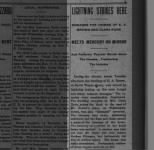
Lightening strike at the Rude house
"LIGHNING STRIKES HERE"
The Waterloo Press, 18 Aug 1910
According to newspaper accounts, Charles abandoned his family when Harry was only six weeks old. In 1900, their family still appeared in the U.S. Census, living in Tecumseh; but in 1910, Clara Rude appeared in Grant, De Kalb county, Indiana, with Harry and her widowed uncle: William's older brother, Reuben Ettinger. At that time, she apparently worked as a dressmaker, but later accounts indicate that Clara and Harry had to rely on relatives for their support, with Harry living for a time with Clara's sister and brother-in-law, Cassy and Dexter Faucett. (This may have been related to the 1910 lightning strike that hit the house Clara, Harry, and Reuben were living in!)

Harry was actually born September 30, 1895, in Pawtucket, Rhode Island, but there is some question as to when his parents returned to Michigan and when they separated. He grew up in Indiana, for the most part, attending high school in Waterloo. After completing a course in civil engineering at what is now Northwestern University, he was employed as civil engineer on Chicago, Burlington and Quincy Railroad. He enlisted on November 5, 1917, in Chicago, and was assigned to the Medical Corps and was sent to training at Ft. Riley, Kansas. He contracted pneumonia and died on January 5, 1918. He was buried in Waterloo.

Clara eventually moved in with her sister's family, and died at the Faucett home in November 1931. After Clara's death, the Faucetts and her brother, William Hurben Ettinger, sued Harry's estate for $2,000 and $1,500, respectively, to compensate for their expenses incurred over the years. Harry's estate was an insurance settlement from the government.


Next week, I'll look at the Faucett family in more detail, show that their home was used for more than hosting funerals, and see how many Ettinger descendants we can fit into one post!

Friday, April 1, 2016

The Reubenites, part 3: Goldsmith

Fair warning: this post may well turn out to be an April Fool's joke on us all.

Such is the nature of dealing with unreliable records! Let me explain:

Back in February, I said in the post The Mysterious McNabbs that there were two people named "John McNabb," both of whom claimed to be the son of Reuben and Mary (Ferguson) McNabb. As I said then,

I am inclined to believe that the second of these - John Goldsmith McNabb - is the actual son of Reuben and Mary McNabb, based on the birth dates. There is a 6-year-old John McNabb listed in Reuben and Mary's family in 1870, and the strongest evidence says that he would be that John McNabb.
I still believe that, and so we'll explore the descendants of John Goldsmith McNabb today; but it may well turn out that we unearth a clue later that forces me to change my mind. If that happens, then I will feel like a very special April Fool!

In case you don't feel like re-reading that whole post, here is my description of the family we'll start with today:

John Goldsmith McNabb was...
... born 24 December 1864 in Auburn, De Kalb, Indiana. He married Ida Ann Sack (1872–1953) in 1894, and they had four children - the first in Wisconsin, and then the others in Michigan - before heading out to California in about 1905. They had two more children after settling in Chico, California, both of whom died in infancy (one in 1907, one in 1912). The couple then divorced in the 1920s. Eventually, John applied for a life claim on his Social Security in January 1943, and died that December in Alturas, Modoc county, California. His Social Security application lists his parents: Ruben McNabb and Mary Furgson.

John appeared in the 1940 Census, living in Alturas and working as a salesman. He was not married, so it is probably safe to assume that he never remarried after his divorce. Ida appeared in 1940, living alone in Durham, Butte county, California. In 1945, she is listed in the city directory for Chico/Oroville as the widow of J.G. McNabb, and after her death in 1953, she was buried with Theodore and Kathryn - the babies who died in 1907 and 1912 - under the name McNabb; so I think it is safe to say she did not remarry, either.

Their four surviving children were:

1. Dores Rosalie McNabb (1894–1992) was born in Wisconsin on 20 June 1894. When she graduated school in Chico, she found work as a stenographer in a lawyer's office. She married Carlyle Conrad Roberts (1894–1981) about 1921, and they raised five children together. He worked as an oiler in a power plant, and she continued to clerk, at least during the 1950s. His family was among the early California pioneers, starting with his mother's family, the Stanfords, who settled in Shasta County from Butler County, Missouri, in 1857. His father Benjamin Franklin Roberts came to Shasta County from Mechanicsville, Penn. around 1871.

Dores and Carlyle started their family on the Middle Fork of the Feather River in a quaint PG&E community called Las Plumas which has since been inundated by Lake Oroville. Around 1937, the family moved to Paradise, Butte county, California.

     i. George Franklin Roberts (1922–1998) enlisted 5 November 1942, and served as a sergeant in the U.S. Marine Corps, earning the Bronze Star. He was married after the war in 1947. After his father's death in 1981, he may have taken in his mother, as she died in Calaveras county, where George and his wife lived, and where George died in 1998. His wife is still living.

     ii. Lewis E "Bud" Roberts (1924–2007)  grew up in Paradise, California, and graduated high school in Chico. He enlisted in the US Army Air Corps in 10 December 1942. According to his obituary, he was discharged in 1945 as a Technical SGT (E-7) at the age of 21. He flew 35 missions over Europe in a B-24 Bomber as a Radio Operator/Top Turret Gunner, with the 458th Bomb Group in the "Princess Pat". He survived the B-24 crash in France with a full load of gasoline that was being hauled for Patton's Tank Force, and a forced landing in Belgium, with two engines feathered landing at a P-47 fighter base during the Battle of the Bulge. He earned the Distinguished Flying Cross, an Air Medal with clusters, European Theatre Campaign Medal and WWII Victory Medal. Bud also served several years in the Naval Reserve as a Radio Operator until he contracted polio in the early 1950's. He retired from service with the State of California in 1984 as a Senior Communications Technician. He was also a ham radio operator for over 65 years, "W6ZFJ".

Bud married Jennie Lee McCandliss (1925–2001) in 1946, and they raised two sons and a daughter who are still living.

     iii. Earl Stanford Roberts (1930–2011) started a career with the California Division of Forestry, Department of Natural Resources as a seasonal firefighter in 1947, when he was 17 years old. He achieved Eagle Scout in 1948.

In December 1950, Earl, along with his childhood friends Hugh Jared and Bill Brill, enlisted in the Navy and took Basic Training in San Diego, Calif. He and Hugh were assigned to the Seabee’s Navy Mobile Construction Battalion 8, “Highball the 8 Ball”. Earl served at Guantanamo Bay, Cuba,  Port Lyautey, French Morroco, Fort St. John, Newfoundland and was discharged in September 1954 at Quonset Point, R. I., Rank Chief Electrician.

His career with CDF continued after discharge. In 1959, he was chosen from among the top employees for a special assignment at Squaw Valley, California, providing fire protection for the 1960 Winter Olympics. In 1965, he moved to Modoc County and served 19 years as a forest ranger. Earl retired in 1984 after 35 years.

At the time of his death, in 2011, Earl left behind a wife, three daughters, and a son, all living, as well as five grandchildren and four great-grandchildren..

     iv. Helen Rosalie Roberts (1931–1976) married Andrew Kenneth "Ken" Hodges (1929–2012) in March 1953. Ken was drafted into the military out of high school and served his country honorably as a member of the U.S. Army during the Korean War. He returned to Chico following his discharge and met Helen. They raised one daughter, who is still living.

     v. Jean Margaret Roberts (1933–2013) grew up in Paradise, and attended Chico High School where she met her future husband. They were married five years later in December 1951. They had daughters, one of whom is still living. After her husband completed a degree at Chico State College the family moved to Woodland in 1959 where they spent the next 14 years. They then moved to Sacramento where she worked at the UC Davis Medical Center.

In 1992 both Jean and her husband retired and moved to Brookings, Oregon.

      a. Joni Lee (Sheldon) Paulsen (1956–2006) was born January 27, 1956, in Chico. She graduated Woodland High in 1974, then attended Chico State University. Joni lived and worked in Austin, Texas from 1978 to 1987, and in 1987 she moved back to Woodland where she met and married her husband. They were wed in 1993 and have two daughters. The family made their home in Woodland and on her beloved island of Kauai.

Joni was very active in her community. She headed the Paulsen Foundation, creating a College Scholarship Fund for local students and she served a term on the Yolo County Fair Board of Directors.

2. Forrest Stevens McNabb (1897–1987) joined the National Guard at age 17 and pursued Poncho Villa, according to one obituary. After serving three years, he joined the U.S. Army (on 5 August 1917) and served in Germany and France in World War I.

He married Laura Louise Frederick (1907–1983) in 1927, and they settled in Durham, Butte county, California, where he farmed through the 1930s. Laura worked for 20 years as a licensed vocational nurse at Enloe Hospital.

When the Second World War broke out, Forrest worked as a machinist foreman at McLelland Air Force Base for two years and then at Tetreau Garage. After the war, he served as the United States Postmaster at Durham from 1949 to 1967.

The couple had two daughters, one of whom is still with us. Lorraine was the elder daughter:

     i. Lorraine Elinor McNabb (1928–1991) married Carroll Myron "Bud" Hansen Sr. (1925–2003) on April 12, 1947 in Durham. Lorraine was a florist at Laughlin's Flower Shop for 13 years. Her husband, Bud, served with the U.S. Army during World War II and received the Purple Heart. He farmed most of his life, retiring in 1991, when Lorraine died. Bud then moved to Wayland, Iowa, in 1994 with his son's family.

 The couple raised three sons and a daughter. Their youngest son died several years ago: James William Hansen (1970–2007).

3. Esther Margaret McNabb (1899–??) graduated from Chico High School in 1920, and went to work as a nurse in the hospital in Chico. She spent most of the 1920s working in Oakland, and the 1930s in Modesto as a superintendent at the Lillian Collins hospital. In 1940, she was working at Nevada County Hospital County Home For the Aged in Nevada City.

After 1940, I can find no more records for Esther. Mathematically, it is unlikely she is still with us, but if she was, she would be 117 years old - and I'm pretty sure her name would have turned up a news article or three about that.

4. John Gerald McNabb (1901–1983) married Leila D Masterson (1898–1976) in Reno, Nevada, on 14 April 1935. The couple set up house in Chico, in the house where Leila and her widowed mother had been living. They do not appear to have left behind any children of their own.

John Gerald is occasional documented as "John G McNabb, Jr." though he and his father clearly did not share a middle name.


For the Record, if you want to know more about the other John McNabb, here are the details I was able to find:

John C McNabb was born on September 20, 1860, in Indiana. He married Inez M. Atkins (1880–1935) on December 25, 1912, in Kalamazoo, Michigan. He died on December 1, 1932, in Battle Creek, Michigan, at the age of 72, and was buried in Augusta, Michigan. They do not appear to have had any children.

Friday, January 22, 2016

A Real Hoot

Nathan Hoot came from Pennsylvania and settled on a farm near Reedsburg, Ohio, probably during the 1830s. He later moved to Ashland with his brother and they ran a shoe business for several years before selling their interests. Nathan relocated to Galion, set up shop there, and worked at making shoes the remainder of his life.

John B. Hoot, his son, was born in Reedsburg in March 1839. After finishing his schooling he was apprenticed to William Ilger to learn harness and saddlery. Upon becoming a journeyman saddler, he entered the Union army, serving in the 196th Regiment, Ohio Infantry.

The Regiment was organized at Camp Chase, Ohio, and mustered in March 25, 1865. They left the state for Winchester, Virginia, on March 26, when they were assigned to 2nd Brigade, 2nd Provisional Division, Army of the Shenandoah. In July they were moved to Baltimore, Maryland, and  held garrison duty there and at Fort Delaware till September. They mustered out on September 11, 1865.

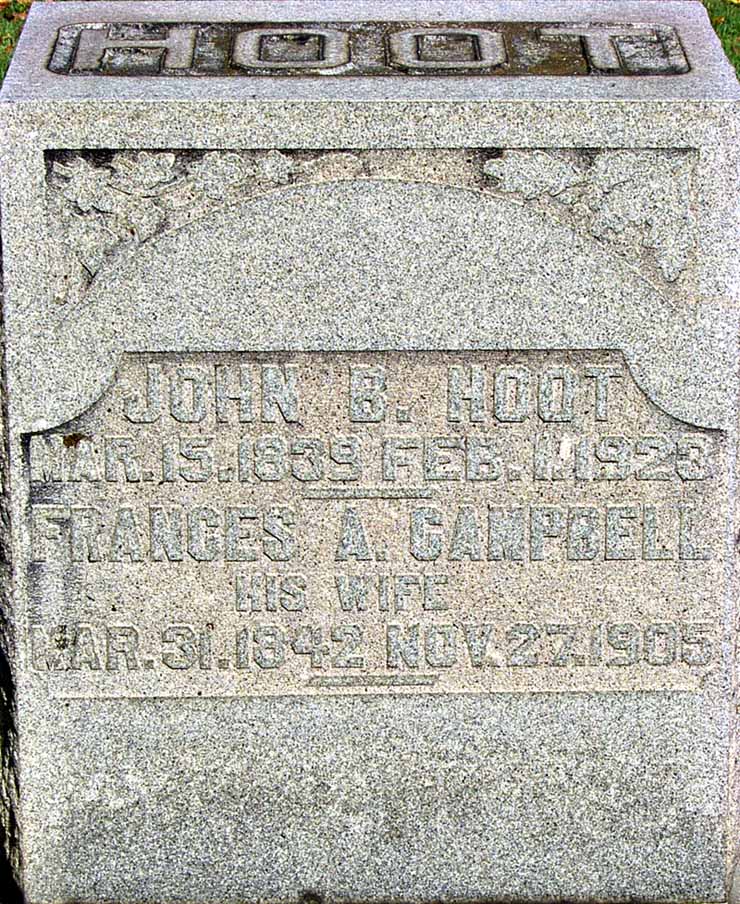
John and Frances (Campbell) Hoot
Frances A. Campbell married John B. Hoot (1839–1911) on 20 February 1862. She was the younger, surviving daughter of Henry and Ann (Callin) Campbell, and the sister of Cyrus and Harrison Campbell, the subjects of our last two posts. Harrison, you might recall, married John Hoot's sister, Catherine Hoot.

Frances was born in Montgomery county, Ohio, on 30 March 1842, and grew up on her father's farm. She married John when she was twenty, and over the following twenty-six years, they had eight children together; two sons and six daughters.

After the war, John moved with his family to Orange, where he rented a saddlery shop for many years, often employing as many as seven men. He was acknowledged throughout the county as being unsurpassed as a saddler and harness maker. His work was reportedly shipped to all parts of the United States. Upon leaving Orange, he removed to Mt. Vernon where he was foreman of a saddlery shop for ten years. In 1903 he retired and moved to Columbus, Ohio, where the family lived on Wisconsin Ave.

Frances died in 1905 at the age of 62, only two years after John retired, and he died in 1923. They were buried together in the Nankin cemetery, Ashland county, Ohio.

1. Agnes Cornelia Hoot (1863–1906)

The eldest daughter, she preferred to go by the name Cornelia, married John Byron Barrick (1858–1935) in 1880. John was a teamster in the Cleveland area for many years. They had a son and a daughter before Cornelia died unexpectedly in 1906 at the age of 43, while visiting in Athens, Georgia. After burying his wife, John moved in with his son, Adelbert, in Ashland, where he lived until his death in 1935.

     a. Adelbert Earl Barrick (1885–1964) worked as a machinist and skilled laborer most of his life. He married Minnie May Mcmurray (1878–1953) on 12 March 1904, and they had four sons. According to his World War I draft registration, Adelbert lost his left leg above the knee in March 1908. The couple remained in Ashland all their lives. Minnie died in 1953 at the age of 75, and Adelbert at 79 years, in 1964. They were buried in the Ashland cemetery.

     i. Charles A Barrick (1908–1969) was a core maker and foundry worker throughout his adult life. He married Velma A Mawhorr (1908–1976) around 1927. Their son, Charles Gaylord Barrick, (1928–2003) was retired pastor of the Sullivan Congregational Church and had taught eighth- and ninth-grade English in the Cloverleaf School District, Lodi, for 30 years.

     ii. Clyde Earl Barrick (1912–1966) was married to Charlotte, though they seem to have been estranged in the 1950s; they had one son and one daughter.

     iii. Ernest Benton Barrick (1920–1977) enlisted in the National Guard on 15 October 1940. He was still living with his parents at that point, but by 1945, he was married to Betty Marken (1918-2014) and living at 30 W Walnut, in Ashtabula. They had four children: three daughters who are still alive, and a son, David Joel Barrick (1951-2013).  David was a U.S. Army veteran and served in the Vietnam Conflict. He and his wife had four daughters.

     iv. Albert Ellis Barrick (1922–1979) was a World War II veteran who served from 26 October 1942 until 15 February 1946. He worked in assembly plants, and never married. He was 57 years old when he died in Ashland.

     b. Rea Barrick (b. May 1890) made one appearance in the 1900 Census, but sadly seems to have disappeared after that. It is possible that after her mother's death in 1906 that Rea might have gone to live with relatives, or gotten married before 1910.

2. Ida N. Hoot (1865–1947) 

Ida was the second daughter of John and Frances (Campbell) Hoot. She married Franklin Pierce Stine (1861–1931) in 1886. Frank was a farmer in Ashland county, and he and Ida had three sons and a daughter.

     a. Leonard Benton Stine (1889–1969), who preferred to be called "Leon," married Norah Wanda Ward (1891-1978). They were a farm family, and lived in Sullivan their entire lives. In 1930, their farm was next door to Leon's brother, Evan's farm. There are no records showing that they had any children of their own.

     b. Evan Francis Stine (1891–1944) married Mary Margaret Gill (1893–1973) around 1918, and began farming in Ashland county. The had seven children (i-vii); four daughters and three sons. Evan died at the age of 53, and Mary at 79.

     i. Mary Lucille Stine (1919–2004) married Paul Eichelberger (1911–1974), and they have four children who are still living: two sons and two daughters, and four grandchildren. Paul and Mary also had twins: a son and daughter born in 1950. The little girl, Carolyn, only lived a couple of weeks, but Carl Harold Eichelberger (1950-2014) was a machinist, like his father, who lived his whole life in Ashland county. Carl left a wife and three daughters.

     ii. Donald F Stine (1921) was born on 30 January and died 7 July 1921. He is buried in the Southview Cemetery in Sullivan township, Ohio.

     iii. Luella Irene Stine (1922–1999) married Donald E Heifner (1911–1960), a farmer from Montgomery township. Don died very young, at 49. Their only child was Kenneth Richard Heifner (1949–1969), a U.S. Marine killed in action in Viet Nam when he was only twenty.

     iv. Walter E Stine (1924–1997) married Mary Ellen Morr (1924–2008) on 13 June 1943, and they had two sons who are still living.

     v. Helen Pauline Stine (1928–1999) was married twice; first to Richard Dale Boales (1927–2009) and then in 1954 to Forrest Milton Fellenbaum (1918–1988).

     vi. Harold Evan Stine (1928–1986) married Martha Irene Johnson (1930–2015) on 25 March 1950. They lost their first two babies at birth (Larry Richard Stine b. 1950 and Stephen Eugene Stine b. 1951), but had a daughter and two more sons, and 36 years together before Harold died at 57. Martha only died last year at 84, having spent her time surrounded by grandchildren and great-grandchildren.

     vii. Phyllis A Stine (1935–1997) married Harold Max Lamb (1934–1992) in 1952, right after she graduated high school. They had a daughter, Mary May Lamb (1953-2003) who married Larry J "Jay" Matthews (1953–2010); the Matthews had three sons, who are still living.

Phyllis and Harold divorced in the early 1960s, and while he remarried later, Phyllis lived out her days in Ashland.

     c. Mary Estella (Stella) Stine (b. 1896), the only daughter of Frank and Ida (Hoot) Stine, grew up on the farm, but in 1920 was living out on her own. She was a factory worker in Ashland, rooming in the home of Rebecca Wood. After 1920, there are no more clues to her whereabouts. I assume she got married and I simply haven't tracked down the record, yet.

     d. Alva Sylvester Stine (1900–1966) grew up farming like his father and brothers, but in 1923 he graduated Ashland University where he was Vice President of his senior class, and he went on to become a school superintendent and administrator. Known as "Alva" throughout his youth, he preferred to be called "Sylvester" later on.

By 1927, Sylvester had married Mary I. Ferrel (1899-1999), and was a principal at a school in Wayne county. Two years after his father died, Sylvester and Mary had their daughter, Miriam Elaine Stine (1933–2000). Miriam grew up in Canton, Ohio, where she married Mr. Cross in 1952. They all relocated to Cass county, Michigan, where Sylvester died in 1966. Miriam was an elementary school teacher there for many years, and she and her husband also had a daughter and two sons who are still with us.

3. Byron A Hoot (1867–1942) 

Byron was one of the leading barbers of Ashland, conducting "a large and elegantly appointed shop" there for many years.

At the age of thirteen years, Byron was apprenticed to a barber. Later he traveled for three years, working as a journeyman in various cities, finally returning to Ashland in 1885, where he opened a shop in the National Bank building. He remained there for eighteen years, becoming popular for his high-class work. After that he relocated to Main street, the third door below Orange street, where he employed three men.

In 1891 Mr. Hoot was united in marriage to Ida Mae Brubaker (1874–1944), daughter of John W. Brubaker and Eliza Barr. Byron and Mae had one daughter and one son.

     a. Glorene Frances Hoot (1895–1977) was the victim of many misspellings in the historical record - "Lorene," "Glarence," and (my least favorite) "Glovine" being just three. She married Harry Eugene Matthews (1895–1976) on 5 October 1916. (He was no relation to the Larry Jay Matthews who married Mary May Lamb as mentioned above.)

Harry was a salesman, worked for a time as a produce manager, and then as an insurance salesman. The couple raised two children:

     i. Rexford Eugene Matthews (1919–2002) enlisted in the U.S. Navy in 1939, and served throughout the war, being discharged in 1946. He married his wife, Virginia Louise Page, in 1948. They had at least one daughter and a son who are still living. Rex worked as a salesman in a shoe store, until he landed a job with the State Highway department; Virginia worked in a pastry shop. They were together for 31 years, until they divorced in 1979, and Rex moved down to Sarasota, Florida. There he remained until his death in 2002.

     ii. Patricia Mae Matthews (1925–2012) was a professional Girl Scout and camp director, then a physical education teacher. Pat also had a beautiful soprano voice, and was a soloist in the Ashland College Choir, as well as a member of the Cleveland Orchestra Chorus in the days of Robert Shaw and George Szell. She performed with that group on the stage of Carnegie Hall.

In 1983 Pat received the "Individual Better Life Award" from the Ohio House of Representatives for being a "remarkable individual, combining humanitarian concern and commitment with selfless initiative to become a dynamic force in behalf of the aged." In 1985, she relocated to Sarasota, Florida - that may have been why her brother moved there, as well.  In Sarasota she volunteered in nursing homes and sang in the Key Chorale for 16 years.

     b. John Weldon Hoot (1902–1950) was a professor who married Evelyn Marie (1902-1969) in Ohio, and took his wife to Upper Darby, Pennsylvania, in the 1930s. After his death at 48 years of age, in Philadelphia, Dr. J. Weldon Hoot was buried back home in Ashland, but Evelyn and their teen aged daughter remained in Pennsylvania. Their daughter is still living in that state, as far as I know.

4. Clara Hoot (1869–1916) 

Clara married Philip Kirsh (also seen as "Kirsch") some time around 1888, and they had three children before Philip's death a decade later. Despite leaving few records behind, it is safe to guess that he died between 1895 and 1900.

     a. Helen G Kirsh (b. 1889) appeared on the 1900 Census in the Mount Vernon, Knox county, Ohio household of her widowed mother. There is a marriage record from Chicago in 1908 showing a Helen Kirsh marrying Harry Schmitz, but the details about her in their 1910 Census record (in Chicago) do not indicate that this Helen came from Ohio, so I can't say for certain that this is our Helen Kirsh.

     b. Arlina A Kirsh (1892–1963) married Ora James Bemiller (1888–1939) in 1910, and moved in with his family. Ora grew up a farmer, then worked for a time as a tobacconist, as a firefighter, and later as a metal worker in Shelby, Ohio. James took ill and died about a month after he and Arlina moved to the Galion area. They had one daughter.

     i. Eva Glorine Bemiller (1913-1956) was partly named after her mother's cousin, Glorene Hoot. She married Daughn D Clow (1913-1987) in Ohio county, West Virginia, in 1936. Some time after Eva's death in 1956, the rest of the family relocated to Florence, South Carolina, where Daughn died in 1987. Daughn and Eva had a son and a daughter, and many grandchildren.

     c. William Frederick Kirsh (1895–1958) married Goldie M Hall (1896–1982) on 30 April 1917. William was a restaurant manager most of his career. He died at home in 1958 at the age of 63. Goldie remained in Ashland the rest of her life.

     i. William Frederick Kirsh Jr (1918–1981) was a stock clerk in Cleveland married to Kathleen Corrine Vessels (1920–2002) when he enlisted in the Army in 1943. After the war, they raised eight children, two of whom have died: William Patrick Kirsh (1953-2000) and Frederick "Fritz" W. Kirsh (1946-2008). Still living are three sons and three daughters.

     ii. Philip Leroy Kirsh (1920–1982) took a engineering degree in metallurgy at Ohio State University in 1941, and a commission in the U.S. Navy, where he rose to the rank of Lieutenant Commander. He was discharged in 1946, and married Elizabeth Axham Keene (1918–2003). They lived for years in Rochester, New York, and retired to Canandaigua in the late 1970s. Their daughter was the late Susan Jean Kirsh Anzalone (1951–2001).

     iii. Jack Loren Kirsh (1927–1973) graduated high school in the class of 1946 and went on to become an educator. He married in 1957 while teaching in Florida, where he was principal of the Greenville Elementary School in 1960. He eventually relocated to Ann Arbor, Michigan, where he died in 1973.

Clara Hoot Kirsh remarried after 1900 to William M Litt (1872–1937), and they had three children in the next few years. Sadly, Clara died in 1916, and William remarried a widow named Edith. (Note: while William's name is clearly spelled "Litt" on his headstone, his sons spelled the name "Lett" - I will leave it to the family to sort that out!)

     d. Benton D Lett (1902–1967) was a fireman in Columbus, Ohio. He married a school teacher named Eva D Eyster (1905–1952) around 1928, and they had one child, Eugene Clay Lett (1929-1995).

     e. Milo F Lett (1905–1967) worked as a truck driver and laborer around Berlin, Knox county, where he grew up. in 1942, he enlisted in the Army and served throughout the war in the 1136 School Squadron. I know from notes in his records that he was divorced, but I have no information about any wife or children.

     f. Catherine Litt (b. 1906) is another mystery - after appearing on the 1910 Census with her family, she is not in the household in 1920. There is an Ohio birth index record, but beyond that, I don't know any more about her.

5. Hattie J. Hoot (1870–1924)

At nineteen, Hattie married Alpheus C. Hamman (1867–c. 1935), and they had one daughter. After Hattie's death at the age of 53, Alpheus seems to have been on his own. His grave marker remains undated.

     a. Emma D Hamman (1905-1985) married Leon Clarence Osborne (1892–1975) on 20 September 1915, and the following year, they went to China as independent missionaries. In 1919, they joined the Church of the Nazarene and served its church at Chao Cheng, Shantung, until 1942.
Leon was detained by the Nationalists in 1928 near the beginning of the Chinese Civil War.

 Found on Newspapers.com

Leon was released, and the couple continued their work in the country until 1942. He published a book about the work in China, Christ at the Bamboo Curtain, (Beacon Hill Press, 1956).

6. Abbey I Hoot (1875–1940)

Abbey stayed in the home of her parents until John's death in 1923, at the age of 83. After that, Abbey took in lodgers at the house on Wisconsin Avenue for a few years, with the help of her niece, Leota Roseberry (Zelpha's elder daughter). Sadly, by 1935, she was unable to continue taking care of herself, and spent the last few years of her life committed to the Columbus State Hospital for the Insane.

7. Zelpha L. Hoot (1877–1951)

Born in Nankin, Zelpha probably met William Crawford Welch (1875-1917) when her father retired and moved the family to Columbus in 1903. Zelpha and William were married about 1906, and had two young daughters when he died at 42. I could not find an explanation of how he died, but he was a railroad man, and he would not be the first person in this family to be killed on the railroad.

Zelpha supported herself by as a dressmaker, and evidence says she married a Mr. Kramer (or Kraner) at some point. While she or her daughters took possession of the house on Wisconsin Ave, Zelpha eventually relocated permanently to San Diego, California, where she died in 1951.

     a. Leota E Welch (1906–1998) married Walter William Roseberry (1904–1990) in 1928, but in 1930, she was still living in the home of her aunt Abbey (see above). It may be that the arrival of their son in 1932 meant that Leota was not able to care for Abbey, and that could be what led to sending Abbey to the state hospital in Columbus.

Walter and Leota did not stay together after their son grew up; Leota remarried Ernest Hamlin (1913-1990) in 1972, and they moved down to Manatee, Florida, where they lived out their retirement.

     i. Kenneth William Roseberry (1932–1991) was an electrician in Columbus, Ohio. He was married in the 1950s, but also divorced by the late 1960s. His wife remarried in 1972. Kenny died the year after his father, and they were buried in the Obetz Cemetery in Franklin county. I do not know whether he left any children behind.

     b. Frances Dana Welch (1909–1963) remained with her mother until she was in her early thirties, accompanying Zelpha as she moved between San Diego and Columbus. Eventually, she seems to have married, probably in the 1950s. She is buried in Union Cemetery under the name Frances Dana Gilmore.

8. Walton Wesley Hoot (1879–1951)

Walton was a barber, like his older brother, and around the time the rest of the Hoot family moved to Columbus, he married Effie Mae Snook (1879–1938) and resided with her family in Ashland. They raised one son, and lived out their days in Ashland.

     a. Forest Emery Hoot (1906–1999) married Helen Louise Pancoast (1906-1993) during the 1930s. Forest was working as a salesman. I have not found any information about this couple to indicate what their business was or whether they had children, but they did leave behind an endowment for a scholarship at Ashland University, so they must have been successful.

-------

And that, good friends, brings us to the end of a very long post about people surnamed Hoot. It also brings us to the end of the descendants of Ann Callin Campbell. I have to say, these last three posts were quite an exercise of my researching abilities, and I am not entirely sure I've done these people justice.

As always, if you are related to any of these families, and can help me identify and fix any mistakes I have made, please do reach out through the comments below, or through my email address, callintad at gmail dot com; there were at least two examples during the preparation of this post that I did "one last search" and found out something revelatory - like a couple I had thought had three children actually had eight children. Or I found an article that revealed a daughter I hadn't known about.

But I'm not complaining. I enjoy the thrill of the hunt, and I love knowing that I've tied together whatever I can for posterity. In fact, for all of the extra work that went into this post, it was, for me...

...a real hoot.