Showing posts with label 1910s. Show all posts

Friday, February 7, 2020

The Montgomery Brothers and the Gold Rush

Welcome back, cousins!

We spent the last year and a half (give or take) since The Montgomery Connection learning everything we could about the Montgomery family, but we still don't know a lot about these last two great uncles. In fact, when it comes to one of them, I feel like I haven't learned much more than what we saw in the biographical sketch about their brother, Theodore:

To these parents were born five children- Mary, now deceased;Sarah, now the wife of Henry Davidson,living in Halsey,Oregon;Theodore, of whom this sketch is concerned; Porter, deceased at Vicksburg, Miss.;and Callen, now interested in the mining business in Coloma, Cal.
(from the Fulton County, Indiana Handbook, published by Tombaugh House)

 When records can't be found, we have to make some guesses, and today's story starts with a lot of guesses.

Porter Montgomery (b. ca. 1828)

I have determined that Porter was born around 1828, because most biographies (like that attached to Theodore) list children or siblings in order of birth. We know that these two younger Montgomery boys had to be born before their mother's death in 1834, so they were almost certainly born in Richland County. Since we have a pretty good idea when his (we assume) younger brother Cal was born, and since we know how human biology works, 1828 is a good guess for Porter.

As for the rest of Porter's story, the line "deceased at Vicksburg, Miss." suggests that he might have died in the Civil War. The Siege of Vicksburg was considered a turning point in the war, taking place in the spring and summer of 1863. Porter would have been about 35 years old, so it's possible that he was there, but I haven't been able to place him there with any certainty. For one thing, there is only one record of a Porter Montgomery in the National Parks Service's Civil War Soldier database, and that person served in the 8th Regiment, Pennsylvania Reserve Infantry (37th Volunteers) - which never saw service south of Virginia.

Also, the Civil War took place from April 1861 through April 1865, so if he was alive during that time, we should expect to see Porter appear somewhere in the 1850 and 1860 Census. Instead, we find no records of a Porter Montgomery who matches our boy in any of the databases.

It's possible that, like his older brother, Theodore, Porter might have served in the Mexican War in the 1840s - and if he died in that war, he would not appear in a later census - but that war wouldn't have placed him in Vicksburg. Of course, he could have gone to Vicksburg for any number of reasons at any other time, and we may have simply not found such a record, yet.

But, as I said, these are all just guesses - at least for Porter.

Callin "Cal" Montgomery (1830–1912)

 Cal Montgomery was born in October 1829, according to the 1900 Census - which I have found can be off by a year in either direction as often as it is correct. His other appearances in the census records put his birth "abt 1831," so I suspect the correct birth date is October 1830.

(The 1900 Census was the first one to ask for a month and year of birth, but I suspect most census takers asked "how old are you?" and then did the math - which would explain why they would be a year off for people who were born in months after the one during which that census was been taken.)

We do not know much else about Cal's early life. He certainly lived in Rochester after his father remarried and moved there around 1837. Cal was not named as one of the members of his brother's party when Theodore traveled to the gold country around 1849; but Cal would have been 20 at the time, and since there is no 20-year-old Callin Montgomery listed in Rochester on the 1850 Census, it seems likely that he either accompanied his brother's party, or set out on his own soon after.

The earliest record we have for Cal is a "C Montgomery" listed in Coloma, El Dorado County, California, on the 1860 Census: born abt 1831 in Ohio, which most likely means he was born in Richland County, Ohio.
19th century placer miner (Wikipedia)

Military records suggest that he enlisted in the Union Army, serving in Company F of the 4th Regiment, California Infantry on 16 October 1861. He was stationed at Benicia Barracks in 1863, and he mustered out on 26 August 1864 at Drum Barracks.

After the war, he returned to Coloma, appearing in the 1870 Census as a saloon keeper with a wife, Laura S, age 18. While he gave the same birth date (abt. 1831), he gave his place of birth as Indiana. I'm inclined to think that one census taker probably asked that question as, "where were you born" and the other asked "where are you from" - and Cal would have been about 7 or 8 years old when his father moved the family to Rochester, Indiana.

1870 is the only time we see Cal married. Laura, who was recorded as being "3/4 white" and born in California, does not appear in any other records. By 1880, Cal was listed as single again, living in Gold Hill, El Dorado County, and working as a placer miner.

Numerous voter registration records and occasional mentions in The Record-Union of Sacramento over the years establish Cal as the kind of colorful side character you might see in an old western. He was the ol' prospector who passed word of a generous stranger in Coloma to a Wells Fargo official in Placerville, thus helping authorities solve a stage coach robbery. He was the grubby old timer who dealt with the remains of a Chinese man who was suffering from leprosy and committed suicide, leaving a corpse no one wanted to go near hanging in remote cabin. (Fair warning: that story was written to sell papers, not to pay respects to the dead.) 

Cal lived in El Dorado county until he was in his eighties, appearing on the 1910 census at a Pilot Hill address in Greenwood. The California, Death Index, 1905-1939 records his death on 3 October 1912 in Napa County, California. When he died, someone had him buried in Veterans Memorial Grove Cemetery in Yountville, Napa County, and I did find his Find-A-Grave memorial.
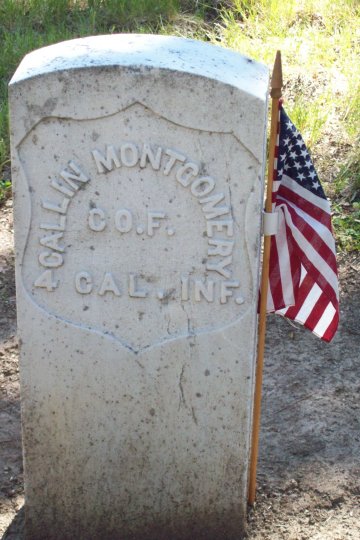

Callin Montgomery, on
Find-A-Grave

- -- --- -- -

So there you have it: unless we make another major breakthrough and open up another years' worth of research, I think we have tracked down as many of James Callin's descendants as is currently possible. I've already re-started the process of compiling all of the information in these blog posts into book form, and I expect it will probably take several months (if not a full year) to copy-edit and proofread all of it.

Though I'm not sure quite what to do next, I don't plan on abandoning this blog. I hope to turn my attention to puzzles and problems in other branches of my family, and I'd love to figure out a way to bridge the focus from the very specific "people I'm related" and the very general "here is how to do a genealogy" so this blog can be more useful to more people. I'm open to ideas!

As always, if you've found one or more of your relatives mentioned in this blog, please get in touch. You can comment below (anonymous comments are usually not as helpful), or email "mightieracorns" at Gmail.com.

We now have more ways to reach out:

a Facebook page - https://www.facebook.com/MightierAcorns/
a Twitter feed - https://twitter.com/MightierAcorns
a Ko-Fi cup - https://ko-fi.com/mightieracorns


...and if you prefer a private group, we still have the Callin Family History group on Facebook for "cousins only" (there will be a question about how you're related to the family before you can join).

Until next time... Happy Hunting!

Friday, June 14, 2019

Guest Post: William Zardie Sly AKA John St. Clair

Welcome back!

School is out for the summer, and we're celebrating with a guest post from cousin Leanna that should help clear up the mystery of what happened to William Zardius Sly (1882–1954).


Saturday, November 19, 2016

Tales of a Prentice

The middle son of John H. and Amanda (Walker) Callin, Prentice George Callin was born in Middleton, Ohio on 22 September 1887.
Prentice & Hattie Callin
wedding - 1910

Prentice grew up as the middle child in a family that valued both learning and adventure. He grew up and attended school in Fostoria, Ohio, and he may have been a student in Detroit in 1910, when he and his bride acquired their marriage license.

Harriet Ellen "Hattie" Owen (1891–1991) was born in Fostoria, Ohio. She was the daughter of Joseph Russell Owen (1866–1941) and Grace Shoemaker (1871–1964). Her father was a railroad man who later ran his own seed supply business.

Hattie and Prentice were married on 15 June 1910 in Fostoria, and the next few years saw the birth of their two sons, Owen and David. In 1915, they moved to Otsego county, New York, where Prentice's brothers, Byron and John, were living and working as teachers. When John enlisted in the Ohio guard, Prentice did, too; and by 1920, he had moved his family back to Bowling Green, where Prentice established himself as a farmer.

Prentice farmed and did clerical work during the 1930s, and worked in the post office in the 1940s. Later in his life, Prentice retired from his farm, and he and Hattie moved to California to be closer to their children and grandchildren. Prentice died in San Diego in 1960, on his 50th wedding anniversary. Hattie followed David and his family when they moved to Washington state, and she died in Shelton, Mason county, Washington on 1 October 1991.

Owen, c. 1912 with
Prentice and Hattie
     I. Owen Prentice Callin (1911–1965) graduated from Ohio State University and began his journalism career on the Lorain (Ohio) Journal in 1936. Later he was employed by the Ohio State Journal in Columbus, the Tampa (Fla.) Times and the Toledo (Ohio) Blade.

Owen married Vivien June O'Hara (1912–1999) in 1937, and in 1943 they moved to California, where Owen worked for International News Service. He later joined the old Los Angeles Herald-Express, and moved to the Times in 1963. He was working as a Los Angeles Times copy editor and former wire service reporter when he died at the age of 53.

Vivien, also a newspaper editor, remarried on 25 October 1969 to Arnold Theodore Fitzmier Sr (1916–1985), and they lived in Long Beach.

       A. Thomas Owen Callin (1941–2008) made the newspaper as a toddler, notable for having grown in his adult molars at only 2 years of age. He was a lifelong resident of Long Beach, California, and left behind his wife, son, and two daughters; all of whom are still living.
David Warren Callin
c. 1935

     II. David Warren Callin (1914–1983) married Helen Ruth Grant (1911–2003) in Auburn, Indiana, on 10 April 1936.

Helen was born in Vermillion, Ohio, to William Graden Grant (1887–1967) and Estella E Westbrook (1884–1986). The Callins lived in Ohio and California before moving to Port Angeles in 1970 and Sequim in 1984. Judging by their frequent appearances in the Daily News of Port Angeles, the couple were adept bridge players during the 1970s.

       A. Michael Prentiss Callin grew up in Los Angeles, and lived for many years in Woodinville, Washington. He worked for Qwest Communications, and moved to Oregon after he retired. He and his wife had one son and one daughter, and as of this writing, they have four granddaughters.

       B. Helen and David's daughter lives with her family in the Pacific Northwest.

       C. Grant David Callin is a science fiction author and retired Air Force officer. He published two novels in the late 1980s, Saturnalia and A Lion on Tharthee, as well as several short stories. During his Air Force career he set a record for human endurance as part of the U.S. space program's tests of human tolerance for designing spacecraft. In 1971, he appeared on a Flip Wilson TV special featuring "Record Makers" which included fellow guests Charles M. Schulz (creator of the Peanuts comic strip) and baseball legend Willie Mays.

Grant and his first wife raised three daughters. He retired to Sammamish, Washington, where he lives with his second wife.

Grant's daughter, Kari, was a public figure for a brief time, when she appeared on season 4 of the show America's Got Talent in 2009. She has several videos on YouTube performing some of her favorite songs (like My Immortal).

 - -- --- -- -

As you can see, we have some celebrities in this branch of the family! I'm still getting to know some of these folks, and I hope to be able to add to what I have here, but this was a fun start.

I'm reminded, though, of the over-arching theme of the blog - the idea that we are all minor celebrities in our own stories, and that every one of us is important to telling those stories. At a time when a lot of us are worried about the future, it's vital that we remember that - just being who we are and taking care of each other is at least as important as being famous, or being successful.

As always, drop a note if you spot any errors or omissions - as we get closer to the end of the two-year effort to document all of James Callin's descendants, the next step will be getting all of this information together for the book. I will need all the help I can get!

Friday, May 13, 2016

Cardinal Rules

  • Rule number one: You are never "done" with your family history.
This project to update and document the descendants of James Callin is something I've been working toward for twenty years or so. And in the past, when I've gone over what I know about the part of the family we'll be looking at today - Margaret Ferguson and her descendants - I have never been able to find much beyond what the Callin Family History told me:

"Record of Margret Ferguson who was the 4th daughter of Eliza Callin Ferguson who was the 3rd daughter of John Callin who was the 2nd son of James 1st.

Born 1839, died 1902.
Married to Jerome Gallaher.
To this union two children were born:
Mary, married.
Helen, married, two children."

So when I began drafting this post, I expected that to be all I could tell you about Margaret Jane (Ferguson) Gallaher. Assuming I could scrape together names of the husbands of Mary and Helen, and find out the names of Helen's two children, I might have bare-bones minimalist biographies of six or eight people, tops.

  • Rule number two: Absence of evidence is not evidence of absence.

Evidence is the life blood of this project. Without documents that say when and where people lived, and what they did there, I can't rule out anything. And for the longest time, I could only find bits and pieces of this family's story - while the rest was a great, empty possibility.

Then I found an obituary...

Jerome Bohan Gallaher was born 23 August 1833, in Litchfield, Connecticut. He was one of eight children and moved westward when he was a young man settling at various points in Ohio and Indiana. He married Margaret Jane Ferguson (1839-1901) on August 15, 1858, in DeKalb county, Indiana, and they had two daughters: Mary (or Mollie), in 1860, and Helen in 1862.

At the beginning of the Civil War, Jerome enlisted in the 2nd Indiana regiment, in which he served until 25 August 1865. At the time of mustering out he had attained the position of Quartermaster of his regiment. After the close of the Civil War the Gallaher family moved to Black River Falls, Wisconsin, where Mr. Gallaher engaged in his old business of photography. In 1872 they moved to the newly incorporated town of Chippewa Falls, where they resided until the early 1890's, when he settled on a homestead outside of town.

Margaret preceded her husband to the grave in May 1901, and after that he lived alone most of the time on his farm. For the last two years of his life, he had been rather feeble, but when his friends planned to have him come to town where he could be looked after, he always vetoed their plans, expressing the wish to remain on the old farm as long as he lived. He died in January 1912.

     I. Mary A (Mollie) Gallaher (1860-1913) married William John Ickstadt (1865-1906) in September 1883. William took her away to the neighboring town of Edson where he was appointed as postmaster in October 1883, and he became a prominent real estate and business man in the Boyd area. In 1906, at the age of 47, he drowned in a boating accident on Pike lake. Mollie only lived another seven years, dying at 53.

     A. Jerome Monroe Ickstadt was born on 19 June 1884. He married Marie A Street in Boyd, Chippewa county, on 20 May 1912. The couple settled in Fond du Lac, where Jerome was a fireman with the Chicago & Northwestern Railroad company. The last record I have found for them placed them in Fond du Lac in 1921; there is another placing Marie in that town in 1924, but with no further listing for Jerome. I have found nothing to indicate when or where either of them died, or whether they had any children.

     B. Alice Mae Ickstadt (1888–1973) married Louis Floyd Shilts (1894–1947), probably around 1910. Louis was a veteran of World War I, and he worked as an auto mechanic in a Chippewa Falls garage. Mae taught in the local schools.

     C. Arthur J Ickstadt (1890–1927) grew up in Chippewa county, and worked at the State Home - what is now known as the Northern Wisconsin Center for the Developmentally Disabled. He married Louisa Rosalie Krenz (1894–1959) around 1925, and she was pregnant with their second son when he died in March 1927. The state later awarded her $7,000 in settlement, one month before the birth of that second son.


Found on Newspapers.com

       1. Donald W Ickstadt (1927–2013) graduated from Chippewa High School in 1945, then served one and ½ years in the Navy aboard the USS Chara and the USS Parikutin. He matriculated at Wisconsin State College at Eau Claire in 1947 and graduated in 1951 with a Bachelor of Science degree in Social Sciences, Physical Education/Secondary Education. He then attended the University of Southern California graduate school in 1952. Married in 1954, his wife, three sons, and two daughters are all still living. Don worked in employment services for the state of Wisconsin his whole career, retiring in 1987.

       2. Arthur Joseph Ickstadt Jr (1928–2013) was a Veteran of WWII and the Korean War. After leaving the Army, he settled in the Seattle, Washington, area. His mother, Louisa, died there in 1959. Art was survived by his wife, son, three daughters, and "16 Grandchildren, 13 Great-Grandchildren, 1 Great-Great Grandchild and numerous nieces and nephews."

     II. Helen J Gallaher (b. 1862) and her husband, Wesley J. Gregg (b. 1851) presented a few challenges to this researcher. First, there is a marriage record for a Helen Gallagher in 1879, which, even though the database does not link the bride record to the groom's record, seems to imply that she married a man named Amasa Nichols. Until I found Jerome's obituary, I did not know to look for Mr. Gregg, but once I did, I found Helen and Wesley in the four Census records (1900-1930), which indicated they were married in 1885. The birth record for their younger daughter, Jennie, lists Helen's maiden name as "Nichols," so I assume that 1879 record is correct. (And looking through the Chippewa county marriage records, Amasa Nichols seemed to marry quite often; there may be a whole other story there!)

But, Wesley appears to have farmed and worked for the railroad as a clerk for a time; and they raised two daughters. As of 1930, 79-year-old Wesley and 69-year-old Helen were retired and living on their farm. I have not been able to determine when they died or find any records of their burial, but I know from some mentions in the Eau Claire Leader that they were living in the area in the 1920s, and the 1930 Census shows them in Arthur, in Chippewa county.

     A. Ruby Gregg (b. 1883) grew up in Chippewa Falls, and appeared on the 1900 Federal and 1905 State Census in her parents' home. She would have been 21 in 1905, and the 1907 Chippewa Falls city directory indicates that she lived at home while working as a domestic servant for the Mcgilvary family. After that, however, the trail of records dries up, and I can't tell what happened to Ruby.

     B. Jennie H Gregg (1887–1931) married George Jerome Cardinal (1887–1963) on 9 December 1905 in Bayfield, Wisconsin. George was a musician and decorator, and was listed as a painter in the Census and city directories. The couple had nine children before Jennie's death in 1931 at the age of 44.

      1. Wesley G Cardinal (1906–1982) married Katherine Quinlan (1910–??) in about 1930. Wesley was listed in the 1930 Census in his family home, working as a painter/decorator, like his father. In 1940, he and Katherine and their two sons were renting their own place in Chippewa Falls, and Wesley was a musician in an orchestra. They may have had more children after the 1940 Census, but I have only managed to track down the eldest. I assume any other children they had are still living, or my searches would have turned up something. (Though, searching through results for people with the name "Cardinal" is surprisingly difficult.)

       a. Peter Paul Cardinal (1931–1997) served in the U.S. Navy during both the Korean and Vietnam conflicts, according to his grave marker. Based on the incomplete information I have found, I would guess that he enlisted in the early 1950s. He was married by 1959, when he is listed in the city directory for Memphis, Tennessee, which is near the Naval Support Activity Mid-South Naval Base in Millington. And he received a commission as an ensign on 1 July 1963. He attained his highest rank as a Lieutenant on 1 January 1967, and retired 1 August 1978. When he died, he had been living in Pegram, Tennessee.

      2. Linus Cardinal (b. 1909) is another minor mystery, in that I lose track of him after 1930. There are two items in the November 1921 Eau Claire Leader newspapers that describe how he was wounded when a gun discharged, and was later rushed to the hospital with "lockjaw" (probably tetanus) from the resulting infection. That happened when he was 12, and we see him listed at home in the 1930 Census, when he was 21, so we know he survived that episode, at least.

      3. George P Cardinal Jr (1910–1997) appears to have served in World War II, but like his older brothers, left little in the way of records, and his obituary does not seem to be online. I have not been able to find anything between the 1930 Census and the records of his death in Elk Mound, Wisconsin. His wife is still living, and I assume any children they have are, too.

      4. Jane Rosemary Cardinal (1914–1991) married Lloyd A Fransway (1910–1966) and they had five sons and seven daughters, in total. Most of them are still living. Lloyd was a painter, employed by Mikesell's Painting contractors for 25 years; he was the union president of Painters Local 259 from 1958 to 1964. He and Jane took in her three youngest siblings some time after the death of their mother; Lyman, Betty Mae, and the brother who is still living were all listed as Lloyd's foster children in his 1966 obituary.

       a. Mary Jo Fransway: died in infancy.

       b. Patricia Jane "Patty" Fransway (1935–2012) was married to Arthur Sedani (1935–1978), and they had two sons who are still living. Patty worked at the Chippewa Woolen Mill, Creamland Dairy, and the Northern Center for the Developmentally Disabled in Chippewa Falls until she retired. She mentored students through the Chippewa Falls Mentoring Program, headed up the spring and fall suppers for Our Saviour's Lutheran Church, and oversaw funeral luncheons. Patty was a beautiful seamstress and was a member of the Quilters and the Altar Guild.

       c. Lloyd Archie Fransway Jr (1937–1998) was a veteran of the U.S. Navy, serving from 12 May 1954 to 14 November 1957. He married at the end of 1960, and his wife and three sons are still living. They also had a daughter.

      i. Robin M Fransway (1961–2011) attended Northwest College in Powell, Wyoming. She lived in the Powell/Cody area and worked as a secretary and bookkeeper, raising her daughter, who is still living. Robin married on July 7, 2001, and her husband is still living, also.

       d. Anthony L "Tony" Fransway, Sr (1945–2009) served in the U.S. Army National Guard for eight years after he graduated high school. He married in 1968, and his wife, son, and daughter are all still living. He worked at Amoco-Pactiv for 39 years until he retired in 2004. He lived in Chippewa Falls his entire life.

       e. Laura Fransway (1946–2013) grew up in Chippewa Falls and graduated from Chippewa Falls Senior High in 1965. She married in 1977. One daughter and one son are still living. Over her lifetime, she worked for Amoco Chemicals, Whitetail Golf Course, Viking Bowl and retired from the Myrtle Werth Hospital. She was a member of Barum Lutheran Church in Elk Mound.

     i. Chad T Brown (1977-2002) was the oldest son of Laura Fransway. He graduated from Colfax High School in May of 1995, and was employed at Big Timber Saw Mill in Colfax until the time of his death from cancer. He was 25 years old when he died.

       f. Samuel Cardinal "Sammy" Fransway (1960–2003) was employed by Markquart Motors for the 14 years before he died. Sam was also a Chef at a number of local Wisconsin restaurants, as well as in Florida. He owned and operated Sammy's Saloon in Chippewa Falls from 1983 to 1987. He left behind one son.

      5. Kathryn Arlene Cardinal (1916–2007) married Fenton Norman Goss (1914–1999), and they left three sons and two daughters, still living. Fenton served in the U.S. Army during the last few months of 1946.

      6. John Samuel "Jack" Cardinal (1919–1990) served in the U.S. Army throughout World War II, from 6 April 1942 through 18 October 1945. He married in October 1946, and settled in the Detroit area with his wife, who is still living.

      7. Lyman Eugene Cardinal (1921–1977) served in the U.S. Army during World War II, and in the U.S. Navy during the Korean War. If I'm reading the records correctly, he enlisted in the Army in 1940, before Pearl Harbor, and switched to the Navy ten years later, retiring after twenty years in October of 1960. He and his wife settled in Westmoreland county, Pennsylvania. They had at least one son, who is still living.

      8. (Still Living) Cardinal - there is one son from this family still living. Here's hoping I don't need to update this entry until he is good and ready!

      9. Betty Mae Cardinal (1926–2015) graduated from Chippewa Falls High School and worked at the A & P Store, where she met her future husband. On April 18, 1948, the two were united in marriage in Chippewa Falls. They resided in Chippewa Falls where Bette worked at the Northern Center as the food service supervisor, retiring from there in 1986. She left behind her husband and two daughters.


And there you have it: just one timely find can add dozens of people to the family tree!


Friday, May 6, 2016

Ettinger Generations

Just to recap:

On 8 March 1860, William Ettinger (1837-1920) married Mildred Ferguson (1837-1911) in DeKalb county, Indiana, and they set up a home in Auburn before moving to Waterloo, where he worked as an undertaker and cabinet maker. Over the following twenty years, the family lived in DeKalb county, and William and Mildred raised eight children; three sons and five daughters. We looked at the two elder children last week:
  • John Clark Ettinger (1860–1927)
  • Clara Ettinger (1862–1931)
  • Flora Ettinger (1866–1941)
  • Lyda Ettinger (1868–1950)
  • Catherine "Cassy" Ettinger (1870–1959)
  • George Daniel Ettinger (1873–1961)
  • William Hurben Ettinger (1879–1933)
The Callin Family History presents them this way:
  • John, married, two children were born.
  • Clara, married, two children, one living -- Rude.
  • Flora, married ---. Neff.
  • Eliza, married --- Eberly, three children
  • Cassy, married ---. Fawcett.
  • George, married, one child.
  • Herbert, unmarried.
As we discussed in the last post, John and his wife did not have any children, and Charles Rude abandoned his wife and young son early on, as opposed to having two children. The CFH also lists "Eliza" as Lyda (or Lida)'s name; the 1870 Census actually appears to list her as Elizabeth, and the then-newborn Cassy as "Lidia," all of which is very confusing. And of course, "Herbert" is not the youngest son's name, despite being listed as such even in one of his obituaries.

But I'll try to set the record straight, and if anyone finds more evidence, please let me know. Most of the below came from the usual Census records, Find a Grave memorials, and an unusually plentiful number of newspaper articles from Newspapers.com!


Flora Ettinger (1866–1941) married James L Neff (1859–1937) on 26 May 1898. They lived in Williams county, Ohio, where James owned a brick factory. They did not have any children, as far as I can tell.

Lyda Ettinger (1868–1950) married Walter R Eberly (1870–1958) on 30 October 1895. They had three children in Indiana, then moved to Tecumseh, Michigan, where Walter ran a foundry in 1900, and owned a steam laundry in 1910. Lyda's brother-in-law, Charles Rude, was involved in a laundry business in Tecumseh, as well, according to his 1900 Census record. It may be that Mr. Rude sold the business to Mr. Eberly before leaving his family for parts unknown. Whatever the case, Walter owned that business at least until 1940.

     1. Cyrille Eberly (1896–1990) married Carl Frederick Wellstead (1897–1978) on 23 August 1923. Carl was from Perrysburg, Wood county, Ohio. He married Cyrille in Hudson, Michigan (in Lenawee county, not far from Tecumseh), and they made their home in Perrysburg. Cyrille was a teacher of home economics, and Carl worked for 21 years at the Rossford plant of the Libbey-Owens Ford Company. He also served for six years as the village clerk of Perrysburg. The couple raised two sons and a daughter, one of whom is still living. (Their surviving son had seven children of his own!)

      a. Frederick Charles Wellstead (1924–1994) married Marjorie June Lafleur (1924–2006) around 1950. Fred enlisted in the U.S. Army on 28 July 1943, when he was 19 years old. Marjorie joined the Cadet Nursing Corps in 1944, and graduated in 1947. The couple raised a son and two daughters, all of whom are still living.

      b. Lydelia Ann Wellstead (1927–1987) married about 1950, and lived with her husband in New York until her death in 1987. Her husband is still living; I do not know whether they had any children.

     2. Ralph Arlington Eberly (1898–1980) married Lucille Margaret (1903–1976) around 1925; I have not found any records to tell me her maiden name. The couple raised a son in Chicago, and as near as I can tell, he is still living. Ralph and Lucille moved to Iowa some time after 1940; they were in Sioux City in 1942 and in Clinton in 1953. After they died, they were buried in Maple Grove Cemetery in Hudson, Michigan.

     3. Earl G Eberly (1899–1974) was teaching at the high school in Hudson when he married Thelma O Tripp (1899–1982) on 9 October 1919. They were only married for four years, divorcing in 1923, but they had a daughter, Georgiene. Earl later married Elva S Reece (1900–1986), and ran his own laundry service for 30 years. He and Elva were very active in the community of Hudson.

      a. Georgiene M Eberly (1920–1986) stayed with her mother after Earl and Thelma divorced. Thelma remarried in 1934, when Gene was in her early teens. Gene graduated from the University of Michigan in 1942 with a Bachelor of Science in Zoology, and went on to have a long career as a Medical Technologist at Mercy Hospital in Jackson Michigan. Gene mentored younger med-techs, taking new technicians under her wing and she is fondly remembered today for her kindness.
Gene was a big outdoors person. She loved birds and bird watching. She loved hiking and boating and had been all over the place doing these things. She took care of her step-father when he became ill and after his passing, she was extremely close with her mom.

Catherine "Cassy" Ettinger (1872–1959) was the youngest of the five Ettinger daughters. She married Alphonso Dexter Fausett (1870–1935) on August 6, 1911.

Dexter had been married in 1896 to a lady named Alice Shultz, who died in June 1909. They had a son who died in infancy and a daughter, Irma, who would later marry O.V. Winks, of Liberty, Indiana. A few years after Cassie and Dexter were married, they adopted a son, Robert.

     1. Robert K Fausett (1916–1995) was born June 18, 1916, in Naperville, Illinois, and grew up in Waterloo, De Kalb county, Indiana. He married Nina V. Wilkins (1916–2009) on June 4, 1938. In 1947, they moved to Indianapolis where Robert was employed as draftsman by Spreuer and Son of LaGrange. They had one daughter in the 1950s, who is still living.

George Daniel Ettinger (1873–1961) married Almeda J Frederick (1878–1962) in August of 1895. He worked at the old McIntyre Buggy factory in Auburn for many years. They had one daughter, and joined the Jehovah's Witnesses in the 1910s. They remained members of that church for the rest of their long lives.

     1. Mildred L Ettinger (1896–1973) married Paul Harold Cosper (1894–1988) on 21 May 1919. They lived in Auburn, not far from Mildred's parents. When George's health began to fail, Mildred filed for guardianship of his estate. It does not appear that the Cospers left any children behind.

William Hurben Ettinger (1879–1933) was born 23 November in Waterloo, and from his graduation in 1898 from the Chicago Embalming school, he was a funeral director there. He married a popular school teacher named Bertha B Bemenderfer (1881–1975) on 2 June 1912.

They were a well known and well liked couple in Waterloo, and he was also serving as the town marshal at the time; so their wedding was considered quite the event. And on that occasion, it would seem the town expressed their affection for their marshal in a most unusual manner:

 Sometimes the man who loves a joke is required to accept what is coming to him, which was the case of town marshal, W.H. Ettinger, Monday night.
 His marriage took place Sunday evening and Monday evening the Progressive Literary club arranged for a reception on the newly wedded at their home on Marion street.
 About the time the guests began to arrive word came to the marshal that the night watch had arrested an unruly fellow and needed help. Faithful to his duties, he rushed to the engine house to give assistance and he found, as his joking friends thrust him into a cell by main force and locked the door, that the unruly prisoner was the marshal himself.
 At first he did not appreciate the joke and how could he? His friends were notified and many came marching to the cell door viewing the "culprit" and enjoying his discomfort no doubt, for over two hours when he was released and allowed to go to his happy home where he and his wife were given an old fashioned noisy belling.
 During his "incarceration" the members of the P.L.C. having concluded their reception at the Ettinger home, marched in a body to the engine house where they filed into the cell and extended their sympathy to the marshal. During the long two hours the crowd told the marshal about the good things to eat in waiting at his home, and one of the crowd played Home Sweet Home on a squeaky old fiddle.

And with that, we conclude our visit with the Ettinger family. There seem to be a lot of Eberly grand-children and great-grandchildren for us to reach out to and get to know, but that will have to wait for another day.

Friday, October 2, 2015

The Distance of Close Connections

For the last couple of months, we've explored the descendants of the man I called Tragic Thomas. Thomas was the son of James, elder of the two Brothers Callin of Ohio, and grandson of the man referred to in the Callin Family History (or CFH) as "James 1st".

I told you what little I know about Thomas's brother, Alec Callin, who felt The Pull of the West and moved further, from Ohio to Iowa. Just to refresh you on the details, the CFH says this of Alec:
"Married and moved with his family and mother to Iowa about the year of 1840. The mother referred to was 'Aunt Mary', wife of James 2nd who was killed with a gun. She sold the farm and went with Alec to Iowa where she died some years later. Nothing has been heard from that branch of the family since 1845."
There are several records of land grants to an Alexander Callin, one identifying him as a resident of Muscatine, Iowa in July 1854, and showing that he purchased a plots of land in the young state. There is also a Mary Callin buried in a Muscatine county cemetery, having died in 1846 at age 77.

Following behind Alec by a year or two, his younger brother, James (3rd), also moved to Iowa. Per the CFH, again:
"James Callin with his wife and baby moved to Iowa where he died in 1844. William Callin, brother of Margret, went to Iowa and brought her and the two above named children home to Ashland Co. after her husband's death." 
The "above named children" are William and Warren on the following chart, which shows the lineage of their parents:

Because it's such a taboo, I hesitate to come out and say plainly that James and Margret were 1st cousins, but clearly, they were. James was the youngest son of James, the brother of John, whose youngest daughter was Margret. 

I don't have any way of knowing what the family might have thought about this arrangement, either. Both fathers were long dead by the time the couple was wed in 1841. Alec had already moved west by this point, taking his and James's mother, Mary, with him; and if Margret's mother, Elizabeth, disapproved of their wedding, it may explain why they decided to make the journey described here. Even today, traveling 435 miles (by modern route estimates) from the frontier of Ohio to the even newer frontier of Muscatine, Iowa with an infant wouldn't be ideal!

But the truth is that we can't know the Truth(tm) - the best we can do is look at what we do know, and try to fill in the blank spots as best we can. We can't know what the people were thinking or what motivated their choices, but we can at least hazard a guess as to what those choices were.

We already know from reading about Tragic Thomas's life that James and Margret were two of at least 13 cousins (including Thomas himself) who grew up together on the farm that their fathers had settled in Milton township. 

We know that when James died (1844), Margret was left with Warren, about age 2, and she was almost certainly pregnant with little William (b. 1845). Since Margret's brother - my own 3rd great grandfather, William - is the one who made the ~870 mile round trip to Iowa to bring Margret back to Ohio, we can assume that Margret either did not want to remain in Iowa or could not, for some reason. Alec had only purchased the first of three recorded properties that we know of, and we have no idea who his wife was or how many children they had; clearing a farm and providing for a large family would have been daunting.

Since "Aunt Mary" (James and Alec's mother) died a year later, perhaps we can guess that she was in poor health. It could be that with her husband dead, Margret simply wanted to return to where she grew up.

Once back in Ohio, Margret herself died in 1847. It is telling that her two small sons - 5 and 3 by that time - were not taken in by any of her siblings' or cousin's families on the 1850 Census. As we will see, at least one of the boys was fostered with a family in New London, Huron county. Of course, for the size of her extended family, Margret's options for finding someone to raise her sons were more limited than you might think.

Consider that Thomas, her cousin/brother-in-law had likely died in 1843, just before she came back from Iowa. His widow, Nancy, had several small ones of her own, two of whom she would lose after 1850; her household may have been stricken with any number of disease outbreaks common at the time, and possibly couldn't have handled the two boys.

Margret's own siblings all had their hands full. The oldest brother, John, died young (23 years old) in 1825, but of the rest:
  • Her oldest brother, George, had six children under 12 in his home; 2 boys, and 4 girls. (The youngest of those, Sabra Ann, was born in 1843 and died in 1849.)
  • Her sister Ann Campbell also had 5 who were 10 and under; 2 boys and 3 girls.
  • Her sister Sarah married John Scott in 1835 and they had moved to Illinois around 1840.
  • Sister Eliza Ferguson and family lived in Auburn, Indiana.
  • Her brother William's third child, a son name James, was born in 1844, and his fourth, George (who grew up to compile the Callin Family History) was born in 1846. The births of these boys bookended his trip to Iowa to fetch Margret, Warren, and little William.
  • Her next eldest brother, James, had two daughters - the younger of whom (born in 1841, and called Sabra Ann) was blind, and likely needed special attention that her parents couldn't spare.
  • And lastly, Hugh had just married Barbara Matthews, and they had a newborn in 1846.
Certainly, each of these families had their own hardships to face, so it wouldn't be charitable to draw any conclusions about them or their sister from the fact that none of them seemed to have room for Warren or William - even William's likely namesake, his uncle.

Wherever he ended up going to live as a boy, we know what eventually happened to Warren:
"Warren enlisted in the spring of 1861 in 25th Regiment O.V.I., and died on Cheat Mt., West Va. Had been on a scout; only sick one hour. It is supposed he died from drinking poisoned milk. He was a musician, and wherever he went his violin went, and when in camp he drew crowds to hear him play. It is said no man in the regiment equaled him in strength, his soldierly qualities won the confidence of his colonel and he was made Scout. His kind heart and sweet disposition endeared him to all his comrades. The whole regiment mourned his death." (CFH - record of Margret, his mother)
As for young William, his first cousin, George, happened to be the author of the CFH, and had this to say:
"Andersonville Prison" by John L. Ransom 
"William Callin was left an orphan in childhood about the age of 3. Was adopted by and raised by a family named Day near New London, O. At eighteen he enlisted in Co. E, 55th Regt. O.V.V.I., was in all of the battles of his Reg't. till captured on Sherman's Atlanta Campaign and remained in Andersonville prison till close of war. He escaped from prison three times but was each time traced by bloodhounds, captured and returned. His prison life resulted in curvature of the spine and he was badly crippled during later life, enduring much suffering and finally death, for the services he rendered his country, to which he gave the full measure of his devotion." (CFH)

I still don't know for certain who the "family named Day" was, though I have a hunch; I will continue that hunt and keep you updated.

After the war, William married Theodocia Johnson (1843 – 1899) 9 August 1868 at age 23, and they had one daughter, Edith May Callin (1872 – 1967). It isn't clear what William did for a living; by the 1900 Census, he was 55 and listed as a "pentioner" (I assume that's just a spelling mistake by the enumerator). Theodocia died in May 1899, and Edith appeared with William on the Census, which says she worked as a seamstress, probably supporting her father.

Just over a year after the death of her mother, Edith married Oley Ray Hanley (1876 – 1953) on 16 August 1900; they had one son: Lyle Elliott Hanley (1902 – 1935). William likely lived with them, until his death in 1907. His brief death notice in the newspaper simply mourns the passing of an "old resident and soldier," and he was buried on a Friday.

Edith divorced Ray around 1912, and moved with 10-year-old Lyle to Toledo. Lyle lived with his mother through the 1920s, and was employed as a clerk, and as a time-keeper by the American Can Co. Lyle died on May 10 1935 in Toledo. He was survived by his young widow, Marie, whom he married around 1930. His obituary did not mention any children.

Edith outlived her son by 32 years. She seems to have made a living taking in boarders, as she did in 1940, judging by the Census, and she died in May 1967 at the age of 94. It's impossible to know whether she ever knew her Callin cousins who also lived in Toledo; Ben Frank and Daisy would have been living there at least until his death in 1953. But it may be that after three somewhat tragic and lonely generations, Edith may not have been interested in her family connections. 

And with that, unless we discover something new, I believe we have officially covered everyone on the "James 2nd" side of the family - from here on, we will look at the descendants of his brother (my 4th great grandfather), John.

Friday, September 25, 2015

Problematic: Between History and Gossip

When I first started trying to ask my grandmother for stories about the members of our family that I never knew, she became very uncomfortable. At first, I couldn't understand why, but she tried to explain to me that collecting stories about the family seemed like the sin of Gossip to her. I learned to back off and let her tell me what she was comfortable sharing, but it could be frustrating to see the way she held back from saying anything she thought was negative.

Personally, I'm not as interested in salacious details as I am in finding out what people were like and what they might have thought about the world around them. Unfortunately, most things that we might find interesting or adventurous - or simply "human" - tend to be very close to Gossip. When I find a story that seems tawdry, shocking, or potentially embarrassing, I think about grandma, and try to use her sensibilities as a guide between recording history as it happened and simply sharing a juicy story.

Today we have something of an update on someone who was included in the previous post, The Sons of the Shoemaker. In case you don't want to click back to re-read it, here is our relevant relative:
William Jefferson Callin was born in Tiro, Crawford county, 17 May 1885. His father's dry goods business was doing well, and the family had relocated to a larger city, where Martin served as postmaster. William would be four years old when his father was killed [in a collision with a train], and he was likely raised in his step-father's home. According to the CFH, he married Elizabeth Ziters in 1907, and they had two children: Joseph (b. 1909) and Virginia Alice (b. 1911).
This marriage would not last, though, and in 1916, Elizabeth remarried to a Carl D Lindsey, who appears to have adopted Joseph and Virginia, as they are listed in 1920 with his surname - not Callin. I can confirm that the Ohio birth index lists both children as being born with the name Callin, and both records show "Additional information" indicating that their mothers' maiden name was "Zeiters." I lost track of Joseph after that 1920 Census, though a Social Security Index for Joseph Lindsey matching his birth date indicates that he most likely died in 1983. Virginia married John H Davis around 1931, and they had two daughters.
As for William, he was married to another woman named Pleassia1, according to his World War I draft registration card, and the 1920 Census, but after that, he stayed single, and went from living with Pearl and Robert Todd (1930) to renting a room on South Broadway in Shelby (1940), to listing his address as the County Home in Richland county (WWII draft registration). He died in 1949.
As it happens, the first sentence of that second paragraph is a bit of an understatement - "This marriage would not last..." - and this excerpt from a 13 July 1910 story in the Mansfield News should make it clear what I mean:
"Elizabeth Callin, of Shelby, has filed an action in probate court against William Callin and Mrs. Harrison Carlisle, in which she asks that she be decreed reasonable alimony and an allowance for the support of her child, also that she be awarded the custody of the child.
"The parties were married Sept. 4, 1907, and have one son, Joseph.
"The petitioner says that her husband has been guilty of habitual drunkenness covering substantially the whole period of their married life; that during the times he was drinking he was neglectful of his duties toward her in that he remained out late at night and repeatedly ordered her to leave their home.
"She says that for some time he has caused her to live in the same house with his mother, Mrs. Harrison Carlisle, who has urged and increased the trouble between them...
"The plaintiff says that she is now living with her father and mother and by reason of her present physical condition is unable to maintain herself and child."

To be honest, I suspected from some of the clues we already had (the traumatic childhood event, the abrupt ending of a young marriage, prolonged bachelorhood, and apparent decline) that William had some problems, probably related to alcohol. This newspaper story seems to confirm that, but you will note that I didn't speculate about any of this until I had seen the clipping.

So, there are a couple of potentially scandalous details in this story; the first being Elizabeth's accusations of William's abusive behavior. Second, because of the timing of the events - July of 1910 - and Virginia's subsequent birth date of February 1911, I have to wonder if the "present physical condition" the plaintiff cites is not Elizabeth's second pregnancy. If it is, this would have complicated Elizabeth's suit for divorce; knowing what little I know about the laws surrounding marriage and divorce, a pregnancy could have been used to argue that William was evidently not "neglectful of his duties" - but now I am speculating and possibly reading too much into a newspaper article. Clearly, the court found for the plaintiff, and from what I can tell from the records, Elizabeth remarried to Carl Lindsey in 1916, and he adopted Joseph and Virginia. 

On the surface, the article tells us some facts, but there are a lot of ways these facts could be interpreted. The accusatory nature of an alimony suit may prejudice us to form a picture of William's mother that is quite uncharitable; or one could turn the story around and look at Elizabeth from Mrs. Carlisle's point of view to see an angry 20-year-old exaggerating her son's faults and trying to take away her grandchildren and as much money as she could. Perhaps if we heard from William, he might argue that he did not have any such problem, and who are we to judge? It would be understandable for the rest of the family to refrain from talking about this, especially if they maintained contact with both parties.

The problem for a family historian in this situation is twofold: How do you know which version of the story is "true"; and how do you record it in a way that won't offend or hurt any of the survivors?

In this story, all of the primary characters are long dead. William in 1949; Elizabeth in 1970; Joseph likely died in 1983; Virginia in 1993. I don't know if Joseph had a family of his own, or how they would feel about this description of their biological ancestor. Virginia had two daughters, both of whom have died; but I don't know whether they had families who might be trying to trace their ancestry. And really, unless they knew the individuals personally, I don't know many people who would be more scandalized than curious find out what kind of person a long-dead grandparent really was.

My personal feeling is that the truth is important. I don't think you can, or should, hide it because it usually comes out in some form, anyway. And having lied about it can make it take a "bad bounce" when it eventually does pop up - a lesson that 50+ years of television comedy has labored to teach us.

So, on the off chance that someone would be hurt by the airing of Gossip, I try to stick as closely to the facts as possible, leave room for the living to preserve their dignity and privacy, and avoid treating any of the parties involved as though they were in a reality show sideshow.

This family obviously had its problems. William's mother tried to look out for him after his father died, and his siblings clearly tried to help by letting him live with them when mother was gone. His young, angry bride seems justified - they married when she was 16, and the abuse she describes combined with the pressures of caring for two small children are problems we see people struggling with to this day. 

I don't think it is too biased of an opinion to say that I'm glad Elizabeth had the courage to get out of a bad situation and make her life - and her children's lives - better.

1 UPDATE: Just found this on Newspapers.com this morning (19/8/2015):

Found on Newspapers.com

Friday, September 11, 2015

The Last of the Mohns

Welcome to the last of three posts rounding up the descendants of Clara Callin and Jacob Mohn. If you're just joining us, here's the background:

Arthur Jefferson Mohn was born 1 February 1880, in Olivesburg, the third born child of Clara and Jacob. He and his family are listed in the 1880 Census in Weller township. His father was working as a butcher, and the household (#176) is not far from his grandparents, Leonard Mohn, a miller, & Nancy (household #183 on the same census page).

Twenty years later, in the 1900 Census, Arthur and all of his younger siblings are still listed at home in the household in Vernon township, Crawford county. Arthur is a farm laborer, while Fred at Susie are at school. Not only are they all still on the farm in the 1910 Census - a different farm, in Cass township, Richland county - but the Mohn family is listed near surnames like Keller, Baker, Lautermilch, and Fackler - all names you might recognize from the last three posts.

In 1913, age 33, Arthur married Orpha Lybarger. They had a son on Christmas Eve, 1915, and named him Reno Juston Mohn; Reno would be the oldest of three children. According to Arthur's WWI draft registration card, in 1918 their address was RFD 3, Shelby, and he still worked on a farm. By 1920, though they still lived in  Shelby, Arthur was working as a laborer in the steel mill. They lived on Earl St. in 1920, then moved to 79 South Gamble by 1929, where Arthur would live to the end of his life on 12 October 1944. After he died, Orpha remarried a Lloyd Umsted, and she lived until 1970.

1. Reno Juston married Florence Cramer around 1940, and they had a son (who is still living, with a son and daughter of his own) at about the time Reno enlisted in the U.S. Army. He served from 7 August 1942 to 20 September 1945. According to his obituary:
After returning from World War II, he worked for the Shelby Sales Book Company. In 1949, he worked for Allied Mills Corp. makers of Wayne Feeds as a salesman. In 1951, he moved his family to Mount Vernon. He worked for Edwards Sheet Metal Company as a salesman and then took over as General Manager. After leaving Edwards Sheet Metal, he along with partners Carl (Pete) Moore, Jim Metcalf, and George Burger formed Buckeye Culvert Company. He retired in 1978 as President of the company.
Florence died in 1994, after 54 years of marriage; Reno died in 20 March 2006 in Mount Vernon.

2. Reno's sister, Twila Lureen Mohn, was born 6 June 1921 in Shelby. She married Howard Clarence "Dutch" Kratzer (1909 – 2008) in 1945, and they had one son (also still living). Twila died 18 November 1999 in Colorado Springs, El Paso, Colorado.

3. Their younger brother Jeffray Arthur Mohn was born 15 June 1929 in Shelby. He married in July 1951, and he and his wife (still living) had a daughter and two sons (all still living). Jeff died 10 April 1994 in Willard, Ohio.

Fred Harrison Mohn, fifth child of Clara and Jacob, was born 12 September 1888 in Olivesburg. He married Frances W Pittenger some time around 1915. She was born 24 August 1896 in Blooming Grove. Their only son, Arthur Wilson Mohn was born 11 July 1915.

The couple divorced around 1935, and Frances remarried to Charles Crum; they had a daughter. Fred moved in with the Traugers, his sister's family, living in Plymouth, and was living with them in 1940. Fred died 21 March 1943 in Blooming Grove, Richland county.

Wilson married M. Helen Strohminger (1915-2011) some time before 1940. In 1945, they appeared in St. Petersburg, Florida, listed in the state census as being "in service", before returning to live in Columbus, Ohio, where Wilson worked as a salesman. It isn't clear whether Wilson was enlisted or not. That seems likely, but I have yet to find military records for him.

By 1960, the couple had moved to Sacramento, where Wilson was a supervisor for Aerojet and Helen was a bookkeeper for the local YMCA until his death, 25 January 1962. Wilson and Helen had no children of their own, and by the end of her life, Helen was living back in Mansfield.

When all is said and done, this seems like a short list with minimal detail - but there are a few things I would point out that I find rather stunning. First, look at the amount of time we just breezed through in a few short paragraphs. Marriages of more than 50 years; lives of nearly 100. Whole childhoods skipped over between census records..Careers sketched out in a few sentences; whole people reduced to a few words and some parenthetical numbers.

It's easy to look at a short post about a couple of families like this and form a simple impression that misses the family between the facts. And for all the richness of life going on between the lines, it's equally amazing how fragile the family tree can be. For all of the names I just listed - for that matter, all of the names in the last four posts combined - only two living men are left to carry on the name of Jacob Mohn.

Think about that for a minute. There may well be other people with the Mohn surname, and the two sons of Jeff Mohn may have had sons of their own by now. But if not, then after only three generations, that name is gone.

And it's even worse from the point of view of someone named Callin; how many of the people in the last three posts would have even known that was their grandmother's maiden name? Their great-grandmother's? Do you know your great-grandmother's maiden name?

That's a huge part of why I do this. It's a way of preserving our memories, and tying myself to history. It's also a way of making sure that even if Clara's great-great grandchildren never take an interest in who she was, that won't be lost completely. And if you're still reading at this point, I have to believe that you think that's important, too.

I hope so.


Updates: I made some minor clarifying edits, and bolded the names of those children in the generation after Arthur and Fred. (TC - 9/27)

Friday, September 4, 2015

The Trauger and Backensto Clans

If you're just joining the party, I'm spending time each week moving down the Callin family tree. Just to orient yourself, the tree starts with:


Last week we did a rundown of the descendants of Clara and Jacob Mohn's eldest child, Jessie Alverda Hess. I gave a lot of disclaimers about what I'm doing with these posts about more modern cousins last week, so follow that link if you are concerned about the privacy of living descendants (whom I leave out) or any mistakes I make with the facts below (which I want to correct). And if you can help fill in blanks, all the better!

Strictly speaking, the next Mohn child born was Arthur Jefferson (1880), but Mabel was the next to marry, wedding Edwin Henry Trauger in 1902, so I thought it would be fair to cover their descendants next.

The Callin Family History (or "CFH" for short) misspells their surname as "Tranger," and it took me a while (several years, actually) to figure out the mistake. But when we see the couple in the 1910 Census with their first two (of four) children, Clara M (1903) and Henry Mohn Trauger (1908), the transcriber lists Ed's surname as "Franger,"so I'm inclined to be understanding about mistakes - as long as we get to the right answer, eventually!

According to his 1965 obituary, Ed was a descendant of early Ohio settlers. The son of Henry and Melinda Trauger, who arrived in the 1840s from Pennsylvania. He and Mabel lived on a farm on Parcel Road, Plymouth Township, which originally belonged to his uncle, Tobias Trauger, one of the first Richland County settlers.

1. Clara M Trauger was born 13 September 1903 in Plymouth. She married Floyd Earl Steele around 1922, and between 1923 and 1941 they had eight children - 3 sons and 5 daughters. Margaret Steele (1923-1984) married Robert A Kessler (1922-2008), and they had two children. Arlene Lucille Steele (1926-2007) married Floyd "Flip" Harrer (1914-1982), and they had three daughters. Jesse Kay Steele (1935-2012) and Wilbur Lee Steele (1936-1993) left spouses and children still with us, as well as the remaining four siblings. Floyd Steele died in 1966, and Clara in 1972.

2. Henry Mohn Trauger was born 17 February 1908 in Plymouth. Hank married in the early 1930s and he and his wife, Mable, had three daughters, who are still living. They appear in the 1940 Census in Norwalk, Huron county, Ohio, but there is (confusingly enough) a March 1956 marriage record in Orange county, Florida in Hank's name - Henry Mohn Trauger, to eliminate most doubt that it's him - and not much else until his death in Winter Garden in 1974. His widow, Mable, died in 1990 in Orlando.

3. Their younger sister, Margaret Eldene Trauger, was born 3 July 1913, and married Paul Bowman in the 1930s. They had four children, but divorced before 1940. She was later married to a Joseph Armstrong, and in 1974 married Clifford Hunter King, who died in 1994. Eldene died at the age of 99 in Galion, Ohio, 1 November 2012.

4. Baby brother Mac Arden Trauger was born 26 July 1917, and enlisted in the Army in 1941. The Sandusky Register announced the Christmas 1942 visit of Corporal Mac Trauger to his parents before shipping out from Fort Sam Houston that year, and like his brother, he lived out his days in Florida. He was married and had at least one daughter, and he died 15 January 2006 in Orlando.

Ed and Mabel Trauger relocated at some point to Shelby. Mabel died in 1951 in Plymouth, and Ed in 1965 from what his obituary described as a lengthy illness.

Mabel's younger sister, Susan A. Mohn, was born 2 September 1891 - a couple of years after her brother Fred Jacob, but Susie married before either of her brothers, so she's up next!

Susie married Gloyd W. Backensto - an unusual name you might recall from an earlier post - in September 1911, just a few months after the 5 April birth of their son, Lloyd Jacque (or Jack, depending on the record). Now, while I don't want to make a big deal about the order of those events - I am not judging anyone, nor am I intentionally spreading gossip - I will point out that the only source I have for their marriage date is the CFH. If that is wrong, and you happen to have a record, I will happily update this. In any event, Gloyd and Susie had 7 children - 3 boys, 4 girls - and lived their long lives together in Richland county. Susie died in 1970, and Gloyd in 1972.

1. Lloyd Jacque married Ruth A Arnold (nee Baker; 1903-1940) and he died in October 1969 of a heart attack, leaving behind a second wife and at least a daughter (whose name I don't know). His tombstone spells his full name "Layde Jacque".

2. The Backensto family had their second son in May 1912, and named him for Susie's brother and father: Fred Jacob Backensto. He married Pearl May Dillon (1915-2009), and they had three children in the 1940s; two daughters and a son, Gary "Butch" Backensto (1946-2013). Fred and Pearl divorced in 1974, and he died in 1980.

3. Margaret Vione was born 12 November 1913, and I gather from a few subtle clues that she went by her middle name. She married Maurice Baker (1911-2001) in January 1930. Maurice was the younger brother of Jacque's first wife, Ruth. Maurice and Vione had nine children together between 1930 and the late 1950s, 4 boys & 5 girls; all of whom are still with us, to my knowledge. Vione's 2005 obituary says she had "35 grandchildren; 47 great grandchildren and 11 great-great grandchildren."

4. James Robert Backensto, born 13 June 1915, married Lola Reddick (or Riddick; 1914-1996) in 1939. They had three sons, one of whom died as an infant in 1939. James enlisted in the Navy in World War II. He and Lola divorced in 1969, and he died in 1983.

5. Clara Jane Backensto (1917-2006) married Maurice Donald Kissel (1904-1977) in 1934. He was no relation to Maurice Baker, but my personality requires me to remark about that sort of coincidence. They had four children, one of whom was a baby daughter named Judy Marie who only lived for two days in 1942. After Maurice died in 1977, Clara married John Jacob Snyder (1911-2005) in 1982.

6. Virginia Mae Backensto (1919-2015) was married in 1937 to Merle Melvin "Biff" Barnd (1908-2010), and they had three children who are still with us.

7. And the youngest child of Susie and Gloyd is also still with us, so that's about all I can say at this point. Except maybe to wish her long life, and happiness, along with all of the descendants of the Trauger and Backensto clans. I can say that!

Next time, we'll round out the rest of the Mohn children - and then we'll go back to some Callin folk.

Friday, August 28, 2015

A Garden of Loose Ends: The Hess Descendants

Our story, so far:
We've reached a point where, if I am going to avoid violating the privacy of living people, I will have to abandon the effort to weave a narrative. Because of that, and because I am still missing a lot of detailed records about these folks, this post will necessarily leave a lot of loose ends.

I'm also more likely to get caught making mistakes, since some of the people I am writing about were known and remembered by people who are still alive. I always make mistakes; some are minor, some frustratingly major. I will remind any new relatives that catch these mistakes that I am putting this out here to show what I have, and to ask for help fixing it before putting it in a book!

So, if you are one of the living relatives who recognizes these people I'm writing about, I'd love to hear from you; either to help me fix mistakes, or tell me to include stories about them that you want to remember.

Clara and Jacob's oldest daughter, Jessie Alverda Mohn, married Thomas William Hess 22 July 1897, and they had the first of their eight children, a daughter, in April 1898. The first six were listed in the Callin Family History.

1. Hattie Helen Hess is a mystery to me. Though she appears in the 1900, 1910, and 1920 Census records in her parents' home in Jackson township, Richland county, I have not been able to scratch out any other records that match her. There is another Helen Hess of precisely the same age living in Richland county at the same time, which stands as an example of why this kind of research is so challenging, why one has to be skeptical of the evidence, and why one can end up going down so many rabbit-holes.

The other Helen married Delbert Pittinger in 1914, so she is listed in his household in January 1920, while our Helen is listed in Jackson township in July 1920 - with a marital status of "widow" just to make things more tantalizing. But while I suspected that Mrs. Helen Pittinger was not the same person as Hattie Helen Hess, I couldn't find definite proof until I had spent a day on researching the Pittinger family. I finally found Mrs. Pittinger's obituary at Newspapers.com, which named her mother, "Mrs. Hayden Hess," and a brother who was not related to our Hattie Helen. Between that obituary and the birth and census records that confirmed it, I could finally prove that her father's name was John Hayden Hess, not Thomas William - but that also means that I don't know any more about our Helen than I did before I started down the rabbit hole.

(Any further information about Hattie Helen's fate would be greatly appreciated. N.B.: Update: Hattie Hess)

2. William and Jessie's second daughter, Rhea Ruby Hess, came along in April 1899, and also appears on the same Census records as her older sister. In 1920, though, she is listed in her parents' home as Rhea Tucker, along with a musically named daughter born around 1919. (I will have to spare you the variety of spellings of her name, as she is still alive somewhere in the world!) I have found no marriage records or anything indicating the fate of Mr. Tucker; however, by 1924 Rhea was married to Howard Wirick (another surname that pops up in the Callin family tree later on - also with a variety of spellings). Howard and Rhea had a son, Clarence Dean, born 30 April 1924.

Clarence, who went by the nickname "Moe" left the planet in 2008 leaving behind five children who are currently about my parents' ages. According to his obituary, he "served with the United States Army Air Corps during World War Two as a crewmember on a B17 bomber. Clarence was the last surviving member of the flight crew."

3. Clayton Clifford Hess was born in November 1900 - and as a parent of closely spaced siblings, let me express some sympathy for Jessie at this point for the sleep deprivation she must have surely been experiencing! Clayton grew up in Richland county, married Blanche Gregg around 1924, and worked as a "heater" in the steel mill in Canton, Ohio, during the 1930s. It looks like after he retired, they moved to Albuquerque, New Mexico, where Blanche died in 1965 and Clayton died in 1969.

They had four children who were all born within six years - two boys and two girls. Glenn Orlo (1924) was a World War II U.S. Navy veteran who died in 1983 in New Mexico. I have no records of him raising a family of his own. His brother, James Thomas (1926), also served in the Navy in WWII, and died in Huron county, Ohio, in 1993. He and his wife had nine children, including a son named James Jay (1954-1988) who worked in a printing shop, and a daughter, Pat Montgomery (b. 1955) who died unexpectedly in January 2015.

Clayton and Blanche's third child was Darlene (1928-2010) who married Noel "Buzz" Zimmerman (1925-2009); they have seven surviving children. Darlene worked in food services, retiring from KFC in 2009, and Buzz was a U.S. Navy veteran (like his brothers) who worked for Bill Harris Auto before his retirement. And the youngest of the four, Maxine Alice Hess, was born 15 February 1931. She had three sons, one of whom, Gregory "Tiny" Hess, passed away in 2013 at 63. Maxine died in 2004.

4. Esther Eleanor Hess was born 15 November 1904 and married Ray Carlton Oberlin in 1923. They had two sons, and she died relatively young in 1953; Ray followed in 1967.

5. Geraldine Hess, born 28 February 1908, married Lester Lee Keller when she was 16 years old, in 1924. They had a son, but soon they divorced, and Geraldine was listed in her parents household with her young son in 1930. Lester died in 1973; I don't know whether he remarried or had more children. Geraldine remarried George Williams in 1935, and they had a son, also. George died in 1946, and she remarried in 1948 - this time to Harold Doerr, and they were together until he died in 1982. Geraldine died in 1997 in Mansfield, Richland county.

6. William W. was the last of the Hess children listed in his mother's record in the Callin Family History. He was born 1 April 1910, and he married Bertha Pauline Deppe around 1935. They had one child, a little girl they named Shirley Ann who died in 1940 at the age of four. William enlisted to fight in the Second World War in 1943, and he died in Cleveland in 1976; Bertha lived until 1992 and died in Mansfield.

7. Byrl B Hess was born 30 December 1911 and married Herbert Zimmerman (1890-1968), who happened to be the father of Noel Zimmerman (1925-2009), the eventual husband of Byrl's niece, Darlene, mentioned above. Noel was one of four sons of Herbert's first wife, Clara Gleason, who died in 1936. Byrl and Herb had two sons together: Marty (b. 1930) and Herb, Jr. (b. 1933).

(Of course, all six of these young men were close in age and raised as brothers, and the records and obituaries made it hard to sort out which boy belonged to which mother - my apologies if I got any of this wrong!)

The Zimmermans operated a grocery store during the Depression, and Marty Zimmerman worked as a distributor for Pepsi-Cola until 1962, when he moved his family to Wooster and opened a Hammond Organ Studios. He and his wife, who survives him, had four daughters; he died in March 2015. His brother, Herb Jr., was a staff commander in the U.S. Navy during the Korean War, and worked in the automotive industry. When he died in 2011, he left a wife, a daughter, two grandchildren, and three great-grandchildren.

 8. Jessie and William's youngest child was Dean D Hess, born 22 December 1913. (If you were keeping track, that is 8 children in 15 years.) He and his first wife had one son and one daughter before 1940; after that, I have found very little information. He married his second wife, Doris Lindenbolt, in 1951, according to an unconfirmed detail on his Find-a-Grave profile; she died in 1972, and he followed a few years later in 1979.

A Guide For New Cousins


I know this gets complicated, but if you happen to be one of the living descendants of any of these folks, here is a guide to figuring out how we are related. Our common ancestor, of course, is James Callin, the Revolutionary War soldier who I believe to be the father of James and John Callin of Milton township.

Jessie Mohn is my 4th cousin, 2x removed; her children are my 5th cousins, 1x removed, and her grandchildren are my 6th cousins. Each generation after her grandchildren would also be 6th cousins, starting with her great-grandchildren, the "removed" part starts counting up from "1x removed." So, for one example, Marty Zimmerman was my 6th cousin; his daughters are my 6th cousines*, 1x removed; and their kids are my 6th cousins, 2x removed.

Of course, I can't keep all of that straight without the computer, so you're all simply "cousins" to me!

Hope you are all well, and hope to hear from you in the comments (or email...or Twitter... or... you get the idea).


*Yes, "cousines" is the feminine plural of "cousins". 

Updates: Refined some of the location information thanks to some helpful feedback.

Friday, August 21, 2015

Clara and her Soldier

Tecumseh's War.png
Licensed under CC BY-SA 3.0 via Wikimedia Commons.
Milton township in Richland county, Ohio, sits in the center of the northern third of the State of Ohio. It is just to the east of what was considered by Tecumseh's Confederacy to belong to the Native American tribes (and to the west of Mansfield, which is shown on this map of Tecumseh's War). Until the defeat of Tecumseh during the War of 1812, there was real danger from raiding parties; some motivated by French or British destabilization efforts, and some motivated by anger over the encroachment of the settlers. It isn't beyond reason to consider future President William Henry Harrison's victory over Tecumseh at the Battle of Tippecanoe to be the point at which settling in Ohio became "safe" for U.S. settlers, and by 1843, the last of the Native Americans who had been living in Ohio were gone.

Clara Callin was the daughter of  Jeff Callin, the shoemaker, and the granddaughter of the tragic Thomas Callin. Thomas's own father, you might recall, was one of those U.S. settlers in the 1810s; and Thomas, who likely died around 1843, would have spent his entire life in an Ohio that believed itself to be under the threat of attack from those remaining indigenous people. But Clara, born in 1855, would have been among that first generation of Ohio Callins who did not grow up in a place where such an attack was a realistic threat. Her generation was marked by a profoundly different threat.

To say that Clara grew up in a "tumultuous time" is too easy. On the other side of the frontier from the "Indian Wars", the decades before Clara's birth were known as the Second Great Awakening, which saw the growth of Protestant churches through revivals and "camp meetings" and saw the creation of new denominations like Churches of Christ, The Church of Jesus Christ of Latter-day Saints (nicknamed the Mormons), and the Seventh-day Adventist Church. In addition to the religious movement, other reform movements such as temperance, abolition, and women's rights also became prominent that period.

Ohio played a huge part in the history of the abolition movement that emerged in the North from that Great Awakening. Abolitionist newspapers were printed in the 1810/1820s, and over time, many Ohio Quakers became active participants in the Underground Railroad. The Fugitive Slave Act of 1850 put these Ohioans on the wrong side of the law, but as the popular reception of Ohio abolitionist Harriet Beecher Stowe's book Uncle Tom's Cabin demonstrated, this didn't derail that railroad. Not everyone believed in the abolitionist cause, of course. Many people feared the end of slavery, believing that African Americans would flee the South and come North, to take jobs away from white Ohioans. Even some abolitionists who abhorred the moral evil of slavery were also racists who feared the soon-to-be-former slaves; if you'll forgive the pun, this issue was far from black and white - and that complicated feelings in both Free and Slave states.

Being six years old at the start of the Civil War, Clara would grow up in an America that had faced down its own demise, torn itself apart from within, and begun trying to put it back together. Clara and her brothers would have been too young too understand how many of their uncles and cousins were "off to war" and only the older ones, like 10-year-old Clara herself, might have understood who was missing after 1865.

Despite all of that heavy background, Clara's youth in 1870s Ohio was probably quite exciting in comparison to her predecessors. The discovery of oil in Ohio before the War meant more wealth and more growth in what had been sleepy little farming communities enlivened by the occasional camp meeting. Her brother Martin certainly benefited from the economic booms, building his dry goods business; and we know from numerous newspaper accounts that there were always church and civic social events going on, often being run by the circle of family and neighbors Clara belonged to.

Somewhere in the booms, busts, banquets and church picnics, she met her soldier. His name was Jacob Mohn, and he was 10 years her senior. Born in Derry, Pennsylvania, Jacob's parents, Leonard Mohn and Nancy Bach, had relocated their family to Ohio some time during the 1850s and settled in the township of Blooming Grove in Richland county. He was only just 18 years old in May 1864, when he mustered in with the 163rd Ohio Infantry at Camp Chase. His unit spent six months guarding Washington, reconnoitering the canal and turnpike to Richmond, and repairing defenses at Fort Pocahontas before heading back to Columbus and mustering out in September. They only lost 29 enlisted men to disease, and no reported combat deaths.

In 1870, young Jacob was listed as a farm laborer in the household of Christopher Hons. He seems to have been rather well off, having $300 in personal assets; and in 1875 married Clara Callin. By 1880, they lived in Olivesburg, where Jacob worked as a butcher and Clara raised their first two children, Alveranda Jesse (1875) and Arthur Jefferson (February 1880).

Sadly, life was not perfect for the young couple; the George Callin Family History (CFH) says they had another son named Earnest in 1879 who only lived two years. There are no records or gravestones to corroborate this, but at least if true, this was their only such loss.

By 1900 the family had relocated to Vernon township in Crawford county, where Jacob ran a farm. In the intervening years, they had Mabel (1882), Fred Harrison (1888), Susan A "Susie" (1891), and little Evangeline (1899).

By this time, Alveranda was also married to Tom Hess, and had her first two children (of an eventual total of eight). They married in 1897, and while most of the records before her marriage list her with different spellings and variations (Aloerda, Alverda, Alverdia), after that she seems to prefer Jessie. I can't say I blame her.

Mabel was the next to marry, wedding Edwin Henry Trauger in 1902. The CFH misspells their surname as "Tranger," but when we see the couple in the 1910 Census with their first two (of four) children, Clara M (1903) and Henry Mohn Trauger (1908), the transcriber lists Ed's surname as "Franger," so I'm happy not to be too critical of cousin George.

In 1910, everyone was living back in Richland county. Jessie and Tom Hess were in Jackson township; Mabel and Ed Trauger were in the town of Plymouth; and Clara and Jacob were in Cass township with the four remaining siblings - Arthur working as a farm hand, Fred and Susie presumably finishing school, and Evangeline (11) probably also in school - and certainly already acquainted with the Lautermilch family listed only a few households down the same Census page from her own.

Susie married Gloyd W. Backensto - an unusual name you might recall from an earlier post - in September 1911, just a few months after the 5 April birth of their son, Lloyd Jacque (or Jack, depending on the record). They also had their second son in May 1912, and named him for Susie's brother and father: Fred Jacob Backensto.

Find-a-Grave memorial - photo by Jill & Ron Weikle
But some time in 1912, Jacob Mohn left his farm to stay with Jessie and Tom in Jackson, and in October, they recorded his death in that town. The following year would see his sons marry women from two prominent Richland county families.

Arthur married Orpha Lybarger, and they settled in Shelby; Fred married Frances Pittenger, and they moved to Franklin. In 1915, each couple added a grandson to Clara's growing legacy. Arthur and Orpha had Reno Juston Mohn; Fred and Frances had Arthur Wilson Mohn.

And so, in 1920, only Clara and Evangeline remained in a home in Blooming Grove township. Based on what we can see in the newspapers, they devoted their energy to many of the same activities that Clara had spent her time on in her own girlhood. They entertained visiting relatives, organized community events, and almost certainly lost count of the growing number of Clara's grandchildren.

Then, in 1922, Evangeline married Loree John Lautermilch, the son of George and Della, the Mohn family's long-time neighbors. They remained in Richland county, and though they never had children of their own, they stayed together for the next 50 years. Evangeline died in 1972, followed by Loree John in 1979.

Clara herself died 19 August 1924, have seen the birth of all but one of her 23 grandchildren. She missed Arthur and Orpha's youngest son, Jeffray Arthur, by only 5 years. To Clara, the world that began with the Civil War (and survived) ended with The War to End All Wars (and survived) - and it survived without taking any of her children. That had to be worth something to the family.

Being born as the threats of frontier life receded, marrying her soldier home safe from war, and seeing terrifyingly incredible changes in America during her lifetime, we can only hope that Clara enjoyed her life. In many ways, it can seem almost idyllic from our point of view, knowing the events that lie ahead for her children and grandchildren.

It's easy to see the appeal of nostalgia.

Updates: Refined some of the location information thanks to some helpful feedback.