Showing posts with label 1860s. Show all posts

Friday, May 15, 2020

Resolving the Uncomfortable Mysteries

Hello, cousins!

I've written before about how sensitive or taboo situations can make it difficult, or at least tricky, to dig into a family's history. It's common for families to have secrets or at least things they don't want to talk about. Adoptions can be touchy subjects, depending on the circumstances. Some of our cousins have had criminal adventures reported in newspapers. I've even found evidence of one cousin who was executed for murder

Divorce is one of those events that can be painful for families to talk about. Sometimes they can be acrimonious, of course, but even when they are amicable, there can be a stigma associated with them. When I was a kid in the 1980s, I heard a great deal about how divorce was a new phenomenon that was undermining the very nature of the American family, but I have seen enough examples of divorce in early generations to know better. That stigma can make it difficult to get answers when it comes to matters of divorce.

My 2nd-great-grandfather, John Henry Callin (1840-1913) was a well-respected man in his community. He was a teacher, Union soldier, poet, and community leader. He was also a divorcee.

The first I learned of this was a document in his pension record in the National Archives. The form, dated 1 January 1898, asked for the pensioner (John) to answer several questions about his marital status. The fourth question was, "Were you previously married? If so, please state the name of your former wife and the date and place of her death or divorce." John's answer, apparently in his own handwriting - which I've become familiar with during the process of transcribing his battlefield poetry - was: "Lucy Patterson. Divorced 1873 at Bowling Green, O. No children by former marriage."

There are several records that document the marriage of John H. Callin to Lucy A Patterson in Wood County, Ohio, on 27 October 1865. This was just a few months after he mustered out of the service on 27 May 1865 in Louisville, Kentucky. Beyond that, however, we know little about her. It is possible, however, that John was acquainted with her family.

A biographical sketch of John was published in 1895 in the J.H. Beers "Commemorative Historical and Biographical Record of Wood County, Ohio" and also ran as his obituary in the local newspapers in 1913. Of his military service, this sketch said he "enlisted in the Twenty-First Battery of the Ohio Light Artillery, Capt. Patterson commanding..." which raises a question about whether there is a relationship between John's wife and his commanding officer. James W Patterson was 44 years of age when he enlisted on 1 Nov 1862 as a captain in the Ohio 21st Light Artillery Battery. This puts his birthdate around 1818. He took command of the unit on 13 Nov 1862 and mustered out on 9 Mar 1864. (U.S., Civil War Soldier Records and Profiles, 1861-1865) However, there is no information about where Capt. Patterson was born, and a search for someone of that name and age turns up a number of possibilities outside Ohio in the 1860 and 1870 Census records. 

As for Lucy's immediate family, there seems to be a case to be made that the Lucy A. Patterson who was married to John Callin from 1865 to 1873 might have been the daughter of Martin Patterson (1818-1891) and Abigail Osgood (1820-1908) of Plain Township, Wood County, Ohio. This Lucy Patterson would have been born on 27 Sep 1846 in Homer, Ohio, which would have made her 19 in 1865. Plain Township happens to be where John Callin registered for the draft in 1863, and according to his biographical sketch, his family had moved to Wood County in 1861. 

There are other Lucy Pattersons in other parts of Ohio, but they were either too young, twenty years older than John, or married to someone else in 1865 (as near as I could tell). The only evidence that might raise questions about whether Martin and Abigail's daughter is the same Lucy Patterson who married John Callin is the 1870 Census, in which Lucy appears in her parents' home under her maiden name. That census doesn't record marriage status, so it doesn't say whether she is "single," "married," "divorced," or "widowed." Of course, I have seen other people who I knew were divorced who were recorded on the census as "widowed" or "single," so that wouldn't be definitive, anyway. It seems most likely that whatever issue brought John and Lucy to split up may have happened early on, and they might well have been living separately three years before their divorce became official.

If I have identified the correct Lucy Patterson in these records, then her family moved to Lenawee County, Michigan, and in 1879 she married the Rev. Llewellyn Vasco Nash. In 1885, they adopted a baby girl and named her Ethel. Rev. Nash moved his family from Michigan to La Crescent, Houston County, Minnesota (1900),  Birmingham, Van Buren County, Iowa (1910), and Scotch Grove, Jones County, Iowa (1920); by 1925, they were back in Birmingham, Van Buren County, Iowa. Lucy died there on 5 Jul 1929 and was buried in Maple Hill Cemetery. We do not know what happened to Rev. Nash after that, though he was last seen in Birmingham in 1930 when he was 75 years old.

We can really only speculate about what happened to end Lucy and John's marriage. Many couples were married during and after the war, and certainly, not all of them would have been happy. John's wartime experience was brutal at times, and his poetry reflects the emotional toll it took on him. As the oldest boy of his family, I imagine that he felt pressure to establish himself and establish his family. It is possible to imagine that the young couple decided to marry before the war, and that he came back changed. It is possible that Lucy proved unable to have children, and that may have driven a wedge between them. 

It's not my place to judge people from another century. I don't entirely know what happened, and even if I can prove what happened, I can't know why it happened. So, when I'm speculating, I try to make sure I'm only doing so in a way that might be useful. I can't think of any other stones that we might be able to turn that might give us more clues, so even though I think it would be interesting to find a connection between Capt. Patterson and Lucy Patterson, I'm satisfied that we know as much as we are likely to know about this particular story.

But it is interesting to know that even our most revered and most respectable ancestors can have things in their history that they may not have wanted to admit.


Friday, May 8, 2020

The Price of Progress: An Update

Hello, Cousins!

I'm working my way through the editorial process for the revision of The Callin Family History - and I realize this is just humble-bragging - but "I keep finding stuff!"

Fortunately for the ultimate end product that will be the revised Callin Family History, the things I'm finding will make the book more complete without forcing me to drastically re-number (and thus, re-edit) major portions of the draft manuscript. I wanted to show you the most significant example:

Do you remember Marquis Callin? He is named in the Callin Family History, but records that could tell us who he was or what happened to him were proving elusive. I talked about the two glimpses of him that I found in the post about his brother, Jeff the Shoemaker. However, going over the draft made me take another look in the database, and I found a couple of very good matches for Marquis and the family described by great-uncle George!

Here's what we started with, from the original CFH:

Record of Marquis, 4th son of Thomas, eldest son of James 2nd, who was eldest son of James 1st.
Born 1840, died in Chicago, date not known.
Married, date not known, Pauline Snyder.
To this union 2 sons were born:
John, date 1871.
Fred, date unknown.
My task all along has been to find evidence that would support or correct the facts in the CFH. This is tricky because, of course, there is a built-in bias on my part to support what great-uncle George recorded. I've worked hard to correct for that bias - meaning that for each fact I've found evidence for, I've tried to find ways to test my assumptions. If you've read my analysis of the evidence supporting the facts in the life of James "1st" Callin, and of his sons, the Brothers Callin, you see that I consider the evidence to be thin and circumstantial, but sufficient to give me a starting point. I'm still searching for records, and I'm open to the possibility that the records I have might prove not to be evidence of our family's story, but of other people. 

Still, I'm satisfied that if we accept that the two brothers who settled in Ohio were who we think they were, my work has proceeded from there, searching for proof of their descendants' various stories before moving to each successive generation. Along the way, I constantly compare the facts assembled from the public records to the version of the story presented in the CFH. Sometimes, this is confusing and challenging.

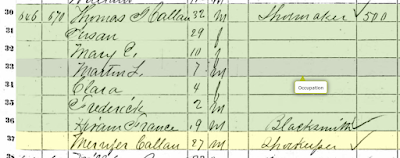
Case in point: At first, the only record that I could find before was the 1860 Census for Thomas Jefferson Callin (a shoemaker who went by the name Jeff), which looks like this:

1860 Census, Weller Township, Richland County, Ohio
The transcriber of this record saw "Munfer" - I can't do better.

That limited information calls into question parts of George Callin's account. Based on this, record, I can't even say for sure that George got this person's name or birthdate correct. Using the facts we have - the wife's name, the children, the bare outlines of his birth/death - I was unable to find anything else to compare to.

Until I got to this point in the editorial process and found a new breakthrough in the 1880 U.S. Census:

Name:     Marquis Collin
Age:     44
Birth Date:     Abt 1836
Birthplace:     Ohio
Home in 1880:     Wauseon, Fulton, Ohio, USA
Relation to Head of House:     Self (Head)
Marital status:     Married
Spouse's name:     Caroline Collin
Father's Birthplace:     Virginia
Mother's Birthplace:     Pennsylvania
Occupation:     Shoemaker
Household Members:    
Name     Age
Marquis Collin     44
Caroline Collin     34
Fredrick Collin     13
John Collin     8

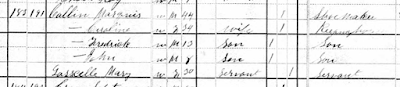
This is pretty exciting - for a couple of reasons. First, I'm thrilled to see "Marquis" written in an official record - I feel like that vindicates great-uncle George, because if I'm honest, I was wondering if the name wasn't something more along the lines of "Manfred" or "Mumford" (both of which I had searched for while trying to find this person in the records). Second, because for all of the little differences, like the wife's name being "Caroline" instead of "Pauline" and listing Marquis's father's birthplace as Virginia (which, to be fair, overlapped with Pennsylvania's territory when Marquis's father was born!), details like his occupation (shoemaker!) and the names of their sons make a pretty compelling case that we have a match.

1880 Census - Wauseon, Fulton County, Ohio
That looks like "Marquis Callin" to me!

Digging in a bit further, I also found this family at the same location in 1870 - minus the young John, who was born later, of course. This time, his name was recorded as "Martin Calin," but the other details match up, and I'm reasonably certain this is the family we were looking for. Sadly, there is a Find-A-Grave memorial in Wauseon for a "Caroline Callins," with a death date of 1880. And while I searched as thoroughly as I could, that trail ends here, for now. Wauseon is well to the east of Chicago, but it's entirely possible that Marquis ended up there. He and his sons could have gone anywhere in the years after Caroline's death.

I couldn't find a marriage record, so I don't know for sure whether Caroline's maiden name is Snyder (there are some tantalizing clues in the 1850 and 1860 Census), and I don't see any death record for Marquis (under any name). I see no traces of Fred, and while there are several records that suggest a John Callin who was born in Ohio in 1871 had a long life in Alaska, I don't have solid evidence that he's the same guy.

(Unless I can learn more that allows me to tie him to Marquis and Caroline, I don't plan on including John's Alaska adventures in the final book.)

But rest assured, the search continues, as does the monumental task of editing all of this into a well-sourced, and hopefully coherent, family history book!

 - -- --- -- - 

As always...

You can comment below (anonymous comments are usually not as helpful), or email "mightieracorns" at Gmail.com.

We have many ways to get in touch:

a Facebook page - https://www.facebook.com/MightierAcorns/

a Twitter feed - https://twitter.com/MightierAcorns

a Ko-Fi cup - https://ko-fi.com/mightieracorns

...and if you prefer a private group, we still have the Callin Family History group on Facebook for "cousins only" (there will be a question about how you're related to the family before you can join).

Until next time... Happy Hunting!

Friday, June 21, 2019

The First Life of Mrs. Reed

If you hearken back almost three years to a post titled The Mysterious McNabbs, we left a mystery unsolved about Elizabeth Ferguson McNabb (1835-1898). Here's what I said about her back then:
     Mystery #2: Mary Ferguson's sister, Elizabeth (1835-1898) also married a McNabb. The Indiana Marriage Index helpfully tells us that a James McNabb and Elizabeth B. Ferguson were married in DeKalb county on 8 February 1858. The CFH tells us that they had six children:
  •     Ella McNabb 1859–
  •     Margret McNabb
  •     Mary McNabb
  •     Charles McNabb
  •     Eliza McNabb
  •     Emma McNabb
But... after finding what I believe to be the only appearance of this family in the 1860 Census (with James, Elizabeth, and 1-year-old Ella), they seem to fall between all of the cracks in the databases. I have not been able to find them in 1870 or 1880, even with very broad searches.

Looking at the data again, there are some details in the original Callin Family History that were hard for me to interpret. This was one of several records in the CFH that could be read in more than one way, and without source citations, it's hard to check the information great-uncle George drew from or figure out what he meant to communicate to us. Here's what his record actually said:
Record of Elizabeth Ferguson who was the 2nd daughter of Eliza Callin Ferguson who was the 3rd daughter of John Callin who was the 2nd son of James 1st.

Born about 1836, died about 1898.

Married to James McNabb.

To this union seven children were born:

Ella, married, has five children living.
G.W. Reid (by 2nd marriage), married, two children living.
Emma, married.
Eliza, married, five children living.
Charles, unmarried.
Margret, married, two children living, three dead.
Mary, died at one year old.

It's pretty clear now that I should have interpreted this as telling me after Ella, the other children listed were from Elizabeth's second marriage. It's an understandable mistake, and since I didn't know to look for people named "Reed" instead of "McNabb," I missed a lot of clues.

The CFH also gave us some of the vague information Great-Uncle George had about Ella:

Record of Ella McNabb, eldest daughter of Elizabeth Ferguson McNabb, who was the 2nd daughter of Eliza Callin Ferguson, who was the 3rd daughter of John Callin, who was the 2nd son of James 1st.

Born ----.

Married ----.

To this union were born five children.

Record of Alta McCorse, eldest daughter of Ella McNabb, eldest daughter of Elizabeth Callin Ferguson, 3rd daughter of John Callin, 2nd son of James 1st.

Born ----.

Married ----.

To this union were born four children.

For years, I misread this as saying that Ella married someone named "McCorse," when it turns out that "McCorse" is similar to her daughter Alta's married name...but we'll get to that next week.

In 2016, I didn't have access to Newspapers.com, so I didn't find Elizabeth's obituary until recently. It still wasn't easy to track down (I had to open my search parameters and dig through a lot of results), but as you can see, this find fits with what we already know from the CFH and the 1860 Census.


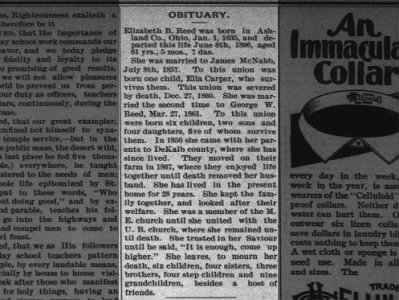
Elizabeth McNabb, wife of James McNabb, obituaryElizabeth McNabb, wife of James McNabb, obituary Thu, Jun 18, 1896 – Page 8 · The Waterloo Press (Waterloo, DeKalb, Indiana) · Newspapers.com
Here's the first part of the obituary:

"Elizabeth B. Reed was born in Ashland Co., Ohio, Jan. 1, 1835, and departed this life June 8th, 1896, aged 61 yrs., 5 mos., 7 das.
"She was married to James McNabb, July 8th, 1857. To this union was born one child, Ella Carper, who survives them. This union was severed by death, Dec. 27, 1860. She was married the second time to George W. Reed, Mar. 27, 1861. To this union were born six children, two sons and four daughters, five of whom survive them. In 1850 she came with her parents to DeKalb county, where she has since lived. They moved on their farm in 1867, where they enjoyed life together until death removed her husband. She has lived in the present home for 28 years."

Elizabeth's place in the tree
That confirms enough of the details we already know and gives us some insights we didn't know so we can start tracing Elizabeth's children.

As with previous breakthroughs, this one document allowed me to find a large number of previously unknown descendants of our common ancestor, James Callin. For the next few weeks, we'll look at the members of this branch of the family.

We'll visit Elizabeth's second husband, Mr. Reed, and their children in future posts, but today we'll look at Ella, the daughter born from her tragic first marriage. There are a lot of folks to cover, and I'm researching as I go, so I'm going to break these down into smaller posts so I can better stick to a weekly schedule.


James McNabb (1834–1860)

James was the first husband of Elizabeth Ferguson. Despite learning his date of death, I haven't been able to dig up anymore about his origins. As the first mystery in the original post on The Mysterious McNabbs concluded, this James McNabb is not obviously related to the other McNabbs who married people in our Callin/Ferguson tree. All we really know about him are these three vital facts:
  • Born about 1834 in Pennsylvania (according to the 1860 Census)
  • Married Elizabeth Ferguson on 8 February 1858 (according to two records in the Indiana, Marriages, 1810-2001 and the Indiana, Marriage Collection, 1800-1941, respectively)
  • Died in Allen County, Indiana (according to the above obituary - I didn't even find an official death record!)
There is a discrepancy between the marriage date in the Indiana marriage records (8 February 1857) and the obituary (8 July 1858), but that's close enough to be either a clerical error or the time between registering for the license and the actual wedding. Either way, before he died, he left behind one child:

I. Ella Florence McNabb (1859–1929)

Like a few other people in our family tree, Ella seems to have shifted from using her first name to going by her middle name as she got older. She first appears as "Ella McNabb" in 1860 and as "Ella F Reed" in 1870. After she married Jacob Carper she appeared on the Census in 1900 as "Ellen Carper" and in 1910 as "Ella Carper;" but on the various marriage and death records of her children, and on the 1880 Census, her name is recorded as either "Florence Carper" or "Florence E. Carper." I surmise that her parents named her "Ella Florence McNabb," but she started using "Florence" later in life. Her eldest daughter and some of her grandchildren were apparently given that name in her honor.

Ella grew up in the home of her mother and step-father in De Kalb County, Indiana, and in 1875 she married the son of Adam Carper (1795–1877) and Ann Elizabeth Cobler (1812–1886). Jacob Carper was born in Indiana in June 1853, the youngest of ten siblings.

Between 1879 and 1891 Jacob and Ella (or Florence, as she got older) had four children in Jackson Township, De Kalb County:

     A. Alda Florence Carper (1879–1970)
     B. Howard Leroy Carper (1882–1948)
     C. John D Carper (1886–1964)
     D. Callie Bell Carper (1891–1980)

Jacob underwent some minor surgery in late July 1927 which resulted in his health quickly deteriorating; he died on 6 August 1927. Florence died just two years later in 1929, and they are buried together in Roselawn Cemetery in Auburn, Indiana.
- -- --- -- -

We'll end there for now, but continue next week with the descendants of Jacob and Ella. There's a lot of them, so be prepared to take thorough notes!

You may notice a few changes around here at Mightier Acorns - we have:
  •  a Twitter feed - @MightierAcorns 
  •  a Facebook page - facebook.com/MightierAcorns/ (for everyone, not just proven relatives!)
  •  and if you like the work I'm doing, you can "buy me a coffee" using the Ko-fi button:
I also set up an email address - mightieracorns@gmail.com - so if you have a question or comment, you can send it there.

Wednesday, September 27, 2017

Have Mercy, Many Johnsons

Finding the family of John and Sarah (Callin) Scott has turned out to be a major breakthrough for the Callin Family History revision. It is also a challenge. The combination of common surnames and given names in an area with limited vital record information means that as a researcher if I can find records for a given person, there are often multiple records for people with similar names and few other clues for telling which are the records for the people I'm interested in.

That challenge is the reason I try to include so many disclaimers in these posts. I want people who come along behind me to know where I had to make guesses, and if they have better information, to let me know when I might have made mistakes.

In the meantime, I do my best, and I try to explain how I got the answers I've given!

III. Mercy Elizabeth "Libbie" Scott (1859–1898)

The third child of George and Lucetta (Beach) Scott was born on 23 May 1860. She was named Mercy Elizabeth, after her maternal grandmother, Mercy Yaw, but she favored the name Elizabeth, which was shortened to the nickname "Libbie."

Johnson family
Find-A-Grave memorial
Libbie grew up on her father's farm in Harrison township, and she married a Swedish immigrant named Alfred Johnson (1855–1932) just before the 1880 Census. They would have five children before Libbie's death on 9 April 1898, less than a month before her 38th birthday.

Alfred's story was a bit tricky to figure out. Beginning with the 1900 Census, which listed his arrival date in the U.S. as 1871, we have a few facts to work with. There were a surprising number of men named Alfred Johnson farming in the Rockford, Illinois, area during this time, and his headstone was never marked with his death date, but eventually, I located a record for his death in the Illinois, Deaths and Stillbirths Index, 1916-1947. That record told us that his birthplace was Smoland, Sweden, and gave his father's name as "Carl Johnson." It also listed his spouse as Marie Johnson.

By 1910, Alfred's and Libbie's elder daughter, Ida, was married, and their younger surviving daughter, Ethel, lived with her. Ernest was married and living with his young family in Sheridan County, North Dakota. There is an Alfred Johnson listed in Sheridan County that year whose wife is listed as "Mary E." who might be the same person as the Marie listed in Alfred's death record.

In 1920, Alfred appears on the census in Rockford, living with his sister and brother-in-law, Matilda and Stephen Harris. Matilda's death record also gives her birthplace as Smoland, but lists her father's name as "John Faust." Her date of arrival in the U.S. was the same as Alfred's, and I did find an immigration record for Matilda Faust who arrived in the States on 23 October 1871 on a ship called the England, along with Ida Faust and Alfred Faust - possibly another sister and our Alfred.

I conclude from all of this that it is possible that the three were siblings (Matilda and Alfred certainly were), and that when they arrived in the U.S., Alfred followed the Scandinavian tradition of taking his father's first name as his surname (ie, "John's son") rather than the name Faust. I was unable to find any more information about Ida, but Alfred may have given her name to his eldest daughter.

Alfred died on 4 December 1932 in Rockford, Illinois. Presumably, he was buried with his wife and two small daughters in the North Burritt Cemetery there.

     A. Ida M Johnson (1882–1975) was born on the first of May 1882. She was 12 years old when her youngest sibling was born, and 16 when her mother died. She married John W Johnson (1874–1958) on 28 February 1900, when she was 18.

Despite the common surname, John and Ida were not related in any direct way. John was born on 5 January 1873 in Boros, Sweden, and immigrated to the U.S. in 1891. His parents' names were given as John L Johnson and Amanda Anderan. He had a sister, Anna, who came to States in 1910 and married one George H Aspelin (1889–1953) in 1911.

John and Ida had five children between 1900 and 1908. They lived in Shirland, Winnebago County, Illinois, until relocating to Delavan, Wisconsin, where they lived on a farm from 1916 to 1919. After that, John was a truck driver for the Doyon-Rayne Lumber Co. for a number of years until retiring.  He was a member of the Modern Woodmen of America. He died in their home at 85 years of age on 21 August 1958. Ida survived him until January 1975. They were buried together in the Spring Grove Cemetery in Delavan.

     1. Floyd Wilburn Johnson (1901–1918) was born on 16 May 1901, in Illinois. He was a student when he died at age 17 on 13 December 1918, in Rockford, Illinois. He was buried in Spring Grove Cemetery in Delavan, Wisconsin, where his parents would eventually join him.
Find-A-Grave photo courtesy of D.L.James

     2. May Elizabeth Johnson (1903–1988) was born on 26 January 1903 and grew up on her father's farm. After the family moved to Delavan, she remained at home and worked as a telephone operator. She died on 27 August 1988 in Delavan and was buried in Spring Grove Cemetery near her parents.

     3. Ralph Alfred Johnson (1904–1997)  was born on April 17, 1904, in Illinois. He married Glennethel Grames (1912–2007) on 25 June 1938. Her parents were Edwin E Grames (1884–1965) and Irena O Hughes (1885–1964) of Warren County, Indiana.

Ralph died on 17 August 1997 in Delavan, Wisconsin, at the age of 93. Glennethel died on 14 January 2007 at the age of 94. There was an obituary published, but as of this writing, it was not available online.

     4. Carl H Johnson (1906-1979) was born 27 August 1906 in Illinois. The 1930 and 1940 Census records say that Carl was employed as a golf teacher. He seems to have remained in the Delavan area most of his life. He died on May 13, 1979, in Delavan, Wisconsin, at the age of 72, and was buried in the Spring Grove Cemetery.

     5. Hazel A Johnson (1908–1999) was born on 29 November 1908. She married Eugene Bernard Cummings (1908–1979) on 5 April 1940, and they had two children, both still living.

Eugene was a veteran of the U.S. Navy in World War II. He was a co-owner of the Tally-Ho Inn in Darien, a club manager of the Swedish Club of Chicago, and a manager of the Big Foot Country Club in Lake Geneva. He died in Elkhorn, Walworth County, Wisconsin, on 2 March 1979, and was buried in Saint Andrews Cemetery in Delavan. Hazel joined him on 12 July 1999.

     B. Mamie A Johnson (1883–1884) was born on 3 May 1883 and died just after her first birthday on 22 May 1884. She was buried in North Burritt Cemetery in Winnebago County, Illinois.

     C. Ernest Elmer Johnson (1885–1951) was born on 2 November 1885 in Harrison, Illinois. He married Exilda L Ray (1878–1947) on 15 February 1905 in Outagamie, Wisconsin. They had two sons. Exilda was born on 30 October 1878 in Fond du Lac, Wisconsin, to Samuel Ray (1852–1929) and Jane Sweet (1851–1937).

Elmer worked for a short time as a teamster but settled into farming for most of his life. He died in 1951 at the age of 66. Exilda had preceded him on 9 May 1947. They are buried in North Burritt Cemetery.

     1. Lewis R Johnson (b. 1907) was born on 27 September 1906 in Winnebago County, Illinois. He married Margaret Ruth Caroline Palmquist (1910–1997) in 1928 in Boone County, Illinois, and they raised three children, all still living, in Rockford. Lewis died on  22 May 1961 and was buried in Willwood Burial Park, in Rockford. Margaret remarried and died on 13 August 1997 in Mountain Home, Arkansas.

     2. Leland E Johnson (1909–1996) was born 15 December 1909, in North Dakota. He married Ila E Main (1909–2007) on 7 July 1930, in Belvidere, Boone County, Illinois. Ila was born 5 April 1909 in New Milford, Illinois, the daughter of Carlton T Main (1872–1939) and Alma G Robinson (1880–1938). Ila was a graduate of New Milford School.

Leland died on 8 November 1996 at the age of 86, and Ila died 28 July 2007 at 98. They were buried in New Milford Cemetery.

     a. Leland Carlton Johnson (1932–1992) was born on 14 December 1932 in New Milford, Illinois. He was married in 1956, in Winnebago, Illinois, and his wife is still living. They had two children who also survive him and several grandchildren. He died on January 15, 1992, in Rockford, Illinois, at the age of 59, and was buried in his hometown.

     D. Bertie L Johnson (1887–1896) was born on 26 September 1887 and died at eight years of age on 23 April 1896. He was buried in North Burritt Cemetery in Winnebago County, Illinois.

     E. Ethel May Johnson (1894–1987) married Frank Willard Petitt (1891–1957) on 14 December 1912 in Beloit, Rock County, Wisconsin. He was the son of David Erwin Petitt (1859–1920) and Ida Ethelena Vinton (1858–1941). They had six children in the next dozen years. Frank worked in a shoe factory.

Sometime after 1930, the couple divorced; Ethel would later remarry Charles W. Schlichter (1894–1950). She died in Beloit in 1987.

     1. Lyle F Petitt (1913–1980) finished high school and stayed in Beloit until the mid-1930s, when he relocated to Silverton, Marion County, Oregon. He married his first wife, Geraldine, in 1938; they had a daughter before they divorced and Geraldine remarried in 1944. Lyle remarried about the same time, after moving across the country to Erie, Pennsylvania.

His second wife was Maxine A Adams (1917–1962) and they had five more children, most of whom are still living.

     a. Sandra Lee Petitt Richins (1939–2003) remained in Oregon with her mother, Geraldine, after her parents parted. She was married and died in Clackamas, Oregon, on 21 April 2003.

     b. William Clyde Petitt (1947–1948) was the son of Lyle and Maxine Petitt; he died on 4 August 1948 in a car accident at fifteen months of age.

     c. Patricia Petitt Holland (1948–2010) died after a fiercely fought battle against pancreatic cancer on 18 March 2010, while vacationing in Kailua, Hawaii.  Pat was raised and attended school in Girard. She and her husband and son resided in the Girard and Lake City area until her retirement from EMSCO Erie after a 20-year career as a highly respected and valued foreman. She was survived by her husband, son, three grandchildren, a great-granddaughter, a brother, a sister, and her beloved dogs Snoopy and Crystal.

     2. Edna Irene Petitt (1915–2005) married farmer Floyd A Lehman (1914–1962) on 29 July 1933. They had a son and daughter, still living, and raised them in Rock County, Wisconsin. After Floyd's death in 1962, Edna married Carl Ambrose Steindl (1912–1977) in January 1966, and she lived in Beloit until her death on 6 March 2005.

     3. Deloss Enoch Petitt (1918–1944) was born on October 16, 1918, in Durand, Illinois, and he enlisted in the U.S. Army on 14 May 1941. He served in the 1202nd Army Air Force Base Unit and died on November 16, 1944, in North Africa. He was buried in Tunisia at the North Africa American Cemetery and Memorial near Carthage.

     4. Lawrence Elliott Petitt (1920–1984) was born on 12 March 1920, in Winnebago, Illinois. He married twice, but I don't know if he had any children. He died on 1 June 1984, in Westfield, Wisconsin, at the age of 64.

     5. Fern Eleanor Petitt (1923–2010) was born on 6 September 1923, in Winnebago, Illinois. She worked at the Wisconsin Telephone Company and at C.Z. Chemical Company and she married August Charles Blake (1918–1995) on 25 February 1950, in her hometown. They had two children during their marriage, both of whom are still living. She died on 21 December 2010, in Beloit, Wisconsin, at the age of 87, and was buried there.

     6. Clyde Franklin Petitt (b. 1925) was born on 26 January 1925, in Winnebago, Illinois, but much of his story remains a mystery to me. We know from his brother Lyle's 1980 obituary that Clyde was living in New Orleans, Louisiana, at that time; and we know from his sister Fern Blake's obituary that he died before her death in 2010.


 - -- --- -- - 

In case this isn't obvious, I've had to slow down my genealogy research for the time being. I've gone back to school to finish my long-dormant music degree, and time is very short these days. I'll keep working as time allows, and if you're a descendant of any of the folks in these posts, I hope you'll reach out so I can fix any mistakes or fill in any blanks.

You can comment below, or email my Gmail address (callintad) - I hope to hear from you!

Saturday, February 4, 2017

The Callin Family Historian

George William Callin was born on the Fourth of July in 1846, on his father's farm near Ashland, Ohio. In 1861 he moved to a farm near Bowling Green on the Sand Ridge road. George served in the Union Army during the Civil War, and then returned home and taught school for 27 years. He was justice of the peace in Bowling Green for the 24 years prior to his death. And he was the family historian who published the Callin Family History.

On 11 December 1862 he enlisted in the 21st Ohio Battery of the O. V. I. at Cleveland, and served until the end of the war. The unit organized at Camp Dennison, Ohio, on 29 April 1863, and was ordered to West Virginia on 5 May. They returned to Camp Dennison on 20 May and stood duty there till September. This was no easy duty, as the unit pursued an invading Confederate army during what is known as Morgan's Raid through Indiana and Ohio July 5-28.

After that, on 22 September, they moved to Camp Nelson, Kentucky, where the 21st was attached to Willcox's Left Wing forces, 9th Army Corps, and moved to Greenville, Tennessee, where they saw action in the Battle of Blue Springs on October 10, and in a skirmish at Walker's Ford on December 2. They did duty at various points in Tennessee and Alabama until they mustered out 21 July 1865. The battery only lost 9 men during its service: 1 officer and 8 enlisted men by disease.

The George W. Callin family
c. 1890
(standing: Roy (left) and Clement;
seated: George, Mabel (center) and Mary Ann)
George married Mary Ann St. John (1850–1894) on 22 April 1871 in Bowling Green. By all accounts, they adored each other, and raised three children together. Sadly, she died as "the result of a serious intestinal derangement" in 1894 at only 43 years of age.

Mary Ann's parents were Stephen W St. John (1817–1893) and Harriet Jane Husted (1833–1899) of Bowling Green. When George's older brother, James, lost his wife, Rosalina Davenport Callin, in 1876, the St. John family took in the infant Jessie Callin and raised her as their own. Jessie was married to Albert Chudley only a few months before Stephen's death in 1893. (Refresh your memory of Jessie in last month's post, Leaving Only Traces.)

George took a second wife, marrying Lura M. Case (1861–1948) on 27 June 1899. Lura was the widow of Rev. Lemuel Lee Warner (1863–1888); they had both contracted typhoid fever in 1888, but only Lura recovered. Lura's son and daughter were just a few years younger than George's youngest, Mabel. George and Lura had another daughter together, Rosemary, born in 1903.

It isn't clear when George took up genealogy, but it is clear that he devoted many years to compiling his family history. In 1911, he had it published, and the resulting book has been passed down in some form or another to many of the descendants of James Callin.

George died at his home, 331 Pearl street, at 12:30 a. m. on 21 July 1921, after an illness of about two months. Death was "due to complication of diseases superinduced by old age." He was 75 years old.

     I. Everett Leroy Callin (1872–1957) married Myrtle A. Rumley (b. 1878) on 16 March 1898. They would raise a son and a daughter together over the next quarter century. Roy was a carpenter, and moved the family around quite a bit. After moving between Lorain and Toledo (which are about 90 miles apart, along the shore of Lake Erie), they were in Gary, Indiana, for a while around 1910 and 1911; then from about 1913, the family resided in Detroit, Michigan.

Roy and Myrtle divorced about 1925, and Myrtle supported herself as a seamstress in Toledo for a few years before marrying Edward M. West (b. 1881) in 1928. That marriage did not last long, and by 1930 she had taken lodging in the house of Edith Hanley - another divorcee, whose maiden name happened to be Edith Callin. (Her family was featured in The Distance of Close Connections.) The last I have been able to learn about Myrtle, she married James Mcnally (b. 1872) in 1933 and settled in his home in Perrysburg, Wood county, which is where they were in 1940.

Roy seemed to prefer to stay in Detroit after his divorce. He remained there until his death in 1957.

       A. Lionel Everett "Lee" Callin (1900–1962) was working as a chauffeur in 1917, according to his World War I draft registration. He lived in Detroit, and married Dorothy Adler (b.1901) there in 1919. They were together for 11 years, and divorced in 1930. Records indicate they had no children. According to his obituary, he was visiting a cousin, Warren Hasmer, in Florida, when he died of a sudden heart attack. He was buried in Oak Grove Cemetery in Bowling Green.

       B. Katharyn Loraine Callin (1904–1950) was born 16 June 1904 in Perrysburg, Wood county, Ohio. She spent at least part of her childhood in Gary, Indiana, but after she married Cloyd J Markwood (1902–1973) in Toledo on 26 June 1926, she remained there for the rest of her life. Cloyd was born in Jackson Township, Ohio, and worked as a maintenance man for the Shell Oil Co. for 10 years until his retirement. After Lorraine died, he married again in 1953; he and his second wife, Letha L (Dubbs) Masters (1913–1972) moved to Phoenix in 1956.

Lorraine and Cloyd had two sons, one of whom is still living.

       1. Robert Kenneth Markwood (1933–1992) was born in Toledo on 24 February 1933, and served in the U.S. Army from 2 February 1954 to 17 January 1956. He lived in Scottsdale, Arizona, and died there in 1992. He was buried in the National Memorial Cemetery Of Arizona in 2001.

     II. Clement Carl Callin (1877–1944) was a veteran of the Spanish-American War, and graduated from Ohio Wesleyan University in 1901, where he received the B.S. and A.B. degrees. While an undergraduate he excelled in football and was a member of the varsity. This is also where he likely met Gertrude DeWees Smith (1879–1955), whom he married on 15 February 1905.

He did graduate work at Temple University, where he re-received his master's degree, and also held a degree of B.C.S. at Rider College. He completed further studies at Teachers' College of the University of Pennsylvania and Columbia University.

He taught, and served as principal of Morrisville schools in Bucks county, Pennsylvania, for many years, and from 1930, he served as head of the junior accounting department of Rider College, Trenton, New Jersey.

     III. Mabel Augusta Callin (1881–1970) was born 15 July 1881 in Bowling Green, and grew up to follow the family profession; namely, she became a teacher in the public schools. She attended Ohio Wesleyan University and Bowling Green State University. She moved to Lorain from Bowling Green about 1920, and after she retired, she returned to Bowling Green, where she died in 1970.

     IV. Rosemary Callin (1903–1978) was the baby of the family, born 15 January 1903. She was the author of the letter I published in the post Silk or Satin, in which she recalls what she knew about her grandmother, Elizabeth Berlein Callin; though it is questionable how much she would remember firsthand, as grandma Elizabeth died when Rosemary was 11 months old.

Still, Rosemary grew up surrounded by a family full of teachers, surrounded by pioneer family, Civil War veterans, and scholars. It seems inevitable that she would also go into teaching. After her father died, she moved with her mother to a new home in Richfield, Henry county, and eventually they settled in Lakeside, Ottawa county, on the shores of Lake Erie, east of Toledo.

The ladies entertained and stayed active in the community, hosting Thanksgiving dinners for the "lonely" townspeople during the tourist-free winter season. After Lura's death, Rosemary remained in Port Clinton until her death at 75 years of age - the same age her father reached.

She was the last surviving Callin from this branch of the family.

 - -- --- -- - 

I've said before that the Callin Family History is the book that inspired me to begin doing family history research and to start this blog. As difficult as it has been to re-trace the information that George provided, even with modern tools and access to millions of digitized online records and newspapers, I find it impressive that he was able to leave us such a reliable record of his scattered, extended family.

As a family history researcher, finding a family like this one is both inspiring and sad; inspiring to find a family so full of accomplished and professional people, but also sad because in the end, there are so few remaining descendants. Bob Markwood and his brother may have had large families for all I know, or that brother could be the last living member of this branch of the family.

But the important thing to recognize is that people make choices. Clement and Mabel chose to be teachers, and if they chose not to have children, that shouldn't diminish our appreciation of their lives. I only wish that the records our childless relatives left behind were as thorough and glowing as Clement's obituary, so I could adequately celebrate them for who they were. Nothing is as sad to me as not knowing enough about who someone is to be able to write more than their birth and death dates.

If you want to help celebrate these families, and you see any mistakes or omissions I should fix, please let me know! This is all part of the plan to give the original Callin Family History a 100-year overhaul, so I want to get it right.

Drop a comment in the box below, email me at callintad at gmail.com, or follow the link to our Callin Family History Facebook group and let me know how you're related to this family. There's a digital (PDF) version of the original Callin Family History available in that group, too, if you want it.

Friday, January 6, 2017

The Three Lives of James Monroe Callin

James Monroe Callin was born 26 February 1844 in the Ashland area of Richland county. That was the year that his father, William, traveled nearly 500 miles west to Iowa to bring Jim's aunt Margret back to Ohio. (I told that story back in the post titled The Distance of Close Connections.) Jim's older sister, Harriet, would have been about 6 years old, and his brother, John, would have been 4.

The family of William Callin would have been surrounded by extended family in the neighboring townships, so their mother, Elizabeth Berlin Callin, would not have been entirely on her own — but imagine sending your husband off on a journey like that at a time when the threat of attack from hostile indigenous tribes was not out of the question. The last major uprising of native peoples, the Battle of Little Bighorn, was still thirty years in the future at this point.

When Jim was six, William took the family to clear and settle a new farm in Peru, Huron county, Ohio. Jim grew up in New London and Ridgefield, attending school and working his father's farm, until the war began. Jim was not yet 18 when the call for troops went out in 1861, but he turned 18 the following February. He went up to Toledo, and on 10 October 1862, a full two months before his older brother John enlisted, he enlisted in the 67th Regiment, Ohio Volunteer Infantry, Company H.

At the time of his enlistment, his personal description was five feet eight inches high, fair complexion, grey eyes, and auburn hair. He was a farmer boy, strong and capable.

Ruins: The Second Assault on Fort Wagner
Jim was twice wounded in action. First, and most serious, he was hit by a shell that struck the upper part of his right thigh near the bone during the charge at the Second Battle of Fort Wagner, South Carolina, 18 July 1863. “He was one of the eighteen men who took their stand on the bomb proof of said Fort and that they held the same about thirty minutes and until their commander ordered them to retreat as best they could.” Jim was in the general hospital No. 9 at Buford (Beaufort), South Carolina, almost three months. He returned to duty 27 September 1863.

Second, he was struck in the back of his head by shrapnel from an exploding shell in the Battle of Chester Station, Virginia, 10 May 1864, and hospitalized at Ft. Monroe, Virginia, on 20 May 1864 after experiencing disorientation and headaches. This injury, though it sounds worse, was less serious than the thigh wound which caused permanent damage and a limp. Almost as bad, he, along with many others, contracted what was called “camp diarrhea,” dysentery, from which he suffered the remainder of his life.

James Monroe Callin was discharged honorably at the end of the war, and returned home in October 1865.

Rosalina Bedora Davenport (1848–1876) was the daughter, and only child, of Martin Sidney Davenport (Jr.) (1824–1895) and Laura Maria Hix (1828–1904). Martin married Laura in Norwalk, Huron county, Ohio, on 11 November 1845.

Laura was born on 5 September 1828 in Vermont, daughter of Daniel Weed Hix and Laura (unknown), and her family had only recently arrived in Ohio before she was married. Martin was a carpenter who descended from Dutch settlers to New Jersey who had spread to the west via Tompkins county, New York, where Martin was born. The Davenport family's origins are still a matter of some debate. They held a reunion in Perrysburg, Ohio, on 4 September 1890, at the home of Alanson Davenport, which was reported on by Charles C. Hum in the newspaper:
"In good old colonial days one Garret Davenport with three half brothers came from Holland to America and located in New Jersey. This circumstance coupled with the undoubted English character of the name, is almost certain evidence that the family was one of the many who had been driven from England in the days of religious persecution to find an asylum in Holland, and afterward a home in wild but free America."
While it's hard to find "almost certain evidence" of anything from that early period, it is certain that after arriving in New Jersey, Garret and his sons spread across the continent, through New York, Pennsylvania, Ohio, and beyond. Garret's son, Martin Sidney, Sr., was born in New Jersey, and lived for a time in Tioga and Tompkins counties, New York, where Martin Sidney Davenport, Jr., was born in 1824 youngest of six sons, the eldest of whom was Alanson. A number of these Davenports moved to Ohio in the 1840s.

Martin Sidney was a Union Army soldier who enlisted in Company A, 100th Regiment, Ohio Volunteer infantry on 1 September 1862. He mustered out on 20 June 1865 at Greensboro, North Carolina. After the war, he was also a member of the Wood County Wiley Post # 46 of the Grand Army of the Republic, and a GAR Flag Holder.

At that 1890 reunion, he recounted a story from those days:
"Sidney Davenport announced that the only behavior of the family that might be criticised [sic] was some of his own. It happened that in old army days a large cheese adhered to his rubber blanket, carelessly throwing over it while taking lunch. After reaching camp he noticed the cheese and tried to make it take the oath of allegiance. Failing in this he confiscated it as he was in duty bound to do. This was not a case of theft and the fault lay clearly with the cheese."

Martin's Veteran’s Pension records showed that though he was never wounded, he, like Jim, contracted “camp diarrhea” or dysentery during the war, from which he never recovered. He was several times left sick in camp in Frankfort, Kentucky and hospitalized in Marietta, Georgia. Like Jim, he eventually died of “cancer of the bowels.” His physical description in 1881 was height, 5 feet nine inches; weight 158; complexion dark; age 56. He died 14 June 1895, aged 70, and his widow, Laura died 5 March 1904, aged 75, both in Bowling Green, Ohio.

Jim Callin and Rosa Davenport were married in Bowling Green on New Year’s Eve, 31 December 1867. They set up a farm in Center township, and had four children over the following eight years.
  • Albert Clifford Callin, born 1869
  • Arthur K Callin, born 1871
  • Bessa Viola Callin, born 1873
  • Jessie Callin, born 1876
Jessie was born in March of 1876, but sadly, Rosa died in September of that year. Now a widower, Jim had to raise his four children on his own. In 1880, the three older children were living with their grandparents, Martin and Laura Davenport, not far from William and Elizabeth Callin's home.

Almira A. Weirick (1858–1889) was the daughter of Jason Weirick (1826–1917) and Matilda E Hassinger (1830–1915), both of whom came from Pennsylvania families that had settled in Ohio around 1830. More than most of our relatives, Almira's name seems to have been very difficult to spell; it appears as "Elmira" and even "Elvira" in some records, and her surname was often rendered as "Wirick" or "Weirich."

Almira was about 21 when she married the 35-year-old widower Jim Callin in 1880. Jim's sons Albert and Arthur were 12 and 9 years old, and his daughters Bessie and Jessie were 7 and 5, respectively. Jim and Almira had three more daughters together before Almira's death at only 31 years of age. They had a son in 1887, but he died at six months of age, and we do not know his name.
  • Cora May Callin (1881–1936)
  • Carrie E Callin (1883–1960)
  • Aurilla M Callin (1885–1969)
  • Unnamed Callin (1887)
 Emma G. Bradt (1856–1907) became James Callin's third wife on 23 August 1893 in Bowling Green, Ohio.

Most of Jim's children were old enough to be independent by 1893. Jessie married that year, and the boys and Bessie were already out on their own. Almira's three daughters would have still been too young to leave home in 1893, but by 1900, Cora had gone to live with her grandparents, Jason and Matilda Weirick; Carrie was married in 1898; and 15-year-old Aurilla was a listed as a boarding school student, living in Cottage 1 of the Ohio Soldier's and Sailor's Orphans Home.

Jim's health deteriorated, and he was unable to farm. He had been increasingly debilitated by his hip injury, but mostly by the diarrhea and resulting severe piles, as shown in his pension requests. Emma took him to her Canadian home in St. Catherines, Ontario, to be near her family, as somehow she was estranged from the Ohio families of Callin, Davenport, and Wirick who were caring for, or had cared for, his children. She apparently had  her mother and a sister or sisters in St Catherines. However, she apparently also became estranged from them during Jim’s final illness.

Jim died of bowel cancer in St. Catherine's on 7 April 1901, age 57. Nine months after Jim died, Emma married Albert A. Flora on 23 January 1902. She had been begging for an increase in Jim’s pension to pay his last doctor’s bill, but she was denied because of her remarriage.

Emma and Albert  had a contentious marriage. They returned to Perrysburg, Ohio, but she sued him for divorce in January 1907, asking to return to the Callin surname. She died just a month later, before her divorce was final, on 13 February 1907, and was buried  as Emma G. Flora, aged 51,  in the Oak Grove Cemetery, Bowling Green.

 - -- --- -- - 

You can take the title of this post, as with most of my titles, in a couple of ways. In one sense, James had three wives/lives, and you could read his biography that way. After all, he was with each of his wives for about 9 years — if you don't examine my math too closely. Or you can view him through the lens of history: pioneer boy, Civil War solider, and father during the Midwest's boom years.

As we look more closely at his descendants in the following weeks, there will be some mysteries that we have to leave unanswered; there will be some shocking crimes; and there will be a lot of children. I'll try to do them justice.

For help with this branch of the family, I thank Joan Callin Foster, who has been one of the most enduring and encouraging of fellow researchers. As I've said before, if you see anything you like here, she deserves full credit; if you find any mistakes, those are all mine!

And as always, if you're related to any of the folks in this post, then you're family! Drop me a note at callintad (at Gmail.com), or in the comments below; or send a request to join the Callin Family History Facebook group. Please do let me know if there are mistakes, and I'll do my best to correct them. This ongoing project is intended to result in a published revision to the Callin Family History, so we want to get it right.

Now brace yourself — next week's post is a long one!

Friday, October 14, 2016

The 20th Century Callin Clan

Amanda Walker, about 1873
(Since John Henry Callin is the next family member on our list, I'm reposting this earlier piece on his family. Enjoy!)

This is the story of one generation of one family; just a little more than one life span. It was a century that bridged centuries, saw three major wars, and took my family from the old frontier to a new one. It was one generation that multiplied two ancestors into many cousins... but enough poetry - let's get started!

My great-great grandmother Amanda Lydia Walker was born in 1857 on Scotch Ridge in Wood county, Ohio. Her father was born in New York around 1828, and there is some speculation that his parents were Scottish immigrants who arrived after the Revolution. In 1874, when she was 17 years old, she married 33-year-old schoolteacher and Civil War veteran John Henry Callin.

John was the oldest son of William Callin and Elizabeth Berlin (who we read about in November's "Silk or Satin" post). William was a prosperous farmer known in the county for his physical strength and his industriousness, but not for his education. John, however, was a good student who was accepted into the Western Reserve Normal School in Milan, Ohio, when he was 18.  Three years later, in 1861, he began teaching his first classes in Wood county, Ohio.

Of course, that April saw the start of hostilities between the states. If it is true that William's farm was a stop on the Underground Railroad, that may have contributed to the enthusiasm his sons showed for enlisting in the fight. John dismissed his students in the middle of their term, and enlisted in the 21st Battery of the Ohio Light Artillery. He acquitted himself well as a soldier, and was later credited with leading Detachment B during its deployment in West Virginia. He brought home notebooks full of poetry he wrote on the battlefield, including an account of his unit's part in halting Morgan's Raid. After his discharge at the close of the war, John attended a course at Hillsdale College in Michigan, and then returned to Wood county, where he taught school for 22 years.

John married a Lucy Patterson in October 1865, according to his pension records - it isn't clear whether she is any relation to the Captain Patterson who commanded John's unit during the war, or what happened to cut that relationship short. Needless to say, there isn't any mention of this first marriage in the biographical sketches of John in the Wood county history. At any rate, they do not seem to have had any children, and John was free to marry Amanda nine years after his wedding to Lucy.

John & Amanda Callin's family - c. 1892
John and Amanda's eldest son, Byron Herbert, was born in November of 1874 - the year they were married. The following year they had a daughter, Leota, who died in infancy. After a few years, they had another son - my great-grandfather, John Quincy, who was born in 1879. Then, starting in 1885, when John would have been 6 and Byron would have been almost 11, the rest of the children came along in quick succession - Emma, their only sister (1885), Prentice (1887), Welles (1889), and Ray (1890).

The family photo to the right shows the whole family from around 1892. Standing up in the back are Byron and John Q. Amanda is seated on the left with Prentice and Welles to her right and left; John H. is holding Ray and Emma is standing to the right.

B. H. Callin, May 1895
Byron was a precocious young man, and he seems to have decided to follow in his father's footsteps as an educator early on. By one account, he was given a teaching certificate by the county board of examiners at age 16. In 1894-5, he taught at the school in New Rochester, Ohio; then attended Berea College in Berea, Kentucky for a term; and he attended the 1895-6 winter term at Findlay College in Findlay, Ohio. On July 18, 1896, he married Fannie E., daughter of John and Eliza Muir of Scotch Ridge, Ohio.


John Q. Callin (right)
Bowling Green HS football
John Q. also grew up to become an educator, though he didn't make as many headlines as his older brother. John played the left halfback position on the Bowling Green High School football team, and broke his ankle during a play against the Perrysburg team - which made the local papers. (BGHS beat Perrysburg 35-0!) He graduated in May 1900, and was listed in the commencement program  as delivering an Oration, Unnoticed Heroes.

(Given that theme, he probably would have appreciated the idea of Mighty Acorns!)

At the Turn of the Century, the Callin family was coming of age. The family portrait below was likely taken in 1902, around the time John H. moved the family to Fostoria. Standing from left to right in back are Ray (12), John Q. (21), Emma (15), Welles (13), and Prentice (14). Seated in front are Byron (26, and living in Dayton by this point), John H., and Amanda.

I estimate that John H. retired from teaching around 1889 - at 49 years of age. He seems to have gone back to farming, and he became more active in the Grand Army of the Republic. Even though his pension records indicate that he was never commissioned by the Union, he was known in his community as "Colonel Callin", which was possibly his rank in the GAR. His mother, Elizabeth, was living in his home in Bowling Green when she died in 1903.

John & Amanda Callin's family - c. 1902
John Q. married Bertha Cramer in 1906, and their daughter, Yvonne, was born in May of 1907. They had two sons: John Norman, in 1912, and Robert (my grandpa Bob), in 1920. They stayed in Fostoria that whole time, presumably supported by John's teaching.

Byron’s marriage to Fannie Muir didn't last long. Records of their divorce have proven to be elusive, but in 1906 he surfaced in Baker, Montana where he married Ruby Cole. Their daughter Opal was the first of John H. and Amanda's grandchildren, and she was born in April 1907, in Minnesota.

During their courtship, Byron and Ruby were riding in a buggy, going on a hunting trip, when the horse became spooked and in the subsequent furor, the gun that he had in the front of the buggy discharged and struck him in the right side of his jaw. He carried a terrible scar on his face for the rest of his life - and in the portrait below, you will note that he keeps his right side turned away from the camera. According to Truman Matcham, a son of Emma Callin, the family was always suspicious of the story and felt there was more to it than Byron would admit.

Welles Monroe Callin was born on April 19, 1889 in Bowling Green, Ohio. He grew up there until 1902, when the family moved to Fostoria. Welles attended Fostoria High School where he was the captain of the Ohio State Championship football team in 1907.

Emma Beatrice, born July 8, 1885, married a man 41 years older than herself in 1907. George D. Matcham was widowed when his first wife, Marion Worcester, died the year before. They had been married since 1871, and had opened a 20-room cottage at Linwood, a resort town on Lake Erie, just a few years before. George and his first wife never had children, but in November 1908 he and Emma presented John and Amanda with their first grandson, George Jr. Since John H. is also said to have owned property at Linwood, it seems likely that his new son-in-law may have helped him get started in the business of building resort cottages.

Welles Monroe Callin, c. 1908
After his high school graduation on November 10, 1908, Welles married Lucy Patterson, daughter of a local Fostoria city councilman, George B. Stone. They eloped to Windsor, Ontario, Canada and moved to Detroit. Welles’ brother Prentice was living there also, and they may have moved in with him. This marriage didn't work out and they were divorced shortly thereafter; they had no children.

Welles and Prentice then seem to have left for Edmunds County, South Dakota where their brother Byron was living.  He held a number of degrees, including at least one in theology, and had been a traveling preacher for a time in South Dakota, as well as teaching school at nearly every level.
Prentice George Callin
Hattie Own

Byron and Ruby had a second daughter, Elda Geraldine, while living in South Dakota, then Byron moved the family to Plevna, Montana. Welles seems to have followed them, but Prentice returned to Ohio where he homesteaded a piece of property and married Hattie Owen in 1910.

It was around this time that Byron began calling himself “Herbert”, his middle name. Welles evidently thought this was quite elegant and is listed in the 1910 census as “Monroe Callin”, though nobody ever seemed to call him that. In Baker, Montana, he met Marion Elizabeth Silvernale, the daughter of Baker's blacksmith, Charles Silvernale. They eloped sometime in 1911. It was quite a scandal, and there was even an article in the local paper with the headline, “Where is Marion Silvernale?”

Her family was not exactly smitten with the idea of their little girl seeing a divorced man, but the couple settled in Whitefish, Montana where Welles went to work for The Great Northern Railroad. They had three boys, Cameron Welles (1912), Charles Silvernale (1913), and John Kenneth (1920).

In 1913, John Henry died at the age of 72. Ray was attending college at Gambier, Ohio (probably Kenyon College), and Amanda moved to Vermillion to live near the Matchams. In 1920 she and Ray were living in the home of a widow named Anna Sherod, where Amanda worked as a housekeeper. Welles was still in Montana with his young family, but it seems the rest of the boys gravitated to Middlefield in Otsego county, New York.

John and Prentice Callin
Byron and family were in Middlefield in 1915. Prentice was there, as well, with Hattie and their two boys, Owen (1911) and David (1914); both boys were born in Ohio, so they must have moved not long after David was born - and by 1917 they seemed to be back in Ohio. Byron and Ruby stayed in New York state through at least 1923 or 4, and had the last three of their children there: Perda Jane (1916), Elsie Permilia (1920), and John Elijah (1923).

After Congress passed the declaration that entered the U.S. into World War I in April 1917, 2.8 million men were drafted into the Army. John and Prentice seem to have enlisted (or at least registered for the draft), though it isn't clear whether they were in the U.S. Army or an Ohio unit. They were a bit older than the average recruit - Prentice was 30 and John was 38. It doesn't appear that they got far from home before hostilities ended in November 1918, which was surely welcome news to the rest of the family.

The good news was not to last. On September 21, 1921, one year and one day after the birth of his youngest boy, John K., Welles was on a short run from Troy to Libby, Montana. He was standing on the platform between the locomotive and the tender when a heavy coal rake, that was sticking out beyond the side of the locomotive, struck a trestle and knocked him off of the train and into the riverbed. He landed on his head and died instantly. He was 32 years old. He is buried in the Missoula Cemetery in Missoula, Montana.
Ray Callin, with
Mary Delcamp

John Q. and Bertha moved to Schenevus, New York (not far from Middlefield) around 1921, when Bobby was about six months old. John taught there for a few years before moving back to Ohio. In February 1923, George Matcham died of pneumonia, leaving Emma with five children - the youngest being three years old: George Jr. (1908), John Edward (1912), Marjorie (1915), Truman (1916), and Ruth Ellen (1920). Emma remarried five years later to Gus Heimsath, and the aging Amanda moved into their home in Oberlin. That same year, 1928, Ray married Mary Delcamp.

Byron Herbert "Prof"
Callin, 1923
Sometime after the birth of John Elijah, Byron and Ruby had moved back to South Dakota from New York. Truman Matcham later recalled that the family felt that the reason Prof moved so often may have been because he was “asked” to leave. He recalls that when he was young and the family was talking about Prof, the kids were told to go out and play. It seems that Prof had quite a liking for the ladies. Some time around 1930, Prof told Ruby that he was going to look for work. He never returned. She divorced him and raised the family alone.

At some point after this, Byron married again. Records about this union are sketchy. They had one child, Flora Ida, but this marriage also ended in divorce. He remarried and another daughter was born, Ella Margaret.

On November 30, 1933, in Alford, Florida Byron Callin was shot to death. There are several stories about what actually happened. One is that he had been repeatedly trespassing on his neighbor’s property. Another was that it was a land dispute with his in laws. His death certificate states “Gunshot inflicted homicidally”. His occupation is listed as “Farmer.” Flora made numerous attempts to look at the records of the incident, but the County of Jackson, Florida refused to allow her access. No arrests were made. The whole incident simply went away. He is buried in an unmarked grave in Alford.

Mercifully, Amanda did not live to see Prof's ignominious end. She died in February 1933 at Oberlin, and after that, the Callin family began to move out of Ohio more permanently.

John Q. and Bertha had moved back to Fostoria from New York by 1930, but they soon decided to move down to Florida, once again following Prof's lead. John tried his hand at building resort cottages around the growing town of Orlando, and they lived out their days in Winter Park. By then, Ray and Mary had moved to Florida, also, with their son, Glenn, who was born in 1936. Prentice stayed in Ohio until the mid-1950s before moving to San Diego with Hattie.

It was barely 100 years from when Amanda, a daughter of Ohio's pioneering settlers, was born in 1857 until the 1950s saw the dispersal of her children and grandchildren to the East and West Coasts - and John Q.'s death in 1956. They were teachers, preachers, soldiers, builders, and adventurers who saw America come through some of its most celebrated episodes; and their lives were bracketed by the end of the Civil War at one end, and the rise of the Civil Rights movement at the other.

And that's just one family.


Friday, September 16, 2016

On the Sly

William Sly came from England to the United States in the 1850s. He was naturalized in 1866 at Bowling Green, Wood county, Ohio. According to the Callin Family History, he married Harriet Callin (1838-1907) in 1859.

We don't know for sure who William's parents were or where in England he came from; there are a couple of candidates in the UK Census records. Other researchers have noted an 1841 England Census which documents a Sly family in a Wiltshire parish called Horningsham: father James (b. 1786), mother Susanna (b. 1796), son William (b. 1826) and his two brothers, James (b. 1829) and Thomas (b. 1832). All of them list Ireland as their place of birth, except for the father, James; William is listed as a shepherd, and James as a pensioner. There is a death record for James in April 1849, which may have prompted a 23-year-old William to seek his fortune in the New World.

William's birthplace in all of his more recent, American records is "England," and not "Ireland," but that isn't enough to rule out this Census record, in my opinion, since the family did live in England, and probably considered themselves as being distinct from the other Irish immigrants arriving in the United States during the 1840s and 1850s.

There was also a James Sly of about the right age to be William's brother from that UK Census record. This James lived in Wood county, dying in 1893. The men would have certainly been aware of each other, living in the same place for decades, but neither of them mentioned the other in their wills, we don't have any newspaper notices from the time, and nothing else solidly connects them to that 1841 record. It could be that they weren't related, or they might have had a falling out, or James might possibly be a more distant cousin. It's hard to rule out any possibilities or draw any definite conclusions in the absence of records linking them. And since even William reportedly wasn't sure of his own birth date when he died in Wood county, Ohio, in 1894, we don't even have that name/birthday combination to narrow down our searches.

Hattie grew up on the Callin family farm in Richland county, which her father had purchased after her grandfather died in 1835. She was probably too little to remember most of the relatives who had lived there; her great-uncle Alex would have taken his family to Iowa when Hattie was still a baby. She would have been about six when her father, William, made his journey to Iowa to bring back her aunt Margret and cousins William and Warren. She might have known her great grandmother, Elizabeth (Simon) Callin, before Elizabeth moved to Auburn, Indiana, to live with the Ferguson branch of the family.

When she was about eleven, her father bought and cleared the new farm in Peru township, Huron county. They would have still been living there when she married William Sly; according to the 1860 Census, she and William lived in Oxford, Erie county, Ohio after they were married. By 1862, however, they had moved to Plain township, Wood county, where her father had purchased and cleared another 160 acre farm.

The petroleum industry in Ohio began in 1859, with an oil well drilled in Trumbull county; but major oil and gas reserves were also discovered in Wood county in the 1880s. According to my grandfather, the Callin farm in Wood county had been sold before William Callin's death in 1881, and it was family legend that "we could have been millionaires" had the oil not been discovered after that. But the Sly family evidently benefited from the oil boom of the 1880s and 1890s.

According to William Sly's will:

"I desire first that all my just debts be paid out of my property, and after the payment of my said debts, I give and bequeath to my beloved wife Harriet E. Sly, the rents and profits of all my real estate, exclusive of the income thereof derived from Royalty from petroleum oil or gas, to have and to enjoy the same for and during the remainder of her natural life time, or as long as she remains my widow, including in the above all the lands and tenements which I may own at my death, both farm and town property."

I don't like to project too much of my own ideas about what people thought and felt based on a few old papers, but the William Sly will has a few comments that hint at the relationships between his children. First, he named his son in law, Cyrus Young, as his executor, and while he divided the shares of his wealth between his three youngest surviving children equally, he only gave his oldest son, William, $50. Later, he added a codicil which essentially swapped William's share for his youngest sister's - leaving the $50 to Hattie May, and giving William a full third of the rest of the estate.

We may discover some clues to explain some of this in coming weeks. For now, it seems enough to say that William Sly's widow lived comfortably in her home in Bowling Green with her daughter until her death in 1907.

Until next week, I'll leave you with Hattie's record in the CFH:

Record of Harriet Callin Sly, only daughter of William Callin, who was the 3rd son of John Callin, who was the 2nd son of James 1st.

Born in 1838 in Ashland, O., died in 1907, in Bowling Green.
Married in 1859 to Wm. Sly who died in 1894.
To this union were born five children:
William in 1859.
Elmer in 1861, died in 1893.
Alice, born in 1864, died in 1896.
Eugene, born in 1866.
May, born in 1881.