Showing posts with label 1830s. Show all posts

Friday, February 21, 2020

The Other Montgomery Connection

Hello, cousins!

Last week, I announced the discovery of Sarah Callin and laid out my evidence that she is the last unknown child in the family of James (1779-1820) and Mary (1768-1846) Callin of Milton Township, Richland County, Ohio. Now that I've had a chance to dig in and research the family of Jonathan and Sarah (Callin) Montgomery, let's jump right in.

Olivesburg and Richland County
(See the modern map on Google Maps)

Olivesburg


After becoming a state in 1803, a steady flow of settlers from the east began pouring into Ohio. The Callin Family History of 1911 says that James and John Callin, sons of "James 1st" the Revolutionary War veteran, moved to the area between what is now Richland County and Ashland County, in Milton Township.

The Callin families lived together on a farm near the village of Olivesburg, which was founded by Benjamin Montgomery in 1816 and named for his daughter, Olive. After James died in 1820, Mary Callin was listed as a founding member of the Hopewell Presbyterian congregation along with neighbors like Abraham Doty and Olivesburg's blacksmith, Abel Montgomery, a son of Benjamin Montgomery.

Both of Mary's daughters married younger brothers of Abel: Elizabeth married Caleb Montgomery in 1822, and Sarah married Jonathan Montgomery in 1824.

Jonathan Montgomery was born in Jefferson County, Ohio, on 5 October 1801. He was fourteen years old in 1815 when the Montgomery family moved to Richland County and settled in the woods, five miles from any neighbor and sixteen miles from a mill and store.
Sarah (Callin) Montgomery
1807-1830

Jonathan grew up with the country and in 1824 married Sarah Callin. They had three daughters together before Sarah's death on 31 December 1830. She was buried in the Old Olivesburg Cemetery.

Jonathan remarried on 7 August 1834, this time with Eleanor "Ellen" Eichard (1802–1858). The family continued to reside in Ohio where Mr. Montgomery was engaged in sawmills and grist mills until some time in 1850 when he became a merchant and postmaster of the town of Olivesburg. In 1850 he was elected County Commissioner.

Ellen died on 38 June 1858, and Jonathan found himself alone, as his three daughters had married. He went to California for a few months in the 1860s and then moved to Rochester, Fulton County, Indiana, where he made his home with his daughter, Huldah Walker.

Jonathan died on 13 February 1898 at nearly 96 years of age and was buried in the Rochester I.O.O.F. Cemetery.

Jonathan and Sarah's three daughters were:


  1. Elvina Montgomery (1826–1869)
  2. Huldah Montgomery (1829–1918)
  3. Mary "Polly" Montgomery (1830–1926)


       I. Elvina Montgomery was born on 16 May 1827 in Richland County, Ohio. She was three years old when her mother died, and five when her father remarried, and she was raised by her father and step-mother in Olivesburg.

Elvina married Philip Huffman (1822–1890) in Richland County on 16 October 1845. Philip was a farmer born on 2 October 1822 in Ohio. After they married, the couple established a farm in Weller Township, Richland County, where they had their first three children during the 1850s. At some point between 1855 and 1860, they moved to Indiana and were living near Rochester when their fourth child was born. Sadly, the baby died from a diphtheria infection - what the local newspaper referred to as "Black Canker."

Philip and Elvina had two more children, but Elvina died on 24 August 1869, when the youngest was only four years old. Philip moved his family from Rochester to Warsaw, Kosciusko County, Indiana, where they appeared on the 1870 Census. Philip hired a housekeeper named Mary (Goodwin) Woodward (1835–1920) and he married her on 24 December 1872.

Mary was the widow of a Union Army private named John Woodward; they had married in 1858 and had a daughter, Margaret, the following year. John enlisted in 1862 and while he was away, Margaret died in February 1863. John came home to Warsaw on a furlough, caught sick, and died that August.


Tragically, Philip had to watch each of his five surviving children succumb to tuberculosis, starting with 17-year-old Amelia in 1871 and 23-year-old Silas in 1872. They were buried with their mother in the Rochester I.O.O.F. cemetery. They were followed by 24-year-old Oliver in 1879 and 15-year-old Izora in 1880, both of whom were buried in the Oakwood Cemetery in Warsaw.

     A. Silas L Huffman (1849–1872)
     B. Amelia C Huffman (1854–1871)
     C. Oliver N Huffman (1855–1879)
     D. Martin Huffman (1860–1860)
     E. John Huffman (1861–1885)
     F. Izora Huffman (1865–1880)


John was the last to die, at 24 years of age. Philip followed on 27 February 1890. They, too, are buried in Oakwood Cemetery.

Mary remained in the home in Warsaw until she died on 1 November 1920. She was buried in Oakwood Cemetery.


- -- --- -- -

This was a sad one, but we'll continue with Elvina's sisters next week. Just be glad we have vaccines, now, and we have figured out how to combat wasting diseases like "consumption."

As always, if you've found one or more of your relatives mentioned in this blog, please get in touch. You can comment below (anonymous comments are usually not as helpful), or email "mightieracorns" at Gmail.com.

We have many ways to get in touch:

a Facebook page - https://www.facebook.com/MightierAcorns/
a Twitter feed - https://twitter.com/MightierAcorns
a Ko-Fi cup - https://ko-fi.com/mightieracorns


...and if you prefer a private group, we still have the Callin Family History group on Facebook for "cousins only" (there will be a question about how you're related to the family before you can join).

Until next time... Happy Hunting!

Friday, February 14, 2020

Here We Go Again

Happy Valentine's Day, cousins!

Well, I have another breakthrough to announce -

If you've followed this blog for a while, you may have noticed some patterns emerging around the two Callin families who settled in Richland County, Ohio. I've noticed them, too. The same names keep popping up in the records and local histories, and while they never quite give me all of the details I would need to paint a complete picture, they give me an outline that I try to fill in.

The Callin brothers, James and John, settled in Milton Township, Ohio, in 1810 and 1816, respectively, and while neither man lived very long, their families became part of the growing community.

Their children and their neighbors probably attended the same church. The Hopewell Presbyterian congregation organized in 1817 and among several others, listed James's widow, Mary Callen, as a member. That church also elected Abraham Doty, who appeared on the same 1820 Census record as the Callin brothers, as an elder.

Benjamin Montgomery established the village of Olvesburg in 1816, naming it after his daughter. Benjamin and his wife, Nancy, later deeded the property to the village for building a school, a church, and a cemetery - the Old Olivesburg Cemetery, in which so many of our Callin descendants are buried.

Elections in 1817 made Benjamin Montgomery a township trustee and John Ferrell "an appraiser of property"; and by 1821, several businesses were established:

Benjamin Montgomery kept a tavern, Abel Montgomery [Benjamin's son], a blacksmith shop; John Gun, a tailor shop; Thomas Beach, a cabinet shop, and Joseph Burget, a tannery. The town is on the left bank of the Whetstone creek, about two miles north of its junction with the Blackfork of the Mohican. (from Baughman's History of Richland County, Ohio, page 417)

You should recall that Benjamin's son, Caleb, married Elizabeth Callin, who I believe to be the daughter of James and Mary Callin. I made my case for that assumption in 2018, and we just finished cataloging their descendants this month. Benjamin's daughter, Olive, for whom the village of Olivesburg was named, was married twice: first to a John Ferrell (possibly the "appraiser of property" mentioned above?), and later to a Boston Burget. Elizabeth's brother, Thomas Callin, married a Nancy Burget in 1823, and Elizabeth's daughter, Mary, married a James Ferrell in Fulton County, Indiana, in 1843.

Because of the implications of these relationships, I started digging to find out more about the Montgomery, Ferrell, and Burget families in Milton Township. While I was digging, I found an obituary for Jonathan Montgomery, another of Benjamin's sons, posted on Find-A-Grave:

Jonathan MONTGOMERY was born in Jefferson county, Ohio, October 5, 1801, when that now great and populous state was still a territory and when the public highways were only Indian paths. He lived with his parents in Jefferson county until he was fourteen years old when they moved to Richland county, Ohio, and settled in the woods, five miles from any neighbor and sixteen miles from a mill and store. There he grew up with the country and in 1824 married Miss Sarah CALLIN. Three daughters were born as a result of that union...

This is far from concrete proof, but I think I know who this Sarah Callin is!
detail from 1830 Census
Milton Township, Richland County, OH

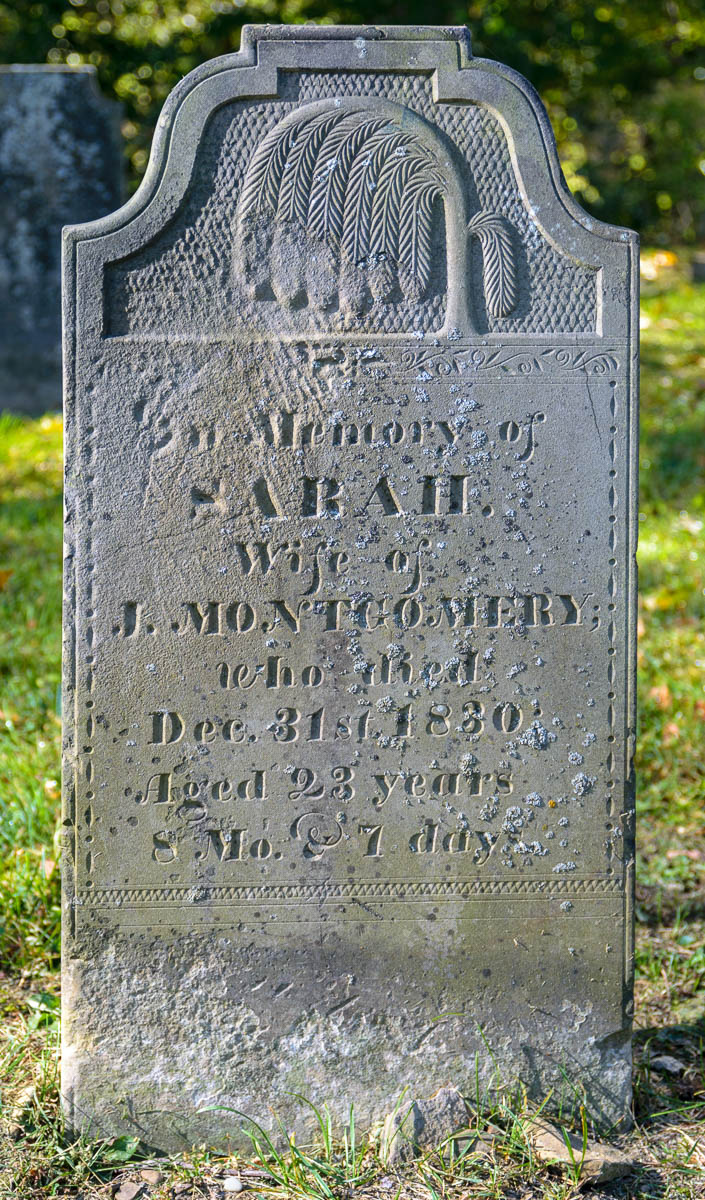
Sarah Montgomery was buried in (where else?) Old Olivesburg Cemetery, and her headstone reports that her date of death is 31 December 1830, "aged 23 years, 8 months, 7 days." This puts her birth date on 24 April 1807 - which is precisely in the age range of the remaining unidentified female in James Callin's 1820 household.

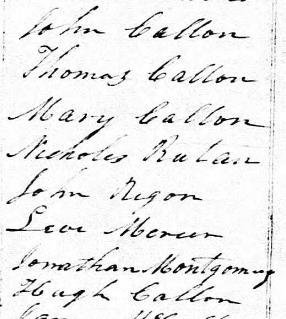
Coincidentally, Jonathan Montgomery also happens to be one of the names listed as one of Milton Township heads-of-household in 1830 - on the same page as several Callin families: John (Sarah's uncle), Thomas (her brother), Mary (her widowed mother), and Hugh (another brother).

I have yet to uncover a marriage record or any documents from before 1830 that affirmatively tie Sarah to our Callin family, but if we accept that Elizabeth and Hugh are children of James and Mary, then that means that every record we have found and every Callin name mentioned in the local histories to this point has turned out to be someone related to one of the two Callin brothers. The fact that the only remaining "unknown daughter" has a convenient birth date suggests very strongly that Sarah is that person.

Just to sum up, this is all the evidence I have for this theory:

  • one mention of her maiden name in her husband's obituary
  • a birthdate calculated from her headstone
  • the Indiana death certificate for Sarah's daughter (Mrs. Huldah Walker), which gives Huldah's mother's maiden name as "Sarah Callin" and birthplace as "Ohio."
  • the circumstantial evidence of a girl of this age living in the household of James Callin in 1820.

I have a lot of work to do to, tracing the descendants of her three daughters, but if you come back next week, we'll get started on them!

- -- --- -- -
Yes, this discovery will delay the book, as adding one more person to that early generation will throw off the outline - but I think you'll agree, it's worth it to have a more complete picture in the end! The good news is that if my reasoning is sound, this should be the last child of James or John Callin left out there to find.

Time will tell.

As always, if you've found one or more of your relatives mentioned in this blog, please get in touch. You can comment below (anonymous comments are usually not as helpful), or email "mightieracorns" at Gmail.com.

We have many ways to get in touch:

a Facebook page - https://www.facebook.com/MightierAcorns/
a Twitter feed - https://twitter.com/MightierAcorns
a Ko-Fi cup - https://ko-fi.com/mightieracorns


...and if you prefer a private group, we still have the Callin Family History group on Facebook for "cousins only" (there will be a question about how you're related to the family before you can join).

Until next time... Happy Hunting!

Friday, February 7, 2020

The Montgomery Brothers and the Gold Rush

Welcome back, cousins!

We spent the last year and a half (give or take) since The Montgomery Connection learning everything we could about the Montgomery family, but we still don't know a lot about these last two great uncles. In fact, when it comes to one of them, I feel like I haven't learned much more than what we saw in the biographical sketch about their brother, Theodore:

To these parents were born five children- Mary, now deceased;Sarah, now the wife of Henry Davidson,living in Halsey,Oregon;Theodore, of whom this sketch is concerned; Porter, deceased at Vicksburg, Miss.;and Callen, now interested in the mining business in Coloma, Cal.
(from the Fulton County, Indiana Handbook, published by Tombaugh House)

 When records can't be found, we have to make some guesses, and today's story starts with a lot of guesses.

Porter Montgomery (b. ca. 1828)

I have determined that Porter was born around 1828, because most biographies (like that attached to Theodore) list children or siblings in order of birth. We know that these two younger Montgomery boys had to be born before their mother's death in 1834, so they were almost certainly born in Richland County. Since we have a pretty good idea when his (we assume) younger brother Cal was born, and since we know how human biology works, 1828 is a good guess for Porter.

As for the rest of Porter's story, the line "deceased at Vicksburg, Miss." suggests that he might have died in the Civil War. The Siege of Vicksburg was considered a turning point in the war, taking place in the spring and summer of 1863. Porter would have been about 35 years old, so it's possible that he was there, but I haven't been able to place him there with any certainty. For one thing, there is only one record of a Porter Montgomery in the National Parks Service's Civil War Soldier database, and that person served in the 8th Regiment, Pennsylvania Reserve Infantry (37th Volunteers) - which never saw service south of Virginia.

Also, the Civil War took place from April 1861 through April 1865, so if he was alive during that time, we should expect to see Porter appear somewhere in the 1850 and 1860 Census. Instead, we find no records of a Porter Montgomery who matches our boy in any of the databases.

It's possible that, like his older brother, Theodore, Porter might have served in the Mexican War in the 1840s - and if he died in that war, he would not appear in a later census - but that war wouldn't have placed him in Vicksburg. Of course, he could have gone to Vicksburg for any number of reasons at any other time, and we may have simply not found such a record, yet.

But, as I said, these are all just guesses - at least for Porter.

Callin "Cal" Montgomery (1830–1912)

 Cal Montgomery was born in October 1829, according to the 1900 Census - which I have found can be off by a year in either direction as often as it is correct. His other appearances in the census records put his birth "abt 1831," so I suspect the correct birth date is October 1830.

(The 1900 Census was the first one to ask for a month and year of birth, but I suspect most census takers asked "how old are you?" and then did the math - which would explain why they would be a year off for people who were born in months after the one during which that census was been taken.)

We do not know much else about Cal's early life. He certainly lived in Rochester after his father remarried and moved there around 1837. Cal was not named as one of the members of his brother's party when Theodore traveled to the gold country around 1849; but Cal would have been 20 at the time, and since there is no 20-year-old Callin Montgomery listed in Rochester on the 1850 Census, it seems likely that he either accompanied his brother's party, or set out on his own soon after.

The earliest record we have for Cal is a "C Montgomery" listed in Coloma, El Dorado County, California, on the 1860 Census: born abt 1831 in Ohio, which most likely means he was born in Richland County, Ohio.
19th century placer miner (Wikipedia)

Military records suggest that he enlisted in the Union Army, serving in Company F of the 4th Regiment, California Infantry on 16 October 1861. He was stationed at Benicia Barracks in 1863, and he mustered out on 26 August 1864 at Drum Barracks.

After the war, he returned to Coloma, appearing in the 1870 Census as a saloon keeper with a wife, Laura S, age 18. While he gave the same birth date (abt. 1831), he gave his place of birth as Indiana. I'm inclined to think that one census taker probably asked that question as, "where were you born" and the other asked "where are you from" - and Cal would have been about 7 or 8 years old when his father moved the family to Rochester, Indiana.

1870 is the only time we see Cal married. Laura, who was recorded as being "3/4 white" and born in California, does not appear in any other records. By 1880, Cal was listed as single again, living in Gold Hill, El Dorado County, and working as a placer miner.

Numerous voter registration records and occasional mentions in The Record-Union of Sacramento over the years establish Cal as the kind of colorful side character you might see in an old western. He was the ol' prospector who passed word of a generous stranger in Coloma to a Wells Fargo official in Placerville, thus helping authorities solve a stage coach robbery. He was the grubby old timer who dealt with the remains of a Chinese man who was suffering from leprosy and committed suicide, leaving a corpse no one wanted to go near hanging in remote cabin. (Fair warning: that story was written to sell papers, not to pay respects to the dead.) 

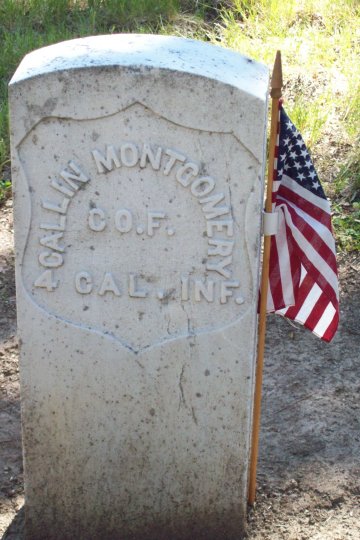
Cal lived in El Dorado county until he was in his eighties, appearing on the 1910 census at a Pilot Hill address in Greenwood. The California, Death Index, 1905-1939 records his death on 3 October 1912 in Napa County, California. When he died, someone had him buried in Veterans Memorial Grove Cemetery in Yountville, Napa County, and I did find his Find-A-Grave memorial.


Callin Montgomery, on
Find-A-Grave

- -- --- -- -

So there you have it: unless we make another major breakthrough and open up another years' worth of research, I think we have tracked down as many of James Callin's descendants as is currently possible. I've already re-started the process of compiling all of the information in these blog posts into book form, and I expect it will probably take several months (if not a full year) to copy-edit and proofread all of it.

Though I'm not sure quite what to do next, I don't plan on abandoning this blog. I hope to turn my attention to puzzles and problems in other branches of my family, and I'd love to figure out a way to bridge the focus from the very specific "people I'm related" and the very general "here is how to do a genealogy" so this blog can be more useful to more people. I'm open to ideas!

As always, if you've found one or more of your relatives mentioned in this blog, please get in touch. You can comment below (anonymous comments are usually not as helpful), or email "mightieracorns" at Gmail.com.

We now have more ways to reach out:

a Facebook page - https://www.facebook.com/MightierAcorns/
a Twitter feed - https://twitter.com/MightierAcorns
a Ko-Fi cup - https://ko-fi.com/mightieracorns


...and if you prefer a private group, we still have the Callin Family History group on Facebook for "cousins only" (there will be a question about how you're related to the family before you can join).

Until next time... Happy Hunting!

Friday, September 7, 2018

Spellchecking the John Berlin Mystery

When you sit down to solve a jigsaw puzzle, you already have a few advantages. Usually, you know that you have all of the pieces in your box. And usually, you have a picture on the box to show you what your solved puzzle should look like. Most importantly, though, you know that only the pieces that should fit together will fit together.

Solving a family history puzzle is the opposite of all of those things. You probably know you don't have all the pieces, and you probably never will. The picture on the box may not have been labeled properly, and when you do find clues, they may add up to give you three or four different answers - sometimes, even the right one!

If we're lucky, we can find enough evidence that matches the pieces we have to tell us where to look for the next several pieces. And that's the game. You will find a lot of information, and some of it is obviously wrong. But some of it is right — and how do you know what to hold onto, and what to let go?

Today, I'm taking a fresh look at the family of Elizabeth Berlin, rebuilding the case I made in a post from 2016.

The Pieces

The Callin Family History


According to the Callin Family History, Elizabeth Berlin is my 3rd-great-grandmother. Here's what we have to work with from the CFH:


Record of William Callin, 3rd son of John Callin, who was 2nd son of James 1st.
Born May 10, 1813, died Nov. 9, 1881, at Bowling Green, O.

Married to Elizabeth Barlene 1837 who died Nov. 14, 1903, at Bowling Green, O., aged 86 years.

The William Callin-Elizabeth Berlin marriage record


One guiding star in any kind of historical research is the rule that tells us to always look to original and primary sources. The CFH is not a primary source, but a marriage record would be. We can see the image of the original record here:

Detail from Ohio, County Marriage Records, 1774-1993

Despite the florid handwriting and odd line break, it is easy enough to see that "Mr. Wm. Cal-lin and Mifs Elizabeth Berlin" were married on the 29th day of Sept. in Richland County, Ohio, in 1836. (I had to crop the part of the image that showed the year, but if anyone needs to see that to believe it, I can send the whole page.)

Notice the way things add up, yet are different. The CFH says William married Elizabeth Barlene in 1837, and the marriage record says he married Elizabeth Berlin on 29 September 1836. It's easy enough to accept this record as proof that corroborates the CFH, but even though they aren't exactly the same. The year is definitely close enough, and the spelling of the surname suggests that a combination of pioneer illiteracy and varied pronunciation could complicate things for us.

Rosemary's Memoir


If you are a long-time reader of this blog, you may remember an early post, Silk or Satin, in which Elizabeth's granddaughter, Rosemary (the youngest daughter of George Callin, the writer of the Callin Family History) recorded her memories of Elizabeth after her death in 1903. Even Rosemary wasn't sure how to spell Elizabeth's maiden name, and she titled her memoir, "Things I Have Been Told About My Grandmother, Elizabeth Berlien (Barline) Callin."

That confusion in what, exactly, Elizabeth's maiden name was makes it difficult to find Elizabeth's family in the Census because there are many households with similar surnames in the 1830 and 1840 Census records for Ohio. Without more information, it would be impossible to track them down.

The Wood County history


Pages 923 and 924 of the Commemorative Historical and Biographical Record of Wood County, Ohio have a biographical sketch of my great-great-grandfather, John H. Callin, son of William and Elizabeth. In its description of William, it says: "In 1835, he married Elizabeth, daughter of John Barlin, of Ashland..."

The Wood County book is definitely not a primary source, but that statement may help us find one. At least we have two more crucial clues: a father's name, John, and a location to hunt in: Ashland. (Also, with that source, we are now up to five alternate spellings of the surname.)

Detail from the 1840 U.S. Census for
Mifflin, Richland County, Ohio
I assume that the location referred to as "of Ashland" is Ashland County, Ohio, where William's father and uncle settled when they arrived in Ohio from Pennsylvania. However, we have to note the fact that Ashland County, Ohio, did not exist in 1835, when the Wood County book says they were married. That book was published in 1895 or 1897 (depending on which edition you find), and it seems that it was referring to the counties as they existed in the 1890s. Ashland County was formed in 1846 from parts of Huron, Lorain, Richland and Wayne Counties. When the Wood County book says "Ashland," it could mean any one of those other counties.

The U.S. Federal Census


In the 1840 Census, we find a John Barlean listed as the head of a household in Mifflin, Richland County. Mifflin is near enough to Milton that the Barlean and Callin families likely knew each other. The 1840 Barlean household is enumerated as having one male between the ages of 50 and 59 (presumably John, putting his birthdate between 1781 and 1790), one female between 50 and 59, and one female between 15 and 19. This could be a younger sister of Elizabeth's, with a birthdate between 1821 and 1825.

Further searches failed to turn up records for 1850 or 1860, but in 1870 we can see an 83-year-old John Barlean listed with his wife, Mary A (age 79), living in the Young household in Vermillion, Ashland County, Ohio. The head of that household is listed as Catherine Young, 50 years old, and born in Pennsylvania. Not only do the estimated birthdates of John (1787, in Pennsylvania) and Mary A (1791, also in Pennsylvania) fit with their 1840 record, but Catherine Young (estimated birthdate of 1820) could be the younger female in that 1840 record, too.
Detail from the 1870 U.S. Census for
Vermillion, Ashland County, Ohio

The Ashland County History


Catherine's eldest son, Samuel, is featured in a biographical sketch in A. J. Baughman's History of Ashland County, Ohio, which says (emphasis is mine):

He is a son of Michael and Katharine (Berlean) Young, both of whom were natives of Pennsylvania as were the paternal grandparents, Mathias and Mary Young. ... The maternal grandparents of our subject were John and Mary Ann Berlean, who were likewise born in the Keystone state and died in Ashland county. ...John Berlean served his country in the war of 1812 and was at Baltimore during the hostilities there. The Berlean homestead, upon which the mother of our subject [the same Catherine we see in the 1870 Census] was born, was situated in Pennsylvania on the Maryland state line.
...Michael Young ...accompanied his parents on their removal to Mifflin township about 1829 and Katherine Berlean arrived about a year later. They were married here and became residents of Mifflin township, taking up their abode on a farm within its borders immediately after their marriage and remaining there until called to their final rest.

A War of 1812 Pension record


So, we now have another clue that tells us where to hunt for primary sources on John Berlean: his military service in the war of 1812. But this is also where I think I made a mistake; look at what I said in 2016, in the post "Great-great-great-grandpa William Callin," specifically this part:

"John Berlin turns up in the War of 1812 Pension Application Files Index, 1812-1815 and from that record we learn that he served from 21 April 1813 to 22 November 1814, in both Captain William Craig's and Captain Jonathan May's companies in the Pennsylvania Militia. The record also shows that he married his second wife (the widow claiming his pension) in 1830 in Columbiana county, Ohio. (Happily, his first wife, Anna Coy, is also named.) It also lists residence dates for Van Wert county, Ohio (1851-1856) and Canton, Stark county (1871); he died in Stark county in 1874."

When I wrote that previous post, I ignored some problems with that record that probably indicate it does not identify our John Berlin/Berlean. First, that pension record says nothing about Ashland County, or any of the neighboring counties that became Ashland later on. Second, the name of the widow given in the pension record was Catherine Landis; this means that even if we assume some scenario where the John Berlin in this record lived in Mifflin in 1840 and in Vermillion in 1870, the name of his wife in the 1870 Census does not match the name of his widow on the pension record.

I suppose it is possible that John and Mary Ann lived in Ashland in the 1840s, moved to Van Wert County during the 1850s, then back to Ashland in time for the 1870 Census, moving finally to Stark County by 1871. But there are problems with that theory. I find it unlikely that "Catherine" would use the name "Mary Ann" only when living in Ashland County. (Mary Ann is not Anna Coy, either, because Anna Coy died before 1830.)

The Ashland County History also specifically states that John and Mary Ann Berlean "died in Ashland county." Unfortunately, I have been unable to confirm this with records of any kind. They do not appear on the 1880 Census, and I can find no death records in Ashland county during the 1870s. I do see a Find-A-Grave memorial for John Berlin and Catherine, both of whom died and are buried in Stark County. It is possible that the writer of the Ashland history confused the location of their deaths, but that seems unlikely, as the two counties are about 60 miles apart.

When all is said and done, I don't think the John Berlin in this pension record is the same as the John Berlin who lived and died in Ashland County.

The Westmoreland County history


George Dallas Albert's History of the County of Westmoreland, Pennsylvania holds two more clues to the origin of our John Barlean (again, emphases mine):

pg. 611 -

"THE BERLIN FAMILY

"In 1794 one of the soldiers who came from Eastern Pennsylvania in the army to put down the "Whiskey Insurrection" was Jacob Berlin. He got a furlough in Pittsburgh to come out to that part of Franklin township now included in Penn, to visit his uncle, Jacob Berlin, who had settled there some twenty years before. He so liked the country that in the spring of 1795 he returned with his wife, formerly Miss Eve Carbaugh.
"He finally settled between the Fink and Lauffer farms. His children were four daughters and six sons, viz.: ...John, Frederick, Joseph, Samuel, Powell, and Elias, of whom Powell removed to Forest County, Frederick to Clarion, and John to State of Ohio. Col. Elias Berlin, the youngest son, was born in 1803...His brother John served in the war of 1812."

And there is this about John's likely bride:

pg. 668 (within the biographical sketch of Jacob Baughman)

"After his marriage Adam Baughman settled on a farm in Armstrong County, about seventy miles up the Allegheny River, and here four children, viz.: Catharine, Michael, Polly, and Jacob, were born. Upon the death of his brother Henry...he sold his place in Armstrong County and returned to Westmoreland, and became the owner of and occupied the homestead until his death. Here the following children were born, viz.: Elizabeth, Margaret, Peter, Anna, Henry, Christian, and Lydia...Anna, wife of John Berlin, six sons and three daughters..."
While none of the places associated with Jacob Berlin are places that I would describe as "situated in Pennsylvania on the Maryland state line," I'm inclined to think that the other details fit with our John Berlin; I'm even willing to think that because the biography of Samuel Young (which names his wife as "Mary Ann") might be more accurate than the biography of Jacob and Adam Baughman (which calls her merely "Anna") because the Samuel Young biography was written by a descendant of the Baughmans! (How's that for history rhyming?)

Conclusions


While I would prefer to have solid, primary sources to prove the relationships here, I think it's reasonable to say that I have enough evidence to assert that we know the key facts about Elizabeth Berlin:

1. William Callin married Elizabeth Berlin on 29 September 1836 in what was then Richland County, Ohio.
  • Ohio marriage record (primary source)
  • Callin Family History (secondary source; last name given as "Barlene" and date as 1837)
  • Wood County History (secondary; last name given as "Barlin" and date as 1835)

2. Elizabeth's father was John Berlin, "of Ashland County" (Ohio)
  • Wood County History (secondary; last name given as "Barlin")

3. Elizabeth's sister was Catherine (or Katherine) Young
  • Ashland County History (secondary; last name given as "Berlean" and Elizabeth not named)
  • 1870 U.S. Census (primary; shows Catherine Young and John & Mary Ann Barlean living in same household)

4. John Berlin's origins were in Westmoreland County
  • Ashland County History (secondary; gives name as "Berlean," identifies Pennsylvania, mentions 1812 service)
  • Westmoreland County History (secondary; gives name as "Berlin," identifies wife as "Anna," places him in Ohio)
That should give us some solid ground to build on.


Friday, September 16, 2016

On the Sly

William Sly came from England to the United States in the 1850s. He was naturalized in 1866 at Bowling Green, Wood county, Ohio. According to the Callin Family History, he married Harriet Callin (1838-1907) in 1859.

We don't know for sure who William's parents were or where in England he came from; there are a couple of candidates in the UK Census records. Other researchers have noted an 1841 England Census which documents a Sly family in a Wiltshire parish called Horningsham: father James (b. 1786), mother Susanna (b. 1796), son William (b. 1826) and his two brothers, James (b. 1829) and Thomas (b. 1832). All of them list Ireland as their place of birth, except for the father, James; William is listed as a shepherd, and James as a pensioner. There is a death record for James in April 1849, which may have prompted a 23-year-old William to seek his fortune in the New World.

William's birthplace in all of his more recent, American records is "England," and not "Ireland," but that isn't enough to rule out this Census record, in my opinion, since the family did live in England, and probably considered themselves as being distinct from the other Irish immigrants arriving in the United States during the 1840s and 1850s.

There was also a James Sly of about the right age to be William's brother from that UK Census record. This James lived in Wood county, dying in 1893. The men would have certainly been aware of each other, living in the same place for decades, but neither of them mentioned the other in their wills, we don't have any newspaper notices from the time, and nothing else solidly connects them to that 1841 record. It could be that they weren't related, or they might have had a falling out, or James might possibly be a more distant cousin. It's hard to rule out any possibilities or draw any definite conclusions in the absence of records linking them. And since even William reportedly wasn't sure of his own birth date when he died in Wood county, Ohio, in 1894, we don't even have that name/birthday combination to narrow down our searches.

Hattie grew up on the Callin family farm in Richland county, which her father had purchased after her grandfather died in 1835. She was probably too little to remember most of the relatives who had lived there; her great-uncle Alex would have taken his family to Iowa when Hattie was still a baby. She would have been about six when her father, William, made his journey to Iowa to bring back her aunt Margret and cousins William and Warren. She might have known her great grandmother, Elizabeth (Simon) Callin, before Elizabeth moved to Auburn, Indiana, to live with the Ferguson branch of the family.

When she was about eleven, her father bought and cleared the new farm in Peru township, Huron county. They would have still been living there when she married William Sly; according to the 1860 Census, she and William lived in Oxford, Erie county, Ohio after they were married. By 1862, however, they had moved to Plain township, Wood county, where her father had purchased and cleared another 160 acre farm.

The petroleum industry in Ohio began in 1859, with an oil well drilled in Trumbull county; but major oil and gas reserves were also discovered in Wood county in the 1880s. According to my grandfather, the Callin farm in Wood county had been sold before William Callin's death in 1881, and it was family legend that "we could have been millionaires" had the oil not been discovered after that. But the Sly family evidently benefited from the oil boom of the 1880s and 1890s.

According to William Sly's will:

"I desire first that all my just debts be paid out of my property, and after the payment of my said debts, I give and bequeath to my beloved wife Harriet E. Sly, the rents and profits of all my real estate, exclusive of the income thereof derived from Royalty from petroleum oil or gas, to have and to enjoy the same for and during the remainder of her natural life time, or as long as she remains my widow, including in the above all the lands and tenements which I may own at my death, both farm and town property."

I don't like to project too much of my own ideas about what people thought and felt based on a few old papers, but the William Sly will has a few comments that hint at the relationships between his children. First, he named his son in law, Cyrus Young, as his executor, and while he divided the shares of his wealth between his three youngest surviving children equally, he only gave his oldest son, William, $50. Later, he added a codicil which essentially swapped William's share for his youngest sister's - leaving the $50 to Hattie May, and giving William a full third of the rest of the estate.

We may discover some clues to explain some of this in coming weeks. For now, it seems enough to say that William Sly's widow lived comfortably in her home in Bowling Green with her daughter until her death in 1907.

Until next week, I'll leave you with Hattie's record in the CFH:

Record of Harriet Callin Sly, only daughter of William Callin, who was the 3rd son of John Callin, who was the 2nd son of James 1st.

Born in 1838 in Ashland, O., died in 1907, in Bowling Green.
Married in 1859 to Wm. Sly who died in 1894.
To this union were born five children:
William in 1859.
Elmer in 1861, died in 1893.
Alice, born in 1864, died in 1896.
Eugene, born in 1866.
May, born in 1881.


Friday, April 29, 2016

Indiana Ettingers

Mildred Ferguson was born to James and Eliza (Callin) Ferguson in 1837. She was the third of what would be eleven children.

That was the year Martin Van Buren succeeded Andrew Jackson as President of the United States. It was also the year that an 18-year-old Queen Victoria took the throne in England, beginning the 63-year reign that we call the Victorian Era today. Closer to home, Michigan was admitted as the 26th state that January, and the city of Chicago was incorporated.

It is unlikely that baby Mildred knew all of this was happening. Her life would have been that of the pioneer farmer's daughter. She and her two older sisters would have surely been busy with chores and tending the growing number of siblings around the farm. At some point, though, her life was uprooted along with all of those brothers and sisters, as the family moved west to Auburn, Indiana.

In 1850, Mildred would have been 13 years old. That year, Vice President Millard Fillmore was sworn in as President after the death of Zachary Taylor. California was admitted as the 31st state. And the "Compromise of 1850" forestalled a civil war, to the relief of many.

The Ettinger family was a numerous bunch, with many branches throughout the Midwest, including a large number who lived in Richland county, Ohio. The family we are looking at today originated in York county, Pennsylvania and came to Scott township in Sandusky county, Ohio, in 1837.

Daniel Ettinger and his wife, the former Catherine Jacobs, arrived in Ohio in time for the birth of their youngest son, William J Ettinger (1837-1920). Daniel eventually settled in Lexington, and taught school in Troy township. He was considered a very intelligent and communicative teacher, and an above average mathematician.

William would have grown up mainly in Lexington. Some time between 1850 and 1860, he left Ohio for Indiana. He would have turned 18 in 1855; perhaps he knew some of the people who had moved west, as the Ferguson family had done just before 1850. However he got there, and whatever motivated him to go, on 8 March 1860, William Ettinger married Mildred Ferguson in DeKalb county, and they set up a home in Auburn before they moved to Waterloo, where he worked as an undertaker and cabinet maker.

Over the following twenty years, the family lived in DeKalb county, and William and Mildred raised eight children; three sons and five daughters:


  • John Clark Ettinger (1860–1927)
  • Clara Ettinger (1862–1931)
  • Flora Ettinger (1866–1941)
  • Lyda Ettinger (1868–1950)
  • Catherine "Cassy" Ettinger (1870–1959)
  • George Daniel Ettinger (1873–1961)
  • William Hurben Ettinger (1879–1933)

The two eldest children did not leave any surviving children of their own, but they led interesting lives. In fact, I found the Indiana newspapers to be very well represented in the Newspapers.com database, which is where I learned a great deal about this family.

In January 1911, Mildred was reportedly very ill, and the family gathered together - but I don't know precisely when Mildred died. Years later, in 1920, William's health also failed, and he died in the home of his daughter, Cassy Faucett, at the age of 83, hailed as one of the oldest citizens of Waterloo. 

     1. John Clark Ettinger worked in Waterloo as a boy, and was a fireman in the grist mill operated by Duncan Bros, at the corner of Van Vleck and Sheridan streets.  He left home and began working as a fireman on the Chicago and Alton railroad, until he became an engineer. About 1917 he developed diabetes, but he lived a careful life and regained his health and was able to run on the railroad until a few weeks before his death in January 1927.

John married Mary Magdalene Schlemm (1870–1936) on 26 February 1890, in Sangamon county, Illinois. John and Mary lived in Springfield, Illinois, and she remained in their home after he died. 

     2. Clara Ettinger grew up in Waterloo, and married in June of 1893, at the age of 21. Her husband was Charles H. Rude, who ran a business in Tecumseh, Michigan, about 100 miles away. The young couple moved to Tecumseh, and two years later, they had a son: Harry Ettinger Rude (1895-1918).

Lightening strike at the Rude house
"LIGHNING STRIKES HERE"
The Waterloo Press, 18 Aug 1910
According to newspaper accounts, Charles abandoned his family when Harry was only six weeks old. In 1900, their family still appeared in the U.S. Census, living in Tecumseh; but in 1910, Clara Rude appeared in Grant, De Kalb county, Indiana, with Harry and her widowed uncle: William's older brother, Reuben Ettinger. At that time, she apparently worked as a dressmaker, but later accounts indicate that Clara and Harry had to rely on relatives for their support, with Harry living for a time with Clara's sister and brother-in-law, Cassy and Dexter Faucett. (This may have been related to the 1910 lightning strike that hit the house Clara, Harry, and Reuben were living in!)

Harry was actually born September 30, 1895, in Pawtucket, Rhode Island, but there is some question as to when his parents returned to Michigan and when they separated. He grew up in Indiana, for the most part, attending high school in Waterloo. After completing a course in civil engineering at what is now Northwestern University, he was employed as civil engineer on Chicago, Burlington and Quincy Railroad. He enlisted on November 5, 1917, in Chicago, and was assigned to the Medical Corps and was sent to training at Ft. Riley, Kansas. He contracted pneumonia and died on January 5, 1918. He was buried in Waterloo.

Clara eventually moved in with her sister's family, and died at the Faucett home in November 1931. After Clara's death, the Faucetts and her brother, William Hurben Ettinger, sued Harry's estate for $2,000 and $1,500, respectively, to compensate for their expenses incurred over the years. Harry's estate was an insurance settlement from the government.


Next week, I'll look at the Faucett family in more detail, show that their home was used for more than hosting funerals, and see how many Ettinger descendants we can fit into one post!

Friday, January 8, 2016

A Family of Respectable Size

Cyrus C. Campbell was born 23 March 1834 on his father's farm in Ashland* county, Ohio. His parents were Henry and Ann (Callin) Campbell, to whom we were introduced last week.

On 4 July 1859 Cyrus married Ursulla Amanda Springer (1839–1924), the daughter of one of Montgomery township's earliest settlers, John Springer. Ursulla's late mother, who died when Ursulla was only eight years old, was Elizabeth Carter, whose family had been among the earliest to arrive in Ohio in 1806. The Carter lineage can be traced back through at least three generations of men named Daniel Carter, to one who is said to have been part of Lord Baltimore's company, which settled the colony of Maryland.

If you seek out Cyrus and Ursulla in the 1860 and 1870 Census records, be aware that between the enumerators and the transcribers who digitized the records, they are probably indexed incorrectly. (Ancestry has them indexed in 1860, in the household next door to Henry and Mary Ann, as "C.C. and Knula Caryatull," for example.)

His father, Henry, worked as a shoemaker, and when Cyrus was young, he was listed as a cobbler, likely repairing shoes in his father's shop. In 1860, he was listed as a clerk; in 1870, he gave no occupation, and had a respectable estate built up. Sadly, he died at age 39 in 1873, of unknown causes, leaving his widow with two sons, thirteen and nine years of age.

Ursulla remarried quickly to Robert Sutton, and they had two daughters; Maud (b. 1874) and Grace (b. 1876). Mr. Sutton appears to have adopted the Campbell boys, who were listed in the 1880 Census with the name Sutton. But after they grew up and left home, they used the name Campbell again. (Note that the brothers also named their first born sons in honor of each other.)

As the 1880 lists the Sutton family in Auglaize county, and identifies Robert's occupation as "Publisher," I think it is safe to conclude that he is the same Robert Sutton who published the History of Auglaize County, Ohio, found here:


   1. Alden W Campbell (1860–1936) married Julia M. Kirkendall (b. 1859) in 1885. The couple was living in Illinois right after their wedding, but moved back to Ohio for a few years, around 1890, before relocating back to Greenup, Cumberland county, Illinois by 1900, where Alden took up farming. By 1910, their older children were out on their own, and Alden had established a farm in Baker, Martin county, Indiana, where he and Julia remained until after 1930.

They had three children, Howard Ernest (1886-1937), Lucille (b. 1888), and Marjorie (b. 1891), and in 1930 their grandson, Colin (b. 1916) was listed in their Indiana home. When Alden died in October 1936, he and Julia were residing in Chicago. Julia was 77 years old when he died, but I haven't been able to find any records to indicate when or where she died.

     a. Howard Ernest Campbell (1886–1937) was born in Illinois, and grew up on his father's farms. In 1900, he was a student living at home in Illinois, apparently studying electrical engineering. Whether he continued his studies or took a job, by 1914 he was living in Brooklyn, New York, where he married Edith Reynolds Whitney (1889-1936).

There are some records hinting that Howard may have had an interesting career; he may have been working aboard passenger ships as an electrical engineer. He doesn't seem to have served in the military, but if he was working aboard ships during World War I, and the 1920s, those were certainly exciting times to be at sea. The only certainty I have is that he traveled from Antwerp, Belgium, to New York aboard the SS Pennland in 1932. My theory is that he spent twenty years working on ships, retired in 1932, and moved his family to Louisville, Kentucky, where he started a new career as an electrical engineer for a company there.

Sadly, Edith suffered an intestinal blockage in 1936, and died that September from complications after the surgery to correct it. Howard died accidentally from carbon monoxide poisoning while working on his car in a closed garage the following November. His Kentucky death certificate names his parents and his wife, Vera N, whom he presumably married in the year after Edith's death.

        i. Colin Wilbur Campbell (1915–1984) grew up in Brooklyn, and at age 16, he was living with his grandparents in Indiana. After that, I can say very little about his life, other than the U.S. Social Security databases indicate that he may have gotten his Social Security number in Colorado, and that he died on 30 September 1984.

        ii. Barbara Lucille Campbell (1917–1992) also grew up in Brooklyn, but unlike her brothers, we do not have a record showing her on the 1930 Census. From the Social Security and Kentucky Death records, we know that she died in Louisville, Kentucky, at age 75, and that her married name was Barbara Campbell Rehm.

        iii. Gordon Whitney Campbell (1918–1982) seems to have led an adventurous life, to say the least. From his home in Brooklyn in 1920, he was sent to a boarding school in Lake Villa , Illinois by 1930. Allendale School was described by some sources as an institution for homeless boys, and was founded in 1897 by Edward "Cap" Bradley, a young Princeton graduate interested in the plight of urban youth and the poor conditions under which they lived. (See a photo of Boys at Drill, Allendale Farm, Lake Villa, Ill. c. 1917.)

Whatever led Gordon there, he grew up to serve in the U.S. Army in World War II and Korea, attaining the rank of Major. His records indicate that he enlisted in November 1940, while living in Pennsylvania. He married in Emporia, Virginia, on 30 August 1941, and he and his wife (who may still be living) had a daughter and a son.

Gordon died in Fresno, California, in 1982, and was buried there under a military headstone.

     b. Lucile Campbell (1888–?) is almost a complete mystery. She appears on the 1900 Census with her parents, brother, and sister, and then vanishes from the record. I suspect that since her brother was listed as "Ernest" on the 1900, she may have been listed by her middle name, too. But until we find a clue...

     c. Marjorie G Campbell (1891– ?) married Arthur Julius Craig (1884–1942) in Martin county, Indiana, in 1915. Arthur soon moved with his wife to Chicago, Illinois, where he was a high school teacher. Aside from a 1920 Census record that places Arthur in Boulder, Colorado, rooming in another household while working as a superintendent in a school there, Arthur and Marjorie seem to have remained in Chicago until Arthur's death in 1942. The couple appears not to have had any children of their own. After Arthur died, there was one more U.S. City Directory listing for a Marjorie Craig, widow of Arthur, listed in Boulder in 1946; but beyond that, no conclusive information about what happened to Marjorie.

   2. Howard W Campbell (1864–1930), Cyrus's second son, was born in Tennessee, and raised in Ohio. His father died when he was nine years old. He struck out from Ohio when he grew up, and settled in Rains county, Texas. There, he married Dora Helen Miller (1878–1960) on 26 August 1896, and took up farming. They had eight children, altogether (a.-h. below). We don't know precisely when he died, but it was before 1930.

     a. Alden Vernon Campbell (1897–1975) married his first wife, Bessie Jewell Day (1903–1935), probably in 1922. They had six children before 1935 (i-vi, below), when Bessie Jewell died unexpectedly. Alden relocated back to Ohio with his children and his widowed mother, Dora some time between 1935 and 1940. Dora died in Ohio in 1960.

Alden later married a second wife named Bessie M. (1900-1980). After they died, they were buried in Collinsville Cemetery, Butler County, Ohio.

        i. Aubrey Julian Campbell (1923–2005) married Jewell Vandeventer on February 22, 1947 in Covington, Kentucky. She was born in Laurel County, Kentucky, on April 9, 1924 the daughter of Charles Woods and Hannah (Durham) Vandeventer. They had three sons and four daughters, all still living. Aubrey died in 2005, and Jewell followed in 2008.

        ii. Thelma Louise Campbell (1925–2013) was born in Tyler, Texas on January 24, 1925.  On August 30, 1944 in Covington, Kentucky, she married Eugene Rogers, and they were married for 63 years before he preceded her in death in 2007. Over her lifetime, she took in approximately 120 foster children.

        iii. Wilma J Campbell (1927–?) was born in Emory, Rains county, Texas on 11 February 1927. We know that she was 13 in 1940, living with her family in Ohio, and we know from her sisters' obituaries that she died before 2011. Her married name was Wilma Davis.

        iv. Pauline R Campbell (1929–2011) was born March 3, 1929 in Mineola, Wood county, Texas, but lived in Middletown most of her life. She married Olney Combs, who died in 1985; her obituary names three sons and two daughters who are still living.

The two youngest children of Alden and Bessie, a girl (v.) and a boy (vi.), are still living

     b. Roy Stanley Campbell (1901–2002) was born 21 April 1901, and he married and had a son before he was twenty. Roy died in 2002 less than one month before his 101st birthday. His son is still living in Texas.

     c. Marion C Campbell (1903–2001) was born in Emory, Texas, on June 27, 1903, and married Elizabeth "Lena" Matlock (1907–2005) on April 26, 1924 . He was a turret lathe operator for Steel Products Engineering Co. in Springfield, Ohio, for 33 years, retiring in 1969. He and Lena had four daughters and two sons, as well as an infant daughter who died in 1933, around the time the family relocated from Texas back to Ohio.

        i. Helen Jane Campbell (1925–2010) was an operator with the Kissell Company, and was married to Roger E. Bayes (1921-2009), a U.S. Postal Service letter carrier for more than thirty years. They have one son and one daughter still living.

        ii. Vernon E Campbell (1926–1984) enlisted in the final year of the second World War, on 7 April 1944. He worked as a machinist in Springfield, Ohio, through the 1950s. I assume from the City Directories that he was married to Florence, though I could not find marriage records or any further information about her. When Vernon died in 1984, at age 58, his wife was one Pansy Ellis (1922-2005), and they seem to have married around 1974.

        iii. Marion Francis Campbell (1927–2013) was a veteran of the U.S. Navy where he served in WWII and the Naval Reserves. He worked for New York Central and Conrail for 42 years. He and his wife (still living) had two sons, the elder of whom was also a railroad worker: Robert Michael Campbell (1947–1989) died at only 41 years of age.

        iv. Shirley Mae Campbell (1930– ?) appears on the 1930 and 1940 Census with the rest of the family, and her father's obituary mentions her as preceding him in death; but I have found no other records to say how old she was when she died.

        v. The fifth child of Marion and Lena was a daughter who is still living in Ohio.

        vi. Infant Daughter Campbell (1933–1933) is buried in Ohio.

        vii. Miriam Colleen Campbell (1939–2012) attended Brown Mackie College in Salina in the early 1990s, and was the owner and operator of DuCharme Tax Services for twenty years. "Mim" DuCharme, as she was known, adopted her granddaughter in 1996, and raised her. Mim died in 2012.

     d. Harold Ellsworth Campbell (1905–1989) was born in Texas, but by the mid-1920s he had relocated to Ohio. He married Doris E. Longbrake (1904–1969) on 23 October 1926, and they had a daughter and two sons before 1940. Their daughter is still living, but their sons are not.

        ii. Fred S. Campbell (1938–2009) married Jeanne E. McCormick (1945–2011) on 22 December 1964 in Melbourne, Florida, and they had three sons and a daughter. Fred was a veteran of the U.S. Air Force, and worked as a senior engineering emissions technician at General Electric for over 35 years, retiring in 2002. He served as Minister of music for 15 years at Ross Avenue Church of God.

        iii. Homer Lee Campbell (1930–2012), apparently named for his uncle, married in Middletown, Ohio, on 21 August 1975 and has two sons still living. He was a veteran of the U.S. Army.

     e. Homer Leonidas Campbell (1907–1987) was born in Rains county, Texas, moved to Ohio, and married Mary E. Kyser (1910-1988) either in 1934 or 1937. They have one daughter, still living.

     f. Grace Dorothy Campbell (1911–1999) married Roger Wynston Longbrake (1901–1981) on 31 August 1928 in Covington, Kentucky, and they relocated to Shelby, Ohio, some time around 1937. Roger was the older brother of Doris Longbrake, wife of Grace's brother, Harold Ellsworth Campbell.

Roger and Grace had six sons, five of whom are no longer with us:

        i. Hugh Roy Longbrake (1929–2010) - married Darlene D Donhow (1929–2007) in 1953.
        ii. Gerald Elsworth Longbrake (1930–2005)
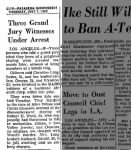
Longbrakes in trouble
"Three Grand Jury Witnesses
Under Arrest" - 7 July 1960
Pasadena, CA
        iii. Howard Mitchell Longbrake (1932–2005) - married MaDonna Accordino (1937–2006). They were survived by two sons. Howard was a 20 year U.S. Marine Corps veteran, serving in Korea and Vietnam.
        iv. Horace Leondis Longbrake (1936–2008)
        v. Wynston Delmar Longbrake (1938–2002)

Their youngest son, George, is presumably still alive. Normally, I wouldn't include information about a living individual, but he and his brothers, Gerald and Wynston, ran into trouble with the law in a 1960 robbery (see linked article to the right). This is probably not something their families want to remember, but it is a matter of public record.

(See "Problematic: Between History and Gossip" for thoughts on the difficulty of documenting uncomfortable truths.)

     g. Daughter Campbell - It is highly unusual to find living relatives born before 1920, but since I can't find any records for this lady, I must assume that she is still alive. Until I know for sure, I will continue to respect her privacy.

     h. Marjorie R Campbell (1919–1998) was a Warrant Officer in the U.S. Navy during World War II, if I'm reading her Find-a-Grave entry correctly. She married Alvie Frank Samford (1912–2004), and they lived in Riverside, California.

Obviously, there is a lot left to learn about the Campbell families. Despite his early death, before turning 40, Cyrus Campbell left a large legacy in his surprisingly numerous descendants. Here's hoping that those still with us are happy and healthy!


* Milton township was originally part of Richland county, until Ashland county formed in 1846.

Friday, January 1, 2016

Meet the Campbells

...our story so far...


Ann Callin was ten years old in 1816 when her family left Pennsylvania for the wild frontier of Ohio. She had two older brothers to look out for her (John and George), two younger sisters to look out for (Sarah and Eliza), and two baby brothers (William and James).

Her father, John, planned to settle on a farm with his older brother, her uncle James. Her cousins were four adventurous boys: Thomas and Hugh, who were older than her, and Alec and James who were younger. Having so many people on one farm meant that there was a lot to do, but there were a lot of hands to do it all, and her mother and Aunt Mary surely kept them all occupied.

Ann's mother, Elizabeth, had two more children after the family arrived in Ohio: Hugh in 1817, and Margret in 1819. As the oldest of the four girls, Ann would have been well schooled in running the household.

Even as the two-family farm expanded, the township was growing rapidly around them. Richland county had no more than 150 people living in it in 1812, but by 1825, there were an estimated 8,000. There were bound to be problems, as in 1820, when uncle James was killed in an altercation with a man named Fowler. But the family was large, and strong, and most of their neighbors were industrious and kind.

Among those neighbors was a young man by the name of Henry Campbell. Henry's father was one of the many early settlers who found success farming in Ohio. He was five years younger than Ann, but he had been born in Pennsylvania, as she had been, and when he acquired land in Milton township, not far from where her brothers were clearing their own farms, he needed someone who could run a household to help him start a family.

And so, on 20 August 1833, at 26 years of age, Ann married Henry and joined him on his farm. Their first son, Cyrus, was born the following March. In those first ten years, the couple had five children. The youngest, Cornelia, was born 13 October 1843, but died before her sixth birthday: 13 March 1849. Their middle child, a daughter named Elizabeth born in June 1840, would stay at home with Ann and Henry, and never marry.

The children of Henry and Ann (Callin) Campbell:
  1. Cyrus C. Campbell (1834–1873)
  2. Harrison M Campbell (1837–1924)
  3. Elizabeth Campbell (1840–1897)
  4. Frances A Campbell (1842–1905)
  5. Cornelia Campbell (1843–1849)

Next week, we'll talk about Cyrus's descendants, followed by Harrison's the next week, and Frances Campbell Hoot's the week after that.

Henry died in Ashland, Ohio, at some point before the 1880 Census was taken; Ann appears there listed as a widow. There is a record for a Henry Campbell in the Headstones Provided for Deceased Union Civil War Veterans, 1879-1903 database, with a death listed as 4 April 1880, but this record lists the receiving cemetery in Zaleski village, Vinton county, which is 155 miles south of Ashland. If he served in the Civil War, Henry would have been in his early 50s at enlistment; that's not impossible, but it is unlikely.

Ann died on 18 March 1889, according to the Callin Family History, and Elizabeth survived until 1897. Elizabeth was buried in the Ashland Cemetery.

Some Tips About Ohio Families

Since Cyrus's family proved to take up a lot of screen, I opted to split them off into their own post, but then I felt bad for making this one so short. To make up for that, here are some things I've observed while researching all of these families.

Michigan: Popular Marriage Get-away? When I want to find marriage records for some of these relatives in the northern part of Ohio, particularly in the decades between 1890 and 1930, I have found that a lot of couples headed up past Toledo and got their licences in Hillsdale or Monroe, Michigan. Those aren't exactly lakeside resorts, as far as I know, but there must have been some reason for so many couples to have gone there to marry. Whatever the reason, if you're researching some people who should have a Richland county or Ashland county marriage license and you can't find it, take a look at Michigan.

U.S. Social Security Applications - This is a relatively new Ancestry database, and it has been a fantastic resource for me - for everyone who applied for a Social Security account, of course. The information is gathered from official forms submitted by the person registered to a particular Social Security Number, and while not every file has every piece of information, you can usually expect to find the following:

  • full name
  • parents' names (including mother's maiden name)
  • birth and death dates
  • married names (and sometimes dates to suggest when the marriage occurred)
  • places - these are tricky, but usually the correct place of birth is listed (it's probably abbreviated in a weird way, thought)

Obituary Blues - There are diminishing returns to searching for obituaries, and different ways to find them depending on when the person in question died. Here's how I usually go about searching.

Step 1: Google. This is my go-to, once I know at least a few facts about someone. I find that if I start with the person's full name (married names for women work best), followed by the word obituary, I usually get the one I'm looking for in the first page of results... if I get anything at all! If not, I add whatever other information I have; names of their parents or spouses can help; birth and death dates can help if you know those.

I'm usually successful with Google when the person I'm looking for has died within the last decade or so. Finding obituaries from further back than 2000 can be dicey.

Step 2: Newspapers.com - I'm paying for the Deluxe Ancestry membership, which includes limited access to Newspapers.com, so if Google comes up empty, I usually go here next. Start your search with the name of your person, and narrow your search using their interface (choose a state, date range, or even a specific newspaper if they have it in their database).

If you have a spouse's name, you can include that - so if you search for "King Kong Fay Wray" you should see results for pages that include all four names. That can help narrow down your search if you're looking for a common name.

Step 3: Rutherford Hayes Presidential Library collection - these folks show up in Ancestry, though if you want to read the obituary, you usually have to order a hard copy from them. At least they tell you which newspapers your obituary appeared in, so you can search for a digital version using Google or Newspapers.com, just in case. Otherwise, the $2.00 may be worth it to you.

Happy Hunting! (And Happy New Year...)

Friday, December 4, 2015

A Tragic Beauty

George's tree
(click for a closer look)
We have spent the last several weeks talking about descendants of George and Polly Ann (Lewis) Callin, starting with the post, Uncle George and the Underground Railroad.

Next we looked at the family of his eldest son, John Callin (1832–1906), and his second son, William H Callin (1834–1919), followed by four weeks of posts covering each of William's daughters and their families.

George and Polly also had four daughters:

  • Minerva Callin (1836–1911)
  • Lavina* Callin (1839–1877)
  • Sabra Ann Callin (1837–1849)
  • Amelia A Callin (1849–1899)
While their birth and death dates are recorded in the Callin Family History, some of the information there is wrong or missing. The CFH does not have Minerva's date of death, for example; it just says "died," and since it was published in 1911, we have to guess that she died before then. It also lists Lovina's* death date as "July, 1880" and Amelia's as "Nov., 1875," both of which turn out to be incorrect.

Sabry A. Callin
(memorial on Find A Grave)
Sabra Ann's short life was apparently not as short as the CFH would have us believe. While Find A Grave does confirm the date of her death as February 11, 1849, her headstone gives her age as "12y 1m" making her birth date January 1837.

Minerva's story is harder to tell, as the CFH gives us surprisingly little to go on. That book tells us that she married a "John Smith," and lists four children, two of whom it says "died," leaving us to assume their deaths occurred some time before 1911. Their names were given as Frank (died), Flora, Willie, and Helen (died).

There is a record in the 1860 Federal Census for a family that fits this limited information rather well. They were listed in the village of Harrison, Winnebago county, Illinois. The head of the household is a blacksmith (aptly named) John N. Smith, age 28, born in Ohio. His 26 year old wife, Minerva, and 4 year old son, Frank, were also born in Ohio; 3 year old William J and 1 year old Hellen A were born in Illinois.

Thanks to the detailed enlistment records kept by Illinois, we know that John enlisted in the 74th Regiment of the Illinois Infantry, Company A, in September of 1862. That record confirms his name and middle initial, his occupation, and his 1860 residence, and it describes him as being 5'6", with black eyes, black hair, and a "dark" complexion. He mustered out of the unit in Nashville in 1865.

Unfortunately for us, in 1870 and 1880, the only John Smith family listed in Harrison, Winnebago county, is that of an English husband and wife, Mary, with children who are decidedly not named Frank, Willie, Helen, or Flora. Searches for each of the people we know to be in our John Smith's family turn up very little convincing evidence. There is a 1900 Census record in Columbia, Whitley county, Indiana which lists a Helen Hudson, living with her husband and children, and her mother: one Minerva Smith. Sadly, there are enough "Minerva Smiths" in the United States during the late 19th Century that without more clues, I can't say for sure that this is the same one.

The name "Smith" is far too common, even when paired with the other details we have, to zero in on the clues we would need to say anything more certain about Minerva and her family.

Lavina married Edward C. Rickey (1831–1896) on 24 October 1855, when she was only 16 years old. Ed was a farmer by trade, born in New Jersey to John and Bertha (Howell) Rickey. His family had moved to Ohio around 1845 and settled in Huron county. Ed enlisted in the 192nd Regiment, Ohio Infantry, in 1865 spending the final six months of the war on duty in the Shenandoah Valley.

We know from Ed's obituary that the couple had a daughter who died in infancy, and three sons; the youngest of those also died in infancy. We do not know the cause of Lavina's death, but she died in July 1877, only a month after the birth of that youngest son. She was 38 years old. Two months later the baby died, too.

Ed remarried to Anna Salome Tessler, on 8 May 1879; they had a daughter they named Florence (1884-1969). Ed died 23 October 1896, and was buried next to Lavina in the Cogswell Cemetery in Bridgewater Twp, Williams county, Ohio.

     1. Clayton E Rickey (1858–1930) was eighteen when his mother died in 1877. He left Ohio, worked as a farm laborer for a time in Michigan, and then married Sadie Taylor (?–1892) on 1 October 1887 in Fort Wayne, Indiana. In 1888, they had a son, Roscoe; but Sadie died in 1892 leaving Clayton and four year old Roscoe on their own. After Sadie died, Clayton married Ellen Teeple (1866–1934), and they had five more children.

The records tell an unusual story, because while the Census records show Clayton and his family living in Indiana, most of his children's birth records placed them in Williams county, Ohio. The two places were about 80 miles apart, and it may simply be that Clayton's family remained close to the rest of the Rickeys living in Ohio; I suppose that could account for a family traveling 80 miles each time they have a baby.

We know that Clayton died some time before 1930, but I have been unable to find any records or memorials to provide more detail. Part of the problem lies in the fact that he tended to use his initials, "C.E." on most official records, and part of the problem lies in the bewildering variety of ways the records list Ellen's name; Ellen, Ella, Lydia E., and Temple, Tebel, or Topple, just to name a few.

     a. Roscoe Leroy Rickey (1888–1917) grew up in his father's household with his step-mother and half-siblings, and they were living in Elkhart, Indiana, in 1900. There is a death record for a Roscoe Rickey who died in Detroit, Michigan, in 1917, and while there is a Roscoe Ritchey in Kokomo, Indiana in 1910 with a wife, Lizzie, it is not certain that our Roscoe Rickey had a family of his own when he died.

     b. Marguerite Rickey (1893–??) married William Harry Heidrick, Jr. on 28 August 1915, and the license was recorded in Hillsdale, Michigan. They lived in Fort Wayne at first, and apparently moved with their two young daughters (Alice V., b. 1917 and Jeanette M., b. 1918) to Sioux Falls, South Dakota, by 1920. After that, I have been unable to find any further records.

There are numerous records for different spellings of "Marguerite Heidrick" -  Margaret, and Headrick being most common - but where they list a husband, the names do not match. As with the Smith family above, we will have to keep hunting to find these descendants.

     c. Paul Edward Rickey (1897–1940) fought in World War I, and served in the 81st Company of the Transportation Corps in 1918 & 1919. His residence was listed on his draft registration as Stutsman, North Dakota, where he was employed as a farm laborer. After the war, there are several records in the 1920s listing his address in Indianapolis, and in 1930, the Census shows him in Marion, Grant county, Indiana. That Census record says he is married, though that is the only record that says so.

Paul was buried with military honors in Portland, Oregon, after he died there on 25 October 1940.

     d. Hugh Rickey (1899–1904) five-year-old Hugh died in December 1904, almost a year after the birth of his sister, Florence. He died in Indiana, and was buried in the Riverside Cemetery in Montpelier, Ohio.

     e. Florence Anola Rickey (1904–1923) may have been named after her father's half-sister, who would have been twenty years old in 1904. Florence Anola married Leonard Christian Roebel (1901–1970) on 11 August 1923, but was taken by typhoid fever in November that year.

     f. Arlo R Rickey (1905–1988) was born on September 20, 1905. He married Fayma Kleber (1909 - 1980) on 27 June 1936, and they lived most of their lives in Fort Wayne, Indiana. He was 37 years old when he enlisted in the U.S. Army after the beginning of World War II.

Fayma died in 1980, and Arlo died on June 13, 1988 at age 82. They were both buried in St Joseph's Catholic Church & Cemetery in Marion Township, Indiana.

     2. Willis L Rickey (1864–1935) married Cora Shoffer (1865–1903) in 1888. She died when their son was only eight years old, and Willis remarried Hannah Drusilla Crouse (1872–1938). Drusilla was the recent widow of Ambrose Stroh (1863–1903), and Willis adopted her four-year-old daughter, Vera I Stroh (1900–1973).

Willis was the proprietor of hardware stores in the towns the family lived in. Over the years, they lived in Madison, Ohio (1900), Wilmington, Indiana (1910), and Detroit, Michigan (1920). Willis died in Parker City, Indiana, in February 1935.

     a. Earl Glenn Rickey, Sr. (1895–1959) married Alma Miller (1897–1983) on 5 May 1914. They had one son, Earl G Rickey Jr. (1915–1986), a lifelong resident of Fort Wayne, Indiana, who served in World War II.


Amelia was the youngest daughter of George and Polly Callin. She was born at their home in Monroeville on 16 March 1849. She married Mr. Charles Henry Horton on 8 November 1875, when she was 26 years old, and they lived in Wellington for 20 years before moving to Painesville.

Charles was born in Holley, Orleans county New York, on 25 April 1845, to Chauncey and Nancy (Masten) Horton. He served as a sergeant in the 55th Ohio Volunteer Infantry for the four years of the Civil War. According to his biographical sketch in the Commemorative Biographical Record of the Counties of Huron and Lorain, Ohio, he "was in the battles of Chattanooga and Buzzard's Roost, and was severely wounded at Resaca, but [after] recovering rapidly rejoined his company, and was with Sherman on his march to the sea." After the war, he invented a threshing machine and a brick making machine, which made his fortune.

The Hortons did not have children of their own, likely owing to Amelia's delicate health. She was known to have a chronic digestive disorder, and her obituary noted that her health prevented her from participating in church activities.

On 3 December 1899, after recovering from a severe attack of typhoid fever, she died from that chronic digestive disorder.

--     ---     --


This was a difficult post to write, as you can probably imagine. It is rare to find so much information about a family and still be left with so much untimely death and so many loose ends. I hate having to leave loose ends. Usually, the untimely deaths keep us from having the loose ends, but this family was special!

I will, of course, keep looking for more clues to finish the story, but for now, aside from the seven or so great-grandchildren of George and Polly whose fates we do not know, this is all there is. Arlo and Fayma may have had some children we did not discover; Paul may have had a family in the twenty years between Indiana and Oregon; and the Smiths and the Heidricks may yet turn up in some unexpected place.

Until they do, we will have these stories of lives lived with their tragic beauty in the middle of America.
--     ---     --

*Note that the CFH spells Lavina/Lovina with both spellings in different places; her husband's obituary spells it "Lavina" but her headstone spells it "Lovina."

Portrait of Amelia Callin Horton is of unknown origin, and is assumed to be in the public domain.

For more information about the Rickey family, visit the Rickey Family Association's Rickey Database (rickeyfamily.org).