Showing posts with label 1960s. Show all posts

Saturday, November 19, 2016

Tales of a Prentice

The middle son of John H. and Amanda (Walker) Callin, Prentice George Callin was born in Middleton, Ohio on 22 September 1887.
Prentice & Hattie Callin
wedding - 1910

Prentice grew up as the middle child in a family that valued both learning and adventure. He grew up and attended school in Fostoria, Ohio, and he may have been a student in Detroit in 1910, when he and his bride acquired their marriage license.

Harriet Ellen "Hattie" Owen (1891–1991) was born in Fostoria, Ohio. She was the daughter of Joseph Russell Owen (1866–1941) and Grace Shoemaker (1871–1964). Her father was a railroad man who later ran his own seed supply business.

Hattie and Prentice were married on 15 June 1910 in Fostoria, and the next few years saw the birth of their two sons, Owen and David. In 1915, they moved to Otsego county, New York, where Prentice's brothers, Byron and John, were living and working as teachers. When John enlisted in the Ohio guard, Prentice did, too; and by 1920, he had moved his family back to Bowling Green, where Prentice established himself as a farmer.

Prentice farmed and did clerical work during the 1930s, and worked in the post office in the 1940s. Later in his life, Prentice retired from his farm, and he and Hattie moved to California to be closer to their children and grandchildren. Prentice died in San Diego in 1960, on his 50th wedding anniversary. Hattie followed David and his family when they moved to Washington state, and she died in Shelton, Mason county, Washington on 1 October 1991.

Owen, c. 1912 with
Prentice and Hattie
     I. Owen Prentice Callin (1911–1965) graduated from Ohio State University and began his journalism career on the Lorain (Ohio) Journal in 1936. Later he was employed by the Ohio State Journal in Columbus, the Tampa (Fla.) Times and the Toledo (Ohio) Blade.

Owen married Vivien June O'Hara (1912–1999) in 1937, and in 1943 they moved to California, where Owen worked for International News Service. He later joined the old Los Angeles Herald-Express, and moved to the Times in 1963. He was working as a Los Angeles Times copy editor and former wire service reporter when he died at the age of 53.

Vivien, also a newspaper editor, remarried on 25 October 1969 to Arnold Theodore Fitzmier Sr (1916–1985), and they lived in Long Beach.

       A. Thomas Owen Callin (1941–2008) made the newspaper as a toddler, notable for having grown in his adult molars at only 2 years of age. He was a lifelong resident of Long Beach, California, and left behind his wife, son, and two daughters; all of whom are still living.
David Warren Callin
c. 1935

     II. David Warren Callin (1914–1983) married Helen Ruth Grant (1911–2003) in Auburn, Indiana, on 10 April 1936.

Helen was born in Vermillion, Ohio, to William Graden Grant (1887–1967) and Estella E Westbrook (1884–1986). The Callins lived in Ohio and California before moving to Port Angeles in 1970 and Sequim in 1984. Judging by their frequent appearances in the Daily News of Port Angeles, the couple were adept bridge players during the 1970s.

       A. Michael Prentiss Callin grew up in Los Angeles, and lived for many years in Woodinville, Washington. He worked for Qwest Communications, and moved to Oregon after he retired. He and his wife had one son and one daughter, and as of this writing, they have four granddaughters.

       B. Helen and David's daughter lives with her family in the Pacific Northwest.

       C. Grant David Callin is a science fiction author and retired Air Force officer. He published two novels in the late 1980s, Saturnalia and A Lion on Tharthee, as well as several short stories. During his Air Force career he set a record for human endurance as part of the U.S. space program's tests of human tolerance for designing spacecraft. In 1971, he appeared on a Flip Wilson TV special featuring "Record Makers" which included fellow guests Charles M. Schulz (creator of the Peanuts comic strip) and baseball legend Willie Mays.

Grant and his first wife raised three daughters. He retired to Sammamish, Washington, where he lives with his second wife.

Grant's daughter, Kari, was a public figure for a brief time, when she appeared on season 4 of the show America's Got Talent in 2009. She has several videos on YouTube performing some of her favorite songs (like My Immortal).

 - -- --- -- -

As you can see, we have some celebrities in this branch of the family! I'm still getting to know some of these folks, and I hope to be able to add to what I have here, but this was a fun start.

I'm reminded, though, of the over-arching theme of the blog - the idea that we are all minor celebrities in our own stories, and that every one of us is important to telling those stories. At a time when a lot of us are worried about the future, it's vital that we remember that - just being who we are and taking care of each other is at least as important as being famous, or being successful.

As always, drop a note if you spot any errors or omissions - as we get closer to the end of the two-year effort to document all of James Callin's descendants, the next step will be getting all of this information together for the book. I will need all the help I can get!

Friday, January 22, 2016

A Real Hoot

Nathan Hoot came from Pennsylvania and settled on a farm near Reedsburg, Ohio, probably during the 1830s. He later moved to Ashland with his brother and they ran a shoe business for several years before selling their interests. Nathan relocated to Galion, set up shop there, and worked at making shoes the remainder of his life.

John B. Hoot, his son, was born in Reedsburg in March 1839. After finishing his schooling he was apprenticed to William Ilger to learn harness and saddlery. Upon becoming a journeyman saddler, he entered the Union army, serving in the 196th Regiment, Ohio Infantry.

The Regiment was organized at Camp Chase, Ohio, and mustered in March 25, 1865. They left the state for Winchester, Virginia, on March 26, when they were assigned to 2nd Brigade, 2nd Provisional Division, Army of the Shenandoah. In July they were moved to Baltimore, Maryland, and  held garrison duty there and at Fort Delaware till September. They mustered out on September 11, 1865.

John and Frances (Campbell) Hoot
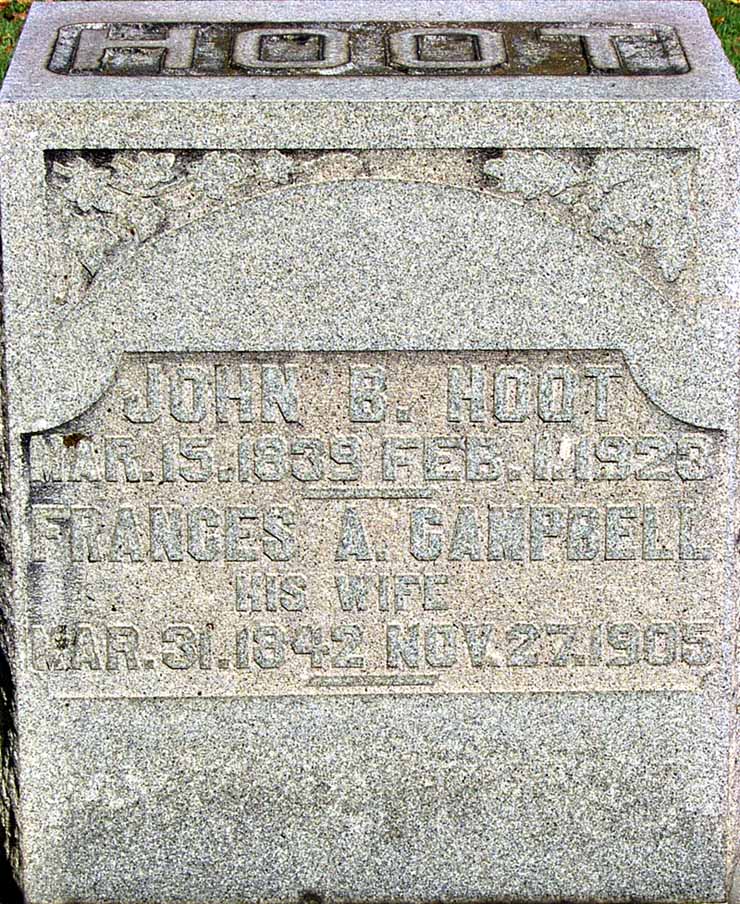
Frances A. Campbell married John B. Hoot (1839–1911) on 20 February 1862. She was the younger, surviving daughter of Henry and Ann (Callin) Campbell, and the sister of Cyrus and Harrison Campbell, the subjects of our last two posts. Harrison, you might recall, married John Hoot's sister, Catherine Hoot.

Frances was born in Montgomery county, Ohio, on 30 March 1842, and grew up on her father's farm. She married John when she was twenty, and over the following twenty-six years, they had eight children together; two sons and six daughters.

After the war, John moved with his family to Orange, where he rented a saddlery shop for many years, often employing as many as seven men. He was acknowledged throughout the county as being unsurpassed as a saddler and harness maker. His work was reportedly shipped to all parts of the United States. Upon leaving Orange, he removed to Mt. Vernon where he was foreman of a saddlery shop for ten years. In 1903 he retired and moved to Columbus, Ohio, where the family lived on Wisconsin Ave.

Frances died in 1905 at the age of 62, only two years after John retired, and he died in 1923. They were buried together in the Nankin cemetery, Ashland county, Ohio.

1. Agnes Cornelia Hoot (1863–1906)

The eldest daughter, she preferred to go by the name Cornelia, married John Byron Barrick (1858–1935) in 1880. John was a teamster in the Cleveland area for many years. They had a son and a daughter before Cornelia died unexpectedly in 1906 at the age of 43, while visiting in Athens, Georgia. After burying his wife, John moved in with his son, Adelbert, in Ashland, where he lived until his death in 1935.

     a. Adelbert Earl Barrick (1885–1964) worked as a machinist and skilled laborer most of his life. He married Minnie May Mcmurray (1878–1953) on 12 March 1904, and they had four sons. According to his World War I draft registration, Adelbert lost his left leg above the knee in March 1908. The couple remained in Ashland all their lives. Minnie died in 1953 at the age of 75, and Adelbert at 79 years, in 1964. They were buried in the Ashland cemetery.

     i. Charles A Barrick (1908–1969) was a core maker and foundry worker throughout his adult life. He married Velma A Mawhorr (1908–1976) around 1927. Their son, Charles Gaylord Barrick, (1928–2003) was retired pastor of the Sullivan Congregational Church and had taught eighth- and ninth-grade English in the Cloverleaf School District, Lodi, for 30 years.

     ii. Clyde Earl Barrick (1912–1966) was married to Charlotte, though they seem to have been estranged in the 1950s; they had one son and one daughter.

     iii. Ernest Benton Barrick (1920–1977) enlisted in the National Guard on 15 October 1940. He was still living with his parents at that point, but by 1945, he was married to Betty Marken (1918-2014) and living at 30 W Walnut, in Ashtabula. They had four children: three daughters who are still alive, and a son, David Joel Barrick (1951-2013).  David was a U.S. Army veteran and served in the Vietnam Conflict. He and his wife had four daughters.

     iv. Albert Ellis Barrick (1922–1979) was a World War II veteran who served from 26 October 1942 until 15 February 1946. He worked in assembly plants, and never married. He was 57 years old when he died in Ashland.

     b. Rea Barrick (b. May 1890) made one appearance in the 1900 Census, but sadly seems to have disappeared after that. It is possible that after her mother's death in 1906 that Rea might have gone to live with relatives, or gotten married before 1910.

2. Ida N. Hoot (1865–1947) 

Ida was the second daughter of John and Frances (Campbell) Hoot. She married Franklin Pierce Stine (1861–1931) in 1886. Frank was a farmer in Ashland county, and he and Ida had three sons and a daughter.

     a. Leonard Benton Stine (1889–1969), who preferred to be called "Leon," married Norah Wanda Ward (1891-1978). They were a farm family, and lived in Sullivan their entire lives. In 1930, their farm was next door to Leon's brother, Evan's farm. There are no records showing that they had any children of their own.

     b. Evan Francis Stine (1891–1944) married Mary Margaret Gill (1893–1973) around 1918, and began farming in Ashland county. The had seven children (i-vii); four daughters and three sons. Evan died at the age of 53, and Mary at 79.

     i. Mary Lucille Stine (1919–2004) married Paul Eichelberger (1911–1974), and they have four children who are still living: two sons and two daughters, and four grandchildren. Paul and Mary also had twins: a son and daughter born in 1950. The little girl, Carolyn, only lived a couple of weeks, but Carl Harold Eichelberger (1950-2014) was a machinist, like his father, who lived his whole life in Ashland county. Carl left a wife and three daughters.

     ii. Donald F Stine (1921) was born on 30 January and died 7 July 1921. He is buried in the Southview Cemetery in Sullivan township, Ohio.

     iii. Luella Irene Stine (1922–1999) married Donald E Heifner (1911–1960), a farmer from Montgomery township. Don died very young, at 49. Their only child was Kenneth Richard Heifner (1949–1969), a U.S. Marine killed in action in Viet Nam when he was only twenty.

     iv. Walter E Stine (1924–1997) married Mary Ellen Morr (1924–2008) on 13 June 1943, and they had two sons who are still living.

     v. Helen Pauline Stine (1928–1999) was married twice; first to Richard Dale Boales (1927–2009) and then in 1954 to Forrest Milton Fellenbaum (1918–1988).

     vi. Harold Evan Stine (1928–1986) married Martha Irene Johnson (1930–2015) on 25 March 1950. They lost their first two babies at birth (Larry Richard Stine b. 1950 and Stephen Eugene Stine b. 1951), but had a daughter and two more sons, and 36 years together before Harold died at 57. Martha only died last year at 84, having spent her time surrounded by grandchildren and great-grandchildren.

     vii. Phyllis A Stine (1935–1997) married Harold Max Lamb (1934–1992) in 1952, right after she graduated high school. They had a daughter, Mary May Lamb (1953-2003) who married Larry J "Jay" Matthews (1953–2010); the Matthews had three sons, who are still living.

Phyllis and Harold divorced in the early 1960s, and while he remarried later, Phyllis lived out her days in Ashland.

     c. Mary Estella (Stella) Stine (b. 1896), the only daughter of Frank and Ida (Hoot) Stine, grew up on the farm, but in 1920 was living out on her own. She was a factory worker in Ashland, rooming in the home of Rebecca Wood. After 1920, there are no more clues to her whereabouts. I assume she got married and I simply haven't tracked down the record, yet.

     d. Alva Sylvester Stine (1900–1966) grew up farming like his father and brothers, but in 1923 he graduated Ashland University where he was Vice President of his senior class, and he went on to become a school superintendent and administrator. Known as "Alva" throughout his youth, he preferred to be called "Sylvester" later on.

By 1927, Sylvester had married Mary I. Ferrel (1899-1999), and was a principal at a school in Wayne county. Two years after his father died, Sylvester and Mary had their daughter, Miriam Elaine Stine (1933–2000). Miriam grew up in Canton, Ohio, where she married Mr. Cross in 1952. They all relocated to Cass county, Michigan, where Sylvester died in 1966. Miriam was an elementary school teacher there for many years, and she and her husband also had a daughter and two sons who are still with us.

3. Byron A Hoot (1867–1942) 

Byron was one of the leading barbers of Ashland, conducting "a large and elegantly appointed shop" there for many years.

At the age of thirteen years, Byron was apprenticed to a barber. Later he traveled for three years, working as a journeyman in various cities, finally returning to Ashland in 1885, where he opened a shop in the National Bank building. He remained there for eighteen years, becoming popular for his high-class work. After that he relocated to Main street, the third door below Orange street, where he employed three men.

In 1891 Mr. Hoot was united in marriage to Ida Mae Brubaker (1874–1944), daughter of John W. Brubaker and Eliza Barr. Byron and Mae had one daughter and one son.

     a. Glorene Frances Hoot (1895–1977) was the victim of many misspellings in the historical record - "Lorene," "Glarence," and (my least favorite) "Glovine" being just three. She married Harry Eugene Matthews (1895–1976) on 5 October 1916. (He was no relation to the Larry Jay Matthews who married Mary May Lamb as mentioned above.)

Harry was a salesman, worked for a time as a produce manager, and then as an insurance salesman. The couple raised two children:

     i. Rexford Eugene Matthews (1919–2002) enlisted in the U.S. Navy in 1939, and served throughout the war, being discharged in 1946. He married his wife, Virginia Louise Page, in 1948. They had at least one daughter and a son who are still living. Rex worked as a salesman in a shoe store, until he landed a job with the State Highway department; Virginia worked in a pastry shop. They were together for 31 years, until they divorced in 1979, and Rex moved down to Sarasota, Florida. There he remained until his death in 2002.

     ii. Patricia Mae Matthews (1925–2012) was a professional Girl Scout and camp director, then a physical education teacher. Pat also had a beautiful soprano voice, and was a soloist in the Ashland College Choir, as well as a member of the Cleveland Orchestra Chorus in the days of Robert Shaw and George Szell. She performed with that group on the stage of Carnegie Hall.

In 1983 Pat received the "Individual Better Life Award" from the Ohio House of Representatives for being a "remarkable individual, combining humanitarian concern and commitment with selfless initiative to become a dynamic force in behalf of the aged." In 1985, she relocated to Sarasota, Florida - that may have been why her brother moved there, as well.  In Sarasota she volunteered in nursing homes and sang in the Key Chorale for 16 years.

     b. John Weldon Hoot (1902–1950) was a professor who married Evelyn Marie (1902-1969) in Ohio, and took his wife to Upper Darby, Pennsylvania, in the 1930s. After his death at 48 years of age, in Philadelphia, Dr. J. Weldon Hoot was buried back home in Ashland, but Evelyn and their teen aged daughter remained in Pennsylvania. Their daughter is still living in that state, as far as I know.

4. Clara Hoot (1869–1916) 

Clara married Philip Kirsh (also seen as "Kirsch") some time around 1888, and they had three children before Philip's death a decade later. Despite leaving few records behind, it is safe to guess that he died between 1895 and 1900.

     a. Helen G Kirsh (b. 1889) appeared on the 1900 Census in the Mount Vernon, Knox county, Ohio household of her widowed mother. There is a marriage record from Chicago in 1908 showing a Helen Kirsh marrying Harry Schmitz, but the details about her in their 1910 Census record (in Chicago) do not indicate that this Helen came from Ohio, so I can't say for certain that this is our Helen Kirsh.

     b. Arlina A Kirsh (1892–1963) married Ora James Bemiller (1888–1939) in 1910, and moved in with his family. Ora grew up a farmer, then worked for a time as a tobacconist, as a firefighter, and later as a metal worker in Shelby, Ohio. James took ill and died about a month after he and Arlina moved to the Galion area. They had one daughter.

     i. Eva Glorine Bemiller (1913-1956) was partly named after her mother's cousin, Glorene Hoot. She married Daughn D Clow (1913-1987) in Ohio county, West Virginia, in 1936. Some time after Eva's death in 1956, the rest of the family relocated to Florence, South Carolina, where Daughn died in 1987. Daughn and Eva had a son and a daughter, and many grandchildren.

     c. William Frederick Kirsh (1895–1958) married Goldie M Hall (1896–1982) on 30 April 1917. William was a restaurant manager most of his career. He died at home in 1958 at the age of 63. Goldie remained in Ashland the rest of her life.

     i. William Frederick Kirsh Jr (1918–1981) was a stock clerk in Cleveland married to Kathleen Corrine Vessels (1920–2002) when he enlisted in the Army in 1943. After the war, they raised eight children, two of whom have died: William Patrick Kirsh (1953-2000) and Frederick "Fritz" W. Kirsh (1946-2008). Still living are three sons and three daughters.

     ii. Philip Leroy Kirsh (1920–1982) took a engineering degree in metallurgy at Ohio State University in 1941, and a commission in the U.S. Navy, where he rose to the rank of Lieutenant Commander. He was discharged in 1946, and married Elizabeth Axham Keene (1918–2003). They lived for years in Rochester, New York, and retired to Canandaigua in the late 1970s. Their daughter was the late Susan Jean Kirsh Anzalone (1951–2001).

     iii. Jack Loren Kirsh (1927–1973) graduated high school in the class of 1946 and went on to become an educator. He married in 1957 while teaching in Florida, where he was principal of the Greenville Elementary School in 1960. He eventually relocated to Ann Arbor, Michigan, where he died in 1973.

Clara Hoot Kirsh remarried after 1900 to William M Litt (1872–1937), and they had three children in the next few years. Sadly, Clara died in 1916, and William remarried a widow named Edith. (Note: while William's name is clearly spelled "Litt" on his headstone, his sons spelled the name "Lett" - I will leave it to the family to sort that out!)

     d. Benton D Lett (1902–1967) was a fireman in Columbus, Ohio. He married a school teacher named Eva D Eyster (1905–1952) around 1928, and they had one child, Eugene Clay Lett (1929-1995).

     e. Milo F Lett (1905–1967) worked as a truck driver and laborer around Berlin, Knox county, where he grew up. in 1942, he enlisted in the Army and served throughout the war in the 1136 School Squadron. I know from notes in his records that he was divorced, but I have no information about any wife or children.

     f. Catherine Litt (b. 1906) is another mystery - after appearing on the 1910 Census with her family, she is not in the household in 1920. There is an Ohio birth index record, but beyond that, I don't know any more about her.

5. Hattie J. Hoot (1870–1924)

At nineteen, Hattie married Alpheus C. Hamman (1867–c. 1935), and they had one daughter. After Hattie's death at the age of 53, Alpheus seems to have been on his own. His grave marker remains undated.

     a. Emma D Hamman (1905-1985) married Leon Clarence Osborne (1892–1975) on 20 September 1915, and the following year, they went to China as independent missionaries. In 1919, they joined the Church of the Nazarene and served its church at Chao Cheng, Shantung, until 1942.
Leon was detained by the Nationalists in 1928 near the beginning of the Chinese Civil War.

 Found on Newspapers.com

Leon was released, and the couple continued their work in the country until 1942. He published a book about the work in China, Christ at the Bamboo Curtain, (Beacon Hill Press, 1956).

6. Abbey I Hoot (1875–1940)

Abbey stayed in the home of her parents until John's death in 1923, at the age of 83. After that, Abbey took in lodgers at the house on Wisconsin Avenue for a few years, with the help of her niece, Leota Roseberry (Zelpha's elder daughter). Sadly, by 1935, she was unable to continue taking care of herself, and spent the last few years of her life committed to the Columbus State Hospital for the Insane.

7. Zelpha L. Hoot (1877–1951)

Born in Nankin, Zelpha probably met William Crawford Welch (1875-1917) when her father retired and moved the family to Columbus in 1903. Zelpha and William were married about 1906, and had two young daughters when he died at 42. I could not find an explanation of how he died, but he was a railroad man, and he would not be the first person in this family to be killed on the railroad.

Zelpha supported herself by as a dressmaker, and evidence says she married a Mr. Kramer (or Kraner) at some point. While she or her daughters took possession of the house on Wisconsin Ave, Zelpha eventually relocated permanently to San Diego, California, where she died in 1951.

     a. Leota E Welch (1906–1998) married Walter William Roseberry (1904–1990) in 1928, but in 1930, she was still living in the home of her aunt Abbey (see above). It may be that the arrival of their son in 1932 meant that Leota was not able to care for Abbey, and that could be what led to sending Abbey to the state hospital in Columbus.

Walter and Leota did not stay together after their son grew up; Leota remarried Ernest Hamlin (1913-1990) in 1972, and they moved down to Manatee, Florida, where they lived out their retirement.

     i. Kenneth William Roseberry (1932–1991) was an electrician in Columbus, Ohio. He was married in the 1950s, but also divorced by the late 1960s. His wife remarried in 1972. Kenny died the year after his father, and they were buried in the Obetz Cemetery in Franklin county. I do not know whether he left any children behind.

     b. Frances Dana Welch (1909–1963) remained with her mother until she was in her early thirties, accompanying Zelpha as she moved between San Diego and Columbus. Eventually, she seems to have married, probably in the 1950s. She is buried in Union Cemetery under the name Frances Dana Gilmore.

8. Walton Wesley Hoot (1879–1951)

Walton was a barber, like his older brother, and around the time the rest of the Hoot family moved to Columbus, he married Effie Mae Snook (1879–1938) and resided with her family in Ashland. They raised one son, and lived out their days in Ashland.

     a. Forest Emery Hoot (1906–1999) married Helen Louise Pancoast (1906-1993) during the 1930s. Forest was working as a salesman. I have not found any information about this couple to indicate what their business was or whether they had children, but they did leave behind an endowment for a scholarship at Ashland University, so they must have been successful.

-------

And that, good friends, brings us to the end of a very long post about people surnamed Hoot. It also brings us to the end of the descendants of Ann Callin Campbell. I have to say, these last three posts were quite an exercise of my researching abilities, and I am not entirely sure I've done these people justice.

As always, if you are related to any of these families, and can help me identify and fix any mistakes I have made, please do reach out through the comments below, or through my email address, callintad at gmail dot com; there were at least two examples during the preparation of this post that I did "one last search" and found out something revelatory - like a couple I had thought had three children actually had eight children. Or I found an article that revealed a daughter I hadn't known about.

But I'm not complaining. I enjoy the thrill of the hunt, and I love knowing that I've tied together whatever I can for posterity. In fact, for all of the extra work that went into this post, it was, for me...

...a real hoot.

Friday, October 2, 2015

The Distance of Close Connections

For the last couple of months, we've explored the descendants of the man I called Tragic Thomas. Thomas was the son of James, elder of the two Brothers Callin of Ohio, and grandson of the man referred to in the Callin Family History (or CFH) as "James 1st".

I told you what little I know about Thomas's brother, Alec Callin, who felt The Pull of the West and moved further, from Ohio to Iowa. Just to refresh you on the details, the CFH says this of Alec:
"Married and moved with his family and mother to Iowa about the year of 1840. The mother referred to was 'Aunt Mary', wife of James 2nd who was killed with a gun. She sold the farm and went with Alec to Iowa where she died some years later. Nothing has been heard from that branch of the family since 1845."
There are several records of land grants to an Alexander Callin, one identifying him as a resident of Muscatine, Iowa in July 1854, and showing that he purchased a plots of land in the young state. There is also a Mary Callin buried in a Muscatine county cemetery, having died in 1846 at age 77.

Following behind Alec by a year or two, his younger brother, James (3rd), also moved to Iowa. Per the CFH, again:
"James Callin with his wife and baby moved to Iowa where he died in 1844. William Callin, brother of Margret, went to Iowa and brought her and the two above named children home to Ashland Co. after her husband's death." 
The "above named children" are William and Warren on the following chart, which shows the lineage of their parents:

Because it's such a taboo, I hesitate to come out and say plainly that James and Margret were 1st cousins, but clearly, they were. James was the youngest son of James, the brother of John, whose youngest daughter was Margret. 

I don't have any way of knowing what the family might have thought about this arrangement, either. Both fathers were long dead by the time the couple was wed in 1841. Alec had already moved west by this point, taking his and James's mother, Mary, with him; and if Margret's mother, Elizabeth, disapproved of their wedding, it may explain why they decided to make the journey described here. Even today, traveling 435 miles (by modern route estimates) from the frontier of Ohio to the even newer frontier of Muscatine, Iowa with an infant wouldn't be ideal!

But the truth is that we can't know the Truth(tm) - the best we can do is look at what we do know, and try to fill in the blank spots as best we can. We can't know what the people were thinking or what motivated their choices, but we can at least hazard a guess as to what those choices were.

We already know from reading about Tragic Thomas's life that James and Margret were two of at least 13 cousins (including Thomas himself) who grew up together on the farm that their fathers had settled in Milton township. 

We know that when James died (1844), Margret was left with Warren, about age 2, and she was almost certainly pregnant with little William (b. 1845). Since Margret's brother - my own 3rd great grandfather, William - is the one who made the ~870 mile round trip to Iowa to bring Margret back to Ohio, we can assume that Margret either did not want to remain in Iowa or could not, for some reason. Alec had only purchased the first of three recorded properties that we know of, and we have no idea who his wife was or how many children they had; clearing a farm and providing for a large family would have been daunting.

Since "Aunt Mary" (James and Alec's mother) died a year later, perhaps we can guess that she was in poor health. It could be that with her husband dead, Margret simply wanted to return to where she grew up.

Once back in Ohio, Margret herself died in 1847. It is telling that her two small sons - 5 and 3 by that time - were not taken in by any of her siblings' or cousin's families on the 1850 Census. As we will see, at least one of the boys was fostered with a family in New London, Huron county. Of course, for the size of her extended family, Margret's options for finding someone to raise her sons were more limited than you might think.

Consider that Thomas, her cousin/brother-in-law had likely died in 1843, just before she came back from Iowa. His widow, Nancy, had several small ones of her own, two of whom she would lose after 1850; her household may have been stricken with any number of disease outbreaks common at the time, and possibly couldn't have handled the two boys.

Margret's own siblings all had their hands full. The oldest brother, John, died young (23 years old) in 1825, but of the rest:
  • Her oldest brother, George, had six children under 12 in his home; 2 boys, and 4 girls. (The youngest of those, Sabra Ann, was born in 1843 and died in 1849.)
  • Her sister Ann Campbell also had 5 who were 10 and under; 2 boys and 3 girls.
  • Her sister Sarah married John Scott in 1835 and they had moved to Illinois around 1840.
  • Sister Eliza Ferguson and family lived in Auburn, Indiana.
  • Her brother William's third child, a son name James, was born in 1844, and his fourth, George (who grew up to compile the Callin Family History) was born in 1846. The births of these boys bookended his trip to Iowa to fetch Margret, Warren, and little William.
  • Her next eldest brother, James, had two daughters - the younger of whom (born in 1841, and called Sabra Ann) was blind, and likely needed special attention that her parents couldn't spare.
  • And lastly, Hugh had just married Barbara Matthews, and they had a newborn in 1846.
Certainly, each of these families had their own hardships to face, so it wouldn't be charitable to draw any conclusions about them or their sister from the fact that none of them seemed to have room for Warren or William - even William's likely namesake, his uncle.

Wherever he ended up going to live as a boy, we know what eventually happened to Warren:
"Warren enlisted in the spring of 1861 in 25th Regiment O.V.I., and died on Cheat Mt., West Va. Had been on a scout; only sick one hour. It is supposed he died from drinking poisoned milk. He was a musician, and wherever he went his violin went, and when in camp he drew crowds to hear him play. It is said no man in the regiment equaled him in strength, his soldierly qualities won the confidence of his colonel and he was made Scout. His kind heart and sweet disposition endeared him to all his comrades. The whole regiment mourned his death." (CFH - record of Margret, his mother)
As for young William, his first cousin, George, happened to be the author of the CFH, and had this to say:
"Andersonville Prison" by John L. Ransom 
"William Callin was left an orphan in childhood about the age of 3. Was adopted by and raised by a family named Day near New London, O. At eighteen he enlisted in Co. E, 55th Regt. O.V.V.I., was in all of the battles of his Reg't. till captured on Sherman's Atlanta Campaign and remained in Andersonville prison till close of war. He escaped from prison three times but was each time traced by bloodhounds, captured and returned. His prison life resulted in curvature of the spine and he was badly crippled during later life, enduring much suffering and finally death, for the services he rendered his country, to which he gave the full measure of his devotion." (CFH)

I still don't know for certain who the "family named Day" was, though I have a hunch; I will continue that hunt and keep you updated.

After the war, William married Theodocia Johnson (1843 – 1899) 9 August 1868 at age 23, and they had one daughter, Edith May Callin (1872 – 1967). It isn't clear what William did for a living; by the 1900 Census, he was 55 and listed as a "pentioner" (I assume that's just a spelling mistake by the enumerator). Theodocia died in May 1899, and Edith appeared with William on the Census, which says she worked as a seamstress, probably supporting her father.

Just over a year after the death of her mother, Edith married Oley Ray Hanley (1876 – 1953) on 16 August 1900; they had one son: Lyle Elliott Hanley (1902 – 1935). William likely lived with them, until his death in 1907. His brief death notice in the newspaper simply mourns the passing of an "old resident and soldier," and he was buried on a Friday.

Edith divorced Ray around 1912, and moved with 10-year-old Lyle to Toledo. Lyle lived with his mother through the 1920s, and was employed as a clerk, and as a time-keeper by the American Can Co. Lyle died on May 10 1935 in Toledo. He was survived by his young widow, Marie, whom he married around 1930. His obituary did not mention any children.

Edith outlived her son by 32 years. She seems to have made a living taking in boarders, as she did in 1940, judging by the Census, and she died in May 1967 at the age of 94. It's impossible to know whether she ever knew her Callin cousins who also lived in Toledo; Ben Frank and Daisy would have been living there at least until his death in 1953. But it may be that after three somewhat tragic and lonely generations, Edith may not have been interested in her family connections. 

And with that, unless we discover something new, I believe we have officially covered everyone on the "James 2nd" side of the family - from here on, we will look at the descendants of his brother (my 4th great grandfather), John.

Friday, August 28, 2015

A Garden of Loose Ends: The Hess Descendants

Our story, so far:
We've reached a point where, if I am going to avoid violating the privacy of living people, I will have to abandon the effort to weave a narrative. Because of that, and because I am still missing a lot of detailed records about these folks, this post will necessarily leave a lot of loose ends.

I'm also more likely to get caught making mistakes, since some of the people I am writing about were known and remembered by people who are still alive. I always make mistakes; some are minor, some frustratingly major. I will remind any new relatives that catch these mistakes that I am putting this out here to show what I have, and to ask for help fixing it before putting it in a book!

So, if you are one of the living relatives who recognizes these people I'm writing about, I'd love to hear from you; either to help me fix mistakes, or tell me to include stories about them that you want to remember.

Clara and Jacob's oldest daughter, Jessie Alverda Mohn, married Thomas William Hess 22 July 1897, and they had the first of their eight children, a daughter, in April 1898. The first six were listed in the Callin Family History.

1. Hattie Helen Hess is a mystery to me. Though she appears in the 1900, 1910, and 1920 Census records in her parents' home in Jackson township, Richland county, I have not been able to scratch out any other records that match her. There is another Helen Hess of precisely the same age living in Richland county at the same time, which stands as an example of why this kind of research is so challenging, why one has to be skeptical of the evidence, and why one can end up going down so many rabbit-holes.

The other Helen married Delbert Pittinger in 1914, so she is listed in his household in January 1920, while our Helen is listed in Jackson township in July 1920 - with a marital status of "widow" just to make things more tantalizing. But while I suspected that Mrs. Helen Pittinger was not the same person as Hattie Helen Hess, I couldn't find definite proof until I had spent a day on researching the Pittinger family. I finally found Mrs. Pittinger's obituary at Newspapers.com, which named her mother, "Mrs. Hayden Hess," and a brother who was not related to our Hattie Helen. Between that obituary and the birth and census records that confirmed it, I could finally prove that her father's name was John Hayden Hess, not Thomas William - but that also means that I don't know any more about our Helen than I did before I started down the rabbit hole.

(Any further information about Hattie Helen's fate would be greatly appreciated. N.B.: Update: Hattie Hess)

2. William and Jessie's second daughter, Rhea Ruby Hess, came along in April 1899, and also appears on the same Census records as her older sister. In 1920, though, she is listed in her parents' home as Rhea Tucker, along with a musically named daughter born around 1919. (I will have to spare you the variety of spellings of her name, as she is still alive somewhere in the world!) I have found no marriage records or anything indicating the fate of Mr. Tucker; however, by 1924 Rhea was married to Howard Wirick (another surname that pops up in the Callin family tree later on - also with a variety of spellings). Howard and Rhea had a son, Clarence Dean, born 30 April 1924.

Clarence, who went by the nickname "Moe" left the planet in 2008 leaving behind five children who are currently about my parents' ages. According to his obituary, he "served with the United States Army Air Corps during World War Two as a crewmember on a B17 bomber. Clarence was the last surviving member of the flight crew."

3. Clayton Clifford Hess was born in November 1900 - and as a parent of closely spaced siblings, let me express some sympathy for Jessie at this point for the sleep deprivation she must have surely been experiencing! Clayton grew up in Richland county, married Blanche Gregg around 1924, and worked as a "heater" in the steel mill in Canton, Ohio, during the 1930s. It looks like after he retired, they moved to Albuquerque, New Mexico, where Blanche died in 1965 and Clayton died in 1969.

They had four children who were all born within six years - two boys and two girls. Glenn Orlo (1924) was a World War II U.S. Navy veteran who died in 1983 in New Mexico. I have no records of him raising a family of his own. His brother, James Thomas (1926), also served in the Navy in WWII, and died in Huron county, Ohio, in 1993. He and his wife had nine children, including a son named James Jay (1954-1988) who worked in a printing shop, and a daughter, Pat Montgomery (b. 1955) who died unexpectedly in January 2015.

Clayton and Blanche's third child was Darlene (1928-2010) who married Noel "Buzz" Zimmerman (1925-2009); they have seven surviving children. Darlene worked in food services, retiring from KFC in 2009, and Buzz was a U.S. Navy veteran (like his brothers) who worked for Bill Harris Auto before his retirement. And the youngest of the four, Maxine Alice Hess, was born 15 February 1931. She had three sons, one of whom, Gregory "Tiny" Hess, passed away in 2013 at 63. Maxine died in 2004.

4. Esther Eleanor Hess was born 15 November 1904 and married Ray Carlton Oberlin in 1923. They had two sons, and she died relatively young in 1953; Ray followed in 1967.

5. Geraldine Hess, born 28 February 1908, married Lester Lee Keller when she was 16 years old, in 1924. They had a son, but soon they divorced, and Geraldine was listed in her parents household with her young son in 1930. Lester died in 1973; I don't know whether he remarried or had more children. Geraldine remarried George Williams in 1935, and they had a son, also. George died in 1946, and she remarried in 1948 - this time to Harold Doerr, and they were together until he died in 1982. Geraldine died in 1997 in Mansfield, Richland county.

6. William W. was the last of the Hess children listed in his mother's record in the Callin Family History. He was born 1 April 1910, and he married Bertha Pauline Deppe around 1935. They had one child, a little girl they named Shirley Ann who died in 1940 at the age of four. William enlisted to fight in the Second World War in 1943, and he died in Cleveland in 1976; Bertha lived until 1992 and died in Mansfield.

7. Byrl B Hess was born 30 December 1911 and married Herbert Zimmerman (1890-1968), who happened to be the father of Noel Zimmerman (1925-2009), the eventual husband of Byrl's niece, Darlene, mentioned above. Noel was one of four sons of Herbert's first wife, Clara Gleason, who died in 1936. Byrl and Herb had two sons together: Marty (b. 1930) and Herb, Jr. (b. 1933).

(Of course, all six of these young men were close in age and raised as brothers, and the records and obituaries made it hard to sort out which boy belonged to which mother - my apologies if I got any of this wrong!)

The Zimmermans operated a grocery store during the Depression, and Marty Zimmerman worked as a distributor for Pepsi-Cola until 1962, when he moved his family to Wooster and opened a Hammond Organ Studios. He and his wife, who survives him, had four daughters; he died in March 2015. His brother, Herb Jr., was a staff commander in the U.S. Navy during the Korean War, and worked in the automotive industry. When he died in 2011, he left a wife, a daughter, two grandchildren, and three great-grandchildren.

 8. Jessie and William's youngest child was Dean D Hess, born 22 December 1913. (If you were keeping track, that is 8 children in 15 years.) He and his first wife had one son and one daughter before 1940; after that, I have found very little information. He married his second wife, Doris Lindenbolt, in 1951, according to an unconfirmed detail on his Find-a-Grave profile; she died in 1972, and he followed a few years later in 1979.

A Guide For New Cousins


I know this gets complicated, but if you happen to be one of the living descendants of any of these folks, here is a guide to figuring out how we are related. Our common ancestor, of course, is James Callin, the Revolutionary War soldier who I believe to be the father of James and John Callin of Milton township.

Jessie Mohn is my 4th cousin, 2x removed; her children are my 5th cousins, 1x removed, and her grandchildren are my 6th cousins. Each generation after her grandchildren would also be 6th cousins, starting with her great-grandchildren, the "removed" part starts counting up from "1x removed." So, for one example, Marty Zimmerman was my 6th cousin; his daughters are my 6th cousines*, 1x removed; and their kids are my 6th cousins, 2x removed.

Of course, I can't keep all of that straight without the computer, so you're all simply "cousins" to me!

Hope you are all well, and hope to hear from you in the comments (or email...or Twitter... or... you get the idea).


*Yes, "cousines" is the feminine plural of "cousins". 

Updates: Refined some of the location information thanks to some helpful feedback.

Thursday, April 2, 2015

The Pull of the Southwest

By the time this posts, I should be in Arizona for Spring Break. We'll be visiting family & friends (I hope!), catching a Diamondbacks game, and soaking up radiation from our star.

Unless I find a whole lot of time and inspiration between now and next week, I may end up skipping a week of posts - sorry about that.

To tide you over, here is a photo of my grandpa Bob visiting a beach with his family in the early 1960s, probably in Florida.


Bob's shirt says "I'm on vacation!"

Bob's trunks say "Norman wishes he was me!"


Bob looks out to sea - "What did Norman say about my trunks?"
Be mighty, and use sunscreen!

Tuesday, February 17, 2015

#NameCollecting - You Know My Name

When commenting on unusual names, it's probably a good idea to state the obvious: I'm not making fun of them.  I like unusual names. Even outside the context of family history, I've always found them to be fun and interesting.

Take my name: Tad.

I'm in my forties, now, so I think I have heard every possible permutation of "tadpole" joke, and have enjoyed being on the short end of "just a tad" remarks both flattering and not. I've also run across my share of fellow Tads, so I know us to be rare, but not completely unheard of. And, obviously, we are generally seen (according to the Namipedia survey results) as "Smart, sexy, friendly, creative, strong, young, and sophisticated."

Statistically, according to the Baby Name Voyager, we peaked in the 1960s, when there were about 48 babies per million named Tad. I found it interesting that my own sister's name showed up (with the correct spelling, even!) in the name cloud of "commonly associated siblings" on that page!

So what does the name "Tad" mean, and where does it come from?  I don't know. Aside from references to Abraham Lincoln's son, whose given name was actually Thomas, we don't seem to have a reliable origin story. It could simply be that it started out life as a nickname, as with the Lincolns, and then came into more legitimate use because people liked the sound of it.

...otherwise, I might have been "Prissy".
That seems to be how I ended up with it.  According to a reliable source (thanks, Mom!), I was originally supposed to be "Priscilla Jane".  I dodged that particular name bullet by emerging with an unexpected ...ahem... extra bit. 

As the story goes, my mother and father were in the delivery room, trying to come up with a name for a little boy, and wouldn't you know the family history played a role in what they came up with?

My grandfather's name was Robert T Callin. When he joined the Army, he filled out all of his induction paperwork with what he thought was his full name: Robert Theodore Callin. He went through the war, married grandma, and enrolled in college under that name - and only found out he was wrong when my dad was born, and he told grandma Bertha that they planned to name him "Robert Theodore, Jr."

"But, Bobby," she said, "Your name isn't 'Theodore'. It's just 'T', like 'Harry S Truman.'"

So they took that information in stride, and since they planned on calling him "Teddy" anyway, they ditched the "Theodore" and just named him "Robert Ted."

Apparently, my own parents were inspired by this story, and since they didn't want a "junior", they just changed one letter - thus, a Tad was born.  I've never had any cause to complain, and obviously, I love having yet another story to tell (and re-tell).

Mom and dad were a little more prepared when my sister came along - she would have been "Andrew Patrick", which is a far better fate than I would have suffered.  (They named our poodle "Priscilla" in the 1980s, so at least it didn't go to waste.)

And when I nervously informed everyone that we had selected the name Séamus for our eldest son, everyone breathed a sigh of relief. "Oh, good! We were afraid you were going to call him 'Robert Tud'!"

Thursday, February 12, 2015

Photo Feature: Valentines and Cradle Robbers

Something a little different this week, in anticipation of Valentine's Day.

Here are three couples with a few things in common:
  • They all married young
  • The grooms (and one bride) were all in the service
  • Not only were did all six of these people share a surname (after their respective weddings), the grooms share their given names, as well!
  • The brides were all VERY young

February 1995, Monterey, California
How young were they? Well, that's the basis for our trivia question - "which of these brides was the youngest at her wedding?"

Obviously, you'll need some dates to make an educated guess, but what with this being the open internet, you'll excuse me for being coy about just posting them here.

First up, you can see a happy young pair of airmen getting their engagement picture taken. Tad was a mature (ahem) 22 years, and Kate was a Bicentennial Baby. They took a lot of ribbing over their age difference, but when they married after a brief, six-week romance, she was 18 - and only just a few months shy of 19.

c. 1968, Glendale, Arizona

Our next couple could hardly wait for high school graduation to set their wedding date, but wait they did. Teddy was a mature (I am certain) 22 years, and Barbie was a true child of the 1950s. They married in 1968, just one month after her 18th birthday.

c.1942, Phoenix, Arizona
 Ted went on to join the National Guard and trained to be a medical technician, then tried his hand at teaching before settling on his career as a firefighter.


And finally, we have the dashing couple straight out of Casablanca, the heroine and hero of When Things Got Serious. Bobby was a 21-year-old Army airplane mechanic, and Nancy was in high school when they met - and the outbreak of the Second World War lent some urgency to their decision. And so they married in 1942 - about 8 months before her 18th birthday.

So there you have it - I come from a long, well established line of young men who married young brides and survived to tell the tale. I think I can safely claim that none of us has regretted it for a moment.


However old or young your sweetheart is, here's hoping you're as happy as we were - and are.

Tuesday, November 11, 2014

Twice Honored

Another revised repost from the original Mighty Acorns blog; this one in honor of Armistice Day.


When I was a kid, I had a plague on my wall that my father had made. It was a dark piece of wood with the newspaper obituary of his grandfather, Dick Witter Sr., held in place by heavy layers of shellac. He had also mounted grandpa Dick's pocket watch and a silver dollar, along with a photograph.

I must have read this clipping a million times while I was supposed to be doing homework:


"Live and Let Live" by a Friend*

It is not entirely accidental that Dick Witter Jr. is one of the most respected citizens of Glendale. After serving as traffic cop, meter minder and in other capacities, he was promoted to City Magistrate, Judge no less, a position which he carries on with dignity and honesty.

One of the main reasons, we believe, that he is what he is today, belongs to the upbringing by his mother and father. We have known them both for nearly 30 years. No finer, more industrious people ever lived.

His dad, Howard R., also called Dick, and known to many of the older residents of Glendale, died Sunday and what a pity. Not because he has gone to his last reward as all of us must but because such a fine image of a man has to disappear from the every day world as we know it.

Possessed of that rarest of human blessings, a sense of humor, he never laughed at others but always at himself. And we cannot think of an unkind word that he ever uttered against anyone. That, in itself, is a rare gift indeed. So many of us, myself included, often belittle and revile others, perhaps as a defense against our own foibles; who knows? But Dick Sr. never did.


This world would be a better place in which to live if more of the people emulated the Witter family with their unsaid but sincere code: "live and let live."

*Written by Tommy Anderson; appeared in the April 5, 1963 "Glendale Herald", Glendale, AZ


When I used to read that plague as a boy, I didn't attach the importance to it that I do today. I don't think I realized it was an obituary for a long time, since the first paragraph is about my great-uncle Dick, who I actually knew and who, at the time, was still alive.

I did think a lot about "live and let live" and what it meant, though. When I would read about that sense of humor, that tendency to laugh at himself, I recognized the same trait in my dad and grandma. I saw how I learned it from them, and without realizing it, reading and re-reading that old plaque made me feel closer to the old dairy farmer in that photo who died nearly a decade before I was born.

Coming from Kansas to raise a family on a hot, dry dairy farm in Glendale, Arizona; building a life in a corner of the infant state; surviving World War I, the Great Depression, and seeing a son through World War II - these were the people in the background of history. He was the "Over There" of song; they had the pot that Roosevelt promised to put a chicken in; and later, they were "back home" to their soldier in the Philippines.

People like these don't expect high honors or recognition; maybe it is the humility passed down from the Witters who came from Germany with the other Pennsylvania Dutch. Maybe it is just a realistic outlook that says, "Don't attach too much importance to yourself." It could have something to do with that self-deprecating sense of humor Mr. Anderson described. I imagine my great-grandmother's reaction when she received the condolences of friends and family after Dick Sr. passed away in March of 1963: the stoic widow's pride at the honors and sympathies, and then the quiet packing away of the memories. No need to fuss, now. Tidy up, and move on.

When we visited Arizona for Christmas in 2005, Grandpa Bob took me to his garage and offered me several boxes of "old junk". He knew I was interested in all this family history stuff, and I knew that he wasn't able to bring himself to throw away everything that Grandma, a notorious pack rat, had held onto over the years. These boxes had been sitting for a couple of years in this garage, a storage unit for a few years before that, and their old house on Gardenia Avenue for some fifty years before that.

Digging through, I found that picture of Dick Sr. and that eulogy I recognized from the plague. I found a letter of condolence from their U.S. Congressman, and in a large manila envelope postmarked February 7, 1964, I found this certificate:


I suppose all the veterans' widows were receiving these, but it was still a thrill for me to find something with my great-grandfather's name on it, signed by President Johnson:


Looking at the postmark, I was struck by how strangely history folds around us. When Dick Sr. died in March 1963, President Kennedy was still alive. It's petty of me, but my first thought was to curse the timing that put one man's signature on a document instead of another's. That moment passed, though, as I thought about how these things must work.

I imagined that certificate would have waited for a break in the busy schedule of a President for his signature while the events of that year played out. The Birmingham Campaign, followed by the March on Washington. The end of Project Mercury, and the first woman in space. The Supreme Court forbids mandated school prayer; and a Partial Nuclear Test Ban treaty is signed and ratified.

And that November surely changed a lot of plans.

Who knows how long it took for someone from a protocol office to get these certificates printed for the heroes of a fifty-year-old war, how many there were in the stack, or how long it sat waiting for the pen stroke of the mighty. Assuming those letters were still being physically signed by the President himself, I imagine how a still-stunned and grieving Mr. Johnson might have felt, sending condolences to my great-grandmother. Considering he was certainly still grappling with the circumstances under which he had just come into office, I like to think that a duty like this, while sad, would be of some comfort to him.

And I can imagine how she, a farmer's widow, reacted when she saw it arrive in the mail - nearly a year after she lost him. I can almost see her face when she opened it; the pang of being reminded of her loss followed by a wry smile of appreciation. That familiar combination of humor and humility that helped her maintain her husband's "live and let live" attitude over all those hard years.

I wonder, if I could go back in time and ask her what she felt, what she would say about that honor? Did it bring her any joy? Did she show it to anyone? She kept it, so it would seem she accepted it as the honor it was intended to be. Did she smile when she saw it, or cry, or simply nod as she slipped it back into its envelope and laid it in a drawer on top of the other one - the one that I found later, as I kept combing through Grandpa's old boxes. The one with the 1963 postmark and that other certificate, identical to the first except for the signature:

John F Kennedy