Showing posts with label immigration. Show all posts

Friday, February 16, 2018

Looking Sharp

Hello again! The holidays have passed, and a new semester of music classes has begun. Time is still a scarce commodity, but while I've been silent for a couple of months, I have continued to work through the descendants of John and Sarah (Callin) Scott.

As you read about the Scotts and related families in Winnebago County, Illinois, keep in mind that the Rockford area is very near the Wisconsin state line and that records for many of the people we're studying appear in both Winnebago County and neighboring Rock County, Wisconsin. This has led to some confusion, as records will occasionally contradict each other as to the birthplace of an individual. If you're using Newspapers.com you will notice that the Janesville Daily Gazette frequently acts as the "local paper" for both areas. (Fun fact: Janesville, WI happens to be the birthplace of the current U.S. Speaker of the House, Paul Ryan.)

We're about a third of the way through the Scott children, so far, and today, we begin with John and Sarah's middle child and her three eldest children:

     Rebecca Scott (1839-1928)

Rebecca was born in April 1839, in Michigan where her family was en route from Ohio to their eventual home in Winnebago County, Illinois. The county was only a few years old, having been settled in 1834, formed in 1836, and then reduced to its present size in 1837. Rebecca grew up on her father's farm in Harrison township, near Rockford, Illinois. On 13 December 1856, at 17 years of age, she married Edward Sharp (1835–1887).

Edward was the son of Michael (1801–1881) and Mary "Polly" Sharp (1806–1886). He was one of eleven children; his eldest brother, John, was born in 1824. Edward was born on 22 October 1835 in St. Lawrence County, New York, and his family relocated briefly to Illinois, and then settled in Sauk County, Wisconsin. In 1847, they established themselves in West Point, Columbia County, Wisconsin, about 100 miles north of Rockford.

Four years after they married Rebecca and Edward appeared in the 1860 Census in a household near his parents and his brother John in West Point, but they soon moved to a farm in Burritt Township, Winnebago County, where they lived until Edward's death on 11 August 1887, not long after the birth of their sixth child, Jesse. Edward was only 51 years old. Rebecca remained on their farm to raise her family but eventually moved to Rockford where she lived with Jesse. She died on 28 August 1928.

     A. Alice Augusta Sharp (1859–1914)

Born in 1859, Alice appears with her parents in the 1860 Census living in West Point, Wisconsin; presumably, that's where she was born, though later records indicate (incorrectly) that she was born after 1860 and in Illinois. She married Duncan F Rogers (1860–1934) in April 1881.

Duncan was the son of Scottish immigrants, William Rodgers (1830–1920) and Helen (or Ellen) McGeachie (1837–1921). He was a vice-president in the Rogers Brothers Galvanizing plant. The couple lived in Rockford, where Alice died in 1914. Duncan eventually remarried, but as far as the records show, left no heirs behind when he died in 1934.

     B. William T Sharp (1860–1926)

William was born in October 1860, most likely in Wisconsin. Records disagree on his birthplace, as several census records indicate he was born in Illinois. He grew up on his parents' farm in Burritt Township and married Catherine Mary "Katie" Drain (1859–1933) on 7 March 1882.

Katie was born in Argyll, Scotland, on 27 February 1859, and came to America not long before her wedding, arriving in New York on 26 December 1879 aboard a ship called Ethiopia. Her parents were James Drain (1816–1859) and Margaret McGeachie (1819–1874) of Campbeltown, Argyll, Scotland. Margeret was an older sister of Helen McGeachie, Duncan Rogers's mother.

After William and Katie were married, they moved to State Center, Marshall County, Iowa, where they lived for at least a few years before relocating to Kansas. From at least 1900 on, they lived in Corinth, Osborne County, and both of them are buried in Corinth Cemetery. William died in 1926, and Katie survived until 14 November 1933.

     1. Edward James Sharp (1883–1957) was born in Marshall County, Iowa, on 11 May 1883. He was 12 when his younger brother was born; by then, the family lived in Kansas.

On 20 July 1910, Edward married Cecile Jefferies (1893–1971) in Saint Joseph, Missouri. Her parents were George Ervin Jeffries (1869–1947) and Grace A McGlothlin (1876–1924). Edward and Cecile lived in Osborne County, Kansas, and Edward farmed there for many years. In 1920, the family appeared in Saint Joseph in the household of Grace Jeffries, and Edward was listed as a conductor for a rail car company, but in 1915, 1925, and 1930 they were listed in either Alton or Downs.

Edward's mother, Katie, died in 1933, and by 1935, he and Cecile had moved back to Missouri; but according to the 1940 Census, Edward lived on a farm in Washington Township, Buchanan County, and Cecile lived in Saint Joseph, where she owned and operated a restaurant. They are each listed as the Head of their respective households, and both are listed as married. However, by 1945, Cecile seems to have sold her restaurant, and moved to Dixon, Illinois, to live near their son, Ivan.

Cecile was married to John K Bevis (1886–1948) of Columbus, Illinois, sometime between 1945 and John's death in 1948. Edward died in Missouri on 30 August 1957 and was buried near his parents in Downs Cemetery, Osborne County, Kansas. Cecile lived in Columbus until at least 1953 and then moved down to St. Augustine, Florida, where she died in 1971 at the age of 79.

     a. Ivan Wayne Sharp (1913–1993) was born on 3 September 1913 in Downs, Kansas, and grew up there on his father's farm. He married Lucille N Nusbaum (1915-2006) of Walnut Creek, Kansas, in 1935, and they lived for at least a brief time with his mother in Saint Joseph.

Lucille was the fourth of 13 children born to Harvey Edward Nusbaum (1885–1973) and Mabel Hendricks (1888–1974). The Nusbaums moved from Kansas to Dixon, Illinois, sometime between 1935 and 1940, and Ivan and Lucille joined them there according to the 1940 Census.

In 1956, the Sharp family moved down to Saint Augustine, Florida. Lucille worked as the manager of the Sears Service Department and retired in 1977 after 20 years with the company. Ivan died in 1993, and Lucille survived him by another thirteen years.

They had three sons and two daughters and they left behind seven grandchildren, seven great-grandchildren, and six great-great-grandchildren at the time of Lucille's death in 2006.

     i. Gary Ivan Sharp (1938–1992) was the eldest son of Ivan and Lucille. He was born in Glen Elder, Mitchell County, Kansas, on 22 August 1938. Because Lucille's youngest sister was born in 1933, Gary was only five years younger than his aunt.

Gary grew up in Nelson, Lee County, Illinois, and after he graduated from Rock Falls High School, he found work on the U.S. Chicago & North Western Railroad until the Sharp family's move to Florida.

Gary married Carol Mae Roesch (1937–2001) in Saint Augustine in September 1959. Her parents, Joseph Roesch and Aagot Rolfson hailed from Ada, Minnesota. She and Gary moved to Montverde in 1971 from St. Augustine. She was president of a spring water company.

Gary was killed in a car crash in 1992, and Carol died in 2001. They are buried in Craig Memorial Park, Saint Augustine, St. Johns County, Florida.

     2. William Archie Sharp (1896–1996) was born on 18 March 1896 in Gove County, Kansas, and lived his whole life in Osborne County. He grew up on his father's farm, and enlisted in the U.S. Army near the end of World War I, serving in Field Artillery Replacement from 14 June to 17 December 1918.

 He married Millie May Irey (1898–1989) from a neighboring township in Osborne County around 1918, and they had three children over the following ten years. Her parents were Sherman Grant Irey (1865–1939) and Margaret Jane Cramer (1871–1954)

The couple was active in their local community, belonging to the Order of the Eastern Star, the American Legion, and the Downs United Methodist Church. Bill farmed and found work as a carpenter; Millie was a partner in the Downs Ready to Wear shop with her daughter, Donaldeen.

Millie died on 20 March 1989 at the age of 90, and Bill died at 100 years of age on 24 March 1996. They are buried in the Downs Cemetery.

     a. Duane Harold Sharp (1919–2007) was born 9 September 1919, in Downs, Osborne County, Kansas. He farmed all of his life in Osborne and Saline counties and owned and operated Sharp Auto Sales in Salina for 55 years. Duane married Margaret Sunshine Tucker (1925–2004) around 1940, and they had three daughters and one son before they divorced.

Margaret was born 27 August 1925 in Missouri and raised in Cawker City, Kansas, the daughter of Henry Lincoln "Harry" Tucker (1868–1933) Alta O Atkins (1869–1958). She married Everett Lee Gardinier (1922–2012) on 6 February 1953. They had another daughter and three sons and later moved to northern Arizona.

Duane married Gloria Jean Miller (1925–2010). She was born Oct. 9, 1925, in Salina, Kansas, the daughter of Charles E. Miller and Mary Hickey. Jean died at 84 years on 22 July 2010. Their survivors included 18 grandchildren, 26 great-grandchildren, and six great-great-grandchildren.

     i. William Duane "Bill" Sharp (1950–1997) was born in Salina, Saline County, Kansas, on 19 December 1950. He married Vicki Jean Fowler (1953–2002) and they raised two sons and a daughter. A third son died in infancy: Shannon David Sharp (24 November 1977).

Bill was shot during an incident at his father's car lot in 1984. He was living next door to Sharp Auto Sales that December, and when he went out to investigate a noise, he was shot by an intruder. It is not clear whether the rest of Bill's family was living there at the time. Bill and Vicki appear to have had a difficult relationship; the court notices in The Salina Journal reported several attempts by the couple to divorce, though they were still together when Bill died. On 12 October 1991, Bill became the first person arrested under a new domestic violence law after Vicki reported an altercation while they were separated.

Bill worked for Federal Express as a courier for more than 10 years and farmed west of Salina. He was killed in an accident involving a tractor and a train on 18 October 1997. He was 46 years old. Vicki remarried in November 2000, but she died only a couple of years later, on 21 August 2002 at 48.

     b. Dan Richard Sharp (1923–2010) was born 29 May 1923 in Corinth Township, Osborne County, Kansas. He was a lifelong farmer in the Downs area, served in the U.S. Army during World War II, and he was a member of the Masonic Lodge and the Downs United Methodist Church.

Dan married Florence Elizabeth "Beth" Boultinghouse (1927-2009) in October 1946. She was the daughter of Louis Arthur Boultinghouse (1901–1973) and Dora Elizabeth Treadwell (1901–1978), and a twin sister of Robert Dean Boultinghouse (1927–1996). The twins were born on 24 March 1927.

Beth helped Dan for more than 62 years in farming, custom cutting, and auto trading, as a homemaker, bookkeeper, wife, and mother. Together they built two homes, raised three children and enjoyed square dancing, boating, bowling, playing bridge and supporting many community activities. Beth's hobby was family history research which resulted in a collection known as "The Boultinghouse Connection" She was a member of the Downs and Osborne County Historical Societies.

Beth died on Monday, 1 June 2009 at the age of 82; Dan died at Mitchel County Hospital on 13 November 2010 at the age of 87. Both are buried in the Downs Cemetery. They were survived by their three children and nine grandchildren.

     c. Donaldeen Sharp (1928–2011) was born 24 January 1928 in Downs, Kansas, attended the Downs schools and graduated from Downs High School. On 25 May 1946, she married the love of her life, Richard "Dick" Carl (1925–2008), in Beloit, Kansas. Dick was born 21 June 1925, on the family farm east of Cawker City, Kansas, the second of nine children born to Nicholas Peter Carl (1894–1972) and Irene L Slipke (1904–1990).

In their early years of marriage, Dick worked construction for Brown & Brown Construction Co., later farming until he retired in 1995. While Dick and Donaldeen lived on the farm, she had a ceramic shop. In 1968, she opened, owned and operated "Downs Ready To Wear" on the main street in Downs in partnership with her mother, Millie.

Although he struggled with rheumatoid arthritis from early in life, Dick always had a smile and a kind word to everyone he greeted. He died peacefully April 28, 2008, at the age of 82. Donaldeen died at 83 years on Monday, 2 May 2011 at the Golden Living Center in Downs, Kansas. They are buried in Downs Cemetery.

Dick and Donaldeen were survived by their daughter and two sons, 12 Grandchildren and 18 Great-grandchildren.

     C. Donna A Sharp (1865–1940)

Donna was born 19 February 1865, just before the end of the Civil War. She grew up on the family farm in Burritt Township, Winnebago County, Illinois, and married Joseph R Randerson (1860–1943) on 20 November 1884.

Joseph was the son of English immigrants Joseph Randerson (1819–1859) and Charlotte Milnes (1826–1915). They came to America in 1848 aboard the Patrick Henry just after their wedding in Yorkshire. Joseph was born on 13 February 1858, and he was not yet one year old when his father died on 2 February 1859. Charlotte married William Riley (1835–1923) in either 1860 or 1861 and Joseph appears with his siblings in the Riley household on the 1870 Census (though, for some reason, the enumerator listed him as "Josephine" and misgendered him).

Joseph and Donna moved to Rockford, where they raised three sons. Joseph worked as a teamster, chauffeur, and sometimes as a laborer. Donna died in Rockford on 16 February 1940, and Joseph died in Lyons, Nebraska, on 2 August 1943 while visiting their son, Harley. They were buried in Greenwood Cemetery in Rockford.

     1. Judson Edward Randerson (1887–1977) was born on 10 January 1887 and grew up in Rockford, Illinois, where he graduated from the business college. In 1911 he moved to Iowa and married Galeta Myrtle Gates (1889–1976) of Des Moines on 27 December. Galeta was the daughter of Charles Henry Gates Sr. (1862–1944) and Charlotte Grace "Lottie" Watson (1863–1905).


Judson and Galeta settled in Malvern, Mills County, Iowa, where Judson purchased a clothing shop from the Kneeland Bros. and ran the business for 42 years. (An example of his advertising from 1938 is shown at right.) They did not have any children of their own, but they adopted Galeta's niece when her brother's wife died less than a month after her birth. The little girl was born Flora Winifred Gates, but the Randerson family called her Flora Barbara, and she went by the nickname "Babs." Babs died on 20 November 2012.

After running his clothing store since 1918, Judson sold the business and retired in 1960. He stayed active running an antique auction through the 1970s. He died in Malvern in December 1977, just a year and a half after Galeta died in May 1976. They are buried in Malvern Cemetery.

     2. Harley Joseph Randerson (1889–1974) was born on 27 January 1889, in Rockford, Illinois. He began working in the local packing plant by 1905 when he was only 16, and he married Mary Jane Boyd (1889–1967) in about 1910.

Mary Jane was born on September 20, 1889, in Oakland, Nebraska, to John Boyd (1843–1905) and Margaret Ferguson (1856–1917). Margaret Ferguson's father, William Ferguson was born in Ireland in 1821 and emigrated to Canada, where Margaret was born, so it is unlikely that these Fergusons are related to the Ferguson families that married into the Callin family. However, John Boyd's mother was Catherine McGeachie, married to George Boyd in Southend, Argyll, Scotland - almost certainly related to the McGeachies who married Alice and William Sharp, above.

Harley and Mary Jane lived in Rockford for several years; their daughters were both born in Rockford, they were listed in several of the city directories, and Harley's World War I draft registration placed them there in 1917. But by 1930 they were back in Nebraska, living in Lyons, Burt County.

Records were hard to find, but a brief newspaper item tells us that Mary Jane died in Lyons on 28 September 1967. Harley died in May 1974 in Lyons at the age of 85, and they were buried in the Lyons Cemetery.

     a. Margaret Donna Randerson (b. 1911) was born in Rockford on 1 August 1911. She was the treasurer of her high school Biology club and became a school teacher. The most recent census record found for her places her in Fort Morgan, Colorado, where she was teaching in the public schools in 1940.

     b. Madeline M Randerson (1913–1999) was born on 15 June 1913 in Rockford, and grew up there. I estimate that her family moved to Lyons, Nebraska, around 1920, and that's where they were in 1930. Madeline married Vernon Samuel Gallup (1912–2006) of Lyons on 30 January 1934.

Vernon was born 8 March 1912 to parents George Gallup (1875–1954) and Clara Thompson (1886–1918). He spent most of his childhood on the farm southeast of town, except for six years, when his family moved into Lyons following the death of his mother in 1918. He graduated from Lyons High School in 1930 and then farmed for 43 years. He received numerous soil conservation awards for his farming. In 1977, Vernon and Madeline sold their farm and moved into a new home in Lyons. They were members of the United Methodist Church where Vernon had been a member since 1925. He held many offices in the church, served on the Viles School Board, and served on the Lyons Cemetery Board.

Madeline died on 1 May 1999, and Vernon on 3 December 2006; they were buried in Lyons cemetery. They were survived by two daughters, five grandchildren, 10 great-grandchildren and three great-great-grandchildren.

     i. Mary Jane Gallup (1937–2015) was born in Lyons, Nebraska, on 5 May 1937. She grew up at the family farm near Lyons and attended Lyons Public School graduating in 1955. She attended Nebraska State Teachers College in Wayne, Nebraska and graduated in 1959 with a degree in elementary education.

Mary Jane married Kosoma K Skaggs (1931–2004) on August 26, 1960. He was the son of Elmer Alonza Scaggs (1897–1979) and Clara Elsie Beams (1896–1980). They moved to Lamar, Prowers County, Colorado, where they lived throughout their married lives. Mary Jane taught in the Lamar Colorado Public Schools systems for many years as an elementary teacher and then later as a substitute teacher.

Kosoma died on 1 February 2004, and Mary Jane lived in Lamar for another eleven years. She died on 31 August 2015 at the Lexington Medical Center in Lexington, South Carolina after a short illness. She was buried near her husband in Fairmount Cemetery in Lamar.

They were survived by her sister, a son and a daughter, five grandchildren, and three great-grandchildren

     3. Banner S Randerson (1890–1918) was born either on 25 February 1890, according to his World War I draft card. He grew up in Rockford and married Gertrude Stuart Blakesby (1891–1930) on 26 October 1915. Gertrude's parents were Joseph Havens Blakesley (1858–1929) and Anna Rebecca Stuart (1866–1940) and she was born on 21 July 1891 in Rockford.

Banner died unexpectedly at the age of 28 on 18 October 1918, not long after the birth of his son, Joseph, and Gertrude soon remarried. She and her new husband Clifford Dwight "Dick" Miller (1901–1972) had a son they named Henry Joseph before Gertrude's death on 7 July 1930. Dick remarried, and he and his new wife raised Joseph Randerson and Henry Joseph Miller along with their own children.

     a. Joseph Stuart Randerson (1917–1999) was born 22 May 1917 and was raised in Rockford by his step-parents. He enlisted in the U.S. Army on 20 June 1941 and was married in Chicago on 6 September 1941. He and his family lived in Highland Park, Lake County, Illinois.

Joe died on 1 December 1999 in Los Gatos, Santa Clara, California. As near as I can tell, he was survived by his wife and daughter.

 - -- --- -- - 

That's probably enough for one post! Next time, we'll talk about the three younger children of Rebecca Scott and Edward Sharp.

Friday, March 3, 2017

What Have We Learned from The Callin Family History?

When I set out to revise the Callin Family History two years ago, I thought I had a pretty good idea what kinds of people I might find in the family tree. I did name the blog "Mightier Acorns," after all, because I knew that few, if any, of our relatives would turn out to be recognizably famous, important figures in World History.

As it happens, a few of our cousins really did have exciting and unique lives. Perhaps the most famous of our cousins has his own Wikipedia entry, due to his record-setting Air Force career and his science fiction novels. A few were missionaries who traveled to Africa or India to build hospitals or schools. One disappeared with Flight 19 in the infamous Bermuda triangle.

But we have largely been ordinary. We have mostly been farmers, and when farming gave way to industrialization, many of us became factory or railroad workers. We also had a few doctors, some lawyers, and in rare cases, successful corporate business leaders. Among our folks, there have always been a prominent number of teachers mixed in, as well.

We have many talented musicians and artists, woodworkers and craftsmen (and women!), some of whom even earned a living or academic honors for their efforts. Most of us have at least enjoyed making a joyful noise, whether literal or metaphorical. Many - including my dad, my grandfather, cousin John, and several others - built furniture as a hobby after retiring.

The legend of our family identity has had a profound influence on us, even though few of us have any idea what the family legend says, and even fewer have done the research necessary to find out what is truth and what is legend. Our common ancestor, James "1st" Callin, was a Revolutionary War hero, so it seems almost inevitable that his descendants take pride in serving the country. And because we have passed down the story that he was from Ireland, we seem to hold a rebellious Irish spirit close to our hearts.

It almost doesn't matter that we haven't definitively proven that the Revolutionary soldier James Callin was the father of James and John Callin of Ashland county, Ohio; our cousins have served in every branch of service and in every American conflict throughout our nation's history. I don't think there was a single post in this two-year project that didn't include at least one World War II or Union Army veteran. Less common, but just as crucial, we have had mighty women from our family serving in the military, in the medical corps, or on the home front.

James may or may not have actually been Irish - he was almost certainly the "orange" variety if he was - but we tend to identify that way when we think about our ethnicity, rather than as English or Scots-Irish. Because we started with an immigrant from the 1750s, I didn't expect to find many immigrant stories in the ranks of Callin descendants, but we certainly married a dazzlingly diverse group.

James 1st's descendants have married into the streams of German and Western European immigrants who washed across Ohio and the Midwest. We have married Eastern Europeans and people of the Slavic and Jewish diaspora; many of us have married into Latino and Hispanic families; and two of our cousins married into Japanese families who were interred in the camps established at the beginning of World War II. At least two of the nearly 5,000 marriages documented in this project have been same-sex couples, though that number might have been larger if such marriages had been accepted in earlier generations.

The religious diversity of people in our family is bewildering, as well. If one was inclined to squint and call the vast majority of them "Christian," that wouldn't be wrong - almost all of them held to some flavor or Christian faith - but the reality is that each family struggled with their faith in their own way, and even when they shared a label, they probably didn't hold to the same set of beliefs for more than a generation or two. There are Presbyterians, Episcopalians, Methodists, Roman Catholics, Jehovah's Witnesses, Mormons, Seventh Day Adventists, Pentacostals, Baptists, Southern Baptists, Nazarenes, Universalists, Unitarians, and a few more, not to mention those of us who either openly or quietly hold to no faith at all.

And of course we have many tragic stories of the broken and the fallen among our number. We have had our share of frailty, whether that was due to what we now understand to be genetic in nature, or from the diseases that used to plague the countryside. We've struggled with our share of mental illness, alcoholism, and we have lost our share to crime and to poor, selfish choices. We've lost more than one of our family to suicide, to post-war trauma, or to accidents involving guns. I've tried to tell those stories honestly, and without judgment, but it never stops feeling uncomfortable - especially when reaching out to a distant cousin who may not be happy about digging up that darker past.

As I've done this research, and unearthed your stories, whether through your own words or through newspaper stories about you, or your parents' and grandparents' obituaries, I've been constantly amazed by all of you. I love the names you've given your children; I am proud of your accomplishments; I've felt sympathetic to the disagreements and struggles that have pushed us apart or made us lose touch.

Those of us who are still living run the gamut of American thought and life. We live on both coasts, North and South, in Red and Blue areas; we are on all sides of the political spectrum; and we are in every economic niche. If there is a controversy facing modern America, it seems we have a relative at the heart of it, whether they are a recently married same-sex couple, a struggling blue collar family in the rust belt, students struggling with college debt, or older retirees trying to get by without being a burden to their children.

Between now and the publication of the Callin Family History revision, I will be reaching out, either directly or through another cousin, to as many of you as possible. Partly, I have to admit, I want you to get excited about the book - and maybe convince you to buy a copy for each of your children, grand-children, and local libraries. But mostly, I want you to know that we're all here, and that whatever this family connection does or doesn't mean to you, it exists.

I want you to know what I've learned - because it's a pretty cool feeling to know that even the most ordinary of us can still be so mighty.

Friday, October 7, 2016

The Sly Family in California

After just a few weeks, we have reached the last of the Sly family (and the end of my bad puns on their distinguished name). Today we'll look at the two youngest children of William and Harriet (Callin) Sly:

Eugene T. Sly was born on October 31, 1866, in Ohio. His father, William, was 40 and his mother, Harriet, was 28. He married Anna Barbara Gano (1871-1895) on December 25, 1888, in Ohio. Anna was born on November 20, 1871, in Wood County, Ohio, when her father, Charles M Gano (1831–1910), was 40 and her mother, Julia E Weigel (1842–1925), was 29.

Eugene and Anna had two children before Anna died on October 13, 1895, in Wood County, Ohio, at the tender age of 23. She was buried in Rudolph, Wood county, Ohio.

Eugene then married Lillian Mae Swindler (1878-1947) in 1897, when Lillian was 19. They had three children together in Bowling Green, where they lived until at least 1920. In the 1930s, the Sly family moved to Los Angeles. It is not clear whether all of these families moved at the same time or for the same reasons, but many of them end up on the west coast.

Lillie died in 1947, but I have not found a burial record for her. Eugene died on December 20, 1951, in Los Angeles, California, at the age of 85, and was buried in Inglewood, California.

     I. Julia H Sly (1889–1983) the daughter of Eugene and Anna Gano Sly grew up to marry Russell K Garnes (1889–1946) on 15 June 1909 in Plain City, Ohio. After living in Bowling Green, where their daughters were born, and then in Toledo for a time, this family was in Alameda county, California, by 1930.

       A. Della Leannah Garnes (1910–1988) married Floyd Hazen Gelvin (1912–1981) 31 March 1934. Floyd clerked for the railroad office, and later worked as an underwriter. Leannah raised their son. The family moved to Covina (later West Covina) about 1947.

     1. William Barton Gelvin (1937–1972) was married for only one year before his death at age 35. His wife remarried a few years later, and is still living.

       B. Martha Launita Garnes (1912–2005) married John James Hamilton (1911–1993) around 1939; they had one son, still living, and the family lived in Los Angeles, California. Records have been hard to find, but it would seem the couple did not stay together, as Launita remarried in 1976. Her second husband may still be living, as well. They lived in Pismo Beach in the 1980s, and when Launita died, she was living in Lake Havasu, Arizona.

     II. Clarence Jefferson "Jack" Sly (1893–1987) was the son of Eugene and Anna Gano Sly. He served with the Army Engineers in World War I and was a commander of two Seabee battalions in World War II, retiring with the rank of commander. For 35 years he maintained a consulting and structural engineering business in San Francisco. He was a past president of the San Francisco Architectural Club and former chairman of the San Francisco Building Industry Conference Board.

Jack married Dora Mae Morris (1896–1978) in California after the First World War, and they were together for nearly 60 years. They were survived by their two sons, 10 grandchildren, eight great-grandchildren and two great-great-grandchildren.

       A. Clarence Jefferson Sly II (1920–2002) married when he was in his 60s, and his wife is still living. I believe he was an architect in the Bay Area, living in Oakland and San Francisco until his retirement. He settled in Baldwin City, Kansas, where he died at 82.

       B. William Thomas Sly Sr (1922–1999) who married Charlotte J Dudek (1922–1999) before enlisting in the U.S. Army and serving from 1943 through 1945. After the war, he was a civil engineer working in the San Francisco bay area, and living in Berkeley. They had three sons and two daughters, all but one of whom are still living.

     1. Clarence Jefferson "Jeff" Sly III (1954-1992) was the middle child of William and Charlotte, and was named after his uncle, Clarence II. He died at only 38 years of age. He was a resident of Riverside, California.

     III. Doris D. Sly (1898–1977) was the elder daughter of Eugene and Lillie Swindler Sly. She grew up in Bowling Green, and married George Earl Irwin (1899–1980) in Toledo on 21 September 1921. They had two daughters and a son in Wood county, Ohio; then they moved their family to Los Angeles in 1930, where Earl worked as a truck driver until he established himself as a real estate broker.

       A. Marjorie Helen Irwin (1922–2012) married Raymond Nathaniel Urick (1922–2007) in Yuma, Arizona, on 1941, while he was stationed at Camp Callan in La Jolla, California. The couple had two children: a daughter, still living, and a son.

     2. Daniel Raymond Urick (1942–1994) was born in Riverside, and died in Los Angeles. I have California Birth Index and Death Index records for him, but nothing else.


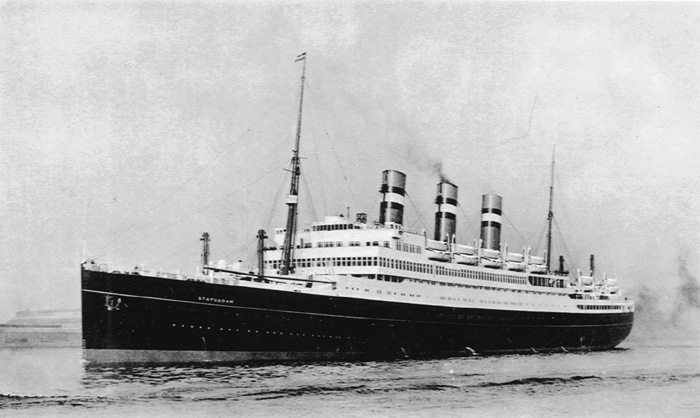
The SS Statendam - from
The World Ship Society
       B. Madelyn Marie Irwin (1924–2006) married Johan "Joe" Jansen (1912–1998) in 1942, and they were together for 56 years. Joe was born in Holland, and immigrated to America in 1930 aboard the SS Statendam. He was naturalized after living in Los Angeles for a number of years. He enlisted in the U.S. Army on 10 December 1942, and served through 1945.

Coincidentally, Madelyn and Joe died on each other's birthdays - Joe on 28 January 1998, and Madelyn on 26 August 2006. They are survived by a son, a daughter, four grandchildren, and two great grandchildren. Two of their sons have died.

     1. Jerrold Johan "Jerry" Jansen (1946–2013)
     2. Thomas William Jansen (1949–2005) both brothers lived in Stanislaus county, California, for most of their adult lives. Their obituaries ran in the Modesto Bee, which locks its obituaries up behind a paywall; so if anyone has them to share or barter, please let me know!

       C. Donald Earl Irwin (1926–2003) served in the U.S. Navy during World War II, enlisting from 1943 through 1946. He died in Norwood, Missouri, and was buried in the Missouri Veterans Cemetery in Springfield.

     IV. Leona Minnie Sly (1899–1930) was the younger daughter of Eugene and Lillie Swindler Sly. She married Raymond Earl Balyeat (1897–1961) before 1920 (other researchers say on 16 November 1918), and they lived in Toledo, where they had a son. By 1924, the family had moved to Long Beach, California, where Raymond's father died.

In April of 1930, Leona was listed in the Census as a patient at the Dore Sanitarium in Monrovia, California. She died in July that year, probably from tuberculosis. Raymond remarried Joanna Wilma Woods (1908–1987) sometime during the 1930s. (She apparently went by "Wilma," at least in the city directories.)

       A. Ray Earle Balyeat Junior (1920–1984) was in Toledo in 1937 and 1938, attending the Macomber Vocational High School. In 1940, he was back in Los Angeles, living with his grandmother, Lillian Sly. He enlisted in the U.S. Army in 1942 and served through 1946.

     V. Alvah Eugene Sly (1906–1978) was the son of Eugene and Lillie Swindler Sly. He married Mabel I Harris (1902–2001) in the first half of the 1930s. They lived in the home of Mabel's parents in 1940, but later lived in Laguna Hills, where Alvah died in 1978. I have not found any evidence that they had any children.

Harriet May Sly (1877–1949) was the youngest of William and Harriet (Callin) Sly's five children. She married Arthur C Solverson (1891–1941), and they lived in Dayton, Ohio, near her brother William James Sly and his wife, Sadie. Hattie Mae worked as a clerk in a dry goods store, and Arthur listed his occupation simply as "inspector," which could mean any number of things. I do not see any evidence that the couple had any children.

 - -- --- -- - 

Once again, we have reached the end of one line, and my branch is up next! If any of you new Sly cousins would like to suggest any corrections or additions, I'd be happy to hear from you. Please drop a note in the comments below, email my callintad Gmail address, or drop by the Callin Family History group on Facebook. It is for family only, so please don't be upset if I ask how you're related.

Happy Hunting!

Thursday, March 26, 2015

The Pull of the West

Benjamin Franklin - yes, that Benjamin Franklin - was living in London in 1771, representing the American colonies to the ministers at court and to Parliament as the growing rift between Britain and her colonies widened. He had been in London for several years, and had developed a strong affection for life in England, but London's poor air quality and the government's seasonal ebb in activity during the summer months had also led him to a habit of traveling and touring around Europe at that time of year.

In 1771, he visited Ireland and Scotland, where he observed that, "Ireland itself is a fine country, and Dublin a magnificent city." But he also noted, "The appearances of general extreme poverty among the lower people are amazing. They live in wretched hovels of mud and straw, are clothed in rags, and subsist chiefly on potatoes. Our New England farmers of the poorest sort, in regard to the enjoyment of all the comforts of life, are princes when compared to them."

Being born in Boston in 1706, and having famously earned himself worldwide fame and a modestly comfortable living as a printer, public servant, and (though he didn't have this word at the time) scientist, the 65-year-old Franklin formed a ready opinion of why conditions were so much better in New England:

"I thought often of the happiness of New England, where every man is a freeholder, has a vote in public affairs, lives in a tidy warm house, has plenty of good food and fuel, with whole clothes from head to foot, the manufactory perhaps of his own family. Long may they continue in this situation!
"But if they should ever envy the trade of these countries [Ireland, Scotland, and England], I can put them in a way to obtain a share of it. Let them with three-fourths of the people of Ireland live the year round on potatoes and butter milk, without shirts, then may their merchants export beef, butter and linen. Let them with the generality of the common people of Scotland go barefoot, then may they make large exports in shoes and stockings. And if they will be content to wear rags like the spinners and weavers of England, they may make cloths and stuffs for all parts of the world.
"Farther, if my countrymen should ever wish for the honour of having among them a gentry enormously wealthy, let them sell their farms and pay racked rents; the scale of the landlords will rise as that of the tenants is depressed, who will soon become poor, tattered, dirty, and abject in spirit."
(from The First American: the Life and Times of Benjamin Franklin, H.W. Brands)

If our Callin Family History is correct, then my ancestor, James Callin, might have been among those people of Ireland, Scotland, or England when Franklin observed those conditions. If James had not already emigrated to the American colonies, a life like that of the New Englander Franklin described as compared to life in Britain would have most certainly been an alluring draw - alluring enough for a young man with no station or prospects to risk the ocean voyage, and enlist in the Continental Army a few short years later.

However, like most rosy comparisons, the Americas were already beginning to suffer from some of the conditions that Franklin observed in his travels. There were already so many land-hungry speculators on the continent that even an industrious investor like Franklin - whose connections in the Court had helped make his son the Governor of New Jersey - had trouble acquiring land to develop. There was growing pressure, even before the Revolution, to open up the land of the Ohio River valley for settlement, but the wars between England and France and the presence of displaced indigenous people in the area kept that land relatively free of settlers.

After the Revolutionary War, that began to change. James Callin appears to have claimed land grants which were made available to Continental soldiers by the new United States government, and his sons, James "2nd" and John, arrived in Richland county, Ohio, around 1810. It's hard for modern Americans to grasp the concept that this area was the "wild west" - but it really was, at the time. It was only about 200 miles west of Westmoreland county, Pennsylvania, and about 500 miles west of Virginia, where James presumably arrived. His sons would have seen Ohio as the land of opportunity, adventure, and danger that James had seen in Virginia and Pennsylvania from his vantage point in Britain.

We don't know a lot for certain. George Callin's family history says this about James 2nd:

"James 2nd, with his family moved from Penn. to Ashland Co. and located on a farm about the year 1810. He was killed in an altercation with a man named Fowler who struck him over the head with a rifle, this occurred about the year 1820. He was buried in Oliversburg Cemetery."

(I should point out that Ashland county did not exist until after 1840; Milton township was located in the part of Richland county that was carved out to create Ashland county, though, and a lot of sources refer to the counties interchangeably.)

James and his brother John show up on the same page of the 1820 U.S. Census (with the spelling "Calan" or "Culan") in Milton township, Richland county. Directly below James, a "Sutton Fowler" (or possibly "Towler") is also listed. Mary Callin, James's likely widow, is listed in 1830 and 1840 Census records, as is Thomas Callin, presumably James 2nd's son. John settled on James 2nd's land with what George describes as a "life lease" of it, and he stayed until he died of tuberculosis in 1835.

In the 30 years between James and John's migration west and the 1840 census, the frontier moved considerably. Land negotiations with Native American tribes continued, and during the 1830s, territory in Iowa began to open up, with the first official settlers arriving in 1833 and the Territory of Iowa being established by Congress in 1838.

Like his father and grandfather, Alec Callin (James 2nd's middle son), felt the pull to move west. George Callin says that he "[m]arried and moved with his family and mother to Iowa about the year of 1840. The mother referred to was 'Aunt Mary', wife of James 2nd who was killed with a gun. She sold the farm and went with Alec to Iowa where she died some years later. Nothing has been heard from that branch of the family since 1845."

There are several records of land grants to an Alexander Callin, one identifying him as a resident of Muscatine, Iowa in July 1854, and showing that he purchased a plots of land in the young state. There is also a Mary Callin buried in a Muscatine county cemetery, having died in 1846. If we can assume this is the same family, we might yet learn more about this branch with more research.

Following behind Alec by a year or two, his younger brother, James (3rd), also moved to Iowa. Per George, again:

"James Callin with his wife and baby moved to Iowa where he died in 1844. William Callin, brother of Margret, went to Iowa and brought her and the two above named children home to Ashland Co. after her husband's death." 

(Yes, if you're paying attention, you are correct that James 3rd and Margret were 1st cousins. Her brother William mentioned here is my 3rd-great grandfather, and the father of the George Callin I keep citing.)

If we assume that James and Margret settled near Alec in Muscatine county, William would have made a 500 mile journey from Ohio to Iowa, to bring Margret and her two boys, Warren and William, 500 miles back to Milton. At an estimated 12 miles a day, over wagon trails and wilderness, this was easily a three month round trip for William. I don't doubt that such a sad and difficult errand had an impact on William, who had three small children of his own at the time. He had more than a month on his way west to compare the romance of the frontier with the reality of it, and to contemplate the contrasting draw of opportunity with the pressures of the swiftly crowding landscape of Ohio. And he had the month or more on his way back east with his sister and small nephews to think about the comforts of living in a more settled place with close neighbors and family.

We still don't know how well or how badly things went for the Callins who stayed in Iowa, but regardless of their fate, I don't doubt that this trip - just a few words in our family history, sketching out the barest details - played a huge part in how William decided to raise his family. After returning to Ohio, he poured his efforts into clearing farmland and educating his sons. He, along with his brother and certainly other neighbors, helped escaped slaves flee the south, and instilled in his sons the desire to fight for the Union cause. He became known as the strongest man in the county.

And I don't doubt that if Benjamin Franklin had traveled 100 years into the future from his 1771 vantage point, he might have marveled that someone from the "wretched hovels of mud and straw" could have arrived in his colonies, and in a mere two generations helped to create a whole new country. Franklin would have been thrilled, I think, to see his theories borne out and to see how much could be accomplished - just by following the pull of the west.

Friday, February 13, 2015

The Unknown and the Unknowable

The book doesn't say where in Scotland Robert Greenlee and his brother came from, but it could have been Lanarkshire as easily as anywhere else. The famous mobility of Lowland Scots was nothing new, and even though the coal industry was just taking off, there were bound to be good reasons for a pair of enterprising young men to follow the flood of people pouring through Ireland and on into the New World.

The settlement of Ulster in the northern counties of Ireland was also nothing new - that had been going on for two centuries by the time the Greenlee brothers came to Ireland around 1770; Robert settled in County Armagh, in the village of Tandragee, while his brother went on to America. The book says he was there in time for the Revolution, but we'll have to take the book's word for that. Robert, a manufacturer of goods, stayed in Tandragee, married, and raised a family of four boys and two girls.

Most of Robert's children would end up in America, but not Robert. His eldest son, Samuel, born in 1795 would grow up to become a linen weaver and marry Nancy Jamphry in 1819. For nearly 20 years, Nancy and Samuel would bring another Greenlee into the world in each of the odd-numbered years, though Robert would only see the first six - he passed away in 1832. By 1837 they had six boys and three girls in their home. Their youngest son, born in 1835, was named Robert.

We don't know the cause, since the book and the records don't say, but their third eldest, a daughter called Margaret, died in 1843 at 18 years of age. Nancy died the following year, in 1844. It's possible that they were taken by disease, and it is certain that the year after that - 1845 - saw the beginning of what would be known as the Great Famine. It could be that chronic hunger, loss of income from the economic impact, and spreading disease associated with the famine made the family decide to move; it could be that their occupation as weavers kept them from feeling the hunger, but their political and religious affiliations as Presbyterian Unionists made them targets of their starving Catholic neighbors frustration. Regardless of the source of the pressures that drove them, the Greenlees were soon to leave Armagh.

Thus, as his uncle and some of his brothers and sisters had likely already done, Samuel decided to bring his family to the United States. On 14 November 1846, Samuel arrived in Philadelphia aboard the Ship Champlain accompanied by a 28-year-old Anne Greenlee. This was most likely his eldest daughter, Mary Ann, who would go on to marry Robert Willis. In 1850, the family was settled in the township of Aston in Delaware county, Pennsylvania. Samuel, along with his sons - Samuel, Jr., Matthew, Thomas, and Robert - worked as weavers; Samuel, Jr. had his wife, Ann Jane Sinton, and their baby daughter, Ann, in the household, and it must have been very... close and cozy.

The Greenlee children began to disperse themselves across the country. John and Mary Ann each married, and ended up in Wineland, Ohio, with their new spouses. James moved to Michigan, and Robert also moved to Ohio, settling in Hancock county, where he married Sarah Bollman in 1857. Thomas married, and may have been in New York, as he joined the 67th Regiment of the New York Infantry in 1861 on the outbreak of war.

Robert and Sarah had their son, Allen, in April of 1861, the month that the Civil War began. Robert enlisted in the 21st Regiment, Ohio Infantry, and he served for 3 months, mustering out in August of 1861. His unit was sent on a reconnaissance expedition down the Kanawha River in West Virginia, but they do not appear to have seen any action or suffered any casualties. His brother, Thomas, was not as fortunate, as the 67th NYI was involved in the Battle at Fair Oaks outside Henrico, Virginia, where he was killed at the end of May 1862.

Here, the story becomes darker and harder to see. As little detail as the book gives us - the book being Ralph Stebbins Greenlee's Genealogy of the Greenlee Families, to be specific - it got us this far. It tells us enough to connect everything we just read to what happened next...but what did happen next?

Sarah Catherine Bollman was born in 1838 in Ohio. In 1850, she live with her mother, Eleanor, and a younger sister and brother (Elizabeth Ann and Solomon, respectively). They lived in the town of Cass in Hancock county, which is where her marriage to Robert Greenlee was recorded in 1857. In 1860, she and Robert showed up in the census, still in Cass. We have records of Robert's enlistment, and they give us no reason to believe that he did not survive the war, and yet in 1870, Sarah and a 9-year-old Allen are back living with Eleanor.

It's impossible to guess from the information available, but the lack of information itself (and the fact that Sarah is listed in 1870 by her maiden name) suggests that something unheroic befell Robert Greenlee. We only know he died because the Greenlee book says so - "died at Vanburen, Ohio." It doesn't say how or when.

(Update: Sarah died in January 1875 and was buried in the Bechtel Cemetery, in Allen township, Hancock county. Robert was buried there after his death in 1879, and Allen in 1887. Sarah's marker lists her as "Sarah C. Greenlee," but the obituary index gives her name as Bollman.)

Allen Greenlee's life was similarly mysterious, in that very little solid information about him exists. We see him in the 1870 and 1880 census records, living with his grandmother (though the 1870 lists his name as "Ellen"), and we do see him listed on his daughter's birth record, so we are at least not guessing at the relationship. But aside from a single appearance in the Cincinnati Enquirer in 1882, when he was apparently raising sheep in Findlay, Ohio, he only left one other trace behind.
Bertha May Greenlee and
Alice Ava Hales - c. 1889

Bertha May Greenlee, my great-grandmother, was born December 5, 1885 in Arcadia, Ohio, to Allen Greenlee and Alice Ava Hales. By the time she was four years old, her father was gone, and her mother remarried to George McClellan Cramer on November 28, 1889. George adopted her, and Bertha Cramer grew up with her half-sister, Mamie Cramer, her mother, and her adopted father in turn-of-the-century Fostoria, Ohio.

If Bertha knew what happened to her father, or to her grandfather, it did not get passed down to us. She did name her youngest son Robert, but that's not necessarily a clue. Her grandchildren and great-grandchildren can only imagine how dangerous life really was in those days and be grateful that we're here to marvel at it! And we are here because Bertha married John Quincy Callin, of the 20th Century Callin Clan, on June 6, 1906 - but that is a whole other story.

There is a lot we still don't know - about Allen and Robert, at least - and it's not likely we'll ever find out what happened to them. We'll keep looking, of course, because that is how you find out what is unknowable, and what is merely unknown. If we don't search, we certainly won't find any answers.

Friday, January 23, 2015

The Immigrants, Part I: The Germans

The more things change...


Growing up in Arizona, issues surrounding immigration have always been bubbling in the background - occasionally erupting onto the national stage. The arguments that get thrown around during those eruptions tend to follow familiar patterns. Any objective analysis of those arguments can see that the root cause of the controversy is always about the same thing: Fear of the Other. Whether the specific conversation is about trade, possibility of war, or even policies based in outright racism, the arguments revolve around the definition of the divide between  "Us" and "Them".

Growing up in the 1980s & 1990s, there was also an ever-present, underlying tension between two cultures living side by side and vying for the right to define who "Us" and "Them" might be. The first was the inclusive, celebratory culture of the post-1960s; these were the people who came of age during the Civil Rights era and who embraced the notion of the "melting pot". Their attitudes were evident in the school curricula I remember from early public school days and in the PBS children's programming (especially from the Children's Television Workshop) - and in my church, in the form of songs like "Jesus Loves the Little Children" and lessons about mission work in Asia and Africa.

The second culture was less noticeable in my childhood. It really came to my notice when I got to college, and saw the rise of 24-hour news cycle and growth of the talk radio media market giving a platform to people who had long existed on the fringes. These figures questioned ideas of "multiculturalism" and "diversity" that I personally had always taken for granted as a common part of American culture. They forced me to question my assumptions, and I quickly determined that they were conflating the notions of equality and fair treatment with something called "political correctness" in order to demonize those ideas. They championed the notion that rather than being a sign of common decency, celebrating different cultures was some kind of progressive plot to erode the primacy of "real" Americans.

It probably goes without saying, but this was not a new idea. It is even older than the concept of a "real American". These ideas and arguments are just a restatement of the "us vs. them" attitude that has plagued Americans since colonial times.

Words and Identity

Though the first permanent settlement in the New World was English, all of the major players in Europe began setting up colonies along the Atlantic coast. The Dutch, French, Spanish, and Germans all sent people over in the first century or two after Columbus's journey.  Whether they were sent as explorers, settlers, prisoners, refugees, governors, traders, or even as military forces, it is critical that modern readers understand that those people would not have necessarily identified themselves with a nation the way we label them today.

Not only were the boundaries between German territory and French territory (just for one major example) very fluid, but the very definition of what these territories were was evolving as the feudal system decayed. The concept of a "nation" was still new, and not broadly well understood even by those who championed it. The New World colonists who spoke German didn't identify with a concept of "Germany" - not as a national identity - and once they settled throughout the New World, tending their new homes and raising their families was their main concern. They tended to keep to themselves as much as possible as political control over their communities shifted from the French to the British and back.

There are a number of parallels between the way English colonists viewed these German people and the way modern Americans view Hispanic and Latino neighbors. The most visible divide, then as now, seemed to be along language boundaries.

Benjamin Franklin wrote of the German-speaking settlers in the Pennsylvania, after he began serving in the Pennsylvania legislative assembly:

"Few of their children in the country learn English; they import many books from Germany... The signs in our streets have inscriptions in both languages, and in some places only German. They begin of late to make all their bonds and other legal writings in their own language, which (though I think it ought not to be) are allowed good in our courts, where the German business so increases that there is continual need of interpreters; and I suppose in a few years they will also be necessary in the Assembly, to tell one half of our legislators what the other half say."
In other places, he wrote of the impossibility of the two cultures mixing, and contrasted the German standards of beauty for their wives against that of the English in terms which, if he were saying them about Latinos today, would have likely scuttled his political career. And yet, two things stand out to me about this:

  1. The same Ben Franklin who held and expressed these opinions, and predicted what seemed like increasing enmity within his own colony, went on to champion the fundamental idea of unity between the colonies that allowed the Continental Army and Congress to force the break with Britain and found the United States.
  2. He was wrong about the future. When Franklin writes of the "continual need of interpreters" he seems to forecast an untenable, unbridgeable split between English and German speakers - which clearly did not come to pass.
The lesson I take from this is that arguments warning of seemingly permanent, trending, and eternally intolerable differences between groups of people should not be treated with the weight that people give them. They are specious arguments that assume people aren't capable of growing, changing, or of setting aside their differences to come together for their common good when necessary.

Or, to put it another way - the words we use to identify ourselves are always just words. When it comes to how we live and how we treat each other as neighbors, words aren't what matters.

Melting Pot


As for the mixing of cultures, I think it's evident that our past (Franklin's future) demonstrates how just a few short generations can change the entire social landscape. The Germans that Franklin was writing about almost certainly included my own German ancestors. The Witters (probably originally a variation of "Weider") who came to Arizona via Kansas after the Civil War migrated from Fulton county, Pennsylvania, where they were married to Pipers (Pfeiffers), Volkman, Shrivers (Schreibers), Zollingers, Howers, and Kerschners.

As I said in "Faiths of Our Fathers", most of them were probably Lutheran. Like other communities formed around religious ideas, they struggled with finding the right balance between orthodoxy and heterodoxy. And the dismay that Franklin expressed over the character of new immigrants wasn't expressed only by Englishmen. Henry Muhlenberg, Lutheran pastor, and immigrant from Germany (arrived 1742, writing in the 1750s):

"It is almost impossible to describe how few good and how many exceptionally godless, wicked people have come into this country every year. The whole country is being flooded with ordinary, extraordinary and unprecedented wickedness and crimes... Our old residents are mere stupid children in sin when compared with the new arrivals! Oh, what a fearful thing it is to have so many thousands of unruly and brazen sinners come into this free air and unfenced country!"
But for every example of conflict and discomfort with the Other, there are also stories of acceptance and tolerance in abundance.

Take the story of my ancestor, Leopold Zindle, a Hessian soldier during the Revolutionary War who spent his four years as a prisoner of war winning friends and earning a place in his New Jersey community. The rhetoric people today throw around about being "invaded" from our neighbor to the south looks rather silly in comparison to actual soldiers sent here to subdue the rebellion - and yet Leopold was accept and honored as a citizen here.

Sadly, the story doesn't end there. American immigration problems continued as different groups "threatened" to swarm in and "overrun" the place. Happily (for me, anyway) we've never successfully fenced ourselves off from Them, or many of Us wouldn't exist!

Friday, December 12, 2014

Love and Loss in Old New York (and New Jersey)

Joseph Frey led a short but interesting life.

Born in Germany, in the mid-1820s, he came to settle in New York, probably during the 1830s or early 1840s. His birthday is listed on various documents as ranging from 1823 to 1828, and his birthplace is usually listed as either "Baden" or "Wurttemberg", but other sources say his parents may have been from a small French town near the Swiss border, or that he was born in Switzerland.

These were very difficult times for working class people in Europe. Between successive revolutions in France, uneasy relations amongst the old Empires, and terrifying epidemics - particularly cholera - sweeping through the increasingly crowded and unsanitary cities, a young man looking across the ocean might have been strongly attracted to the relative prosperity and peacefulness of the United States.

Once settled in one of the German speaking neighborhoods around New York, that young man would have become part of the story of that young, still experimental nation. He would have seen the growing stream of immigrants from Ireland pouring through New York Harbor during the so-called Potato Famine of the 1840s; he would have seen politicians arguing about Westward expansion; and and he would have heard about threats of war from Britain, France and Mexico. Without records or writing from Joseph's point of view, I have to assume from the evidence available that he found his place in America, and decided to invest himself in it.

When President Polk maneuvered the U.S. into war with Mexico, Joseph enlisted as a private in Company A, 5th Regiment of Infantry, New York Volunteers. He signed up for a 5 year term on 3 December 1846, but was discharged honorably after 11 months and 24 days on 27 November 1847 after the relatively quick American victory at Mexico City.

On March 11, 1849, he married Elizabeth Horn in the Lutheran church in Williamsburg, New York, and they began raising their family; Frederick (1851), Maggie (1853), William (1856), Theodore (1858), and the twins, Edwin August and Edward (1859).

As a veteran soldier, and a member of a close-knit community in a burgeoning New World city, I like to imagine that this would have been a happy and hopeful decade for Joseph and Elizabeth. Despite the growth of the anti-immigrant sentiment in the 1840s and 1850s, people like the Freys were learning how to thrive in the "melting pot" of New York. Joseph was listed in the 1860 census - along with Elizabeth and the children listed above - and identified as a brush maker, which implies that he was literate and educated, and moderately well off.

And then there came another war.

Enlisted in Captain Robinson's Company of New York Volunteers on 6 September 1861, Joseph re-enlisted 15 November 1863, and was discharged and mustered out with the Company on 21 June 1865. His pension records say he contracted seriously debilitating rheumatism during his time in service, and while he and Elizabeth had two more children - Augusta ("Gussie", b. 1865) and my great-great grandfather, Emil Adolph Carl (1869) - his health would never fully recover.

In 1870, Joseph had taken his brush making profession back up, and his older sons and daughter seem to have been helping with the house and the business in the Flushing neighborhood of Queens, New York. But his condition seems to have deteriorated so that some time around 1876, he had to move into the Soldier's Home in Washington, DC - where he died in February 1877, barely 50 years of age.

Frey family, about 1903
from left: Edna, Emil, Bessie, Amelia
(front) Grace, Marjorie
By 1880, Elizabeth had moved the family to Newark, New Jersey, probably to be near her brother's family, and the Freys lived at 103 Congress Street for many years. Young Emil met Miss Emily Amelia Opp, whose family split their time between a cottage in nearby Paterson (about 15 miles from Newark) and Dansville, in upstate New York.

Emil and Amelia were married around 1894 in Dansville, and settled back in Newark. They had six daughters: my great grandmother, Edna (1895), Elizabeth "Bessie" May (1897), Blanch (1899-1900), Marjorie (1900), Grace (1902), and Theresa "Tessie" Decker (1908).

I have the impression that Emil found a second family in the Opps.
Jacob Opp

Amelia's father, Jacob, was a veteran of the war, just like Emil's father. He worked as a locomotive engineer, which might account for his family seeming to simultaneously live in two towns separated by nearly 300 miles. For example, in 1900, Emil and Amelia and their girls show up twice in the Census records - once in the home of Susan Opp (Jacob's widowed mother) and once in their own home in Newark. Interestingly, the two records were enumerated only about a week apart - one on the 1st and one on the 9th of June - suggesting that they were recorded both while visiting Dansville AND after their return home to Newark.

These years seem to have been happy ones for Emil. He worked as a grocer and (according to a Frey family tradition) as a Borden's milk delivery man. It isn't clear what caused the tragic loss of little Blanch before her second birthday, but the other girls seem to have all been healthy and the family seems to have prospered. Sadly, Emil and Amelia would not see their twentieth wedding anniversary.

Frey daughters, about 1909
(clockwise from left) Edna, Theresa,
Elizabeth, Marjorie, Grace
In 1910, Jacob was listed in the Census records as living in Emil's household, where he apparently lived out his days. He succumbed to pneumonia in July 1913, only a few months after Amelia died, in March of that year. At this writing, I am just shy of my twentieth anniversary myself; I know how I would feel if I lost my lovely bride right now. If my impression of their relationship is correct, Emil then immediately lost someone who may have been like a surrogate father for an even longer time. Then, as if that weren't enough, Emil's mother, Elizabeth, died in 1914 of Bright's disease at the age of 86.

This all seems to have been too much for him. Emil's older daughters, Edna and Bessie, began working to support the family, and they took care of the younger girls. By 1920, Edna was married to Alfred Tuttle; Bessie was working as a legal clerk, living with the other girls in a rented house on Fourth street in Newark while they attended school; and Emil was an inmate in the Essex County Hospital Center (also called Overbrook hospital) in Cedar Grove.

My grandmother, Edna's younger daughter, recalls visiting Emil in the hospital. She told me, "We used to visit him every Sunday, and take him fruit and treats. I was very young then of course." She would have been 11 years old when he died of pneumonia in February 1936.

Today, approaching 2015, I have to wonder if it might have been possible to do more to treat Emil; if we could go back armed with a better understanding of the mind and brain, would we be better equipped to help him, and get him back home with people who loved him? It's hard to know what his life was like those last 16 years; I haven't found records that could describe his condition or diagnosis, and the hospital itself shut down in 2007. It is now a favorite haunt for so-called urban explorers and ghost hunters - thrill seekers more interested in playing up the "spookiness" of old buildings than understanding what life was like for the patients.

At least his life was bookended by heroic people. From his father, the devoted soldier, to his self-sufficient daughters, Emil Frey seems to have been surrounded by love, strength, hope, and joy for most of his life. I will leave it to you to decide whether that lessens or sharpens the tragedy of those last years.