In another stunning example of how helpful strangers on the internet can be, we just received several photos from a Find A Grave user, Names In Stone, settling a number of questions from one of my first Callin Family History posts, Tragic Thomas.
All of these graves are located in the Old Olivesburg Cemetery in Weller Township, Richland County, Ohio. I'm not sure, but it looks like some of these photos might have been taken during or after a restoration project, judging by the water lines.
Showing posts with label 1840s. Show all posts
Showing posts with label 1840s. Show all posts
Tuesday, October 3, 2017

Saturday, July 29, 2017
Update: Located in Illinois
I'm excited to announce another breakthrough; let me refresh the details for you (borrowing from The Rise of the Fergusons):
The year is 1835, and the younger of the Brothers Callin of Ohio, John Callin, has just died of tuberculosis. While the farm where John's children and nephews grew up must have begun to feel crowded by the end of the 1820s, during the 1830s and 1840s these children began to grow up and set off on their own.After years of periodically running the same searches without seeing any results, Ancestry has added at least one Ohio marriage database containing a record of John Scott and Sarah Callin, who married in 1823 in Richland county, Ohio. I've also been checking in with other sites when I don't see results in Ancestry, and when I looked for Sarah and John at FamilySearch.org, I got a death record for a James Callin (1832-1916) which listed his father's name and his mother's maiden name: Sarah Callion.
Indeed, at least the older of John's children would have been married by the time of his death. His son, George Callin, was married though he may not have moved out to Huron county, yet. His daughter, Ann Callin Campbell, had certainly struck out on her own with Henry Campbell. And we have discussed how his nephew Alec Callin will soon embark on his journey to Iowa, taking wife and children with him, as well as his widowed mother (John's sister-in-law).
The Callin Family History (or CFH) is not very elaborate when it comes to conveying all of this activity and motion. It tends to compact a great deal of an individual's history into very little text. For example, the book has two lines about John's next two eldest daughters which seem to say very similar things, but which have very different stories to tell:
Sarah, born 1808, married John Scott, moved to Ills. About 1840.
Eliza, born 1811, married Jas. Ferguson, moved to Ind. 1851.
This doesn't specify when Sarah and John were married, though it might be safe to guess that it was probably within a year or two of 1830; Sarah would have been in her early twenties, then. But the real tragedy is that we know nothing else about this couple - because none of their children are named in the CFH, and we have no idea where in Illinois they might have gone.
That's all I needed. I began to pull that thread, and we now have another populous branch to add to the revised Callin Family History!
Joseph Scott was born in Pennsylvania in 1765. He may be the Joseph Scott who appeared in Washington, Pennsylvania, on the 1790 U.S. Census, but according to other researchers, he moved with his wife, Elizabeth Mary (1778-1848), to Ohio where all of his children were born. His oldest child, John Scott, was born in Richland County, Ohio, on 6 October 1798.
John Scott married Sarah Callen in Richland County on 18 January 1823. Depending on which record you trust for her birth date, she would have been anywhere from 15 (using the Callin Family History date of 1808) to 22 (using the date on her Find-A-Grave memorial). John and Sarah had their first three children there in Richland county before the Scott family relocated to Winnebago county, Illinois in about 1836.
 |
| North Burritt Cemetery, Winnebago, IL |
- George Scott (1827–1905)
- James Scott (1832–1916)
- Sarah E Scott (1836–1854)
- Rebecca Scott Sharp (1837–1928)
- Nancy A Scott (b. 1840)
- Cyrus H Scott (1843–1931)
- Lucina Scott (b. 1845)
Sarah and John lived out their lives in Harrison, and died just a few weeks apart from each other; he died on 20 January 1872, and she died on 6 February 1872. They are buried in North Burritt Cemetery
- -- --- -- -
I have seen several other names of researchers who seem interested in this branch of the family, so I'll be reaching out to them to let them know about this blog and the Callin Family History project. As always, if you are related to anyone named in the blog, I'd like to hear from you.
I'm on FTDNA if you'd like to look for our genetic connection, we have the Callin Family History group on Facebook (be prepared to explain how you're related before I approve any join requests), you can reach me at my Gmail address (callintad), and, of course, you can drop a comment below.
I always appreciate corrections, clarifications, and even new mysteries!
Monday, July 24, 2017
Breaking News: New Find-A-Grave photo for Mary Callin in Muscatine
Thanks to Find-A-Grave member Kelly Muldoon for fulfilling this photo request in the Oak Grove Cemetery, Muscatine, Iowa.
In case you don't recall the post The Distance of Close Connections, here's a quick quote:
I won't keep you in suspense - the memorial carved on the other side of that stone belongs to one Callin Rayburn. I had seen that name pop up in some of my searches, and it was interesting, but other researchers on Find-A-Grave connect his mother, Eleanor Callen Rayburn, back to the Patrick Callen family from Armstrong county, Pennsylvania.
This isn't concrete proof (pun intended), but it is a clue literally set in stone - at the very least, our Callin family was close enough to the descendants of Patrick Callen to be buried side by side in an Iowa cemetery.
I have a lot of work to do to see if I can find more information, but this is tantalizing and exciting!
(And, as always, if you're related to these Rayburn and/or Callen folks, please let me know! I'd love to compare notes!)
In case you don't recall the post The Distance of Close Connections, here's a quick quote:
Alec Callin, who felt The Pull of the West and moved further, from Ohio to Iowa. Just to refresh you on the details, the CFH says this of Alec:The existing Find-A-Grave memorial for Mary Callin had that information - and if the photo had only been "head on," it would have merely confirmed what we already knew. I've scoured the records in the area trying to find connections to the Callin family in that area. But because Kelly also posted this photo, I got a bonus clue:
"Married and moved with his family and mother to Iowa about the year of 1840. The mother referred to was 'Aunt Mary', wife of James 2nd who was killed with a gun. She sold the farm and went with Alec to Iowa where she died some years later. Nothing has been heard from that branch of the family since 1845."
There are several records of land grants to an Alexander Callin, one identifying him as a resident of Muscatine, Iowa in July 1854, and showing that he purchased a plots of land in the young state. There is also a Mary Callin buried in a Muscatine county cemetery, having died in 1846 at age 77.
 |
| Mary Callin's memorial in Muscatine (click to go to Find-A-Grave) |
I won't keep you in suspense - the memorial carved on the other side of that stone belongs to one Callin Rayburn. I had seen that name pop up in some of my searches, and it was interesting, but other researchers on Find-A-Grave connect his mother, Eleanor Callen Rayburn, back to the Patrick Callen family from Armstrong county, Pennsylvania.
This isn't concrete proof (pun intended), but it is a clue literally set in stone - at the very least, our Callin family was close enough to the descendants of Patrick Callen to be buried side by side in an Iowa cemetery.
I have a lot of work to do to see if I can find more information, but this is tantalizing and exciting!
(And, as always, if you're related to these Rayburn and/or Callen folks, please let me know! I'd love to compare notes!)
Friday, January 6, 2017
The Three Lives of James Monroe Callin
James Monroe Callin was born 26 February 1844 in the Ashland area of Richland county. That was the year that his father, William, traveled nearly 500 miles west to Iowa to bring Jim's aunt Margret back to Ohio. (I told that story back in the post titled The Distance of Close Connections.) Jim's older sister, Harriet, would have been about 6 years old, and his brother, John, would have been 4.
The family of William Callin would have been surrounded by extended family in the neighboring townships, so their mother, Elizabeth Berlin Callin, would not have been entirely on her own — but imagine sending your husband off on a journey like that at a time when the threat of attack from hostile indigenous tribes was not out of the question. The last major uprising of native peoples, the Battle of Little Bighorn, was still thirty years in the future at this point.
When Jim was six, William took the family to clear and settle a new farm in Peru, Huron county, Ohio. Jim grew up in New London and Ridgefield, attending school and working his father's farm, until the war began. Jim was not yet 18 when the call for troops went out in 1861, but he turned 18 the following February. He went up to Toledo, and on 10 October 1862, a full two months before his older brother John enlisted, he enlisted in the 67th Regiment, Ohio Volunteer Infantry, Company H.
At the time of his enlistment, his personal description was five feet eight inches high, fair complexion, grey eyes, and auburn hair. He was a farmer boy, strong and capable.
Jim was twice wounded in action. First, and most serious, he was hit by a shell that struck the upper part of his right thigh near the bone during the charge at the Second Battle of Fort Wagner, South Carolina, 18 July 1863. “He was one of the eighteen men who took their stand on the bomb proof of said Fort and that they held the same about thirty minutes and until their commander ordered them to retreat as best they could.” Jim was in the general hospital No. 9 at Buford (Beaufort), South Carolina, almost three months. He returned to duty 27 September 1863.
Second, he was struck in the back of his head by shrapnel from an exploding shell in the Battle of Chester Station, Virginia, 10 May 1864, and hospitalized at Ft. Monroe, Virginia, on 20 May 1864 after experiencing disorientation and headaches. This injury, though it sounds worse, was less serious than the thigh wound which caused permanent damage and a limp. Almost as bad, he, along with many others, contracted what was called “camp diarrhea,” dysentery, from which he suffered the remainder of his life.
James Monroe Callin was discharged honorably at the end of the war, and returned home in October 1865.
Rosalina Bedora Davenport (1848–1876) was the daughter, and only child, of Martin Sidney Davenport (Jr.) (1824–1895) and Laura Maria Hix (1828–1904). Martin married Laura in Norwalk, Huron county, Ohio, on 11 November 1845.
Laura was born on 5 September 1828 in Vermont, daughter of Daniel Weed Hix and Laura (unknown), and her family had only recently arrived in Ohio before she was married. Martin was a carpenter who descended from Dutch settlers to New Jersey who had spread to the west via Tompkins county, New York, where Martin was born. The Davenport family's origins are still a matter of some debate. They held a reunion in Perrysburg, Ohio, on 4 September 1890, at the home of Alanson Davenport, which was reported on by Charles C. Hum in the newspaper:
Martin Sidney was a Union Army soldier who enlisted in Company A, 100th Regiment, Ohio Volunteer infantry on 1 September 1862. He mustered out on 20 June 1865 at Greensboro, North Carolina. After the war, he was also a member of the Wood County Wiley Post # 46 of the Grand Army of the Republic, and a GAR Flag Holder.
At that 1890 reunion, he recounted a story from those days:
Martin's Veteran’s Pension records showed that though he was never wounded, he, like Jim, contracted “camp diarrhea” or dysentery during the war, from which he never recovered. He was several times left sick in camp in Frankfort, Kentucky and hospitalized in Marietta, Georgia. Like Jim, he eventually died of “cancer of the bowels.” His physical description in 1881 was height, 5 feet nine inches; weight 158; complexion dark; age 56. He died 14 June 1895, aged 70, and his widow, Laura died 5 March 1904, aged 75, both in Bowling Green, Ohio.
Jim Callin and Rosa Davenport were married in Bowling Green on New Year’s Eve, 31 December 1867. They set up a farm in Center township, and had four children over the following eight years.
The family of William Callin would have been surrounded by extended family in the neighboring townships, so their mother, Elizabeth Berlin Callin, would not have been entirely on her own — but imagine sending your husband off on a journey like that at a time when the threat of attack from hostile indigenous tribes was not out of the question. The last major uprising of native peoples, the Battle of Little Bighorn, was still thirty years in the future at this point.
When Jim was six, William took the family to clear and settle a new farm in Peru, Huron county, Ohio. Jim grew up in New London and Ridgefield, attending school and working his father's farm, until the war began. Jim was not yet 18 when the call for troops went out in 1861, but he turned 18 the following February. He went up to Toledo, and on 10 October 1862, a full two months before his older brother John enlisted, he enlisted in the 67th Regiment, Ohio Volunteer Infantry, Company H.
At the time of his enlistment, his personal description was five feet eight inches high, fair complexion, grey eyes, and auburn hair. He was a farmer boy, strong and capable.
 |
| Ruins: The Second Assault on Fort Wagner |
Second, he was struck in the back of his head by shrapnel from an exploding shell in the Battle of Chester Station, Virginia, 10 May 1864, and hospitalized at Ft. Monroe, Virginia, on 20 May 1864 after experiencing disorientation and headaches. This injury, though it sounds worse, was less serious than the thigh wound which caused permanent damage and a limp. Almost as bad, he, along with many others, contracted what was called “camp diarrhea,” dysentery, from which he suffered the remainder of his life.
James Monroe Callin was discharged honorably at the end of the war, and returned home in October 1865.
Rosalina Bedora Davenport (1848–1876) was the daughter, and only child, of Martin Sidney Davenport (Jr.) (1824–1895) and Laura Maria Hix (1828–1904). Martin married Laura in Norwalk, Huron county, Ohio, on 11 November 1845.
Laura was born on 5 September 1828 in Vermont, daughter of Daniel Weed Hix and Laura (unknown), and her family had only recently arrived in Ohio before she was married. Martin was a carpenter who descended from Dutch settlers to New Jersey who had spread to the west via Tompkins county, New York, where Martin was born. The Davenport family's origins are still a matter of some debate. They held a reunion in Perrysburg, Ohio, on 4 September 1890, at the home of Alanson Davenport, which was reported on by Charles C. Hum in the newspaper:
"In good old colonial days one Garret Davenport with three half brothers came from Holland to America and located in New Jersey. This circumstance coupled with the undoubted English character of the name, is almost certain evidence that the family was one of the many who had been driven from England in the days of religious persecution to find an asylum in Holland, and afterward a home in wild but free America."While it's hard to find "almost certain evidence" of anything from that early period, it is certain that after arriving in New Jersey, Garret and his sons spread across the continent, through New York, Pennsylvania, Ohio, and beyond. Garret's son, Martin Sidney, Sr., was born in New Jersey, and lived for a time in Tioga and Tompkins counties, New York, where Martin Sidney Davenport, Jr., was born in 1824 youngest of six sons, the eldest of whom was Alanson. A number of these Davenports moved to Ohio in the 1840s.
Martin Sidney was a Union Army soldier who enlisted in Company A, 100th Regiment, Ohio Volunteer infantry on 1 September 1862. He mustered out on 20 June 1865 at Greensboro, North Carolina. After the war, he was also a member of the Wood County Wiley Post # 46 of the Grand Army of the Republic, and a GAR Flag Holder.
At that 1890 reunion, he recounted a story from those days:
"Sidney Davenport announced that the only behavior of the family that might be criticised [sic] was some of his own. It happened that in old army days a large cheese adhered to his rubber blanket, carelessly throwing over it while taking lunch. After reaching camp he noticed the cheese and tried to make it take the oath of allegiance. Failing in this he confiscated it as he was in duty bound to do. This was not a case of theft and the fault lay clearly with the cheese."
Martin's Veteran’s Pension records showed that though he was never wounded, he, like Jim, contracted “camp diarrhea” or dysentery during the war, from which he never recovered. He was several times left sick in camp in Frankfort, Kentucky and hospitalized in Marietta, Georgia. Like Jim, he eventually died of “cancer of the bowels.” His physical description in 1881 was height, 5 feet nine inches; weight 158; complexion dark; age 56. He died 14 June 1895, aged 70, and his widow, Laura died 5 March 1904, aged 75, both in Bowling Green, Ohio.
Jim Callin and Rosa Davenport were married in Bowling Green on New Year’s Eve, 31 December 1867. They set up a farm in Center township, and had four children over the following eight years.
- Albert Clifford Callin, born 1869
- Arthur K Callin, born 1871
- Bessa Viola Callin, born 1873
- Jessie Callin, born 1876
Jessie was born in March of 1876, but sadly, Rosa died in September of that year. Now a widower, Jim had to raise his four children on his own. In 1880, the three older children were living with their grandparents, Martin and Laura Davenport, not far from William and Elizabeth Callin's home.
Almira A. Weirick (1858–1889) was the daughter of Jason Weirick (1826–1917) and Matilda E Hassinger (1830–1915), both of whom came from Pennsylvania families that had settled in Ohio around 1830. More than most of our relatives, Almira's name seems to have been very difficult to spell; it appears as "Elmira" and even "Elvira" in some records, and her surname was often rendered as "Wirick" or "Weirich."
Almira was about 21 when she married the 35-year-old widower Jim Callin in 1880. Jim's sons Albert and Arthur were 12 and 9 years old, and his daughters Bessie and Jessie were 7 and 5, respectively. Jim and Almira had three more daughters together before Almira's death at only 31 years of age. They had a son in 1887, but he died at six months of age, and we do not know his name.
Most of Jim's children were old enough to be independent by 1893. Jessie married that year, and the boys and Bessie were already out on their own. Almira's three daughters would have still been too young to leave home in 1893, but by 1900, Cora had gone to live with her grandparents, Jason and Matilda Weirick; Carrie was married in 1898; and 15-year-old Aurilla was a listed as a boarding school student, living in Cottage 1 of the Ohio Soldier's and Sailor's Orphans Home.
 Jim's health deteriorated, and he was unable to farm. He had been increasingly debilitated by his hip injury, but mostly by the diarrhea and resulting severe piles, as shown in his pension requests. Emma took him to her Canadian home in St. Catherines, Ontario, to be near her family, as somehow she was estranged from the Ohio families of Callin, Davenport, and Wirick who were caring for, or had cared for, his children. She apparently had her mother and a sister or sisters in St Catherines. However, she apparently also became estranged from them during Jim’s final illness.
Jim died of bowel cancer in St. Catherine's on 7 April 1901, age 57. Nine months after Jim died, Emma married Albert A. Flora on 23 January 1902. She had been begging for an increase in Jim’s pension to pay his last doctor’s bill, but she was denied because of her remarriage.
Emma and Albert had a contentious marriage. They returned to Perrysburg, Ohio, but she sued him for divorce in January 1907, asking to return to the Callin surname. She died just a month later, before her divorce was final, on 13 February 1907, and was buried as Emma G. Flora, aged 51, in the Oak Grove Cemetery, Bowling Green.
You can take the title of this post, as with most of my titles, in a couple of ways. In one sense, James had three wives/lives, and you could read his biography that way. After all, he was with each of his wives for about 9 years — if you don't examine my math too closely. Or you can view him through the lens of history: pioneer boy, Civil War solider, and father during the Midwest's boom years.
As we look more closely at his descendants in the following weeks, there will be some mysteries that we have to leave unanswered; there will be some shocking crimes; and there will be a lot of children. I'll try to do them justice.
For help with this branch of the family, I thank Joan Callin Foster, who has been one of the most enduring and encouraging of fellow researchers. As I've said before, if you see anything you like here, she deserves full credit; if you find any mistakes, those are all mine!
And as always, if you're related to any of the folks in this post, then you're family! Drop me a note at callintad (at Gmail.com), or in the comments below; or send a request to join the Callin Family History Facebook group. Please do let me know if there are mistakes, and I'll do my best to correct them. This ongoing project is intended to result in a published revision to the Callin Family History, so we want to get it right.
Now brace yourself — next week's post is a long one!
Almira was about 21 when she married the 35-year-old widower Jim Callin in 1880. Jim's sons Albert and Arthur were 12 and 9 years old, and his daughters Bessie and Jessie were 7 and 5, respectively. Jim and Almira had three more daughters together before Almira's death at only 31 years of age. They had a son in 1887, but he died at six months of age, and we do not know his name.
- Cora May Callin (1881–1936)
- Carrie E Callin (1883–1960)
- Aurilla M Callin (1885–1969)
- Unnamed Callin (1887)
Most of Jim's children were old enough to be independent by 1893. Jessie married that year, and the boys and Bessie were already out on their own. Almira's three daughters would have still been too young to leave home in 1893, but by 1900, Cora had gone to live with her grandparents, Jason and Matilda Weirick; Carrie was married in 1898; and 15-year-old Aurilla was a listed as a boarding school student, living in Cottage 1 of the Ohio Soldier's and Sailor's Orphans Home.
 Jim's health deteriorated, and he was unable to farm. He had been increasingly debilitated by his hip injury, but mostly by the diarrhea and resulting severe piles, as shown in his pension requests. Emma took him to her Canadian home in St. Catherines, Ontario, to be near her family, as somehow she was estranged from the Ohio families of Callin, Davenport, and Wirick who were caring for, or had cared for, his children. She apparently had her mother and a sister or sisters in St Catherines. However, she apparently also became estranged from them during Jim’s final illness.
Jim died of bowel cancer in St. Catherine's on 7 April 1901, age 57. Nine months after Jim died, Emma married Albert A. Flora on 23 January 1902. She had been begging for an increase in Jim’s pension to pay his last doctor’s bill, but she was denied because of her remarriage.
Emma and Albert had a contentious marriage. They returned to Perrysburg, Ohio, but she sued him for divorce in January 1907, asking to return to the Callin surname. She died just a month later, before her divorce was final, on 13 February 1907, and was buried as Emma G. Flora, aged 51, in the Oak Grove Cemetery, Bowling Green.
- -- --- -- -
You can take the title of this post, as with most of my titles, in a couple of ways. In one sense, James had three wives/lives, and you could read his biography that way. After all, he was with each of his wives for about 9 years — if you don't examine my math too closely. Or you can view him through the lens of history: pioneer boy, Civil War solider, and father during the Midwest's boom years.
As we look more closely at his descendants in the following weeks, there will be some mysteries that we have to leave unanswered; there will be some shocking crimes; and there will be a lot of children. I'll try to do them justice.
For help with this branch of the family, I thank Joan Callin Foster, who has been one of the most enduring and encouraging of fellow researchers. As I've said before, if you see anything you like here, she deserves full credit; if you find any mistakes, those are all mine!
And as always, if you're related to any of the folks in this post, then you're family! Drop me a note at callintad (at Gmail.com), or in the comments below; or send a request to join the Callin Family History Facebook group. Please do let me know if there are mistakes, and I'll do my best to correct them. This ongoing project is intended to result in a published revision to the Callin Family History, so we want to get it right.
Now brace yourself — next week's post is a long one!
Friday, September 16, 2016
On the Sly
William Sly came from England to the United States in the 1850s. He was naturalized in 1866 at Bowling Green, Wood county, Ohio. According to the Callin Family History, he married Harriet Callin (1838-1907) in 1859.
We don't know for sure who William's parents were or where in England he came from; there are a couple of candidates in the UK Census records. Other researchers have noted an 1841 England Census which documents a Sly family in a Wiltshire parish called Horningsham: father James (b. 1786), mother Susanna (b. 1796), son William (b. 1826) and his two brothers, James (b. 1829) and Thomas (b. 1832). All of them list Ireland as their place of birth, except for the father, James; William is listed as a shepherd, and James as a pensioner. There is a death record for James in April 1849, which may have prompted a 23-year-old William to seek his fortune in the New World.
William's birthplace in all of his more recent, American records is "England," and not "Ireland," but that isn't enough to rule out this Census record, in my opinion, since the family did live in England, and probably considered themselves as being distinct from the other Irish immigrants arriving in the United States during the 1840s and 1850s.
There was also a James Sly of about the right age to be William's brother from that UK Census record. This James lived in Wood county, dying in 1893. The men would have certainly been aware of each other, living in the same place for decades, but neither of them mentioned the other in their wills, we don't have any newspaper notices from the time, and nothing else solidly connects them to that 1841 record. It could be that they weren't related, or they might have had a falling out, or James might possibly be a more distant cousin. It's hard to rule out any possibilities or draw any definite conclusions in the absence of records linking them. And since even William reportedly wasn't sure of his own birth date when he died in Wood county, Ohio, in 1894, we don't even have that name/birthday combination to narrow down our searches.
Hattie grew up on the Callin family farm in Richland county, which her father had purchased after her grandfather died in 1835. She was probably too little to remember most of the relatives who had lived there; her great-uncle Alex would have taken his family to Iowa when Hattie was still a baby. She would have been about six when her father, William, made his journey to Iowa to bring back her aunt Margret and cousins William and Warren. She might have known her great grandmother, Elizabeth (Simon) Callin, before Elizabeth moved to Auburn, Indiana, to live with the Ferguson branch of the family.
When she was about eleven, her father bought and cleared the new farm in Peru township, Huron county. They would have still been living there when she married William Sly; according to the 1860 Census, she and William lived in Oxford, Erie county, Ohio after they were married. By 1862, however, they had moved to Plain township, Wood county, where her father had purchased and cleared another 160 acre farm.
The petroleum industry in Ohio began in 1859, with an oil well drilled in Trumbull county; but major oil and gas reserves were also discovered in Wood county in the 1880s. According to my grandfather, the Callin farm in Wood county had been sold before William Callin's death in 1881, and it was family legend that "we could have been millionaires" had the oil not been discovered after that. But the Sly family evidently benefited from the oil boom of the 1880s and 1890s.
According to William Sly's will:
I don't like to project too much of my own ideas about what people thought and felt based on a few old papers, but the William Sly will has a few comments that hint at the relationships between his children. First, he named his son in law, Cyrus Young, as his executor, and while he divided the shares of his wealth between his three youngest surviving children equally, he only gave his oldest son, William, $50. Later, he added a codicil which essentially swapped William's share for his youngest sister's - leaving the $50 to Hattie May, and giving William a full third of the rest of the estate.
We may discover some clues to explain some of this in coming weeks. For now, it seems enough to say that William Sly's widow lived comfortably in her home in Bowling Green with her daughter until her death in 1907.
Until next week, I'll leave you with Hattie's record in the CFH:
We don't know for sure who William's parents were or where in England he came from; there are a couple of candidates in the UK Census records. Other researchers have noted an 1841 England Census which documents a Sly family in a Wiltshire parish called Horningsham: father James (b. 1786), mother Susanna (b. 1796), son William (b. 1826) and his two brothers, James (b. 1829) and Thomas (b. 1832). All of them list Ireland as their place of birth, except for the father, James; William is listed as a shepherd, and James as a pensioner. There is a death record for James in April 1849, which may have prompted a 23-year-old William to seek his fortune in the New World.
William's birthplace in all of his more recent, American records is "England," and not "Ireland," but that isn't enough to rule out this Census record, in my opinion, since the family did live in England, and probably considered themselves as being distinct from the other Irish immigrants arriving in the United States during the 1840s and 1850s.
There was also a James Sly of about the right age to be William's brother from that UK Census record. This James lived in Wood county, dying in 1893. The men would have certainly been aware of each other, living in the same place for decades, but neither of them mentioned the other in their wills, we don't have any newspaper notices from the time, and nothing else solidly connects them to that 1841 record. It could be that they weren't related, or they might have had a falling out, or James might possibly be a more distant cousin. It's hard to rule out any possibilities or draw any definite conclusions in the absence of records linking them. And since even William reportedly wasn't sure of his own birth date when he died in Wood county, Ohio, in 1894, we don't even have that name/birthday combination to narrow down our searches.
Hattie grew up on the Callin family farm in Richland county, which her father had purchased after her grandfather died in 1835. She was probably too little to remember most of the relatives who had lived there; her great-uncle Alex would have taken his family to Iowa when Hattie was still a baby. She would have been about six when her father, William, made his journey to Iowa to bring back her aunt Margret and cousins William and Warren. She might have known her great grandmother, Elizabeth (Simon) Callin, before Elizabeth moved to Auburn, Indiana, to live with the Ferguson branch of the family.
When she was about eleven, her father bought and cleared the new farm in Peru township, Huron county. They would have still been living there when she married William Sly; according to the 1860 Census, she and William lived in Oxford, Erie county, Ohio after they were married. By 1862, however, they had moved to Plain township, Wood county, where her father had purchased and cleared another 160 acre farm.
The petroleum industry in Ohio began in 1859, with an oil well drilled in Trumbull county; but major oil and gas reserves were also discovered in Wood county in the 1880s. According to my grandfather, the Callin farm in Wood county had been sold before William Callin's death in 1881, and it was family legend that "we could have been millionaires" had the oil not been discovered after that. But the Sly family evidently benefited from the oil boom of the 1880s and 1890s.
According to William Sly's will:
"I desire first that all my just debts be paid out of my property, and after the payment of my said debts, I give and bequeath to my beloved wife Harriet E. Sly, the rents and profits of all my real estate, exclusive of the income thereof derived from Royalty from petroleum oil or gas, to have and to enjoy the same for and during the remainder of her natural life time, or as long as she remains my widow, including in the above all the lands and tenements which I may own at my death, both farm and town property."
I don't like to project too much of my own ideas about what people thought and felt based on a few old papers, but the William Sly will has a few comments that hint at the relationships between his children. First, he named his son in law, Cyrus Young, as his executor, and while he divided the shares of his wealth between his three youngest surviving children equally, he only gave his oldest son, William, $50. Later, he added a codicil which essentially swapped William's share for his youngest sister's - leaving the $50 to Hattie May, and giving William a full third of the rest of the estate.
We may discover some clues to explain some of this in coming weeks. For now, it seems enough to say that William Sly's widow lived comfortably in her home in Bowling Green with her daughter until her death in 1907.
Until next week, I'll leave you with Hattie's record in the CFH:
Record of Harriet Callin Sly, only daughter of William Callin, who was the 3rd son of John Callin, who was the 2nd son of James 1st.
Born in 1838 in Ashland, O., died in 1907, in Bowling Green.
Married in 1859 to Wm. Sly who died in 1894.
To this union were born five children:
William in 1859.
Elmer in 1861, died in 1893.
Alice, born in 1864, died in 1896.
Eugene, born in 1866.
May, born in 1881.
Friday, September 9, 2016
Great Great Great Grandpa William Callin
At last, we have arrived at my 3rd great-grandfather:
William H. Callin (1813-1881)
His father was John Callin, whose story was told in The Brothers Callin of Ohio. His mother was Elizabeth Simon, about whom we asked Who Was Great Grandma Callin?
We talked about his older brother in Uncle George and the Underground Railroad; and since this time last year, we've looked at all of his older siblings and their descendants. We even talked about his youngest sister already in The Distance of Close Connections. You may remember even further back, when we talked about his eldest son and grandchildren in 20th Century Callin Clan.
Here is his record from the Callin Family History - as written by his fourth son, George Callin:
The J.H. Beers company published their Commemorative Historical and Biographical Record of Wood County, Ohio in 1897. These hagiographic histories were very popular in the late 19th century, and George may have even contributed some of the information in this biographical sketch of his brother, John, which included these paragraphs about William:
While these old books of pioneer history have a reputation for being wrong or incomplete, the records I have been able to locate largely back up the later details of the Beers sketch; and the details between the Beers and CFH accounts mostly match, too. The only real doubt I have is about the claim that William was born in Callensburg, Pennsylvania.
Callensburg was not surveyed until 1826, and wasn't incorporated until 1851. William's father and uncle (The Brothers Callin) were both settled in Milton township, Richland county, Ohio, with John appearing in both the 1820 and 1830 Census records there; so William couldn't have been born in that town. That said, the founder of Callensburg, Hugh Callen, did purchase the 300 acres that would later become the town in 1812, so there is an outside chance that our Callin family was living there at the time William was born. That's hard to prove without records, though.
Another quibble with the Beers and the CFH is that Ashland wasn't formed until 1846, and both histories refer to people settling there before that date. I'm not a professional historian, but I'm pretty sure it's bad form to refer to a place by its current name, and not indicate that it used to be called something else.
Because of these bad habits, I'm more willing to think that wherever he was actually born (whether on the property that later became Callensburg, or somewhere near that), William's parents probably told him that's where he was from, and that is what got passed down into the written record.
William married Elizabeth Berlin (1817–1903) about 1836. I actually have a citation record from an ancient CD ROM, the Family Tree Maker's Family Archives: Marriage Index; Selected Counties of Ohio, 1789-1850 CD 400, which puts their wedding on 29 September 1836 in Richland county. When you take into account the Richland/Ashland confusion of the older historians, that fits with their versions of events. (Someday, I need to track down the original record.)
Elizabeth's family has been tough for me to hunt down. Let's start with the facts from the Beers sketch: Elizabeth, daughter of John Barlin, of Ashland.
There is a John Barlean listed in the 1840 Census as living in Richland county (Mifflin township), and in the 1870 Census in Ashland county (Vermillion). (Remember, parts of Richland became part of Ashland in the 1840s.) The 1870 lists 83-year-old John in a household with 79-year-old Mary A Barlean, and the family of 50-year-old Catherine Young. Some further digging turned up another biographical sketch that fits with the family described here; this one for Catherine's son, Samuel Young.
There are a lot of clues there. The timing seems to add up for the Berlean family to arrive in Mifflin (though they weren't there in 1830); but other facts don't add up. And the 1840 record only counts three people - a male and female between 50 and 59 years of age (presumably John and his wife), and a female between 15 and 19 (presumably Katherine). No Elizabeth, though she would have already been married to William Callin by 1840.
John Berlin turns up in the War of 1812 Pension Application Files Index, 1812-1815 and from that record we learn that he served from 21 April 1813 to 22 November 1814, in both Captain William Craig's and Captain Jonathan May's companies in the Pennsylvania Militia. The record also shows that he married his second wife (the widow claiming his pension) in 1830 in Columbiana county, Ohio. (Happily, his first wife, Anna Coy, is also named.) It also lists residence dates for Van Wert county, Ohio (1851-1856) and Canton, Stark county (1871); he died in Stark county in 1874.
There is still no direct link to Elizabeth, but there are two men (one John Barlin, one John Barline) in Columbiana county, Ohio, in 1830. The former had four daughters under 20 and lived in Beaver township (which became part of Mahoning county in 1846); the latter had one son and one daughter, both under 5, and lived in Green township.
None of this adds up to concrete proof, but the facts do seem to fit together. I wouldn't be comfortable posting this next section without the preceding five paragraphs as a disclaimer, but I think this is what happened:
John Berlin (1787-1874) was born in Pennsylvania, and served from 1813-1814 in the PA Militia during the War of 1812. He married Anna Coy in 1815 or 1816, and entered a tract of bounty land in Beaver township, Columbiana county, Ohio, probably just after 1820.
Elizabeth Berlin (1817–1903) would have been the eldest daughter; her sister, Catherine (mother of Samuel Young in the sketch above) was born about 1820. The couple had four daughters; the two youngest were under 5 when Anna died, likely around 1827. In 1830, John married Catharine Landis (1807-1882), and moved the family to Mifflin township, Richland county.
Elizabeth married William Callin in 1836, and they set up house on the Callin family farm in Milton township. William had purchased the deed after his father died in 1835, and many of the Callin family members who had grown up there had moved further west. In 1845, William took his wagon 500 miles west to Iowa to retrieve his recently widowed sister, Margret, and her two small sons, and return them to Ohio.
William moved to Peru township, Huron county, in 1849 and the family lived there for a decade before relocating in 1860 to Wood county, where he cleared a 160 acre farm in Plain township. When the Civil War broke out, William and Elizabeth sent their three oldest sons, and proudly received all three back. William retired from farming and he and Elizabeth moved into Bowling Green, where he died in 1881. She moved into the home of her son, George, where she made an impression on her granddaughter, Rosemary. Elizabeth survived William by more than twenty years, and she died 19 November 1903 in Bowling Green.
Rosemary recorded her memories of Elizabeth in the post Silk or Satin.
As we head forward and start exploring the Sly family next week, I'm keenly aware that there are more cousins watching who are directly related to the individuals I'll be writing about. I will continue to try to tell the best/most complete/most accurate stories I can, but I need you all to keep me honest!
If you spot a mistake, or catch me taking a shortcut, call me on it!
And if you want to offer a guest post for your family, let me know before we get there, so I can schedule you in.
As always... comment below, email callintad at Gmail, or click through to the Facebook group.
William H. Callin (1813-1881)
His father was John Callin, whose story was told in The Brothers Callin of Ohio. His mother was Elizabeth Simon, about whom we asked Who Was Great Grandma Callin?
We talked about his older brother in Uncle George and the Underground Railroad; and since this time last year, we've looked at all of his older siblings and their descendants. We even talked about his youngest sister already in The Distance of Close Connections. You may remember even further back, when we talked about his eldest son and grandchildren in 20th Century Callin Clan.
Here is his record from the Callin Family History - as written by his fourth son, George Callin:
Record of William Callin, 3rd son of John Callin, who was 2nd son of James 1st.
Born May 10, 1813, died Nov. 9, 1881, at Bowling Green, O.
Married to Elizabeth Barlene 1837 who died Nov. 14, 1903, at Bowling Green, O., aged 86 years.
To this union were born seven children:
- Harriett, born 1838, died 1907.
- John, born 1840, lives in Fostoria, Ohio.
- James M., born Feb 26, 1844, died 1903 in Canada.
- George, born July 4, 1846, lives at Bowling Green, O.
- Hugh, born May 16, 1848, died 1880 at Portage, Ohio.
- Zimri, born Dec. 10, 1850, died Aug., 1907, at Bowling Green, O.
William Callin was 3 years old when his father moved from Penn. To Ashland, Ohio. He grew to manhood on the old farm. Married and lived there till 1849 when he moved to Huron Co., Ohio; bought and cleared up a new farm. In 1861 he bought and moved his family on to a farm in Wood Co., near Bowling Green.
- Milton, born 1852, died at 5 months old.
He was a perfect specimen of physical manhood, six feet tall, weight 200 pounds; all bone and muscle. Few men equaled him in strength. He followed clearing timber land and was badly crippled with rheumatism in old age.
The J.H. Beers company published their Commemorative Historical and Biographical Record of Wood County, Ohio in 1897. These hagiographic histories were very popular in the late 19th century, and George may have even contributed some of the information in this biographical sketch of his brother, John, which included these paragraphs about William:
His father, William H. Callin, was born at Callinsburg, Clarion Co., Penn., September 10, 1813, and was the fourth son in a family of nine children. He was an industrious, hardy, persevering man, possessing great physical strength, but had only a limited knowledge of books. He had a mind of keen perception and sound judgment, and was well fitted for pioneer life. In 1831 he accompanied his parents to Ashland county, Ohio, where his father entered a tract of land from the government, becoming one of the first settlers of that locality. William Callin aided in clearing and improving this property, and finally, on the death of the father, in paying it out of the land office and receiving title (the land having been entered on what was termed the ninety-nine-year lease). In 1835, he married Elizabeth, daughter of John Barlin, of Ashland, and of their union were born eight children, the eldest and youngest dying in infancy. The surviving members of the family are Harriet, widow of William , of Bowling Green; John H.; James M., and George W., both of Bowling Green; Hugh H. and Zimri L., of Pioneer, Ohio.
In 1849 William Callin removed from Ashland county to Peru, Huron Co., Ohio, locating on a farm of eighty acres which he sold in 1860, preparatory to his removal to Wood county. Here he settled on 160 acres of land in Plain township, and, on his retirement from farming, took up his residence in Bowling Green. He was an exemplary man, of high Christian character, and a consistent and faithful member of the Methodist Episcopal Church. He supported the first Republican presidential candidate, John C. Fremont, and was ever afterward a stanch advocate of the party. His death occurred in Bowling Green, December 11, 1881. His widow still makes her home there, and is now in her seventy-ninth year.
While these old books of pioneer history have a reputation for being wrong or incomplete, the records I have been able to locate largely back up the later details of the Beers sketch; and the details between the Beers and CFH accounts mostly match, too. The only real doubt I have is about the claim that William was born in Callensburg, Pennsylvania.
Callensburg was not surveyed until 1826, and wasn't incorporated until 1851. William's father and uncle (The Brothers Callin) were both settled in Milton township, Richland county, Ohio, with John appearing in both the 1820 and 1830 Census records there; so William couldn't have been born in that town. That said, the founder of Callensburg, Hugh Callen, did purchase the 300 acres that would later become the town in 1812, so there is an outside chance that our Callin family was living there at the time William was born. That's hard to prove without records, though.
Another quibble with the Beers and the CFH is that Ashland wasn't formed until 1846, and both histories refer to people settling there before that date. I'm not a professional historian, but I'm pretty sure it's bad form to refer to a place by its current name, and not indicate that it used to be called something else.
Because of these bad habits, I'm more willing to think that wherever he was actually born (whether on the property that later became Callensburg, or somewhere near that), William's parents probably told him that's where he was from, and that is what got passed down into the written record.
William married Elizabeth Berlin (1817–1903) about 1836. I actually have a citation record from an ancient CD ROM, the Family Tree Maker's Family Archives: Marriage Index; Selected Counties of Ohio, 1789-1850 CD 400, which puts their wedding on 29 September 1836 in Richland county. When you take into account the Richland/Ashland confusion of the older historians, that fits with their versions of events. (Someday, I need to track down the original record.)
Elizabeth's family has been tough for me to hunt down. Let's start with the facts from the Beers sketch: Elizabeth, daughter of John Barlin, of Ashland.
There is a John Barlean listed in the 1840 Census as living in Richland county (Mifflin township), and in the 1870 Census in Ashland county (Vermillion). (Remember, parts of Richland became part of Ashland in the 1840s.) The 1870 lists 83-year-old John in a household with 79-year-old Mary A Barlean, and the family of 50-year-old Catherine Young. Some further digging turned up another biographical sketch that fits with the family described here; this one for Catherine's son, Samuel Young.
The maternal grandparents of our subject were John and Mary Ann Berlean, who were likewise born in the Keystone state and died in Ashland county. Mathias Young was a soldier of the Revolutionary War, while John Berlean served his country in the war of 1812 and was at Baltimore during the hostilities there. The Berlean homestead, upon which the mother of our subject was born, was situated in Pennsylvania on the Maryland state line.
The birth of Michael Young [Samuel's father] occurred in Union county, Pennsylvania, after which he removed to Center county and later to Huntingdon county in the same state. From that point he accompanied his parents on their removal to Mifflin township about 1829 and Katherine Berlean arrived about a year later.
(from History of Ashland County, Ohio, by A. J. Baughman, 1909)
There are a lot of clues there. The timing seems to add up for the Berlean family to arrive in Mifflin (though they weren't there in 1830); but other facts don't add up. And the 1840 record only counts three people - a male and female between 50 and 59 years of age (presumably John and his wife), and a female between 15 and 19 (presumably Katherine). No Elizabeth, though she would have already been married to William Callin by 1840.
John Berlin turns up in the War of 1812 Pension Application Files Index, 1812-1815 and from that record we learn that he served from 21 April 1813 to 22 November 1814, in both Captain William Craig's and Captain Jonathan May's companies in the Pennsylvania Militia. The record also shows that he married his second wife (the widow claiming his pension) in 1830 in Columbiana county, Ohio. (Happily, his first wife, Anna Coy, is also named.) It also lists residence dates for Van Wert county, Ohio (1851-1856) and Canton, Stark county (1871); he died in Stark county in 1874.
There is still no direct link to Elizabeth, but there are two men (one John Barlin, one John Barline) in Columbiana county, Ohio, in 1830. The former had four daughters under 20 and lived in Beaver township (which became part of Mahoning county in 1846); the latter had one son and one daughter, both under 5, and lived in Green township.
None of this adds up to concrete proof, but the facts do seem to fit together. I wouldn't be comfortable posting this next section without the preceding five paragraphs as a disclaimer, but I think this is what happened:
- -- --- -- -
John Berlin (1787-1874) was born in Pennsylvania, and served from 1813-1814 in the PA Militia during the War of 1812. He married Anna Coy in 1815 or 1816, and entered a tract of bounty land in Beaver township, Columbiana county, Ohio, probably just after 1820.
Elizabeth Berlin (1817–1903) would have been the eldest daughter; her sister, Catherine (mother of Samuel Young in the sketch above) was born about 1820. The couple had four daughters; the two youngest were under 5 when Anna died, likely around 1827. In 1830, John married Catharine Landis (1807-1882), and moved the family to Mifflin township, Richland county.
Elizabeth married William Callin in 1836, and they set up house on the Callin family farm in Milton township. William had purchased the deed after his father died in 1835, and many of the Callin family members who had grown up there had moved further west. In 1845, William took his wagon 500 miles west to Iowa to retrieve his recently widowed sister, Margret, and her two small sons, and return them to Ohio.
William moved to Peru township, Huron county, in 1849 and the family lived there for a decade before relocating in 1860 to Wood county, where he cleared a 160 acre farm in Plain township. When the Civil War broke out, William and Elizabeth sent their three oldest sons, and proudly received all three back. William retired from farming and he and Elizabeth moved into Bowling Green, where he died in 1881. She moved into the home of her son, George, where she made an impression on her granddaughter, Rosemary. Elizabeth survived William by more than twenty years, and she died 19 November 1903 in Bowling Green.
Rosemary recorded her memories of Elizabeth in the post Silk or Satin.
- -- --- -- -
As we head forward and start exploring the Sly family next week, I'm keenly aware that there are more cousins watching who are directly related to the individuals I'll be writing about. I will continue to try to tell the best/most complete/most accurate stories I can, but I need you all to keep me honest!
If you spot a mistake, or catch me taking a shortcut, call me on it!
And if you want to offer a guest post for your family, let me know before we get there, so I can schedule you in.
As always... comment below, email callintad at Gmail, or click through to the Facebook group.
Friday, May 20, 2016
The Second James L. Ferguson
The sixth child of James L. Ferguson and Eliza Callin was a boy named after his father. He was their second son, born in Ohio, and at about 8 years of age, his parents moved the family to Indiana.
James L. Ferguson (1841–1907) married Margaret Walters (1845–1926) on 9 April 1865 - the same day that Robert E. Lee surrendered to Ulysses S. Grant at the Appomattox Court house, signaling the end of the Civil War. James served in the war, having enlisted in Company B, Ohio 11th Infantry Regiment on 20 June 1861. He mustered out on 21 June 1864.
I imagine that the joy of the wedding and the end of the war was dampened by the death of James's older brother, George, in February 1865. The Callin Family History says that George was killed in battle on the Potomac, but I believe George was serving in the Indiana 13th Infantry Regiment, which was in North Carolina in February. Whatever the details were, the loss could not have been easy to bear.
James and Margaret began their family on a farm near his parent's farm in Jackson Township, DeKalb county, Indiana. They had six children over the following 15 years, four of whom survived to adulthood. Some time during the 1870s they relocated to a farm in Union township, and in March 1906, a downturn in his health forced James to move into Auburn, where he died of heart disease in June 1907. She was sick for a long time with Bright's disease and neuritis and was bedridden for two years before she died at the home of her daughter, Mrs. Jennie Kosht of East Seventh street, Auburn.
I. Sarah M. Ferguson (1867–1881) died at age 13, of unknown causes.
II. Mary Jane 'Jennie' Ferguson (1869–1963) married Emmett Kosht (1869–1920) in 1892. They had a baby that year which died in infancy. Emmett died in 1920, leaving his estate to Jennie and their son, Walter. Jennie's mother, Margaret Ferguson, likely moved into their home around 1924.
a. Walter Markley Kosht (1904–1925) graduated from Auburn high school with the class of 1924, but was taken to the Irene Byron sanatorium for treatment for tuberculosis in February 1925 and died on 31 July 1925.
After losing Emmett, Walter, and her mother in just a few short years, Jennie remarried John H. Flemming (1867-1944); as of 1930, they were living in Jennie's home. That is where Jennie remained after John's death in 1944, until about 1962, when her health deteriorated to the point where she needed to move in with the Ruchel family in Jackson. She died there on 3 April 1963.
III. Rev. Joseph W Ferguson (1871–1963) married the younger sister of Emmett Kosht, Cora I Kosht (1871–1927), early in 1891. "In his early days" he served as a deputy sheriff in De Kalb county. In 1892, he entered the ministry of the United Brethren church, and he was sent to minister in the Hicksville, Ohio, area. He took his young family to Ohio, about twenty miles from Auburn, where they remained until Cora's health began to deteriorate in the 1920s.
Joseph resigned his ministry so he could stay in Auburn and tend to Cora. In February 1927, she died in their home "from a stroke of apoplexy."
After Cora died, Joseph remarried Delia Hassig (1893–1977) in November 1927, in Coldwater, Michigan, and returned to his ministry. Over the course of his career, he estimated that he officiated at 3,400 funerals; when searching through the Newspapers.com database for his obituary, there were many other obituaries listing him as the officiating minister, right up through the last months of his life. In 1962, his health began to fail, and he died in November 1963 at the age of 92.
a. Justus A Ferguson (1891–1910) was born in September 1891, in De Kalb county, Indian, and grew up in Ohio, where his father's ministry had taken the family. He died 24 April 1910 in North Baltimore, Wood county, Ohio, at the age of 18, and was buried in Woodlawn cemetery, Auburn, Indiana.
b. Ford M Ferguson (1904–1978) married Florence Ferne Hook (1906–2000) in April 1927, just two months after his mother died. Ferne was born in Hicksville, and that is where they were married, but they settled in Auburn, where they raised their daughter, who is still living. Ferne worked as a bookkeeper for Messenger Corp. for 19 years, and served as a deputy auditor for De Kalb county for 9 years. She retired as secretary of the Auburn Street Department in 1985.
IV. Elmer Ellsworth Ferguson (b. 1875) died in infancy.
V. Terry Victor Ferguson (1877–1961) married Grace Beatrice Rush (1882–1975) on 2 June 1900 in Hicksville, Ohio, probably by his older brother, and settled his family on a farm near Auburn, Indiana. This family suffered several severe tragedies, such as the 1935 hunting accident in which Terry was shot in the face by a shotgun, nearly costing him an eye. He was 55 years old at the time. After her retired from farming, Terry enjoyed good health until the late 1950s, when he moved into the Sheehy nursing home, where he died in 1961.
a. Harold R Ferguson (1902–1995) married Freda M Warfield (1902–1989) on 28 November 1923, and as far as I know, they raised one daughter, who is still living.
b. Chalmer Ferguson (1908–1970) is someone who will require more research. He was born 24 November 1908 in De Kalb county, Indiana, probably on his father's farm outside Auburn. He had a cousin with the same name (about whom we will learn more next week), and I was not able to easily distinguish between them in the Indiana records databases.
This Chalmer Ferguson was definitely living in Portland, Indiana (Jay county) in 1944, and he was married three years later in Butte, Montana. He married Louise Walter (b. 1917) on 7 March 1947, and the Montana marriage record lists his parents' names. There is also a Chalmer Ferguson listed in the Anaconda, Montana, city directory that year, and since the towns are 24 miles apart, I'll allow that this is our boy.
Less certain are marriage records which only list the bride & groom and the date. A Chalmer Ferguson married Danell Armstrong Sparks (1916-1993) on 3 September 1957 in Nez Perce, Clearwater county, Idaho. According to his father's obituary in December 1961, Chalmer was living in Orofino in Clearwater county, Idaho, so I'm inclined to accept that this is the same Chalmer. Danell Ferguson died in Orofino in 1993, so I presume they were together during his last thirteen years.
If anyone out there is/knows a descendant of this man, I'd love to find out more about him!
c. Fidelis Lucille Ferguson (1916–1936) died of a heart attack at the age of 21 in the State hospital in Fort Wayne, Indiana. She was committed to the state school for the feeble minded at Fort Wayne in August 1934.
d. Thomas Woodrow Ferguson (1917–1944) went by the name "Joe" growing up in Auburn; probably in honor of his uncle, the Rev. Joseph Ferguson. He attended school at St. John's and East Keyser, and graduated Auburn high school in 1936. He was working in Dayton, Ohio, and married to Mable Campbell when World War II broke out, and he enlisted in the Army August 22, 1942. He received his training at Atlantic City and was sent overseas on January 10, 1943 to be stationed in China for nearly two years.
On his last furlough before deploying, a baby girl was born to the Fergusons. They named her Helene. Sadly, she died that day: October 14, 1942. Mabel went back to Auburn, where she lived with Joe's parents and found work at the Donna beauty shop. He went back to New Jersey, and shipped out for China.
In the summer of 1944, Corporal Ferguson wrote home to let the family know that he had been sick with typhoid in July, but that he was getting better. On 24 August, however, his fever returned, and he died. He was buried in an American Military cemetery at APO 627, which his commander described in the letter to Joe's parents as "nestled in a broad fertile plateau over six thousand feet up in the mountains."
I do not know what became of Mabel, but I hope she lived a long, happier life after these awful years.
VI. Thomas L Ferguson (1880–1958), the youngest son of James and Margaret Ferguson, married Mary Jones (1881–1960) on 13 April 1901 in Hicksville, Ohio - likely married by his brother. Thomas was a farmer and a railroader, and after he retired from those activities, he and Mary ran an apartment house in Auburn for nearly 30 years, until his death in 1958 from heart disease and complications from diabetes. Mary followed him a couple of years later, after suffering from cancer for two years. They left no children behind.
As I put the finishing touches on this post, I was struck by just how sad the last half of it has been. With the exception of the adventurous Chalmer, who may have left behind a number of children for whom I simply found no records, the Fergusons in this branch of the family seem to have had few or no children, and suffered numerous tragedies. It's easy to forget sometimes how much life can go on between the dates at the beginning and ending of each person's story.
These were people living through the "Turn of the Century" - they saw the 20th Century begin, with all of the wild inventions, booms and busts, history-changing wars, and disease-defeating scientific progress. They traveled, they learned, they loved...and when they lost, they picked up and kept trying.
There were only a couple of daughters mentioned as still living within these paragraphs, but I hope there are more whom I simply didn't find. I hope they find out about this blog. And if they do, I hope they'll tell us a bit more about these people and the lives they led between the tragedies.
And next week, I hope we'll find a few more victories, with fewer of those tragedies to go with them!
James L. Ferguson (1841–1907) married Margaret Walters (1845–1926) on 9 April 1865 - the same day that Robert E. Lee surrendered to Ulysses S. Grant at the Appomattox Court house, signaling the end of the Civil War. James served in the war, having enlisted in Company B, Ohio 11th Infantry Regiment on 20 June 1861. He mustered out on 21 June 1864.
I imagine that the joy of the wedding and the end of the war was dampened by the death of James's older brother, George, in February 1865. The Callin Family History says that George was killed in battle on the Potomac, but I believe George was serving in the Indiana 13th Infantry Regiment, which was in North Carolina in February. Whatever the details were, the loss could not have been easy to bear.
James and Margaret began their family on a farm near his parent's farm in Jackson Township, DeKalb county, Indiana. They had six children over the following 15 years, four of whom survived to adulthood. Some time during the 1870s they relocated to a farm in Union township, and in March 1906, a downturn in his health forced James to move into Auburn, where he died of heart disease in June 1907. She was sick for a long time with Bright's disease and neuritis and was bedridden for two years before she died at the home of her daughter, Mrs. Jennie Kosht of East Seventh street, Auburn.
I. Sarah M. Ferguson (1867–1881) died at age 13, of unknown causes.
II. Mary Jane 'Jennie' Ferguson (1869–1963) married Emmett Kosht (1869–1920) in 1892. They had a baby that year which died in infancy. Emmett died in 1920, leaving his estate to Jennie and their son, Walter. Jennie's mother, Margaret Ferguson, likely moved into their home around 1924.
a. Walter Markley Kosht (1904–1925) graduated from Auburn high school with the class of 1924, but was taken to the Irene Byron sanatorium for treatment for tuberculosis in February 1925 and died on 31 July 1925.
After losing Emmett, Walter, and her mother in just a few short years, Jennie remarried John H. Flemming (1867-1944); as of 1930, they were living in Jennie's home. That is where Jennie remained after John's death in 1944, until about 1962, when her health deteriorated to the point where she needed to move in with the Ruchel family in Jackson. She died there on 3 April 1963.
III. Rev. Joseph W Ferguson (1871–1963) married the younger sister of Emmett Kosht, Cora I Kosht (1871–1927), early in 1891. "In his early days" he served as a deputy sheriff in De Kalb county. In 1892, he entered the ministry of the United Brethren church, and he was sent to minister in the Hicksville, Ohio, area. He took his young family to Ohio, about twenty miles from Auburn, where they remained until Cora's health began to deteriorate in the 1920s.
Joseph resigned his ministry so he could stay in Auburn and tend to Cora. In February 1927, she died in their home "from a stroke of apoplexy."
After Cora died, Joseph remarried Delia Hassig (1893–1977) in November 1927, in Coldwater, Michigan, and returned to his ministry. Over the course of his career, he estimated that he officiated at 3,400 funerals; when searching through the Newspapers.com database for his obituary, there were many other obituaries listing him as the officiating minister, right up through the last months of his life. In 1962, his health began to fail, and he died in November 1963 at the age of 92.
a. Justus A Ferguson (1891–1910) was born in September 1891, in De Kalb county, Indian, and grew up in Ohio, where his father's ministry had taken the family. He died 24 April 1910 in North Baltimore, Wood county, Ohio, at the age of 18, and was buried in Woodlawn cemetery, Auburn, Indiana.
b. Ford M Ferguson (1904–1978) married Florence Ferne Hook (1906–2000) in April 1927, just two months after his mother died. Ferne was born in Hicksville, and that is where they were married, but they settled in Auburn, where they raised their daughter, who is still living. Ferne worked as a bookkeeper for Messenger Corp. for 19 years, and served as a deputy auditor for De Kalb county for 9 years. She retired as secretary of the Auburn Street Department in 1985.
IV. Elmer Ellsworth Ferguson (b. 1875) died in infancy.
V. Terry Victor Ferguson (1877–1961) married Grace Beatrice Rush (1882–1975) on 2 June 1900 in Hicksville, Ohio, probably by his older brother, and settled his family on a farm near Auburn, Indiana. This family suffered several severe tragedies, such as the 1935 hunting accident in which Terry was shot in the face by a shotgun, nearly costing him an eye. He was 55 years old at the time. After her retired from farming, Terry enjoyed good health until the late 1950s, when he moved into the Sheehy nursing home, where he died in 1961.
a. Harold R Ferguson (1902–1995) married Freda M Warfield (1902–1989) on 28 November 1923, and as far as I know, they raised one daughter, who is still living.
b. Chalmer Ferguson (1908–1970) is someone who will require more research. He was born 24 November 1908 in De Kalb county, Indiana, probably on his father's farm outside Auburn. He had a cousin with the same name (about whom we will learn more next week), and I was not able to easily distinguish between them in the Indiana records databases.
This Chalmer Ferguson was definitely living in Portland, Indiana (Jay county) in 1944, and he was married three years later in Butte, Montana. He married Louise Walter (b. 1917) on 7 March 1947, and the Montana marriage record lists his parents' names. There is also a Chalmer Ferguson listed in the Anaconda, Montana, city directory that year, and since the towns are 24 miles apart, I'll allow that this is our boy.
Less certain are marriage records which only list the bride & groom and the date. A Chalmer Ferguson married Danell Armstrong Sparks (1916-1993) on 3 September 1957 in Nez Perce, Clearwater county, Idaho. According to his father's obituary in December 1961, Chalmer was living in Orofino in Clearwater county, Idaho, so I'm inclined to accept that this is the same Chalmer. Danell Ferguson died in Orofino in 1993, so I presume they were together during his last thirteen years.
If anyone out there is/knows a descendant of this man, I'd love to find out more about him!
c. Fidelis Lucille Ferguson (1916–1936) died of a heart attack at the age of 21 in the State hospital in Fort Wayne, Indiana. She was committed to the state school for the feeble minded at Fort Wayne in August 1934.
d. Thomas Woodrow Ferguson (1917–1944) went by the name "Joe" growing up in Auburn; probably in honor of his uncle, the Rev. Joseph Ferguson. He attended school at St. John's and East Keyser, and graduated Auburn high school in 1936. He was working in Dayton, Ohio, and married to Mable Campbell when World War II broke out, and he enlisted in the Army August 22, 1942. He received his training at Atlantic City and was sent overseas on January 10, 1943 to be stationed in China for nearly two years.
On his last furlough before deploying, a baby girl was born to the Fergusons. They named her Helene. Sadly, she died that day: October 14, 1942. Mabel went back to Auburn, where she lived with Joe's parents and found work at the Donna beauty shop. He went back to New Jersey, and shipped out for China.
In the summer of 1944, Corporal Ferguson wrote home to let the family know that he had been sick with typhoid in July, but that he was getting better. On 24 August, however, his fever returned, and he died. He was buried in an American Military cemetery at APO 627, which his commander described in the letter to Joe's parents as "nestled in a broad fertile plateau over six thousand feet up in the mountains."
I do not know what became of Mabel, but I hope she lived a long, happier life after these awful years.
VI. Thomas L Ferguson (1880–1958), the youngest son of James and Margaret Ferguson, married Mary Jones (1881–1960) on 13 April 1901 in Hicksville, Ohio - likely married by his brother. Thomas was a farmer and a railroader, and after he retired from those activities, he and Mary ran an apartment house in Auburn for nearly 30 years, until his death in 1958 from heart disease and complications from diabetes. Mary followed him a couple of years later, after suffering from cancer for two years. They left no children behind.
- -- --- -- -
As I put the finishing touches on this post, I was struck by just how sad the last half of it has been. With the exception of the adventurous Chalmer, who may have left behind a number of children for whom I simply found no records, the Fergusons in this branch of the family seem to have had few or no children, and suffered numerous tragedies. It's easy to forget sometimes how much life can go on between the dates at the beginning and ending of each person's story.
These were people living through the "Turn of the Century" - they saw the 20th Century begin, with all of the wild inventions, booms and busts, history-changing wars, and disease-defeating scientific progress. They traveled, they learned, they loved...and when they lost, they picked up and kept trying.
There were only a couple of daughters mentioned as still living within these paragraphs, but I hope there are more whom I simply didn't find. I hope they find out about this blog. And if they do, I hope they'll tell us a bit more about these people and the lives they led between the tragedies.
And next week, I hope we'll find a few more victories, with fewer of those tragedies to go with them!
Friday, April 29, 2016
Indiana Ettingers
Mildred Ferguson was born to James and Eliza (Callin) Ferguson in 1837. She was the third of what would be eleven children.
That was the year Martin Van Buren succeeded Andrew Jackson as President of the United States. It was also the year that an 18-year-old Queen Victoria took the throne in England, beginning the 63-year reign that we call the Victorian Era today. Closer to home, Michigan was admitted as the 26th state that January, and the city of Chicago was incorporated.
It is unlikely that baby Mildred knew all of this was happening. Her life would have been that of the pioneer farmer's daughter. She and her two older sisters would have surely been busy with chores and tending the growing number of siblings around the farm. At some point, though, her life was uprooted along with all of those brothers and sisters, as the family moved west to Auburn, Indiana.
In 1850, Mildred would have been 13 years old. That year, Vice President Millard Fillmore was sworn in as President after the death of Zachary Taylor. California was admitted as the 31st state. And the "Compromise of 1850" forestalled a civil war, to the relief of many.
The Ettinger family was a numerous bunch, with many branches throughout the Midwest, including a large number who lived in Richland county, Ohio. The family we are looking at today originated in York county, Pennsylvania and came to Scott township in Sandusky county, Ohio, in 1837.
Daniel Ettinger and his wife, the former Catherine Jacobs, arrived in Ohio in time for the birth of their youngest son, William J Ettinger (1837-1920). Daniel eventually settled in Lexington, and taught school in Troy township. He was considered a very intelligent and communicative teacher, and an above average mathematician.
William would have grown up mainly in Lexington. Some time between 1850 and 1860, he left Ohio for Indiana. He would have turned 18 in 1855; perhaps he knew some of the people who had moved west, as the Ferguson family had done just before 1850. However he got there, and whatever motivated him to go, on 8 March 1860, William Ettinger married Mildred Ferguson in DeKalb county, and they set up a home in Auburn before they moved to Waterloo, where he worked as an undertaker and cabinet maker.
Over the following twenty years, the family lived in DeKalb county, and William and Mildred raised eight children; three sons and five daughters:
According to newspaper accounts, Charles abandoned his family when Harry was only six weeks old. In 1900, their family still appeared in the U.S. Census, living in Tecumseh; but in 1910, Clara Rude appeared in Grant, De Kalb county, Indiana, with Harry and her widowed uncle: William's older brother, Reuben Ettinger. At that time, she apparently worked as a dressmaker, but later accounts indicate that Clara and Harry had to rely on relatives for their support, with Harry living for a time with Clara's sister and brother-in-law, Cassy and Dexter Faucett. (This may have been related to the 1910 lightning strike that hit the house Clara, Harry, and Reuben were living in!)
That was the year Martin Van Buren succeeded Andrew Jackson as President of the United States. It was also the year that an 18-year-old Queen Victoria took the throne in England, beginning the 63-year reign that we call the Victorian Era today. Closer to home, Michigan was admitted as the 26th state that January, and the city of Chicago was incorporated.
It is unlikely that baby Mildred knew all of this was happening. Her life would have been that of the pioneer farmer's daughter. She and her two older sisters would have surely been busy with chores and tending the growing number of siblings around the farm. At some point, though, her life was uprooted along with all of those brothers and sisters, as the family moved west to Auburn, Indiana.
In 1850, Mildred would have been 13 years old. That year, Vice President Millard Fillmore was sworn in as President after the death of Zachary Taylor. California was admitted as the 31st state. And the "Compromise of 1850" forestalled a civil war, to the relief of many.
The Ettinger family was a numerous bunch, with many branches throughout the Midwest, including a large number who lived in Richland county, Ohio. The family we are looking at today originated in York county, Pennsylvania and came to Scott township in Sandusky county, Ohio, in 1837.
Daniel Ettinger and his wife, the former Catherine Jacobs, arrived in Ohio in time for the birth of their youngest son, William J Ettinger (1837-1920). Daniel eventually settled in Lexington, and taught school in Troy township. He was considered a very intelligent and communicative teacher, and an above average mathematician.
William would have grown up mainly in Lexington. Some time between 1850 and 1860, he left Ohio for Indiana. He would have turned 18 in 1855; perhaps he knew some of the people who had moved west, as the Ferguson family had done just before 1850. However he got there, and whatever motivated him to go, on 8 March 1860, William Ettinger married Mildred Ferguson in DeKalb county, and they set up a home in Auburn before they moved to Waterloo, where he worked as an undertaker and cabinet maker.
Over the following twenty years, the family lived in DeKalb county, and William and Mildred raised eight children; three sons and five daughters:
- John Clark Ettinger (1860–1927)
- Clara Ettinger (1862–1931)
- Flora Ettinger (1866–1941)
- Lyda Ettinger (1868–1950)
- Catherine "Cassy" Ettinger (1870–1959)
- George Daniel Ettinger (1873–1961)
- William Hurben Ettinger (1879–1933)
The two eldest children did not leave any surviving children of their own, but they led interesting lives. In fact, I found the Indiana newspapers to be very well represented in the Newspapers.com database, which is where I learned a great deal about this family.
In January 1911, Mildred was reportedly very ill, and the family gathered together - but I don't know precisely when Mildred died. Years later, in 1920, William's health also failed, and he died in the home of his daughter, Cassy Faucett, at the age of 83, hailed as one of the oldest citizens of Waterloo.
1. John Clark Ettinger worked in Waterloo as a boy, and was a fireman in the grist mill operated by Duncan Bros, at the corner of Van Vleck and Sheridan streets. He left home and began working as a fireman on the Chicago and Alton railroad, until he became an engineer. About 1917 he developed diabetes, but he lived a careful life and regained his health and was able to run on the railroad until a few weeks before his death in January 1927.
John married Mary Magdalene Schlemm (1870–1936) on 26 February 1890, in Sangamon county, Illinois. John and Mary lived in Springfield, Illinois, and she remained in their home after he died.
2. Clara Ettinger grew up in Waterloo, and married in June of 1893, at the age of 21. Her husband was Charles H. Rude, who ran a business in Tecumseh, Michigan, about 100 miles away. The young couple moved to Tecumseh, and two years later, they had a son: Harry Ettinger Rude (1895-1918).
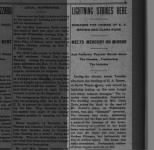 |
| "LIGHNING STRIKES HERE" The Waterloo Press, 18 Aug 1910 |
Harry was actually born September 30, 1895, in Pawtucket, Rhode Island, but there is some question as to when his parents returned to Michigan and when they separated. He grew up in Indiana, for the most part, attending high school in Waterloo. After completing a course in civil engineering at what is now Northwestern University, he was employed as civil engineer on Chicago, Burlington and Quincy Railroad. He enlisted on November 5, 1917, in Chicago, and was assigned to the Medical Corps and was sent to training at Ft. Riley, Kansas. He contracted pneumonia and died on January 5, 1918. He was buried in Waterloo.
Clara eventually moved in with her sister's family, and died at the Faucett home in November 1931. After Clara's death, the Faucetts and her brother, William Hurben Ettinger, sued Harry's estate for $2,000 and $1,500, respectively, to compensate for their expenses incurred over the years. Harry's estate was an insurance settlement from the government.
Next week, I'll look at the Faucett family in more detail, show that their home was used for more than hosting funerals, and see how many Ettinger descendants we can fit into one post!
Friday, February 5, 2016
The Rise of the Fergusons
Welcome back to Milton township, Ohio.
The year is 1835, and the younger of the Brothers Callin of Ohio, John Callin, has just died of tuberculosis. While the farm where John's children and nephews grew up must have begun to feel crowded by the end of the 1820s, during the 1830s and 1840s these children began to grow up and set off on their own.
Indeed, at least the older of John's children would have been married by the time of his death. His son, George Callin, was married though he may not have moved out to Huron county, yet. His daughter, Ann Callin Campbell, had certainly struck out on her own with Henry Campbell. And we have discussed how his nephew Alec Callin will soon embark on his journey to Iowa, taking wife and children with him, as well as his widowed mother (John's sister-in-law).
The Callin Family History (or CFH) is not very elaborate when it comes to conveying all of this activity and motion. It tends to compact a great deal of an individual's history into very little text. For example, the book has two lines about John's next two eldest daughters which seem to say very similar things, but which have very different stories to tell:
Sarah, born 1808, married John Scott, moved to Ills. About 1840.
Eliza, born 1811, married Jas. Ferguson, moved to Ind. 1851.
This doesn't specify when Sarah and John were married, though it might be safe to guess that it was probably within a year or two of 1830; Sarah would have been in her early twenties, then. But the real tragedy is that we know nothing else about this couple - because none of their children are named in the CFH, and we have no idea where in Illinois they might have gone. There is a couple named Scott, John and Sarah, listed in the 1860 Census living in Mission, LaSalle county, Illinois, but if this is our couple, their children have clearly grown and left home, so there is no other lead information to work with. (My hunch is that this is most likely our John and Sarah Scott; Sarah's age is right, and her birthplace is listed as Ohio, while Sarah Callin was actually born in Pennsylvania, but I could chalk that up to a mistake on the enumerator's part.)
Perhaps someday, we'll learn enough about the Scott family to say more than that, in contrast, we have a great deal more information about Eliza (1811-1870) and her husband, James L. Ferguson (1810-1886).
It does help considerably that the CFH recorded many of their descendants. We know, thanks to their appearance in Jackson township, De Kalb county, Indiana, in 1850 that the CFH is slightly off about when they made their move; but we also know that it correctly records the ten children they had in Ohio prior to their big move. After they settled in Jackson township, they had one more daughter to make a nice, round eleven children:
- Mary Ferguson (1833–1895)
- Elizabeth Ferguson (1835–1898)
- Mildred Ferguson (1837–1910)
- George T Ferguson (1838–1865)
- Margaret Jane Ferguson (1839–1901)
- James L. Ferguson (1841–1907)
- Nicholas P. Ferguson (1843–1912)
- Sarah Ferguson (1846–1934)
- Eliza Ferguson (1847–1920)
- John D Ferguson (1848–1922)
- Minerva J Ferguson (1854–1881)
James Ferguson was a farmer, as you might have come to expect of the men of this generation. Since we don't know where they were living while they were still in Ohio, it may or may not be safe to assume that they were near the rest of the Callin family farms. There is a James Ferguson listed in 1840 living in Brown township, Delaware county, 133 miles to the west of Milton township; this James Ferguson had children of ages that match our James Ferguson. The important thing for us is that we have them placed in Indiana in 1850.
By 1860, Eliza's mother, Elizabeth Simon Callin, was living in the Ferguson household on James's forty acre farm near Auburn in De Kalb county. I don't have a lot of documentation on her story, but she does appear on the 1860 Census, and the CFH says that she died in November 1864 and was buried in Auburn. It could be that she moved to Indiana with James and Eliza, or she followed along during the 1850s. She certainly got to spend her last few years with her smaller grandchildren.
Of the eleven Ferguson children, only George died without leaving behind a family of his own. According to the CFH, he was twenty-seven years old when he was "Killed in battle on the Potomac, Feb., 1865." If our George is the George Ferguson who enlisted in the 13th Regiment of the Indiana Infantry, they would have been some 380 miles south of the Potomac in February 1865, engaged in operations around Wilmington, North Carolina. George may well have enlisted in another state, though, as many young men did if they could not find a regiment in their home state. If that was the case, he might well have been killed on the Potomac.
Eliza Callin Ferguson followed a few years after George on 17 November 1870, and was buried in the Evergreen Cemetery in Auburn. If I'm interpreting the evidence right, it would seem that James stayed in the house with their youngest son, John D. Ferguson, and soon, with John's family.
John married his wife, Lovina Reed (1853-1925) on 9 November 1871, and he brought his young wife home to live with him and his father. The young couple dealt with a tragedy that first year, when they had twins that died in February 1872, Albert Allen and Alberta Alice Ferguson. The following year, they had their daughter, Dora E. Ferguson (1873–1908), and a few years later, Mary Jane Ferguson (1876–1879), who only survived three years.
The 1880 Census shows James, John and Lovina, and Dora living in De Kalb county, with James and John listed as farmers. Later that year, Leora B. Ferguson (1880–1899) was born (the CFH calls her "Aola"), followed by Catherine M. "Kate" Ferguson (1882–1951).
Then, in 1885, James seems to have grown ill, and he updated his will accordingly (transcribed by me - consider all of the spelling irregularities to be part of the original):
Know all by these presents that I James L. Fergeson son of Jackson township in DeKalb Couty State of Indiana being of sound mind and memory do make and publish this my last will and testament, revoking all former wills by me made; that is to say
First--I give and devise unto Six daughters Mary McNabb Elizabeth Reed Mildred Ettinger Margaret J. Gallaher Sarah Myers and Eliza Myers in equal portion all my household goods of every name and character to be by them divided
Second--To my Son John D. Furgeson I devIse the entire use and possession of the forty acres of land I own in said township for the term of two years from my death upon the express condition that he pay or cause to be paid all my debts; expenses of my last illness and funeral and the taxes on said land for the two years
Third--All the balance and residue of my estate real and personal I devise (except as Stated above) unto my three Sons James L Furgeson Jun- Nicholas Perrine Furgeson and John D. Furgeson in equal portions and Shares- provided that they shall and will pay or cause to be paid within three year from my death the sum of Four hundred and twenty (420) dollars - that is to Say - that they Shall pay to each of my above named daughters the Sun of Sixty (60) dollars and to said John D Furgeson who has purchased the interest of Clarissa J Copp daughter of my daughter Minerva Copp deceased in my estate the further Sun of Sixty (60) dollars, Interest is to be charged on said. Four hundred and twenty dollars if not paid within Said three years
Fourth- I name and advise that my Son John D Furgeson act as the Executor of this will.
In witness whereof I hereunto Subscribe my name and affix my seal this 12th day of December 1885
After James died in 1886, John and Lovina had one more child, Oscar Dale Ferguson (1890–1891) who only survived a year. It isn't clear when, but probably after his two year lease on the forty acre farm expired, John seems to have sold the property and moved his family to Milford in Lagrange county. That is where he and Lovina were living with Kate in 1900.
Dora had married Charles Frederick Kinsey (1870–1949) on 13 December 1890, and they lived in Union township in De Kalb county, where Charles was the proprietor of his own shop. They had two children before Dora's untimely death in 1908; Charles then remarried Sophia M Kiner in 1910, and she helped him raise the children.
1. Gladys F Kinsey (b. 1893) attended Auburn High School, Class of 1913, and from there I have not been able to determine where she went.
2. Keith Harlan Kinsey (1905–1958) married Thelma M Schlegel (1906–2001) in 1924, and they had a son; but for whatever reason, they did not stay together for long. In 1930, Thelma and her 4-year-old son were living with her parents. She remarried, and presumably raised the boy. Keith married Garnet Geneva (Lewis) Sprowl (1905-1995) about 1939, and while there are places where the records could indicate that they may have separated at times in the next twenty years, they are buried together in the La Fontaine IOOF* Cemetery in Wabash county.
Keith served as a corporal in an Indiana field artillery unit during World War II.
a. Keith Charles Kinsey (1925–2003) grew up in Indiana and attended Purdue University where he was the President of the Purdue Aero Club in 1948. He accepted a commission in the U.S. Air Force in September 1949, and served in Korea and Vietnam, rising to the rank of Lieutenant Colonel. He lived in San Diego in the 1990s, died in Kirkland, Washington, in 2003, and he is buried in the Fort Rosecrans National Cemetery in San Diego, California.
I have not found any information indicating that he married or had any children.
 Leora married George Dancer (b. 1877) in January 1899, but she died by the end of the same year. He remarried in 1902 to Carrie Belle Reed (1879-1924), and they had one son - but it is not clear whether Carrie might have been otherwise related to Leora's mother.
Kate, the last surviving daughter of John and Lovina Ferguson, stayed at home and single until she was 35. She worked as a photographer in a studio in Auburn, and married Ora E. Martz (1881–1944) on Boxing Day, 26 December 1917. In 1920, the couple was living with John and Lovina, and may have stayed with them until John died (in 1922) and Lovina died (in 1925). They had no children of their own.
And with that, we begin the saga of the Ferguson descendants of James Callin. It may take us a couple of months to go through and tell the stories of James and Eliza's other nine children and the dizzying array of surnames we'll be looking at may seem overwhelming.
As always, please let me know if you're related to any of these folks, and especially let me know if I missed anyone or got anything wrong.
* IOOF = Independent Order of Odd Fellows
Dora had married Charles Frederick Kinsey (1870–1949) on 13 December 1890, and they lived in Union township in De Kalb county, where Charles was the proprietor of his own shop. They had two children before Dora's untimely death in 1908; Charles then remarried Sophia M Kiner in 1910, and she helped him raise the children.
1. Gladys F Kinsey (b. 1893) attended Auburn High School, Class of 1913, and from there I have not been able to determine where she went.
2. Keith Harlan Kinsey (1905–1958) married Thelma M Schlegel (1906–2001) in 1924, and they had a son; but for whatever reason, they did not stay together for long. In 1930, Thelma and her 4-year-old son were living with her parents. She remarried, and presumably raised the boy. Keith married Garnet Geneva (Lewis) Sprowl (1905-1995) about 1939, and while there are places where the records could indicate that they may have separated at times in the next twenty years, they are buried together in the La Fontaine IOOF* Cemetery in Wabash county.
Keith served as a corporal in an Indiana field artillery unit during World War II.
a. Keith Charles Kinsey (1925–2003) grew up in Indiana and attended Purdue University where he was the President of the Purdue Aero Club in 1948. He accepted a commission in the U.S. Air Force in September 1949, and served in Korea and Vietnam, rising to the rank of Lieutenant Colonel. He lived in San Diego in the 1990s, died in Kirkland, Washington, in 2003, and he is buried in the Fort Rosecrans National Cemetery in San Diego, California.
I have not found any information indicating that he married or had any children.
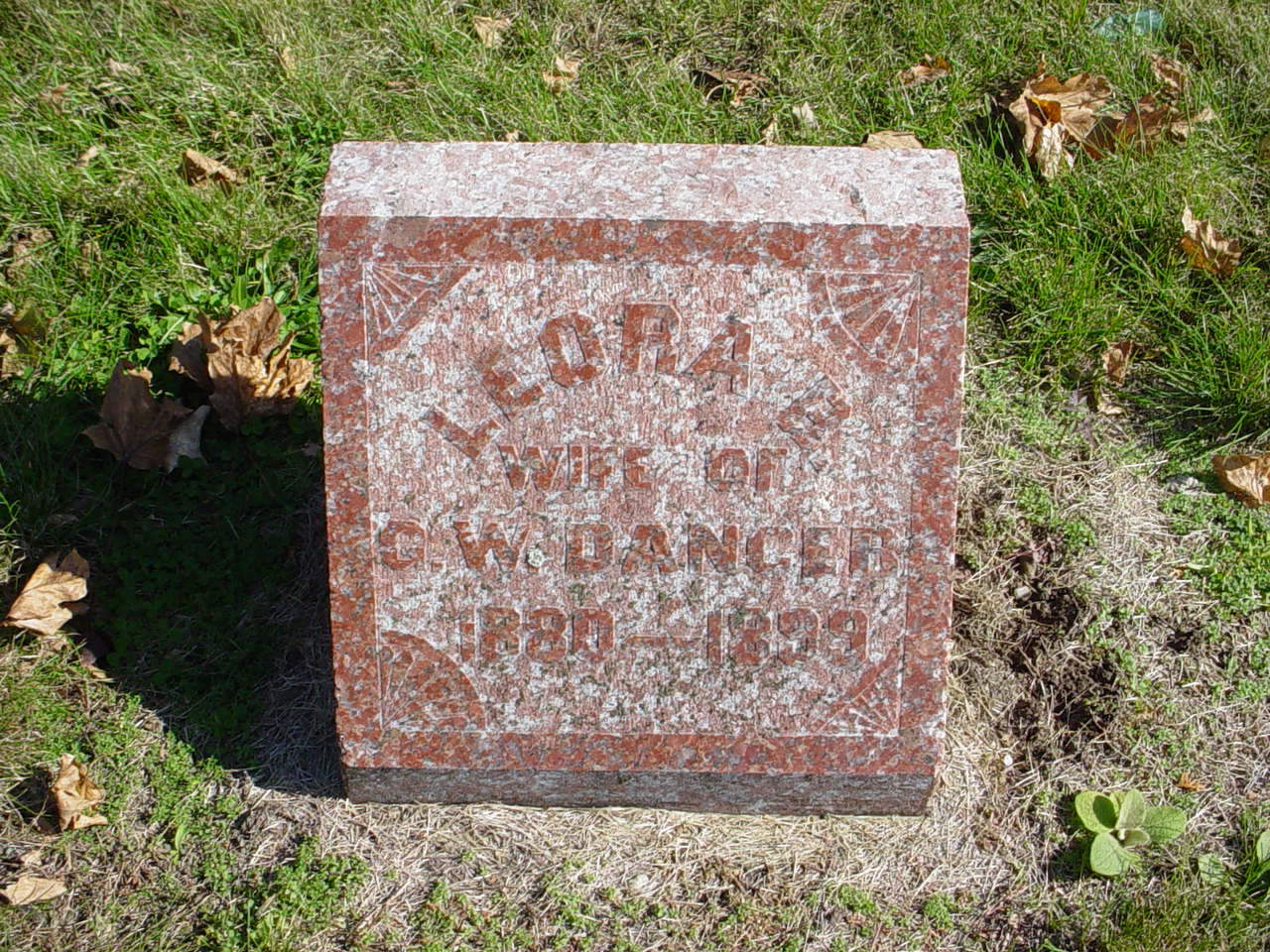 Leora married George Dancer (b. 1877) in January 1899, but she died by the end of the same year. He remarried in 1902 to Carrie Belle Reed (1879-1924), and they had one son - but it is not clear whether Carrie might have been otherwise related to Leora's mother.
Kate, the last surviving daughter of John and Lovina Ferguson, stayed at home and single until she was 35. She worked as a photographer in a studio in Auburn, and married Ora E. Martz (1881–1944) on Boxing Day, 26 December 1917. In 1920, the couple was living with John and Lovina, and may have stayed with them until John died (in 1922) and Lovina died (in 1925). They had no children of their own.
And with that, we begin the saga of the Ferguson descendants of James Callin. It may take us a couple of months to go through and tell the stories of James and Eliza's other nine children and the dizzying array of surnames we'll be looking at may seem overwhelming.
As always, please let me know if you're related to any of these folks, and especially let me know if I missed anyone or got anything wrong.
Friday, January 1, 2016
Meet the Campbells
...our story so far...
Ann Callin was ten years old in 1816 when her family left Pennsylvania for the wild frontier of Ohio. She had two older brothers to look out for her (John and George), two younger sisters to look out for (Sarah and Eliza), and two baby brothers (William and James).
Her father, John, planned to settle on a farm with his older brother, her uncle James. Her cousins were four adventurous boys: Thomas and Hugh, who were older than her, and Alec and James who were younger. Having so many people on one farm meant that there was a lot to do, but there were a lot of hands to do it all, and her mother and Aunt Mary surely kept them all occupied.
Ann's mother, Elizabeth, had two more children after the family arrived in Ohio: Hugh in 1817, and Margret in 1819. As the oldest of the four girls, Ann would have been well schooled in running the household.
Even as the two-family farm expanded, the township was growing rapidly around them. Richland county had no more than 150 people living in it in 1812, but by 1825, there were an estimated 8,000. There were bound to be problems, as in 1820, when uncle James was killed in an altercation with a man named Fowler. But the family was large, and strong, and most of their neighbors were industrious and kind.
Among those neighbors was a young man by the name of Henry Campbell. Henry's father was one of the many early settlers who found success farming in Ohio. He was five years younger than Ann, but he had been born in Pennsylvania, as she had been, and when he acquired land in Milton township, not far from where her brothers were clearing their own farms, he needed someone who could run a household to help him start a family.
And so, on 20 August 1833, at 26 years of age, Ann married Henry and joined him on his farm. Their first son, Cyrus, was born the following March. In those first ten years, the couple had five children. The youngest, Cornelia, was born 13 October 1843, but died before her sixth birthday: 13 March 1849. Their middle child, a daughter named Elizabeth born in June 1840, would stay at home with Ann and Henry, and never marry.
The children of Henry and Ann (Callin) Campbell:
- Cyrus C. Campbell (1834–1873)
- Harrison M Campbell (1837–1924)
- Elizabeth Campbell (1840–1897)
- Frances A Campbell (1842–1905)
- Cornelia Campbell (1843–1849)
Next week, we'll talk about Cyrus's descendants, followed by Harrison's the next week, and Frances Campbell Hoot's the week after that.
Henry died in Ashland, Ohio, at some point before the 1880 Census was taken; Ann appears there listed as a widow. There is a record for a Henry Campbell in the Headstones Provided for Deceased Union Civil War Veterans, 1879-1903 database, with a death listed as 4 April 1880, but this record lists the receiving cemetery in Zaleski village, Vinton county, which is 155 miles south of Ashland. If he served in the Civil War, Henry would have been in his early 50s at enlistment; that's not impossible, but it is unlikely.
Ann died on 18 March 1889, according to the Callin Family History, and Elizabeth survived until 1897. Elizabeth was buried in the Ashland Cemetery.
Some Tips About Ohio Families
Since Cyrus's family proved to take up a lot of screen, I opted to split them off into their own post, but then I felt bad for making this one so short. To make up for that, here are some things I've observed while researching all of these families.Michigan: Popular Marriage Get-away? When I want to find marriage records for some of these relatives in the northern part of Ohio, particularly in the decades between 1890 and 1930, I have found that a lot of couples headed up past Toledo and got their licences in Hillsdale or Monroe, Michigan. Those aren't exactly lakeside resorts, as far as I know, but there must have been some reason for so many couples to have gone there to marry. Whatever the reason, if you're researching some people who should have a Richland county or Ashland county marriage license and you can't find it, take a look at Michigan.
U.S. Social Security Applications - This is a relatively new Ancestry database, and it has been a fantastic resource for me - for everyone who applied for a Social Security account, of course. The information is gathered from official forms submitted by the person registered to a particular Social Security Number, and while not every file has every piece of information, you can usually expect to find the following:
- full name
- parents' names (including mother's maiden name)
- birth and death dates
- married names (and sometimes dates to suggest when the marriage occurred)
- places - these are tricky, but usually the correct place of birth is listed (it's probably abbreviated in a weird way, thought)
Obituary Blues - There are diminishing returns to searching for obituaries, and different ways to find them depending on when the person in question died. Here's how I usually go about searching.
Step 1: Google. This is my go-to, once I know at least a few facts about someone. I find that if I start with the person's full name (married names for women work best), followed by the word obituary, I usually get the one I'm looking for in the first page of results... if I get anything at all! If not, I add whatever other information I have; names of their parents or spouses can help; birth and death dates can help if you know those.
I'm usually successful with Google when the person I'm looking for has died within the last decade or so. Finding obituaries from further back than 2000 can be dicey.
Step 2: Newspapers.com - I'm paying for the Deluxe Ancestry membership, which includes limited access to Newspapers.com, so if Google comes up empty, I usually go here next. Start your search with the name of your person, and narrow your search using their interface (choose a state, date range, or even a specific newspaper if they have it in their database).
If you have a spouse's name, you can include that - so if you search for "King Kong Fay Wray" you should see results for pages that include all four names. That can help narrow down your search if you're looking for a common name.
Step 3: Rutherford Hayes Presidential Library collection - these folks show up in Ancestry, though if you want to read the obituary, you usually have to order a hard copy from them. At least they tell you which newspapers your obituary appeared in, so you can search for a digital version using Google or Newspapers.com, just in case. Otherwise, the $2.00 may be worth it to you.
Happy Hunting! (And Happy New Year...)
Friday, December 4, 2015
A Tragic Beauty
 |
| George's tree (click for a closer look) |
Next we looked at the family of his eldest son, John Callin (1832–1906), and his second son, William H Callin (1834–1919), followed by four weeks of posts covering each of William's daughters and their families.
George and Polly also had four daughters:
- Minerva Callin (1836–1911)
- Lavina* Callin (1839–1877)
- Sabra Ann Callin (1837–1849)
- Amelia A Callin (1849–1899)
While their birth and death dates are recorded in the Callin Family History, some of the information there is wrong or missing. The CFH does not have Minerva's date of death, for example; it just says "died," and since it was published in 1911, we have to guess that she died before then. It also lists Lovina's* death date as "July, 1880" and Amelia's as "Nov., 1875," both of which turn out to be incorrect.
Sabra Ann's short life was apparently not as short as the CFH would have us believe. While Find A Grave does confirm the date of her death as February 11, 1849, her headstone gives her age as "12y 1m" making her birth date January 1837.
Minerva's story is harder to tell, as the CFH gives us surprisingly little to go on. That book tells us that she married a "John Smith," and lists four children, two of whom it says "died," leaving us to assume their deaths occurred some time before 1911. Their names were given as Frank (died), Flora, Willie, and Helen (died).
There is a record in the 1860 Federal Census for a family that fits this limited information rather well. They were listed in the village of Harrison, Winnebago county, Illinois. The head of the household is a blacksmith (aptly named) John N. Smith, age 28, born in Ohio. His 26 year old wife, Minerva, and 4 year old son, Frank, were also born in Ohio; 3 year old William J and 1 year old Hellen A were born in Illinois.
Thanks to the detailed enlistment records kept by Illinois, we know that John enlisted in the 74th Regiment of the Illinois Infantry, Company A, in September of 1862. That record confirms his name and middle initial, his occupation, and his 1860 residence, and it describes him as being 5'6", with black eyes, black hair, and a "dark" complexion. He mustered out of the unit in Nashville in 1865.
Unfortunately for us, in 1870 and 1880, the only John Smith family listed in Harrison, Winnebago county, is that of an English husband and wife, Mary, with children who are decidedly not named Frank, Willie, Helen, or Flora. Searches for each of the people we know to be in our John Smith's family turn up very little convincing evidence. There is a 1900 Census record in Columbia, Whitley county, Indiana which lists a Helen Hudson, living with her husband and children, and her mother: one Minerva Smith. Sadly, there are enough "Minerva Smiths" in the United States during the late 19th Century that without more clues, I can't say for sure that this is the same one.
The name "Smith" is far too common, even when paired with the other details we have, to zero in on the clues we would need to say anything more certain about Minerva and her family.
Lavina married Edward C. Rickey (1831–1896) on 24 October 1855, when she was only 16 years old. Ed was a farmer by trade, born in New Jersey to John and Bertha (Howell) Rickey. His family had moved to Ohio around 1845 and settled in Huron county. Ed enlisted in the 192nd Regiment, Ohio Infantry, in 1865 spending the final six months of the war on duty in the Shenandoah Valley.
We know from Ed's obituary that the couple had a daughter who died in infancy, and three sons; the youngest of those also died in infancy. We do not know the cause of Lavina's death, but she died in July 1877, only a month after the birth of that youngest son. She was 38 years old. Two months later the baby died, too.
Ed remarried to Anna Salome Tessler, on 8 May 1879; they had a daughter they named Florence (1884-1969). Ed died 23 October 1896, and was buried next to Lavina in the Cogswell Cemetery in Bridgewater Twp, Williams county, Ohio.
1. Clayton E Rickey (1858–1930) was eighteen when his mother died in 1877. He left Ohio, worked as a farm laborer for a time in Michigan, and then married Sadie Taylor (?–1892) on 1 October 1887 in Fort Wayne, Indiana. In 1888, they had a son, Roscoe; but Sadie died in 1892 leaving Clayton and four year old Roscoe on their own. After Sadie died, Clayton married Ellen Teeple (1866–1934), and they had five more children.
The records tell an unusual story, because while the Census records show Clayton and his family living in Indiana, most of his children's birth records placed them in Williams county, Ohio. The two places were about 80 miles apart, and it may simply be that Clayton's family remained close to the rest of the Rickeys living in Ohio; I suppose that could account for a family traveling 80 miles each time they have a baby.
We know that Clayton died some time before 1930, but I have been unable to find any records or memorials to provide more detail. Part of the problem lies in the fact that he tended to use his initials, "C.E." on most official records, and part of the problem lies in the bewildering variety of ways the records list Ellen's name; Ellen, Ella, Lydia E., and Temple, Tebel, or Topple, just to name a few.
a. Roscoe Leroy Rickey (1888–1917) grew up in his father's household with his step-mother and half-siblings, and they were living in Elkhart, Indiana, in 1900. There is a death record for a Roscoe Rickey who died in Detroit, Michigan, in 1917, and while there is a Roscoe Ritchey in Kokomo, Indiana in 1910 with a wife, Lizzie, it is not certain that our Roscoe Rickey had a family of his own when he died.
b. Marguerite Rickey (1893–??) married William Harry Heidrick, Jr. on 28 August 1915, and the license was recorded in Hillsdale, Michigan. They lived in Fort Wayne at first, and apparently moved with their two young daughters (Alice V., b. 1917 and Jeanette M., b. 1918) to Sioux Falls, South Dakota, by 1920. After that, I have been unable to find any further records.
There are numerous records for different spellings of "Marguerite Heidrick" - Margaret, and Headrick being most common - but where they list a husband, the names do not match. As with the Smith family above, we will have to keep hunting to find these descendants.
c. Paul Edward Rickey (1897–1940) fought in World War I, and served in the 81st Company of the Transportation Corps in 1918 & 1919. His residence was listed on his draft registration as Stutsman, North Dakota, where he was employed as a farm laborer. After the war, there are several records in the 1920s listing his address in Indianapolis, and in 1930, the Census shows him in Marion, Grant county, Indiana. That Census record says he is married, though that is the only record that says so.
Paul was buried with military honors in Portland, Oregon, after he died there on 25 October 1940.
d. Hugh Rickey (1899–1904) five-year-old Hugh died in December 1904, almost a year after the birth of his sister, Florence. He died in Indiana, and was buried in the Riverside Cemetery in Montpelier, Ohio.
e. Florence Anola Rickey (1904–1923) may have been named after her father's half-sister, who would have been twenty years old in 1904. Florence Anola married Leonard Christian Roebel (1901–1970) on 11 August 1923, but was taken by typhoid fever in November that year.
f. Arlo R Rickey (1905–1988) was born on September 20, 1905. He married Fayma Kleber (1909 - 1980) on 27 June 1936, and they lived most of their lives in Fort Wayne, Indiana. He was 37 years old when he enlisted in the U.S. Army after the beginning of World War II.
Fayma died in 1980, and Arlo died on June 13, 1988 at age 82. They were both buried in St Joseph's Catholic Church & Cemetery in Marion Township, Indiana.
2. Willis L Rickey (1864–1935) married Cora Shoffer (1865–1903) in 1888. She died when their son was only eight years old, and Willis remarried Hannah Drusilla Crouse (1872–1938). Drusilla was the recent widow of Ambrose Stroh (1863–1903), and Willis adopted her four-year-old daughter, Vera I Stroh (1900–1973).
Willis was the proprietor of hardware stores in the towns the family lived in. Over the years, they lived in Madison, Ohio (1900), Wilmington, Indiana (1910), and Detroit, Michigan (1920). Willis died in Parker City, Indiana, in February 1935.
a. Earl Glenn Rickey, Sr. (1895–1959) married Alma Miller (1897–1983) on 5 May 1914. They had one son, Earl G Rickey Jr. (1915–1986), a lifelong resident of Fort Wayne, Indiana, who served in World War II.

Amelia was the youngest daughter of George and Polly Callin. She was born at their home in Monroeville on 16 March 1849. She married Mr. Charles Henry Horton on 8 November 1875, when she was 26 years old, and they lived in Wellington for 20 years before moving to Painesville.
Charles was born in Holley, Orleans county New York, on 25 April 1845, to Chauncey and Nancy (Masten) Horton. He served as a sergeant in the 55th Ohio Volunteer Infantry for the four years of the Civil War. According to his biographical sketch in the Commemorative Biographical Record of the Counties of Huron and Lorain, Ohio, he "was in the battles of Chattanooga and Buzzard's Roost, and was severely wounded at Resaca, but [after] recovering rapidly rejoined his company, and was with Sherman on his march to the sea." After the war, he invented a threshing machine and a brick making machine, which made his fortune.
The Hortons did not have children of their own, likely owing to Amelia's delicate health. She was known to have a chronic digestive disorder, and her obituary noted that her health prevented her from participating in church activities.
On 3 December 1899, after recovering from a severe attack of typhoid fever, she died from that chronic digestive disorder.
This was a difficult post to write, as you can probably imagine. It is rare to find so much information about a family and still be left with so much untimely death and so many loose ends. I hate having to leave loose ends. Usually, the untimely deaths keep us from having the loose ends, but this family was special!
I will, of course, keep looking for more clues to finish the story, but for now, aside from the seven or so great-grandchildren of George and Polly whose fates we do not know, this is all there is. Arlo and Fayma may have had some children we did not discover; Paul may have had a family in the twenty years between Indiana and Oregon; and the Smiths and the Heidricks may yet turn up in some unexpected place.
Until they do, we will have these stories of lives lived with their tragic beauty in the middle of America.
*Note that the CFH spells Lavina/Lovina with both spellings in different places; her husband's obituary spells it "Lavina" but her headstone spells it "Lovina."
Portrait of Amelia Callin Horton is of unknown origin, and is assumed to be in the public domain.
For more information about the Rickey family, visit the Rickey Family Association's Rickey Database (rickeyfamily.org).
 |
| Sabry A. Callin (memorial on Find A Grave) |
Minerva's story is harder to tell, as the CFH gives us surprisingly little to go on. That book tells us that she married a "John Smith," and lists four children, two of whom it says "died," leaving us to assume their deaths occurred some time before 1911. Their names were given as Frank (died), Flora, Willie, and Helen (died).
There is a record in the 1860 Federal Census for a family that fits this limited information rather well. They were listed in the village of Harrison, Winnebago county, Illinois. The head of the household is a blacksmith (aptly named) John N. Smith, age 28, born in Ohio. His 26 year old wife, Minerva, and 4 year old son, Frank, were also born in Ohio; 3 year old William J and 1 year old Hellen A were born in Illinois.
Thanks to the detailed enlistment records kept by Illinois, we know that John enlisted in the 74th Regiment of the Illinois Infantry, Company A, in September of 1862. That record confirms his name and middle initial, his occupation, and his 1860 residence, and it describes him as being 5'6", with black eyes, black hair, and a "dark" complexion. He mustered out of the unit in Nashville in 1865.
Unfortunately for us, in 1870 and 1880, the only John Smith family listed in Harrison, Winnebago county, is that of an English husband and wife, Mary, with children who are decidedly not named Frank, Willie, Helen, or Flora. Searches for each of the people we know to be in our John Smith's family turn up very little convincing evidence. There is a 1900 Census record in Columbia, Whitley county, Indiana which lists a Helen Hudson, living with her husband and children, and her mother: one Minerva Smith. Sadly, there are enough "Minerva Smiths" in the United States during the late 19th Century that without more clues, I can't say for sure that this is the same one.
The name "Smith" is far too common, even when paired with the other details we have, to zero in on the clues we would need to say anything more certain about Minerva and her family.
Lavina married Edward C. Rickey (1831–1896) on 24 October 1855, when she was only 16 years old. Ed was a farmer by trade, born in New Jersey to John and Bertha (Howell) Rickey. His family had moved to Ohio around 1845 and settled in Huron county. Ed enlisted in the 192nd Regiment, Ohio Infantry, in 1865 spending the final six months of the war on duty in the Shenandoah Valley.
We know from Ed's obituary that the couple had a daughter who died in infancy, and three sons; the youngest of those also died in infancy. We do not know the cause of Lavina's death, but she died in July 1877, only a month after the birth of that youngest son. She was 38 years old. Two months later the baby died, too.
Ed remarried to Anna Salome Tessler, on 8 May 1879; they had a daughter they named Florence (1884-1969). Ed died 23 October 1896, and was buried next to Lavina in the Cogswell Cemetery in Bridgewater Twp, Williams county, Ohio.
1. Clayton E Rickey (1858–1930) was eighteen when his mother died in 1877. He left Ohio, worked as a farm laborer for a time in Michigan, and then married Sadie Taylor (?–1892) on 1 October 1887 in Fort Wayne, Indiana. In 1888, they had a son, Roscoe; but Sadie died in 1892 leaving Clayton and four year old Roscoe on their own. After Sadie died, Clayton married Ellen Teeple (1866–1934), and they had five more children.
The records tell an unusual story, because while the Census records show Clayton and his family living in Indiana, most of his children's birth records placed them in Williams county, Ohio. The two places were about 80 miles apart, and it may simply be that Clayton's family remained close to the rest of the Rickeys living in Ohio; I suppose that could account for a family traveling 80 miles each time they have a baby.
We know that Clayton died some time before 1930, but I have been unable to find any records or memorials to provide more detail. Part of the problem lies in the fact that he tended to use his initials, "C.E." on most official records, and part of the problem lies in the bewildering variety of ways the records list Ellen's name; Ellen, Ella, Lydia E., and Temple, Tebel, or Topple, just to name a few.
a. Roscoe Leroy Rickey (1888–1917) grew up in his father's household with his step-mother and half-siblings, and they were living in Elkhart, Indiana, in 1900. There is a death record for a Roscoe Rickey who died in Detroit, Michigan, in 1917, and while there is a Roscoe Ritchey in Kokomo, Indiana in 1910 with a wife, Lizzie, it is not certain that our Roscoe Rickey had a family of his own when he died.
b. Marguerite Rickey (1893–??) married William Harry Heidrick, Jr. on 28 August 1915, and the license was recorded in Hillsdale, Michigan. They lived in Fort Wayne at first, and apparently moved with their two young daughters (Alice V., b. 1917 and Jeanette M., b. 1918) to Sioux Falls, South Dakota, by 1920. After that, I have been unable to find any further records.
There are numerous records for different spellings of "Marguerite Heidrick" - Margaret, and Headrick being most common - but where they list a husband, the names do not match. As with the Smith family above, we will have to keep hunting to find these descendants.
c. Paul Edward Rickey (1897–1940) fought in World War I, and served in the 81st Company of the Transportation Corps in 1918 & 1919. His residence was listed on his draft registration as Stutsman, North Dakota, where he was employed as a farm laborer. After the war, there are several records in the 1920s listing his address in Indianapolis, and in 1930, the Census shows him in Marion, Grant county, Indiana. That Census record says he is married, though that is the only record that says so.
Paul was buried with military honors in Portland, Oregon, after he died there on 25 October 1940.
d. Hugh Rickey (1899–1904) five-year-old Hugh died in December 1904, almost a year after the birth of his sister, Florence. He died in Indiana, and was buried in the Riverside Cemetery in Montpelier, Ohio.
e. Florence Anola Rickey (1904–1923) may have been named after her father's half-sister, who would have been twenty years old in 1904. Florence Anola married Leonard Christian Roebel (1901–1970) on 11 August 1923, but was taken by typhoid fever in November that year.
f. Arlo R Rickey (1905–1988) was born on September 20, 1905. He married Fayma Kleber (1909 - 1980) on 27 June 1936, and they lived most of their lives in Fort Wayne, Indiana. He was 37 years old when he enlisted in the U.S. Army after the beginning of World War II.
Fayma died in 1980, and Arlo died on June 13, 1988 at age 82. They were both buried in St Joseph's Catholic Church & Cemetery in Marion Township, Indiana.
2. Willis L Rickey (1864–1935) married Cora Shoffer (1865–1903) in 1888. She died when their son was only eight years old, and Willis remarried Hannah Drusilla Crouse (1872–1938). Drusilla was the recent widow of Ambrose Stroh (1863–1903), and Willis adopted her four-year-old daughter, Vera I Stroh (1900–1973).
Willis was the proprietor of hardware stores in the towns the family lived in. Over the years, they lived in Madison, Ohio (1900), Wilmington, Indiana (1910), and Detroit, Michigan (1920). Willis died in Parker City, Indiana, in February 1935.
a. Earl Glenn Rickey, Sr. (1895–1959) married Alma Miller (1897–1983) on 5 May 1914. They had one son, Earl G Rickey Jr. (1915–1986), a lifelong resident of Fort Wayne, Indiana, who served in World War II.

Amelia was the youngest daughter of George and Polly Callin. She was born at their home in Monroeville on 16 March 1849. She married Mr. Charles Henry Horton on 8 November 1875, when she was 26 years old, and they lived in Wellington for 20 years before moving to Painesville.
Charles was born in Holley, Orleans county New York, on 25 April 1845, to Chauncey and Nancy (Masten) Horton. He served as a sergeant in the 55th Ohio Volunteer Infantry for the four years of the Civil War. According to his biographical sketch in the Commemorative Biographical Record of the Counties of Huron and Lorain, Ohio, he "was in the battles of Chattanooga and Buzzard's Roost, and was severely wounded at Resaca, but [after] recovering rapidly rejoined his company, and was with Sherman on his march to the sea." After the war, he invented a threshing machine and a brick making machine, which made his fortune.
The Hortons did not have children of their own, likely owing to Amelia's delicate health. She was known to have a chronic digestive disorder, and her obituary noted that her health prevented her from participating in church activities.
On 3 December 1899, after recovering from a severe attack of typhoid fever, she died from that chronic digestive disorder.
-- --- --
This was a difficult post to write, as you can probably imagine. It is rare to find so much information about a family and still be left with so much untimely death and so many loose ends. I hate having to leave loose ends. Usually, the untimely deaths keep us from having the loose ends, but this family was special!
I will, of course, keep looking for more clues to finish the story, but for now, aside from the seven or so great-grandchildren of George and Polly whose fates we do not know, this is all there is. Arlo and Fayma may have had some children we did not discover; Paul may have had a family in the twenty years between Indiana and Oregon; and the Smiths and the Heidricks may yet turn up in some unexpected place.
Until they do, we will have these stories of lives lived with their tragic beauty in the middle of America.
-- --- --
Portrait of Amelia Callin Horton is of unknown origin, and is assumed to be in the public domain.
For more information about the Rickey family, visit the Rickey Family Association's Rickey Database (rickeyfamily.org).
Friday, November 27, 2015
Putting On the Ritz
 |
| Grace Callin Ritz's family tree |
Twenty-five years is a big gap, but the story of these German immigrants is not completely unknowable. We know that after the Revolution, German immigration to America grew steadily; and after the War of 1812, life in Ohio was definitely safer for settlers and land could be had if one was industrious. We also know that life in the German states during that time was difficult. Economies were wracked by shifting borders, wars, and religious strife. America's First Amendment created a place where one no longer had to worry which side of the Schism the current leaders were on, where one could worship as one pleased, or not at all, without fear of being arrested or killed for it.
We don't know how many of those pressures affected the Ritz and Freimuth families, but whatever their motivation, they came. The records for William Ritz's family that are available on Ancestry aren't as complete as they are for many of the people I research. They must have arrived in Ohio by the mid-1840s, but William and his family don't appear in the Federal Census records where I would expect them to in 1850, 1860, or 1870. Instead, he shows up in alternate enumerations like the Non-Population Schedules or the Indexed County Land Owner Maps. They show a "Wm. Ritz" in Norwalk Township, Huron County, Ohio. Naturally, they spell his name with a bewildering variety: Reitz, Retz, and Ritts among the alternatives.
William and Catherine had a son right on schedule in September of 1847 (almost exactly nine months after their wedding!) and named him George William Ritz. They would also have at least three daughters, though with the gaps in the records, they might have had more children than that. Catherine died at the age of 64, and was buried in the Trinity Lutheran Cemetery in Willard; William lived another 16 years, and died in George's home in 1906 after a two month illness. He was known as "Grandpa Ritz" in Willard.
George worked as a farmer in Huron county, as his father had before him; and like his father, he was married on 31 December. George married Mary Ann Resh (1849 – 1883) at the very end of 1871 and in 1873 they had their first child: a son they named William Henry. Over the next ten years, the couple had three more sons and two daughters. The last of these, a baby girl they named Amy Catherine, only lived a couple of weeks, and died in October 1882. Mary Ann followed in July 1883.
Widowed and with five children aged ten and under, George married Johanna Kleinknecht the following year; they had three more children together between 1885 and 1900.
 |
| The Callin sisters (from left): Lydia, Lillian, Anna, Grace (in back) |
Grace was born 5 January 1880 on the Callin farm in Richmond township, so it would stand to reason that she and her future husband might have seen each other around Willard, as both families attended churches in town. The Ritz family were members of the Trinity Lutheran Church, and the Callin family were likely members of the United Brethren Church.
William and Grace raised two daughters, who were born almost eight years apart.
William died in 1952, having retired from farming. His death certificate (witnessed by R.V. Conkle) attributed his death to "chronic myocarditis." Grace died 4 February 1978 and was buried in the Trinity Lutheran Cemetery in Willard, next to her husband.
1. Gertrude Louisa Ritz (1905 – 1995) grew up on the family farm, and on 12 June 1922 she married Wade Monroe Smeltz (1901 – 1960). Wade was a plumber, employed at Hunter Hardware Store for 35 years. They lived on Park street in Willard, where they raised their only daughter.
Wade died of a heart attack at only 58; Gertrude survived him by 35 years, and survived their daughter, as well. Gertrude and Wade were buried in the Trinity Lutheran Cemetery in Willard.
a. Marjorie J Smeltz (1923 – 1994) married Leland E. Stein (1923 – 1987) and they had 5 daughters and a son. Two of their daughters died in 2004 and 2005, at 52 and 45 years of age, respectively; their other children and grandchildren are still alive.
2. Vera Lucille Ritz (1913 – 1998) married Richard Vance Conkle (1911 – 1990) in about 1931. Vance was from DeKalb county, Indiana; the son of Frank P Conkle (1884 – 1964) and Goldie Kelham (1887 – 1971).
Vera and Vance had three children; their elder daughter is still living, but their younger daughter and son are not.
b. Janice Arlene Conkle (1935 – 2000) married in August 1951, but later divorced. She then married Robert Charles Remmy (1940-1996).
c. William Frank Conkle (1940 – 1998) graduated from Willard High School, Class of 1958 and attended Capital University for two years. He married before 1965, and his wife is still living as of this writing. They had two sons who are still living, and a daughter, Jennifer Leigh Steingass, who died in 2009 from malignant melanoma. Jennifer left behind a husband and two sons.
Bill served in the Army Reserves, and was employed as an offset artworker by R.R. Donnelley and Sons for 37 years. He retired in 1997 after a stroke, and died the following year at 58 years of age.
* * *
That's actually a large part of why I am putting all of these blog posts together here. I hope that one day we (and I say "we" because there is no way I'll have the time or energy to do it by myself) will be able to find and contact all of these family members, and show them what we know about our shared history.
My hope is that when I am done running down the list of descendants of James Callin that I will be able to include more of the living people who are hidden from view, and share their stories. Whenever I do hear from a cousin, however distant, they always bring their grandparents and parents to life in a way that I can't, just relying on records and newspapers.
But whatever may come, and however long it takes, I'm enjoying this process. So, on we press!
Next week, we'll begin with the Daughters of Great Uncle George!
Photos posted with permission of Ancestry user meganoneill10.
Subscribe to:
Posts (Atom)