When I set out to revise the Callin Family History two years ago, I thought I had a pretty good idea what kinds of people I might find in the family tree. I did name the blog "Mightier Acorns," after all, because I knew that few, if any, of our relatives would turn out to be recognizably famous, important figures in World History.
As it happens, a few of our cousins really did have exciting and unique lives. Perhaps the most famous of our cousins has his own Wikipedia entry, due to his record-setting Air Force career and his science fiction novels. A few were missionaries who traveled to Africa or India to build hospitals or schools. One disappeared with Flight 19 in the infamous Bermuda triangle.
But we have largely been ordinary. We have mostly been farmers, and when farming gave way to industrialization, many of us became factory or railroad workers. We also had a few doctors, some lawyers, and in rare cases, successful corporate business leaders. Among our folks, there have always been a prominent number of teachers mixed in, as well.
We have many talented musicians and artists, woodworkers and craftsmen (and women!), some of whom even earned a living or academic honors for their efforts. Most of us have at least enjoyed making a joyful noise, whether literal or metaphorical. Many - including my dad, my grandfather, cousin John, and several others - built furniture as a hobby after retiring.
The legend of our family identity has had a profound influence on us, even though few of us have any idea what the family legend says, and even fewer have done the research necessary to find out what is truth and what is legend. Our common ancestor, James "1st" Callin, was a Revolutionary War hero, so it seems almost inevitable that his descendants take pride in serving the country. And because we have passed down the story that he was from Ireland, we seem to hold a rebellious Irish spirit close to our hearts.
It almost doesn't matter that we haven't definitively proven that the Revolutionary soldier James Callin was the father of James and John Callin of Ashland county, Ohio; our cousins have served in every branch of service and in every American conflict throughout our nation's history. I don't think there was a single post in this two-year project that didn't include at least one World War II or Union Army veteran. Less common, but just as crucial, we have had mighty women from our family serving in the military, in the medical corps, or on the home front.
James may or may not have actually been Irish - he was almost certainly the "orange" variety if he was - but we tend to identify that way when we think about our ethnicity, rather than as English or Scots-Irish. Because we started with an immigrant from the 1750s, I didn't expect to find many immigrant stories in the ranks of Callin descendants, but we certainly married a dazzlingly diverse group.
James 1st's descendants have married into the streams of German and Western European immigrants who washed across Ohio and the Midwest. We have married Eastern Europeans and people of the Slavic and Jewish diaspora; many of us have married into Latino and Hispanic families; and two of our cousins married into Japanese families who were interred in the camps established at the beginning of World War II. At least two of the nearly 5,000 marriages documented in this project have been same-sex couples, though that number might have been larger if such marriages had been accepted in earlier generations.
The religious diversity of people in our family is bewildering, as well. If one was inclined to squint and call the vast majority of them "Christian," that wouldn't be wrong - almost all of them held to some flavor or Christian faith - but the reality is that each family struggled with their faith in their own way, and even when they shared a label, they probably didn't hold to the same set of beliefs for more than a generation or two. There are Presbyterians, Episcopalians, Methodists, Roman Catholics, Jehovah's Witnesses, Mormons, Seventh Day Adventists, Pentacostals, Baptists, Southern Baptists, Nazarenes, Universalists, Unitarians, and a few more, not to mention those of us who either openly or quietly hold to no faith at all.
And of course we have many tragic stories of the broken and the fallen among our number. We have had our share of frailty, whether that was due to what we now understand to be genetic in nature, or from the diseases that used to plague the countryside. We've struggled with our share of mental illness, alcoholism, and we have lost our share to crime and to poor, selfish choices. We've lost more than one of our family to suicide, to post-war trauma, or to accidents involving guns. I've tried to tell those stories honestly, and without judgment, but it never stops feeling uncomfortable - especially when reaching out to a distant cousin who may not be happy about digging up that darker past.
As I've done this research, and unearthed your stories, whether through your own words or through newspaper stories about you, or your parents' and grandparents' obituaries, I've been constantly amazed by all of you. I love the names you've given your children; I am proud of your accomplishments; I've felt sympathetic to the disagreements and struggles that have pushed us apart or made us lose touch.
Those of us who are still living run the gamut of American thought and life. We live on both coasts, North and South, in Red and Blue areas; we are on all sides of the political spectrum; and we are in every economic niche. If there is a controversy facing modern America, it seems we have a relative at the heart of it, whether they are a recently married same-sex couple, a struggling blue collar family in the rust belt, students struggling with college debt, or older retirees trying to get by without being a burden to their children.
Between now and the publication of the Callin Family History revision, I will be reaching out, either directly or through another cousin, to as many of you as possible. Partly, I have to admit, I want you to get excited about the book - and maybe convince you to buy a copy for each of your children, grand-children, and local libraries. But mostly, I want you to know that we're all here, and that whatever this family connection does or doesn't mean to you, it exists.
I want you to know what I've learned - because it's a pretty cool feeling to know that even the most ordinary of us can still be so mighty.
Showing posts with label Great Women. Show all posts
Showing posts with label Great Women. Show all posts
Friday, March 3, 2017

Thursday, May 7, 2015
Photo Feature: Hello, Nurse!
 Welcome to National Nurses Week, 2015!
The holiday runs from 6-12 May, so this week's photo is of an unnamed nurse:

The only clue I have to her identity is the studio inscription on the mounting: "Heath, Phoenix." I found a website on historic photography that indicates this studio probably operated between 1850 and 1920, so that at least helps narrow down the period.
Whoever she is, I'm sure she helped a lot of people during her career. As always, if you have any clues to offer, the comments are below, or you can email me at callintad at gmail dot com.
Tuesday, March 17, 2015
Score
I was 22 years old, and I thought I had already hit bottom and rebounded.
The Air Force was my way back up, and despite (or because of) the harrowing time I had in basic training, I had decided to make an honest effort to establish myself. No more romantic dreams - I would work hard, and do my best to make the Air Force work for me. Career first. I would focus on what was in front of me.
But then one of the first sights I focused on was the girl in front of me in our first Monday morning formation. They had mispronounced her name, and she was making wisecracks about it to everyone around her - including me. ("There's no 'F' in my name, but I heard them say an 'F'. Do you see an 'F' on my name tape?")
Later, when a mutual friend introduced us, I tried to be cool. I wasn't looking for a relationship. I wasn't looking for my soul mate - there would be time for that later. "Later" turned out to be about six weeks, give or take. First she asked me out, and then a short time later, I asked her to marry me. When your dreams come looking for you, you damn sure don't tell them to come back later.
I was 30 years old, and I was pretty sure I had hit bottom - it felt harder this time, because it wasn't just me.
The Air Force and I hadn't worked out so well. It was an amicable parting, and I got to keep the kids - and the wife. But being unemployed with a wife and kids just as the economy tanks isn't a very clever career path, either. She had to step up in ways that no equal partner should ever be asked to do, while I seemed to fail at everything I touched.
But there were opportunities, and we had to make some hard moves to grab them. 2,000 mile moves, into small, over-priced apartments. Long commutes, longer overtime hours; nothing ideal except for her and the kids. That was a long, hard uphill climb, and I got a little cocky about it before actually reaching the top of the hill.
I was 37 years old, and when the world lurched to the side, I could see all the way to the bottom.
We were better off after years of hard work, but there was a cost. We had put too much on her shoulders, and neither of us thought about her limits until it was almost too late. She made some choices, and I had to make some of my own. I chose her, and I had to convince her to choose me again. It wasn't a sure thing.
The next few years were a challenge for each of us - there were things that we had to face down and help each other through that don't belong in a blog, or a family history; things that you don't want to remember, but you have to. Things that you wouldn't choose or ask for, but that you deal with - and after you've survived intact, you see what your strengths really are.
I am 42 years old, and I know that I have never really "hit bottom."
There is always another sub-level, until there is nothing at all - and no one comes back from that. The fact that we're still here means we still have something to lose. And I have no interest in losing any time soon.
I've learned what I'm good at. I've learned that as bad as I am at making Grand Plans, I'm pretty good at sticking to the simple ones. I can be a rock, or an anchor; I can iron and clean the turtle tank. (Reminder - I need to clean the turtle tank.) I can share a laugh, and lift a burden; and I can follow orders and hustle - just don't ask me to sketch the blueprints or do any math.
And she is my General. There is still no 'F' in her name, but I share mine with her, anyway. I have to be on guard in these happy times, not to let my boring inner demons mess things up, but things are good. Our kids are good, and we're figuring out how to get the best of our surroundings.
While I don't take anything for granted, I look forward to the next twenty years. We don't have everything we want, yet, and that gives us something to shoot for. As far as I'm concerned, I have what I dreamed about - and she has me, for as long as she wants me.
Happy Anniversary, Kate. I love you.
The Air Force was my way back up, and despite (or because of) the harrowing time I had in basic training, I had decided to make an honest effort to establish myself. No more romantic dreams - I would work hard, and do my best to make the Air Force work for me. Career first. I would focus on what was in front of me.
But then one of the first sights I focused on was the girl in front of me in our first Monday morning formation. They had mispronounced her name, and she was making wisecracks about it to everyone around her - including me. ("There's no 'F' in my name, but I heard them say an 'F'. Do you see an 'F' on my name tape?")
Later, when a mutual friend introduced us, I tried to be cool. I wasn't looking for a relationship. I wasn't looking for my soul mate - there would be time for that later. "Later" turned out to be about six weeks, give or take. First she asked me out, and then a short time later, I asked her to marry me. When your dreams come looking for you, you damn sure don't tell them to come back later.
I was 30 years old, and I was pretty sure I had hit bottom - it felt harder this time, because it wasn't just me.
The Air Force and I hadn't worked out so well. It was an amicable parting, and I got to keep the kids - and the wife. But being unemployed with a wife and kids just as the economy tanks isn't a very clever career path, either. She had to step up in ways that no equal partner should ever be asked to do, while I seemed to fail at everything I touched.
But there were opportunities, and we had to make some hard moves to grab them. 2,000 mile moves, into small, over-priced apartments. Long commutes, longer overtime hours; nothing ideal except for her and the kids. That was a long, hard uphill climb, and I got a little cocky about it before actually reaching the top of the hill.
I was 37 years old, and when the world lurched to the side, I could see all the way to the bottom.
We were better off after years of hard work, but there was a cost. We had put too much on her shoulders, and neither of us thought about her limits until it was almost too late. She made some choices, and I had to make some of my own. I chose her, and I had to convince her to choose me again. It wasn't a sure thing.
The next few years were a challenge for each of us - there were things that we had to face down and help each other through that don't belong in a blog, or a family history; things that you don't want to remember, but you have to. Things that you wouldn't choose or ask for, but that you deal with - and after you've survived intact, you see what your strengths really are.
I am 42 years old, and I know that I have never really "hit bottom."
There is always another sub-level, until there is nothing at all - and no one comes back from that. The fact that we're still here means we still have something to lose. And I have no interest in losing any time soon.
I've learned what I'm good at. I've learned that as bad as I am at making Grand Plans, I'm pretty good at sticking to the simple ones. I can be a rock, or an anchor; I can iron and clean the turtle tank. (Reminder - I need to clean the turtle tank.) I can share a laugh, and lift a burden; and I can follow orders and hustle - just don't ask me to sketch the blueprints or do any math.
And she is my General. There is still no 'F' in her name, but I share mine with her, anyway. I have to be on guard in these happy times, not to let my boring inner demons mess things up, but things are good. Our kids are good, and we're figuring out how to get the best of our surroundings.
While I don't take anything for granted, I look forward to the next twenty years. We don't have everything we want, yet, and that gives us something to shoot for. As far as I'm concerned, I have what I dreamed about - and she has me, for as long as she wants me.
Happy Anniversary, Kate. I love you.
Friday, February 27, 2015
Famous Playmates
In 2007 music journalist Andrew Means published Some Memories: Growing Up with Marty Robbins - As Remembered by His Twin Sister, Mamie. Mamie recalled a number of anecdotes about growing up with her famous brother, including a few about a girl she met and befriended after becoming neighbors in Glendale, Arizona - my grandmother, Nancy Witter.
For those who may not be familiar with him, here is a little YouTube introduction to Marty Robbins, performing two of his songs about El Paso in 1965 and 1978:
I remember hearing about grandma's famous neighbor from time to time when I was growing up, but aside from being an interesting thing to mention whenever Big Iron came on the radio, it wasn't something that seemed to have much to do with family history - until my cousin Chad acquired a copy, signed by the author, and sent it to me a few years ago.
Mamie and Martin Robinson - "Marty Robbins" was his stage name - were twins, born five minutes apart in September 1925 in a two-room house near Glendale, Arizona. The family moved around quite a bit, from that house (which was about 8 miles north of Glendale along what is now 59th Avenue) to Prescott, to Phoenix, north to Cactus (which no longer exists, being absorbed by Phoenix suburbs around the intersection of Thunderbird and Cave Creek Roads) and eventually, back to Glendale.
Dick Witter Sr., my great-grandfather, ran a dairy farm there, and Hannah Merle (whose family helped settle Glendale in the 1910s - which you can read about here) raised their two kids, Dick Jr. and Nancy. Nancy was born in March 1925, and Richard in February 1921.
Around 1932 or 1933, Mamie recalls moving from Cactus, where they attended Sunnyside Elementary (which later became Greenway Middle School), to Glendale, where they enrolled in the Peoria School District. "We walked about half a mile to catch the bus," she says, "and it seemed we rode a long way to Peoria."
I attended Peoria Schools myself, though 50 years later. In high school, I had to ride the bus about 15 miles from my house at 89th Avenue & Deer Valley Road to Cactus High, so I have a pretty good idea what that bus ride might have felt like to Mamie and Martin. And this is where my grandmother comes into the story!
"A little girl named Nancy came over to me and asked me my name. I told her it was Mamie and she laughed, saying it was the funniest name she had ever heard. I happened to agree with her, but nevertheless I started to cry. Later she became my best friend during the years we went to Peoria School."
That does sound like my grandma, I have to admit. I've inherited a bit of that trait myself - the tendency to notice the odd and call it out without picking up on the social cues that would alert a normal person that they had caused an offense. Nancy probably had no idea that she had caused Mamie any distress! Despite the initial hurt feelings, though, when Nancy invited Mamie to play with her at recess, all was apparently forgiven.
Mamie had a lot to say about her twin brother's antics. He liked to challenge other boys to wrestle, torment her and her friends with taunting nicknames, and he even indulged in the occasional bit of petty shoplifting from the local store - much to Mamie's horror.
She also had some interesting things to say about her friend's family - giving me a view of my grandmother's life I wouldn't have otherwise had:
It would seem that the girls were close enough friends to survive these setbacks. As they got older, some of the problems they faced were a little more serious. Martin and Mamie's father had long had a drinking problem, and it either got worse as they grew older, or they simply noticed it more. Either way, after a few years, the family moved out of their house and into two big tents they set up near what is now 59th Avenue and Thunderbird Road.
Life there was busy, and Mamie, her brothers, and their parents seemed to have an increasingly fractious relationship.
As a kid, my dad would always get excited when he heard a Marty Robbins tune on the local country station, KNIX. Sometimes he would allude to grandma's acquaintance with the singer, but it wasn't something the family talked about in great detail - just an interesting fact. For us, it was the beautiful voice, the cowboy tales, and the sense of a local boy making it big that made the songs important to us. But the older I get, the more I appreciate the small ways we are tied to our history and our culture.
Grandma died in 2004, the same year Mamie Robinson died. Without Mamie's recollections, I would only have a vague family legend about their relationship - but thanks to her (and to Mr. Means for making sure those recollections got published!), I have something small and precious to remember about the woman who painted this sunset, and a reason to hum a certain cowboy's tune while looking at it.

For those who may not be familiar with him, here is a little YouTube introduction to Marty Robbins, performing two of his songs about El Paso in 1965 and 1978:
I remember hearing about grandma's famous neighbor from time to time when I was growing up, but aside from being an interesting thing to mention whenever Big Iron came on the radio, it wasn't something that seemed to have much to do with family history - until my cousin Chad acquired a copy, signed by the author, and sent it to me a few years ago.
 |
| Dick Jr. and Nancy Witter, 1930s Glendale |
Dick Witter Sr., my great-grandfather, ran a dairy farm there, and Hannah Merle (whose family helped settle Glendale in the 1910s - which you can read about here) raised their two kids, Dick Jr. and Nancy. Nancy was born in March 1925, and Richard in February 1921.
Around 1932 or 1933, Mamie recalls moving from Cactus, where they attended Sunnyside Elementary (which later became Greenway Middle School), to Glendale, where they enrolled in the Peoria School District. "We walked about half a mile to catch the bus," she says, "and it seemed we rode a long way to Peoria."
I attended Peoria Schools myself, though 50 years later. In high school, I had to ride the bus about 15 miles from my house at 89th Avenue & Deer Valley Road to Cactus High, so I have a pretty good idea what that bus ride might have felt like to Mamie and Martin. And this is where my grandmother comes into the story!
"A little girl named Nancy came over to me and asked me my name. I told her it was Mamie and she laughed, saying it was the funniest name she had ever heard. I happened to agree with her, but nevertheless I started to cry. Later she became my best friend during the years we went to Peoria School."
 |
| Richard and Nancy, c. 1930 |
That does sound like my grandma, I have to admit. I've inherited a bit of that trait myself - the tendency to notice the odd and call it out without picking up on the social cues that would alert a normal person that they had caused an offense. Nancy probably had no idea that she had caused Mamie any distress! Despite the initial hurt feelings, though, when Nancy invited Mamie to play with her at recess, all was apparently forgiven.
Mamie had a lot to say about her twin brother's antics. He liked to challenge other boys to wrestle, torment her and her friends with taunting nicknames, and he even indulged in the occasional bit of petty shoplifting from the local store - much to Mamie's horror.
She also had some interesting things to say about her friend's family - giving me a view of my grandmother's life I wouldn't have otherwise had:
"These were depression years for everyone, although at the time it seemed as if some were far richer than others in this farming community. It wasn't until years later that we found out that other families were just as doubtful about making it financially as we were.
"Besides, riches are all a matter of how you see things. I thought my friend Nancy was really rich when I visited her and saw that she lived i a house that wasn't falling down, and that she had her own bedroom with pretty blankets and bedspreads.
"Years later she told me she liked to visit me as a child because I had so much more to play with than she did. By that she meant spaces to roam, trees to climb, and the endless thickets that served us as imaginary rooms and houses in which to play.
"Nancy was from a small family. She had one brother. I thought he was cruel and scary because he was a bully. On the school bus, he would take my nickel away from me. Not even Martin could help me get it back.
"When we had no school, Nancy would often visit with me all day. She would arrive early in the morning and stay until her father came after her.
"When she came to play, there would be a certain amount of jealous rivalry between my cousin Lois - another frequent playmate - and me. But in an effort to outfox Martin, the three of us would usually end up banding together and the visit would turn out well.
"We had to watch continually for Martin and his tricks. Once I thought I had lost Nancy's friendship because of him. We were playing around a haystack. It seemed awfully high to me at the time, but in reality was probably only a few feet. Martin sneaked up on one side of it and jumped down on us, taking us completely by surprise and scaring us badly in the bargain.
"Nancy began crying and wanted to go home right then. She had no way of getting to her house, so instead she went with Lois to her home. I was sure I had lost my best friend, and was really upset with Martin. I began crying and chasing after him. He tried to say he was sorry for scaring us, but at that point it was too late for apologies."
("Some Memories", pg. 80-81)
 |
| Nancy and Richard, c. 1930 |
Life there was busy, and Mamie, her brothers, and their parents seemed to have an increasingly fractious relationship.
"Sometimes I would go to my friend Nancy's house, about five miles away, and play with her in peace. I would be given a ride over there, and we would play house or paddle in an irrigation ditch.In 1937, Emma Robinson took Mamie, Martin, and the other siblings then still living at home, moved into Glendale, and divorced their father. It would seem that Mamie and Nancy saw less of each other after that. A few years later, when things got serious, Martin joined the Navy and went to War. Life moved on for everyone as he returned and eventually became an internationally famous country singer.
"Even at these times, we did not escape entirely. Often Martin would show up and throw rocks at us. It seemed as if he came from nowhere. When we went after him, he ran away laughing like crazy.
"Needless to say, Nancy didn't like him at all. Telling on him did no good, so we had to suffer. Mom definitely had a blind side when it came to Martin's tricks. The ditch, by the way, is still there. I think of us playing there every time I drive by it."
("Some Memories", pg. 94)
As a kid, my dad would always get excited when he heard a Marty Robbins tune on the local country station, KNIX. Sometimes he would allude to grandma's acquaintance with the singer, but it wasn't something the family talked about in great detail - just an interesting fact. For us, it was the beautiful voice, the cowboy tales, and the sense of a local boy making it big that made the songs important to us. But the older I get, the more I appreciate the small ways we are tied to our history and our culture.
Grandma died in 2004, the same year Mamie Robinson died. Without Mamie's recollections, I would only have a vague family legend about their relationship - but thanks to her (and to Mr. Means for making sure those recollections got published!), I have something small and precious to remember about the woman who painted this sunset, and a reason to hum a certain cowboy's tune while looking at it.
Thursday, February 26, 2015
Photo Feature: Faces of Nancy
 |
| The Witter family, c.1931 Glendale, Arizona |
Here she is in a rare snapshot of her whole family - her daddy, Dick Witter, her momma, Hannah Merle Huff (who preferred to go by "Merle"), and her brother, Richard (usually referred to as Dick Jr.). I say rare because Merle did not seem to be as fond of getting her picture taken as she was of having pictures of her kids. Her family, the Huffs, displayed a fondness for keeping and sending photos to each other, so I imagine she was motivated
 |
| Dick Sr. with Dick Jr and Nancy c. 1936 |
 |
| Nancy as a young teenager |
(Check out tomorrow's post for a look at what young Nancy was like, and how she got on with one of her most famous neighbors!)
Scout Finch wasn't the only literary comparison we made to young Nancy. I remember the first time I saw this portrait of her as a a girl thinking that it looked like my cover of The Diary of Anne Frank:
 |
| Nancy (right) and her best friend Bobbe visiting Rosa Murray Huff, c. 1940 |
I don't recall any details, but I got the impression that Nancy inherited her passion for traveling the country from her Huff grandparents. The Huffs were the adventurous early settlers from Kansas, as you might recall from an earlier post.
 |
| Bob and Nancy - 1940s newlyweds |
I have grandpa with his rakish Casablanca hat...
 |
| The Witters at home - Dick Sr., Nancy, Merle, and Dick Jr. |
These three are school photos, presumably from Nancy's long career as an art teacher with the Glendale Union School District:


 |
| Nancy, Bob, Vicki, Ted, and Barbara |

And this one can only be explained by the 1960s!
Grandma Nancy and Grandpa Bob with my mom and dad (and aunt Vicki peeking out in the middle).
But this is the lady I remember most - another school photo, this one probably from the early to mid-1980s.
This is the Grandma who babysat my sister and I on occasion, letting us watch The Dukes of Hazard and play with her art supplies. This is the Grandma who let us come swim in her pool all summer long, and who fed us iced oatmeal cookies (Grandma's brand, naturally) before bed.
Thursday, February 12, 2015
Photo Feature: Valentines and Cradle Robbers
Something a little different this week, in anticipation of Valentine's Day.
Here are three couples with a few things in common:
Here are three couples with a few things in common:
- They all married young
- The grooms (and one bride) were all in the service
- Not only were did all six of these people share a surname (after their respective weddings), the grooms share their given names, as well!
- The brides were all VERY young
 |
| February 1995, Monterey, California |
How young were they? Well, that's the basis for our trivia question - "which of these brides was the youngest at her wedding?"
Obviously, you'll need some dates to make an educated guess, but what with this being the open internet, you'll excuse me for being coy about just posting them here.
First up, you can see a happy young pair of airmen getting their engagement picture taken. Tad was a mature (ahem) 22 years, and Kate was a Bicentennial Baby. They took a lot of ribbing over their age difference, but when they married after a brief, six-week romance, she was 18 - and only just a few months shy of 19.
 |
| c. 1968, Glendale, Arizona |
 |
| c. 1968, Glendale, Arizona |
Our next couple could hardly wait for high school graduation to set their wedding date, but wait they did. Teddy was a mature (I am certain) 22 years, and Barbie was a true child of the 1950s. They married in 1968, just one month after her 18th birthday.
Ted went on to join the National Guard and trained to be a medical technician, then tried his hand at teaching before settling on his career as a firefighter.
And finally, we have the dashing couple straight out of Casablanca, the heroine and hero of When Things Got Serious. Bobby was a 21-year-old Army airplane mechanic, and Nancy was in high school when they met - and the outbreak of the Second World War lent some urgency to their decision. And so they married in 1942 - about 8 months before her 18th birthday.
So there you have it - I come from a long, well established line of young men who married young brides and survived to tell the tale. I think I can safely claim that none of us has regretted it for a moment.
However old or young your sweetheart is, here's hoping you're as happy as we were - and are.
 |
| c.1942, Phoenix, Arizona |
And finally, we have the dashing couple straight out of Casablanca, the heroine and hero of When Things Got Serious. Bobby was a 21-year-old Army airplane mechanic, and Nancy was in high school when they met - and the outbreak of the Second World War lent some urgency to their decision. And so they married in 1942 - about 8 months before her 18th birthday.
So there you have it - I come from a long, well established line of young men who married young brides and survived to tell the tale. I think I can safely claim that none of us has regretted it for a moment.
However old or young your sweetheart is, here's hoping you're as happy as we were - and are.
Friday, December 12, 2014
Love and Loss in Old New York (and New Jersey)
Joseph Frey led a short but interesting life.
Born in Germany, in the mid-1820s, he came to settle in New York, probably during the 1830s or early 1840s. His birthday is listed on various documents as ranging from 1823 to 1828, and his birthplace is usually listed as either "Baden" or "Wurttemberg", but other sources say his parents may have been from a small French town near the Swiss border, or that he was born in Switzerland.
These were very difficult times for working class people in Europe. Between successive revolutions in France, uneasy relations amongst the old Empires, and terrifying epidemics - particularly cholera - sweeping through the increasingly crowded and unsanitary cities, a young man looking across the ocean might have been strongly attracted to the relative prosperity and peacefulness of the United States.
Once settled in one of the German speaking neighborhoods around New York, that young man would have become part of the story of that young, still experimental nation. He would have seen the growing stream of immigrants from Ireland pouring through New York Harbor during the so-called Potato Famine of the 1840s; he would have seen politicians arguing about Westward expansion; and and he would have heard about threats of war from Britain, France and Mexico. Without records or writing from Joseph's point of view, I have to assume from the evidence available that he found his place in America, and decided to invest himself in it.
When President Polk maneuvered the U.S. into war with Mexico, Joseph enlisted as a private in Company A, 5th Regiment of Infantry, New York Volunteers. He signed up for a 5 year term on 3 December 1846, but was discharged honorably after 11 months and 24 days on 27 November 1847 after the relatively quick American victory at Mexico City.
On March 11, 1849, he married Elizabeth Horn in the Lutheran church in Williamsburg, New York, and they began raising their family; Frederick (1851), Maggie (1853), William (1856), Theodore (1858), and the twins, Edwin August and Edward (1859).
As a veteran soldier, and a member of a close-knit community in a burgeoning New World city, I like to imagine that this would have been a happy and hopeful decade for Joseph and Elizabeth. Despite the growth of the anti-immigrant sentiment in the 1840s and 1850s, people like the Freys were learning how to thrive in the "melting pot" of New York. Joseph was listed in the 1860 census - along with Elizabeth and the children listed above - and identified as a brush maker, which implies that he was literate and educated, and moderately well off.
And then there came another war.
Enlisted in Captain Robinson's Company of New York Volunteers on 6 September 1861, Joseph re-enlisted 15 November 1863, and was discharged and mustered out with the Company on 21 June 1865. His pension records say he contracted seriously debilitating rheumatism during his time in service, and while he and Elizabeth had two more children - Augusta ("Gussie", b. 1865) and my great-great grandfather, Emil Adolph Carl (1869) - his health would never fully recover.
In 1870, Joseph had taken his brush making profession back up, and his older sons and daughter seem to have been helping with the house and the business in the Flushing neighborhood of Queens, New York. But his condition seems to have deteriorated so that some time around 1876, he had to move into the Soldier's Home in Washington, DC - where he died in February 1877, barely 50 years of age.
By 1880, Elizabeth had moved the family to Newark, New Jersey, probably to be near her brother's family, and the Freys lived at 103 Congress Street for many years. Young Emil met Miss Emily Amelia Opp, whose family split their time between a cottage in nearby Paterson (about 15 miles from Newark) and Dansville, in upstate New York.
Emil and Amelia were married around 1894 in Dansville, and settled back in Newark. They had six daughters: my great grandmother, Edna (1895), Elizabeth "Bessie" May (1897), Blanch (1899-1900), Marjorie (1900), Grace (1902), and Theresa "Tessie" Decker (1908).
I have the impression that Emil found a second family in the Opps.
Amelia's father, Jacob, was a veteran of the war, just like Emil's father. He worked as a locomotive engineer, which might account for his family seeming to simultaneously live in two towns separated by nearly 300 miles. For example, in 1900, Emil and Amelia and their girls show up twice in the Census records - once in the home of Susan Opp (Jacob's widowed mother) and once in their own home in Newark. Interestingly, the two records were enumerated only about a week apart - one on the 1st and one on the 9th of June - suggesting that they were recorded both while visiting Dansville AND after their return home to Newark.
These years seem to have been happy ones for Emil. He worked as a grocer and (according to a Frey family tradition) as a Borden's milk delivery man. It isn't clear what caused the tragic loss of little Blanch before her second birthday, but the other girls seem to have all been healthy and the family seems to have prospered. Sadly, Emil and Amelia would not see their twentieth wedding anniversary.
In 1910, Jacob was listed in the Census records as living in Emil's household, where he apparently lived out his days. He succumbed to pneumonia in July 1913, only a few months after Amelia died, in March of that year. At this writing, I am just shy of my twentieth anniversary myself; I know how I would feel if I lost my lovely bride right now. If my impression of their relationship is correct, Emil then immediately lost someone who may have been like a surrogate father for an even longer time. Then, as if that weren't enough, Emil's mother, Elizabeth, died in 1914 of Bright's disease at the age of 86.
This all seems to have been too much for him. Emil's older daughters, Edna and Bessie, began working to support the family, and they took care of the younger girls. By 1920, Edna was married to Alfred Tuttle; Bessie was working as a legal clerk, living with the other girls in a rented house on Fourth street in Newark while they attended school; and Emil was an inmate in the Essex County Hospital Center (also called Overbrook hospital) in Cedar Grove.
My grandmother, Edna's younger daughter, recalls visiting Emil in the hospital. She told me, "We used to visit him every Sunday, and take him fruit and treats. I was very young then of course." She would have been 11 years old when he died of pneumonia in February 1936.
Today, approaching 2015, I have to wonder if it might have been possible to do more to treat Emil; if we could go back armed with a better understanding of the mind and brain, would we be better equipped to help him, and get him back home with people who loved him? It's hard to know what his life was like those last 16 years; I haven't found records that could describe his condition or diagnosis, and the hospital itself shut down in 2007. It is now a favorite haunt for so-called urban explorers and ghost hunters - thrill seekers more interested in playing up the "spookiness" of old buildings than understanding what life was like for the patients.
At least his life was bookended by heroic people. From his father, the devoted soldier, to his self-sufficient daughters, Emil Frey seems to have been surrounded by love, strength, hope, and joy for most of his life. I will leave it to you to decide whether that lessens or sharpens the tragedy of those last years.
Born in Germany, in the mid-1820s, he came to settle in New York, probably during the 1830s or early 1840s. His birthday is listed on various documents as ranging from 1823 to 1828, and his birthplace is usually listed as either "Baden" or "Wurttemberg", but other sources say his parents may have been from a small French town near the Swiss border, or that he was born in Switzerland.
These were very difficult times for working class people in Europe. Between successive revolutions in France, uneasy relations amongst the old Empires, and terrifying epidemics - particularly cholera - sweeping through the increasingly crowded and unsanitary cities, a young man looking across the ocean might have been strongly attracted to the relative prosperity and peacefulness of the United States.
Once settled in one of the German speaking neighborhoods around New York, that young man would have become part of the story of that young, still experimental nation. He would have seen the growing stream of immigrants from Ireland pouring through New York Harbor during the so-called Potato Famine of the 1840s; he would have seen politicians arguing about Westward expansion; and and he would have heard about threats of war from Britain, France and Mexico. Without records or writing from Joseph's point of view, I have to assume from the evidence available that he found his place in America, and decided to invest himself in it.
When President Polk maneuvered the U.S. into war with Mexico, Joseph enlisted as a private in Company A, 5th Regiment of Infantry, New York Volunteers. He signed up for a 5 year term on 3 December 1846, but was discharged honorably after 11 months and 24 days on 27 November 1847 after the relatively quick American victory at Mexico City.
On March 11, 1849, he married Elizabeth Horn in the Lutheran church in Williamsburg, New York, and they began raising their family; Frederick (1851), Maggie (1853), William (1856), Theodore (1858), and the twins, Edwin August and Edward (1859).
As a veteran soldier, and a member of a close-knit community in a burgeoning New World city, I like to imagine that this would have been a happy and hopeful decade for Joseph and Elizabeth. Despite the growth of the anti-immigrant sentiment in the 1840s and 1850s, people like the Freys were learning how to thrive in the "melting pot" of New York. Joseph was listed in the 1860 census - along with Elizabeth and the children listed above - and identified as a brush maker, which implies that he was literate and educated, and moderately well off.
And then there came another war.
Enlisted in Captain Robinson's Company of New York Volunteers on 6 September 1861, Joseph re-enlisted 15 November 1863, and was discharged and mustered out with the Company on 21 June 1865. His pension records say he contracted seriously debilitating rheumatism during his time in service, and while he and Elizabeth had two more children - Augusta ("Gussie", b. 1865) and my great-great grandfather, Emil Adolph Carl (1869) - his health would never fully recover.
In 1870, Joseph had taken his brush making profession back up, and his older sons and daughter seem to have been helping with the house and the business in the Flushing neighborhood of Queens, New York. But his condition seems to have deteriorated so that some time around 1876, he had to move into the Soldier's Home in Washington, DC - where he died in February 1877, barely 50 years of age.
 |
| Frey family, about 1903 from left: Edna, Emil, Bessie, Amelia (front) Grace, Marjorie |
Emil and Amelia were married around 1894 in Dansville, and settled back in Newark. They had six daughters: my great grandmother, Edna (1895), Elizabeth "Bessie" May (1897), Blanch (1899-1900), Marjorie (1900), Grace (1902), and Theresa "Tessie" Decker (1908).
I have the impression that Emil found a second family in the Opps.
 |
| Jacob Opp |
Amelia's father, Jacob, was a veteran of the war, just like Emil's father. He worked as a locomotive engineer, which might account for his family seeming to simultaneously live in two towns separated by nearly 300 miles. For example, in 1900, Emil and Amelia and their girls show up twice in the Census records - once in the home of Susan Opp (Jacob's widowed mother) and once in their own home in Newark. Interestingly, the two records were enumerated only about a week apart - one on the 1st and one on the 9th of June - suggesting that they were recorded both while visiting Dansville AND after their return home to Newark.
These years seem to have been happy ones for Emil. He worked as a grocer and (according to a Frey family tradition) as a Borden's milk delivery man. It isn't clear what caused the tragic loss of little Blanch before her second birthday, but the other girls seem to have all been healthy and the family seems to have prospered. Sadly, Emil and Amelia would not see their twentieth wedding anniversary.
 |
| Frey daughters, about 1909 (clockwise from left) Edna, Theresa, Elizabeth, Marjorie, Grace |
This all seems to have been too much for him. Emil's older daughters, Edna and Bessie, began working to support the family, and they took care of the younger girls. By 1920, Edna was married to Alfred Tuttle; Bessie was working as a legal clerk, living with the other girls in a rented house on Fourth street in Newark while they attended school; and Emil was an inmate in the Essex County Hospital Center (also called Overbrook hospital) in Cedar Grove.
My grandmother, Edna's younger daughter, recalls visiting Emil in the hospital. She told me, "We used to visit him every Sunday, and take him fruit and treats. I was very young then of course." She would have been 11 years old when he died of pneumonia in February 1936.
Today, approaching 2015, I have to wonder if it might have been possible to do more to treat Emil; if we could go back armed with a better understanding of the mind and brain, would we be better equipped to help him, and get him back home with people who loved him? It's hard to know what his life was like those last 16 years; I haven't found records that could describe his condition or diagnosis, and the hospital itself shut down in 2007. It is now a favorite haunt for so-called urban explorers and ghost hunters - thrill seekers more interested in playing up the "spookiness" of old buildings than understanding what life was like for the patients.
At least his life was bookended by heroic people. From his father, the devoted soldier, to his self-sufficient daughters, Emil Frey seems to have been surrounded by love, strength, hope, and joy for most of his life. I will leave it to you to decide whether that lessens or sharpens the tragedy of those last years.
Friday, December 5, 2014
Sample-More Meats - a Businesswoman's Story
Note: I'm making some assumptions to turn all of these disparate facts I have into a story. If you find mistakes, comment or email me, and I'll update it!
Albert C. Huff was born in Ohio just 6 years before the beginning of the Civil War. His father moved the family to Savonburg, Kansas, not long after it was founded in 1879. There, Albert met and married Rosa Edith Murray. They raised seven children in Savonburg, but somewhere around 1905 or so, the family felt the pull to move to the Arizona territory. Based on the post cards and letters between Glendale, Arizona and Savonburg, they didn't all move at once, but by 1910, most of the clan appeared on the federal census records in Glendale.
 Perry Huff was the eldest of Albert and Rosa's seven children. He and his wife, Pearl, along with two of his three sisters, Bertha and Iva, and their husbands, were the probably the first to relocate. Perry started a meat market on Glendale Avenue in partnership with his brother-in-law, Bertha's husband, Roy Sample. It was one of the first businesses in the young town: the Huff/Sample Meat Market.
This post card addressed to "Miss Merl Huff" (my great-grandmother!) appears to have been written by Perry - based on the greeting "Hello Sis" - it shows the meat market, and possibly its owners. The "R.S." at the bottom may refer to Roy Sample, on the left; Perry ought to be the other man in white to the right of the slicer; and "Bill" might refer to the other man to the far right. [1]
Sadly, Perry's young wife, Pearl, did not survive to see his success. She died in 1907, possibly in Las Vegas, New Mexico, during the move from Kansas. Perry and his infant daughter, Doris, were living in his parents' new Arizona home by the time of 1910 Census, but the family's correspondence indicates that his health was giving out, too. When Perry died in 1911, Doris was sent back to Kansas where she was raised by Pearl's mother, Lucy Enos.
After Perry's death, Perry's other brother-in-law, Harry More, took over the business. The Sample & More Meat Market thrived, and so did all of the young Huff families living there in the young state of Arizona.
Harry and Iva had a son, Phil, who was born in 1909. Roy and Bertha had Thelma in 1909 and a boy named J.L. in 1914. By this period, Albert Burton Huff (everyone called him Burt) had moved to Glendale, and he and his wife Mary had four little girls: Maurine (1908), Maxine (1910), Bruce (1917), and Ezell (1919) - who would grow up to have quite a few adventures of her own!
After President Taft signed the bill establishing Arizona's statehood, Phoenix became the new state capital, which spurred growth in the surrounding towns, as well. Glendale grew, along with the Huff families, and they were all part of what changed the area from a wild frontier into something more like a city.
It might not seem that wild when you're looking at some old photos of a butcher shop and reading a list of babies' birthdays, but it's worth remembering that between the births of young J.L. Sample and Bruce Huff, General Pershing spent a year trying to catch the Mexican outlaw, Pancho Villa - and there was every chance that chase could have turned north into Arizona. The migrating Huffs also had to come past the famous Fort Apache on their 1,200 mile journey from Kansas. Located not quite 200 miles to the east of Glendale, it operated until 1924, when the native Americans were granted U.S. citizenship - even after that, the possibility of unrest and some kind of "Indian attack" of Old West lore was a real, potential threat in the back of their minds.
In spite of the risks of frontier life, Arizona was also a place that was looking ahead. After having removed parts of their original constitution - containing things like direct election of senators, womens' suffrage, and other reforms - things which were delaying the passage of their statehood bill, Arizonans turned around and put those parts right back in a referendum election, effectively making the Huff sisters voters earlier than many of their contemporaries in the rest of the country.
And so it goes - a simple photo of a parade of old cars down an empty street under a big desert sky turns out to be a story about brave, ordinary people, carving a home out of the dirt, setting up shop, and trying out the wonders of a new age while living in the setting of the old one. Knowing that these people came to the area in covered wagons barely a decade before, and built all of this in the heat and the dust, with the possibility of death from outlaws, displaced indigenous people or unnamed diseases around every corner makes this a triumph.
Life being what it is, though, Bertha and her two youngsters lost Roy just before Christmas in 1918. [2] This seems to be when Bertha began to take charge of more of the business, and by the time she re-married in October of 1920, she was described in the local newspaper article about the event as, "a well-known business woman and property owner in Glendale,"
The man she married, Earnest Kinman, was a well-liked and outgoing friend of the family. His best friend was my great-grandfather, Dick Witter, who had only married Bertha's little sister, Merle, a couple of years before - before getting himself drafted and going off to join the Army, of course.
Harry More would pass away in 1925, and after that, his widow Iva moved on to California with Phil, leaving the meat market to Earn and Bertha to run. By the time Bertha died in 1965, the wild west was 100 years in the past, the pioneer families were all but gone, and meat markets were being replaced by supermarkets. But along the way, the family had grown, loved, lost, fought, and eventually become a small background part of history.
As we all do, if we're lucky enough.
1. My identifications of the men in the post card of the Meat Market are pure speculation. I am guessing based on what is on the back of the post card. The Glendale Arizona Historical Society has a photo of Roy outside the market with an Albert Huff, but they identify Albert as Roy's father-in-law. I think the man in the photo is actually his brother-in-law, Albert Burton (who went by "Burt"); Burt's father was Albert C Huff, and this is what he looked like:
2. Despite the timing of Roy's death, and his eligibility for the draft, I don't have any indication that he served in the war. Of course, his brother-in-law, Dick Witter, did - but that's a different post!
 3. The scanned "meat tray" above is of an original sheet saved by my great-grandmother, which was photocopied by her daughter, Nancy Witter Callin, and annotated with the historical notes you see in this picture. I used her notes as a sort of timeline for putting this essay together, and filled in other facts based on official records, post cards, and letters.
Albert C. Huff was born in Ohio just 6 years before the beginning of the Civil War. His father moved the family to Savonburg, Kansas, not long after it was founded in 1879. There, Albert met and married Rosa Edith Murray. They raised seven children in Savonburg, but somewhere around 1905 or so, the family felt the pull to move to the Arizona territory. Based on the post cards and letters between Glendale, Arizona and Savonburg, they didn't all move at once, but by 1910, most of the clan appeared on the federal census records in Glendale.
Perry Huff was the eldest of Albert and Rosa's seven children. He and his wife, Pearl, along with two of his three sisters, Bertha and Iva, and their husbands, were the probably the first to relocate. Perry started a meat market on Glendale Avenue in partnership with his brother-in-law, Bertha's husband, Roy Sample. It was one of the first businesses in the young town: the Huff/Sample Meat Market.This post card addressed to "Miss Merl Huff" (my great-grandmother!) appears to have been written by Perry - based on the greeting "Hello Sis" - it shows the meat market, and possibly its owners. The "R.S." at the bottom may refer to Roy Sample, on the left; Perry ought to be the other man in white to the right of the slicer; and "Bill" might refer to the other man to the far right. [1]
Sadly, Perry's young wife, Pearl, did not survive to see his success. She died in 1907, possibly in Las Vegas, New Mexico, during the move from Kansas. Perry and his infant daughter, Doris, were living in his parents' new Arizona home by the time of 1910 Census, but the family's correspondence indicates that his health was giving out, too. When Perry died in 1911, Doris was sent back to Kansas where she was raised by Pearl's mother, Lucy Enos.
 |
| Harry More and Iva Huff possibly a wedding photo |
Harry and Iva had a son, Phil, who was born in 1909. Roy and Bertha had Thelma in 1909 and a boy named J.L. in 1914. By this period, Albert Burton Huff (everyone called him Burt) had moved to Glendale, and he and his wife Mary had four little girls: Maurine (1908), Maxine (1910), Bruce (1917), and Ezell (1919) - who would grow up to have quite a few adventures of her own!
After President Taft signed the bill establishing Arizona's statehood, Phoenix became the new state capital, which spurred growth in the surrounding towns, as well. Glendale grew, along with the Huff families, and they were all part of what changed the area from a wild frontier into something more like a city.
 |
| Scan of original "meat tray" - order form for Sample & More meat market [3] |
In spite of the risks of frontier life, Arizona was also a place that was looking ahead. After having removed parts of their original constitution - containing things like direct election of senators, womens' suffrage, and other reforms - things which were delaying the passage of their statehood bill, Arizonans turned around and put those parts right back in a referendum election, effectively making the Huff sisters voters earlier than many of their contemporaries in the rest of the country.
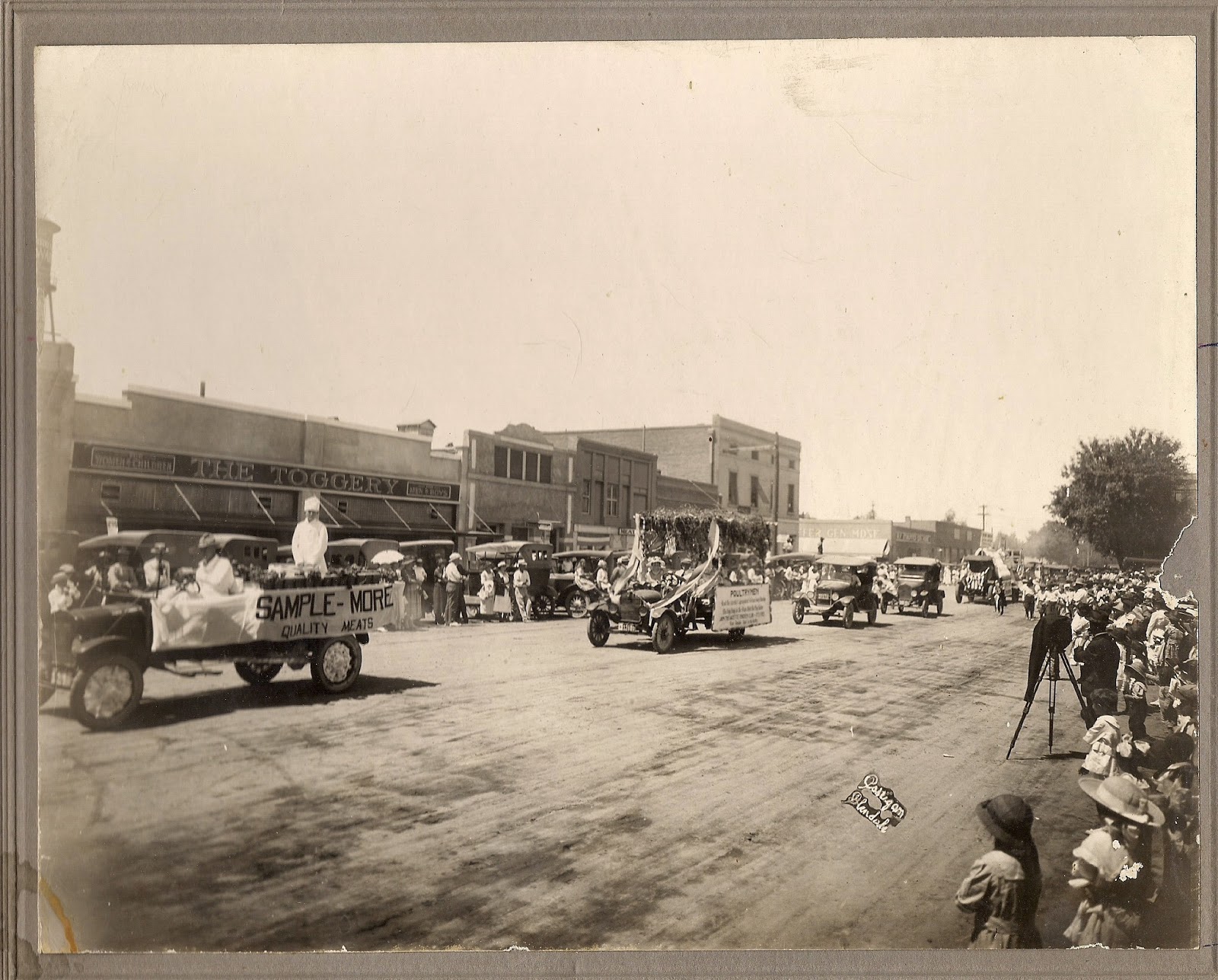 |
| Parade down Glendale Ave. c. 1915 |
 |
| Bertha, Thelma, and J.L. at Roy's gravesite |
The man she married, Earnest Kinman, was a well-liked and outgoing friend of the family. His best friend was my great-grandfather, Dick Witter, who had only married Bertha's little sister, Merle, a couple of years before - before getting himself drafted and going off to join the Army, of course.
Harry More would pass away in 1925, and after that, his widow Iva moved on to California with Phil, leaving the meat market to Earn and Bertha to run. By the time Bertha died in 1965, the wild west was 100 years in the past, the pioneer families were all but gone, and meat markets were being replaced by supermarkets. But along the way, the family had grown, loved, lost, fought, and eventually become a small background part of history.
As we all do, if we're lucky enough.
 |
| Aunt Bertha and Uncle Earn |
 |
| Albert C. Huff |
1. My identifications of the men in the post card of the Meat Market are pure speculation. I am guessing based on what is on the back of the post card. The Glendale Arizona Historical Society has a photo of Roy outside the market with an Albert Huff, but they identify Albert as Roy's father-in-law. I think the man in the photo is actually his brother-in-law, Albert Burton (who went by "Burt"); Burt's father was Albert C Huff, and this is what he looked like:
2. Despite the timing of Roy's death, and his eligibility for the draft, I don't have any indication that he served in the war. Of course, his brother-in-law, Dick Witter, did - but that's a different post!
Friday, November 28, 2014
Where the Women Folk Are
There is an obvious and tragic problem built into the bones of genealogy. Its source is obvious, but its solution is not. It affects everyone, every family, regardless of culture and convention - and sometimes it costs us more than we understand.
Kameron Hurley's 2014 Hugo-award winning blog post, "We Have Always Fought" talks about the ways in which women have been erased from the narrative of our fiction. She talks about the effect the pressures of simplicity and tradition have on the stories we tell, and while she mainly talks about fiction, it is worth remembering that history is one of the stories that we tell. Her essay resonated with me deeply because I have seen the effect in action in my research.
In most Western cultures, surnames developed as a way of tracing heredity which has a tendency to favor the preservation of the paternal line's identity, often at the total expense of the maternal. Scandinavians passed fathers' names to sons, literally - Hans's son took the surname "Hansen" and if his name was Tom, his son would be "Tomsen" (yes, I'm oversimplifying, and not everyone followed that custom). Spanish traditions could be more complicated, passing names of fathers AND mothers to children. There are areas in Germany and other places where the groom assumed the bride's name, but that only reverses the problem. Some families try to solve the problem by using hyphens - but the pressures of simplicity and tradition (and public record-keeping) still have the effect of erasing mothers' surnames from records and memories.
Sometimes, completely.
It isn't just that their names are hard to find - that's part of the fun and challenge that drew me into this hobby in the first place.
The problem is that I see, over and over, generation after generation, in branch after branch of the family tree that women are recorded differently from the men they lived with. It's not just that they pass - are passed - from their father's house bearing their father's name into their husband's bearing his; it's not just that the stories told about them are centered on the home, and bearing children, and being quiet, pious, and lovingly in the background. Many of them insisted on being portrayed that way. The problem I have with that is that they did more, saw more, thought more, and had more influence on our history than they get credit for.
I pore through the census records, and I often see stories between the boring lines of simple tabulation. Sometimes I see that there are clearly recent widows with small children out on the frontier. Sometimes I see odd pairings or May-December marriages after what must have been an epidemic. Yet when I dig through the old books about The Founders, there is almost never a mention of the mother who fed the town or the young wife who rescued the broken-hearted widower and his brood of orphans. Even those kinds of simple, traditional stories are left out in favor of listing the forming of business partnerships, the surveying and clearing of land, and the staunch political affiliations of the local burgesses.
As Hurley says in her essay, women are erased from the stories we tell, because:
Again, I'm not complaining that my family tree is full of wives, mothers, sisters, and daughters - that's a good thing. I'm pointing out that while we have all kinds of stories about brave soldiers, traveling preachers and teachers, builders, and local leaders that tell us what our forefathers were like, we rarely have those kinds of stories about their wives, mothers, sisters, or daughters.
Part of the problem lies in the way they are written about. When I find old books about pioneer families, and the founding of towns across 19th century America, the biographical sketches are always about prominent men. Always. Their wives and daughters are rarely mentioned outside the context of who they married or how many children they mothered.
But another part of the problem lies in the way they wrote about themselves. Obviously, they felt the pressure to be seen as wives, mothers, sisters, daughters - not as pioneers, adventurers, trailblazers. Even writing about women of more recent generations, women who I know to be strong, brilliant three-dimensional people, it's easy to cave in to that pressure to stick to the simple, common, traditional narrative. As much as I crave the opportunity to write about the badassed, big-hearted, boisterous, and brilliant women in my family, I have already been told to be careful about it. They do not want to be embarrassed. They do not want to be seen in ways that aren't ... right.
Well, brace yourselves.
This is your warning that I am looking for ways to bring the amazing women of my history to light. I don't plan to make these stories up - that would be a different problem, and still wrong - but sometimes we have to use our imaginations to recreate what life must have been like in days gone by.
I may have to read between the lines to see what my 4th great-grandmother Eleanor was really like. She was widowed, and left to raise her grandson, my great-great grandfather, only to see him die young; and I don't even know her full name. And I need to dig to find out who this author named Frances Adams More is - what did she write, and what happened to her. And what about those adventurous Huff sisters, who seemed to travel abroad so much?
If I have the choice, and if the evidence will support me, I will choose to look beyond the flowery words in obituaries about loving wives and doting mothers to see the pioneers, the engineers, and the adventurers. Many of them will be mothers, and of course, they are all daughters. But I will seek to show you the capable drivers, the financial wizards, the creative writers and artists, and the community organizers when I find them.
So, where are these women? They're right there in the crooks of the trees, hiding in plain sight. They left clues, and when I find them, I will show them to you - because I owe them that. Because if these ordinary men can be Mighty Acorns, it stands to reason their partners were just as amazing. (And they likely did most of the work...if they were anything like my partner.)
Traditional narrative be damned, I intend to tell their stories. Whether they wore silk or satin, whether they raised a family or raised hell, they deserve to be remembered.
Kameron Hurley's 2014 Hugo-award winning blog post, "We Have Always Fought" talks about the ways in which women have been erased from the narrative of our fiction. She talks about the effect the pressures of simplicity and tradition have on the stories we tell, and while she mainly talks about fiction, it is worth remembering that history is one of the stories that we tell. Her essay resonated with me deeply because I have seen the effect in action in my research.
In most Western cultures, surnames developed as a way of tracing heredity which has a tendency to favor the preservation of the paternal line's identity, often at the total expense of the maternal. Scandinavians passed fathers' names to sons, literally - Hans's son took the surname "Hansen" and if his name was Tom, his son would be "Tomsen" (yes, I'm oversimplifying, and not everyone followed that custom). Spanish traditions could be more complicated, passing names of fathers AND mothers to children. There are areas in Germany and other places where the groom assumed the bride's name, but that only reverses the problem. Some families try to solve the problem by using hyphens - but the pressures of simplicity and tradition (and public record-keeping) still have the effect of erasing mothers' surnames from records and memories.
Sometimes, completely.
It isn't just that their names are hard to find - that's part of the fun and challenge that drew me into this hobby in the first place.
The problem is that I see, over and over, generation after generation, in branch after branch of the family tree that women are recorded differently from the men they lived with. It's not just that they pass - are passed - from their father's house bearing their father's name into their husband's bearing his; it's not just that the stories told about them are centered on the home, and bearing children, and being quiet, pious, and lovingly in the background. Many of them insisted on being portrayed that way. The problem I have with that is that they did more, saw more, thought more, and had more influence on our history than they get credit for.
I pore through the census records, and I often see stories between the boring lines of simple tabulation. Sometimes I see that there are clearly recent widows with small children out on the frontier. Sometimes I see odd pairings or May-December marriages after what must have been an epidemic. Yet when I dig through the old books about The Founders, there is almost never a mention of the mother who fed the town or the young wife who rescued the broken-hearted widower and his brood of orphans. Even those kinds of simple, traditional stories are left out in favor of listing the forming of business partnerships, the surveying and clearing of land, and the staunch political affiliations of the local burgesses.
As Hurley says in her essay, women are erased from the stories we tell, because:
"...none of those things fit our narrative. What we want to talk about are women in one capacity: their capacity as wife, mother, sister, daughter to a man. I see this in fiction all the time. I see it in books and TV. I hear it in the way people talk."
Again, I'm not complaining that my family tree is full of wives, mothers, sisters, and daughters - that's a good thing. I'm pointing out that while we have all kinds of stories about brave soldiers, traveling preachers and teachers, builders, and local leaders that tell us what our forefathers were like, we rarely have those kinds of stories about their wives, mothers, sisters, or daughters.
Part of the problem lies in the way they are written about. When I find old books about pioneer families, and the founding of towns across 19th century America, the biographical sketches are always about prominent men. Always. Their wives and daughters are rarely mentioned outside the context of who they married or how many children they mothered.
But another part of the problem lies in the way they wrote about themselves. Obviously, they felt the pressure to be seen as wives, mothers, sisters, daughters - not as pioneers, adventurers, trailblazers. Even writing about women of more recent generations, women who I know to be strong, brilliant three-dimensional people, it's easy to cave in to that pressure to stick to the simple, common, traditional narrative. As much as I crave the opportunity to write about the badassed, big-hearted, boisterous, and brilliant women in my family, I have already been told to be careful about it. They do not want to be embarrassed. They do not want to be seen in ways that aren't ... right.
Well, brace yourselves.
This is your warning that I am looking for ways to bring the amazing women of my history to light. I don't plan to make these stories up - that would be a different problem, and still wrong - but sometimes we have to use our imaginations to recreate what life must have been like in days gone by.
I may have to read between the lines to see what my 4th great-grandmother Eleanor was really like. She was widowed, and left to raise her grandson, my great-great grandfather, only to see him die young; and I don't even know her full name. And I need to dig to find out who this author named Frances Adams More is - what did she write, and what happened to her. And what about those adventurous Huff sisters, who seemed to travel abroad so much?
If I have the choice, and if the evidence will support me, I will choose to look beyond the flowery words in obituaries about loving wives and doting mothers to see the pioneers, the engineers, and the adventurers. Many of them will be mothers, and of course, they are all daughters. But I will seek to show you the capable drivers, the financial wizards, the creative writers and artists, and the community organizers when I find them.
So, where are these women? They're right there in the crooks of the trees, hiding in plain sight. They left clues, and when I find them, I will show them to you - because I owe them that. Because if these ordinary men can be Mighty Acorns, it stands to reason their partners were just as amazing. (And they likely did most of the work...if they were anything like my partner.)
Traditional narrative be damned, I intend to tell their stories. Whether they wore silk or satin, whether they raised a family or raised hell, they deserve to be remembered.
Friday, November 7, 2014
Silk or Satin
Transcribed from a letter dated 1973:
The Revolutionary War soldiers were given land in the Northwest Territory -- Pennsylvania, Ohio -- to settle their wages for service, I believe. But this was a generation before Elizabeth's time. I am under the impression that my grandfather William Callin fought in the War of 1812. I don't know how or where he met up with Elizabeth Berlien. My father's Callin family history says they settled first in around Ashland, Ohio, later moving to Wood County.
Anyhow they lived in a Lincoln-like log cabin in Wood County. My father, George Callin, born in 1846 said they would waken in the morning and find a light layer of snow over their bed. William paid his taxes by cutting wood and hauling it into town, 50 cents a load.
William and Elizabeth had six children, five boys and a girl. I believe the girl was the oldest -- Harriet (Sly), John Zimri, George, Hugh and Jim. Father said they were warned not to say nothing at school about it, but their cabin was a station on the Underground Railway. I don't know whether it was William or Elizabeth, probably the latter, who awakened them softly in the middle of the night and led them to the window. The moon flashed out and they saw a white man, maybe William, leading a string of blacks through the clearing around their cabin and into the woods. They were on their way to Great Uncle George's barn. From there he would take them onto the next stop.
William was a powerful man, six feet tall. The boys had to be in the fields around sunup. He had a big, black whip. I don't know whether it was Elizabeth or her mother-in-law who would say pleadingly, "Now, William, don't whup 'em." It was a brutal age.
The first thing the children heard in the morning was the sound of her spinning wheel and the last thing at night. Papa said that one time she didn't get the buttons sewed on their shirts or maybe she didn't have any buttons so she sewed their shirts together with thread and so off they went to school or wherever.
When the Civil War came all five enlisted. I have a strong feeling that probably Elizabeth always had a Bible and encouraged visiting preachers and friends who could read it to her. She possibly taught the children verses and stories from it. I have known among my Appalachian friends people who couldn't read and write at all who knew their Bible by heart, sometimes more strongly and sincerely perhaps than literate people because to them it is the one book. They think about it and discuss it constantly.
The five boys went to war and for the first time Elizabeth learned to read and write so that she could communicate with them. This was probably not too hard for her as those "Dotsch" are good at everything anyway.
William died at maybe around 62 and I don't know what Elizabeth did then. I believe she lived to be about 84. In her very last years she came to live with us at 331 Pearl Street in Bowling Green. And this is where this picture must have been taken, probably by my mother who had a camera. Later I inherited my half-sister's (Mabel Callin's) dress-up picture of my father. I was handling it when it fell apart and here was this picture that I didn't know existed of Grandmother Callin.
I don't remember her but she knew me. She sat by the window mostly in the east bedroom. Papa loved to go in for a chat and he delighted in her witty answers. Mother was going to make her a dress and Papa asked --- he knew well enough that it would be calico or gingham, but he said playfully, "What'll it be, Mother, silk or satin?"
"It'll be sat in, all right."
"George, sometimes I wish I had gone over the hills to the poor house." (In those days considered a great disgrace.) "There would be old people there and they would know the things I want to talk about."
Another day she said to him.
"The woman next door (mother) is going to have a baby (me)."
After I came she said;
"I guess you better call her "Melia". (Sure glad they didn't.)
Mother went in one time and laid me on the bed for a moment. When she came back, Grandmother had grabbed me by the skirts and was pulling me toward her. I was almost off the bed. Mother probably let her hold me. She liked old ladies and was kind to them. When I was a young girl I used Elizabeth for my middle name but later I decided that Rosemary was enough.
Elizabeth passed away in 1903 and was probably buried from our house. I don't know where. There is a George Callin lot in Oak Grove Cemetery at Bowling Green and, by-the-way, there are still two places on it if any one in the family should need them. She and William might be buried on Uncle John Callin's lot also in Oak Grove, but I don't think so. I don't remember ever seeing them there.
If any of you know any more about Grandmother Callin I would certainly appreciate hearing about it. I see from the Callin family history that I have the order of the children wrong. It was John, Zimri, Jim, George and Hugh. Jim was possibly the flower of the flock. Papa said he once accused Elizabeth of liking Jim best. She answered that he needed her the most.
Rosemary Callin
September, 1973
I have a photocopy of this 1973 letter, though I don't know if the original was typed or handwritten. I would love to get copies of any of the photographs mentioned in this letter, so if you have them, please comment below or email me (callintad at gmail dot com).
The writer of this memoir is Rosemary Callin (1902-1978), daughter of George W. Callin (1846-1921), the man who compiled the "Callin Family History" in 1911. Rosemary was born to George and his second wife, Lura Warner, in 1903. She never married, and it's not clear who was her intended audience.
(Pictured at right are George, his first wife, Mary Ann St. John, and Rosemary's older half-siblings.)
As far as Rosemary's facts:
I haven't found any proof of William (who would have been about 3 years old) fighting in the War of 1812. His father and uncle migrated from Westmoreland county, PA, around 1816, though, so either or both of them may have been involved in the fighting around the Great Lakes. As of the date of this post, I'm still looking for evidence to show where they came from and where they might have served.
I believe the Great Uncle George referred to would be William's uncle George Callin (1804-1879), who shows up in Huron County on the 1850, 1860, and 1870 census records.
When the Civil War began, I don't believe "all five" Callin brothers enlisted - I have found pension records for John, Jim, and George, but Hugh would have been 13 when the war began, and Zimri would have been 15 at its close. (In an interesting twist, Zimri's son, Edward, is the only relative of mine that I have found to date who served in the Spanish-American War.)
According to the Find-a-Grave database (thanks to cousin Joan!), Elizabeth is indeed buried in Oak Grove Cemetery.
Things I Have Been Told About My Grandmother, Elizabeth Berlien (Barline) Callin.
The Revolutionary War soldiers were given land in the Northwest Territory -- Pennsylvania, Ohio -- to settle their wages for service, I believe. But this was a generation before Elizabeth's time. I am under the impression that my grandfather William Callin fought in the War of 1812. I don't know how or where he met up with Elizabeth Berlien. My father's Callin family history says they settled first in around Ashland, Ohio, later moving to Wood County.
Anyhow they lived in a Lincoln-like log cabin in Wood County. My father, George Callin, born in 1846 said they would waken in the morning and find a light layer of snow over their bed. William paid his taxes by cutting wood and hauling it into town, 50 cents a load.
William and Elizabeth had six children, five boys and a girl. I believe the girl was the oldest -- Harriet (Sly), John Zimri, George, Hugh and Jim. Father said they were warned not to say nothing at school about it, but their cabin was a station on the Underground Railway. I don't know whether it was William or Elizabeth, probably the latter, who awakened them softly in the middle of the night and led them to the window. The moon flashed out and they saw a white man, maybe William, leading a string of blacks through the clearing around their cabin and into the woods. They were on their way to Great Uncle George's barn. From there he would take them onto the next stop.
William was a powerful man, six feet tall. The boys had to be in the fields around sunup. He had a big, black whip. I don't know whether it was Elizabeth or her mother-in-law who would say pleadingly, "Now, William, don't whup 'em." It was a brutal age.
The first thing the children heard in the morning was the sound of her spinning wheel and the last thing at night. Papa said that one time she didn't get the buttons sewed on their shirts or maybe she didn't have any buttons so she sewed their shirts together with thread and so off they went to school or wherever.
When the Civil War came all five enlisted. I have a strong feeling that probably Elizabeth always had a Bible and encouraged visiting preachers and friends who could read it to her. She possibly taught the children verses and stories from it. I have known among my Appalachian friends people who couldn't read and write at all who knew their Bible by heart, sometimes more strongly and sincerely perhaps than literate people because to them it is the one book. They think about it and discuss it constantly.
The five boys went to war and for the first time Elizabeth learned to read and write so that she could communicate with them. This was probably not too hard for her as those "Dotsch" are good at everything anyway.
William died at maybe around 62 and I don't know what Elizabeth did then. I believe she lived to be about 84. In her very last years she came to live with us at 331 Pearl Street in Bowling Green. And this is where this picture must have been taken, probably by my mother who had a camera. Later I inherited my half-sister's (Mabel Callin's) dress-up picture of my father. I was handling it when it fell apart and here was this picture that I didn't know existed of Grandmother Callin.
I don't remember her but she knew me. She sat by the window mostly in the east bedroom. Papa loved to go in for a chat and he delighted in her witty answers. Mother was going to make her a dress and Papa asked --- he knew well enough that it would be calico or gingham, but he said playfully, "What'll it be, Mother, silk or satin?"
"It'll be sat in, all right."
"George, sometimes I wish I had gone over the hills to the poor house." (In those days considered a great disgrace.) "There would be old people there and they would know the things I want to talk about."
Another day she said to him.
"The woman next door (mother) is going to have a baby (me)."
After I came she said;
"I guess you better call her "Melia". (Sure glad they didn't.)
Mother went in one time and laid me on the bed for a moment. When she came back, Grandmother had grabbed me by the skirts and was pulling me toward her. I was almost off the bed. Mother probably let her hold me. She liked old ladies and was kind to them. When I was a young girl I used Elizabeth for my middle name but later I decided that Rosemary was enough.
Elizabeth passed away in 1903 and was probably buried from our house. I don't know where. There is a George Callin lot in Oak Grove Cemetery at Bowling Green and, by-the-way, there are still two places on it if any one in the family should need them. She and William might be buried on Uncle John Callin's lot also in Oak Grove, but I don't think so. I don't remember ever seeing them there.
If any of you know any more about Grandmother Callin I would certainly appreciate hearing about it. I see from the Callin family history that I have the order of the children wrong. It was John, Zimri, Jim, George and Hugh. Jim was possibly the flower of the flock. Papa said he once accused Elizabeth of liking Jim best. She answered that he needed her the most.
Rosemary Callin
September, 1973
Some notes:
 |
| George W. Callin, Everett (standing), Clem, Mary Ann, and Mabel - c. 1890 |
I have a photocopy of this 1973 letter, though I don't know if the original was typed or handwritten. I would love to get copies of any of the photographs mentioned in this letter, so if you have them, please comment below or email me (callintad at gmail dot com).
The writer of this memoir is Rosemary Callin (1902-1978), daughter of George W. Callin (1846-1921), the man who compiled the "Callin Family History" in 1911. Rosemary was born to George and his second wife, Lura Warner, in 1903. She never married, and it's not clear who was her intended audience.
(Pictured at right are George, his first wife, Mary Ann St. John, and Rosemary's older half-siblings.)
As far as Rosemary's facts:
I haven't found any proof of William (who would have been about 3 years old) fighting in the War of 1812. His father and uncle migrated from Westmoreland county, PA, around 1816, though, so either or both of them may have been involved in the fighting around the Great Lakes. As of the date of this post, I'm still looking for evidence to show where they came from and where they might have served.
I believe the Great Uncle George referred to would be William's uncle George Callin (1804-1879), who shows up in Huron County on the 1850, 1860, and 1870 census records.
When the Civil War began, I don't believe "all five" Callin brothers enlisted - I have found pension records for John, Jim, and George, but Hugh would have been 13 when the war began, and Zimri would have been 15 at its close. (In an interesting twist, Zimri's son, Edward, is the only relative of mine that I have found to date who served in the Spanish-American War.)
According to the Find-a-Grave database (thanks to cousin Joan!), Elizabeth is indeed buried in Oak Grove Cemetery.
Subscribe to:
Posts (Atom)