Showing posts with label Rhode Island. Show all posts

Friday, April 29, 2016

Indiana Ettingers

Mildred Ferguson was born to James and Eliza (Callin) Ferguson in 1837. She was the third of what would be eleven children.

That was the year Martin Van Buren succeeded Andrew Jackson as President of the United States. It was also the year that an 18-year-old Queen Victoria took the throne in England, beginning the 63-year reign that we call the Victorian Era today. Closer to home, Michigan was admitted as the 26th state that January, and the city of Chicago was incorporated.

It is unlikely that baby Mildred knew all of this was happening. Her life would have been that of the pioneer farmer's daughter. She and her two older sisters would have surely been busy with chores and tending the growing number of siblings around the farm. At some point, though, her life was uprooted along with all of those brothers and sisters, as the family moved west to Auburn, Indiana.

In 1850, Mildred would have been 13 years old. That year, Vice President Millard Fillmore was sworn in as President after the death of Zachary Taylor. California was admitted as the 31st state. And the "Compromise of 1850" forestalled a civil war, to the relief of many.

The Ettinger family was a numerous bunch, with many branches throughout the Midwest, including a large number who lived in Richland county, Ohio. The family we are looking at today originated in York county, Pennsylvania and came to Scott township in Sandusky county, Ohio, in 1837.

Daniel Ettinger and his wife, the former Catherine Jacobs, arrived in Ohio in time for the birth of their youngest son, William J Ettinger (1837-1920). Daniel eventually settled in Lexington, and taught school in Troy township. He was considered a very intelligent and communicative teacher, and an above average mathematician.

William would have grown up mainly in Lexington. Some time between 1850 and 1860, he left Ohio for Indiana. He would have turned 18 in 1855; perhaps he knew some of the people who had moved west, as the Ferguson family had done just before 1850. However he got there, and whatever motivated him to go, on 8 March 1860, William Ettinger married Mildred Ferguson in DeKalb county, and they set up a home in Auburn before they moved to Waterloo, where he worked as an undertaker and cabinet maker.

Over the following twenty years, the family lived in DeKalb county, and William and Mildred raised eight children; three sons and five daughters:


  • John Clark Ettinger (1860–1927)
  • Clara Ettinger (1862–1931)
  • Flora Ettinger (1866–1941)
  • Lyda Ettinger (1868–1950)
  • Catherine "Cassy" Ettinger (1870–1959)
  • George Daniel Ettinger (1873–1961)
  • William Hurben Ettinger (1879–1933)

The two eldest children did not leave any surviving children of their own, but they led interesting lives. In fact, I found the Indiana newspapers to be very well represented in the Newspapers.com database, which is where I learned a great deal about this family.

In January 1911, Mildred was reportedly very ill, and the family gathered together - but I don't know precisely when Mildred died. Years later, in 1920, William's health also failed, and he died in the home of his daughter, Cassy Faucett, at the age of 83, hailed as one of the oldest citizens of Waterloo. 

     1. John Clark Ettinger worked in Waterloo as a boy, and was a fireman in the grist mill operated by Duncan Bros, at the corner of Van Vleck and Sheridan streets.  He left home and began working as a fireman on the Chicago and Alton railroad, until he became an engineer. About 1917 he developed diabetes, but he lived a careful life and regained his health and was able to run on the railroad until a few weeks before his death in January 1927.

John married Mary Magdalene Schlemm (1870–1936) on 26 February 1890, in Sangamon county, Illinois. John and Mary lived in Springfield, Illinois, and she remained in their home after he died. 

     2. Clara Ettinger grew up in Waterloo, and married in June of 1893, at the age of 21. Her husband was Charles H. Rude, who ran a business in Tecumseh, Michigan, about 100 miles away. The young couple moved to Tecumseh, and two years later, they had a son: Harry Ettinger Rude (1895-1918).
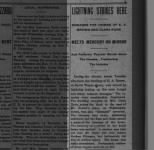
Lightening strike at the Rude house
"LIGHNING STRIKES HERE"
The Waterloo Press, 18 Aug 1910
According to newspaper accounts, Charles abandoned his family when Harry was only six weeks old. In 1900, their family still appeared in the U.S. Census, living in Tecumseh; but in 1910, Clara Rude appeared in Grant, De Kalb county, Indiana, with Harry and her widowed uncle: William's older brother, Reuben Ettinger. At that time, she apparently worked as a dressmaker, but later accounts indicate that Clara and Harry had to rely on relatives for their support, with Harry living for a time with Clara's sister and brother-in-law, Cassy and Dexter Faucett. (This may have been related to the 1910 lightning strike that hit the house Clara, Harry, and Reuben were living in!)

Harry was actually born September 30, 1895, in Pawtucket, Rhode Island, but there is some question as to when his parents returned to Michigan and when they separated. He grew up in Indiana, for the most part, attending high school in Waterloo. After completing a course in civil engineering at what is now Northwestern University, he was employed as civil engineer on Chicago, Burlington and Quincy Railroad. He enlisted on November 5, 1917, in Chicago, and was assigned to the Medical Corps and was sent to training at Ft. Riley, Kansas. He contracted pneumonia and died on January 5, 1918. He was buried in Waterloo.

Clara eventually moved in with her sister's family, and died at the Faucett home in November 1931. After Clara's death, the Faucetts and her brother, William Hurben Ettinger, sued Harry's estate for $2,000 and $1,500, respectively, to compensate for their expenses incurred over the years. Harry's estate was an insurance settlement from the government.


Next week, I'll look at the Faucett family in more detail, show that their home was used for more than hosting funerals, and see how many Ettinger descendants we can fit into one post!

Friday, January 2, 2015

Foundation Found, Providence Provided

Map and inset made from Google maps and Wikipedia
On February 9, 1597, Mary, the wife of Sir Richard Greene, the Lord of Bowridge Hill, gave birth to a son they named John.  Bowridge Hill had been the birthplace of three generations of Greenes, starting with Sir Richard's grandfather, Robert. It was - and is - located about eight miles from the village of Gillingham in the English county of Dorset.

Mary's father was John Hooker, who had been a prominent historian and Member of Parliament. Coming from a family with rank and education, young John Greene grew up in a privileged environment, with titles such as "Mr." and "Gent" applied to his name on many of the records that refer to him. He trained as a surgeon, and moved to Salisbury, in Wiltshire, where he practiced his profession and lived for 16 years.

Around the time he moved to Salisbury, in 1619, on the fourth of November, John married Joanne Tattershall. It isn't clear how her family came by that surname (and the spellings do vary quite a bit), but it indicates some relationship to the town and castle of Tattershall located in Lincolnshire.

Tattershall Castle, Lincolnshire
Just through sheer coincidence, 379 years later, the 11th great-grandson of John and Joanne - yours truly! - was stationed at a Royal Air Force camp in Lincolnshire as a member of the United States Air Force. It is unlikely that Joanne or any of her immediate ancestry lived in the castle, since it had been sold to the Earl of Lincoln by her time, but it is exciting to find a connection to the place. We visited it several times while we lived in Lincolnshire, notably for a U.S.-UK 4th of July celebration in 1998.

On the 6th of April, 1635 at 45 years of age, John Greene registered for embarkation with his wife and six children on the James of London - William Cooper, Master. After a voyage of fifty-eight days, they arrived in Boston on 3 June. Their prospects seemed good - a surgeon in the colonies was a rare and valuable thing, and John joined the church at Salem, led by Roger Williams.

Sadly, things began to turn difficult almost as soon as the family settled in. In August of 1635, a hurricane swept through the young colony, drowning farms and wrecking houses. In October, Roger Williams was convicted of sedition and heresy, and he famously fled Boston in a blizzard in January 1636. Somewhere among these events, Joanne died. Most of the children were 10 or under, so John remarried to a widow named Alice Daniels in 1637, and the family acquired a home lot in Roger Williams's new settlement of Providence.

List of original 12 members, from
Henry Melville King's
Historical catalogue of the members of the 
First Baptist Church of Providence, Rhode Island
The following year saw the establishment of the First Baptist Church of Providence, the first Baptist church in the Americas.  After meeting in Williams's home for the first year, the group of believers were baptized by Williams in the Seekonk river in 1638 - a group that included John Greene, surgeon.

In 1642 Samuel Gorton and Narragansett Indian Chief Sachem Miantonomi agreed to exchange 144 fathoms of Wampumpeague for what was known as "The Shawhomett Purchase" (also spelled "Shawomet"). However, the purchase was disputed by two other sachems of the area, Sacononoco and Pumham; they complained to the Massachusetts colony that Miantonomi had sold the land without asking for their approval. They took their case to Boston, where they placed their lands under Massachusetts rule, and in October 1643 Massachusetts sent a militia force of "forty mounted and armed men” from Boston to arrest Gorton and his neighbors. The militia fired over the houses, and the women and children fled to the woods.

Samuel Gorton wrote of this attack of the Massachusetts troops:
"Afflicting our wifes and children, forcing them to betake themselves, some into the woods among the Indians, suffering such hardships as occasioned the death of divers of them, as the wife of John Greene, as, also, the wife of Robert Potter."
After a tense standoff, all but three of Gorton's settlers surrendered to the Massachusetts force. This event prompted the other three towns on Narragansett Bay (Providence, Portsmouth, and Newport) to unite and get a royal charter allowing the towns on Narragansett Bay to form the Colony of Rhode Island and Providence Plantations. In 1648, Gorton was granted a Charter by Robert Rich, 2nd Earl of Warwick, Lord Admiral and head of the Parliamentary Commission on Plantation Affairs. After this, the name of the settlement was changed from Shawomet to Warwick. While Massachusetts continued to lay claim to the area, it made no further effort to enforce it.

It isn't clear whether John Greene was part of the effort to obtain the royal charter, but he did sail back to England in 1644. There, he received a number of Latin books that had been willed to him by his brother, and he married his third wife, Phillipa, with whom he returned to Warwick in 1646. Upon his return, he became a leader of the community of Warwick, first being elected to the Town Council in August 1647, and later serving as town Commissioner from 1655-1657.

John Greene, surgeon, died in Warwick in January of 1659, a respectable 69 years of age.

His son, James, had married Deliverance Potter the previous year; her mother, Isabel, was the "wife of Robert Potter" who had died along with James's step-mother, Alice1, in the 1643 attack on Shawomet. They had two sons and two daughters (all under age 5) when Deliverance died in 1664. James remarried the following year to Elizabeth Anthony.

James and Elizabeth had 8 more children - including my ancestor, the John Greene known for building the estate, "Potowomut" - and the line continued until 8 generations later, when we arrive at my grandmother's grandmother, Florence Mabel Hart - one of "My Sixteen." That makes John Greene, the surgeon, and Joanne Tattershall my 11th great-grandparents.

1. Footnote: Some accounts say that it was Joanne, not Alice, who died in the 1643 event. I went with this version of the story for the sake of telling the story without a confusing debate in the middle, but I don't want anyone to think I claim to speak authoritatively as to which wife it was. If there is a real historian reading this who would like to set me straight, I'm happy to edit!