Showing posts sorted by relevance for query Nancy Burget. Sort by date Show all posts

Friday, August 7, 2015

Tragic Thomas

Thomas Callin is, to me, the first of many firsts.

As near as we can tell, he was the eldest son of an eldest son, and he is the earliest of these ancestors to leave behind multiple records. He had to be a survivor - that much is evident in his story. But thanks to war, disease, and the other dangers of frontier life, he came close to leaving no legacy at all.

I'm sure I'm projecting a bit, but the Callin men in my contemporary branch of the family tend to be a bit clumsy. For us, it's not usually fatal - it often leads to minor injuries and embarrassingly preventable consequences. Most of our misfortunes are small enough to be laughed off (and maybe bandaged up), but Thomas's life, with its many tragedies, seems to have been plagued with the kinds of misfortunes that are harder to laugh off.

Born in Pennsylvania in 1801, Thomas would have been just old enough during the War of 1812 to have been aware of his family's vulnerable position as a farm in the middle of a growing American frontier. If his father, James (from our previous post, The Brothers Callin of Ohio) did have a sister carried off during a raid on their settlement (see The Perils of Polly (or Margaret) for that story), then Thomas would have grown up hearing that harrowing adventure around the fire, and experiencing the dread of attack from his earliest memories.

Thomas would have been about 9 years old when the family relocated to the new state of Ohio - a state younger than Thomas himself! - and there are some resources available if you want to learn more about what that would have been like. (I found a quaint book, and linked to it at the bottom of this post if you're interested - "Philip Seymour, or Pioneer Life in Richland County"written in 1858 and set in 1812.)

There is a lot we don't know about that time on the Callin farm. Thomas's uncle, John, arrived in 1816, about six years after Thomas's father did. I like to think adding seven cousins to the farm lessened the work load, and spread out the chores. According to the 1820 Census for Milton township, Thomas had four brothers and two sisters, and his aunt and uncle had added two more to their brood, bringing the total for both families to 17 cousins!

Sadly, this is when the first real tragedy struck, as sometime around 1820, James got involved in an altercation with a man named Fowler, who hit him in the head with a rifle and killed him. (The census does show a neighbor named Sutton Fowler, but without any documentation, there is no way to tell if that is the same person.)

Milton Township, Richland county, 1820
We don't have any evidence outside of George Callin's Family History, but according to him, Thomas married Nancy Burget in 1822.

The 1820 Census did show two households headed by Burgets - one named Thomas and one named Boston. From looking at the ages of the people in each of those households, I've concluded that it's most likely that Thomas and Boston could be Nancy's brothers, and that if she was living in either household in 1820, it might have been the one headed by Thomas Burget.

Marrying Nancy and setting up his own home on or near the family farm ought to have been a happy occasion for Thomas. I like to think of everyone getting along and working together, making a life like that you might have seen on Little House on the Prairie. But it can't have been without its share of heartbreak. The picture we have is murky, as the facts in our different sources don't paint a complete picture. But we'll do the best we can to piece together the family of Thomas and Nancy Callin.

The George Callin Family History (which I'm going to refer to as the "CFH") tells us that Thomas and Nancy's eldest child was a girl named Jane, born in 1823. But, there is no girl of that age listed in the 1830 or 1840 census, and even though George's account says she lived until 1879, unmarried, there is no Jane Callin listed in any of the subsequent census records for this family - nor is there such a person listed in Ohio for any of those dates. There is, however, a James of about the right age (born 1826) listed in the 1850, 1860, and 1870 census records, living with his mother, Nancy. I suspect the CFH simply got that one little fact wrong.

Their second child, George, was born in 1825. (I guess that would make him the eldest, if my Jane/James theory is correct.) There is a boy the right age to be George in the 1830 and 1840 Census records, and while he is nowhere to be found in 1850, there is a George Callan the right age in nearby Vermillion, Ashland county, in the 1860 census, living with a family called Boyd. Military records support the CFH account that says he was killed at the end of the Civil War in 1865. He enlisted in Company G, Ohio 178th Infantry Regiment on 23 Sep 1864, and though the records say he mustered out on 26 March 1865, his unit was in North Carolina at that time, and counted 2 of their members as Killed at the end of the war. The CFH says he was shot by a rebel sharpshooter while on "pickete duty".

Both of these eldest sons died unmarried, according to all of the sources I have; their third son will be the subject of next week's tale: Thomas Jefferson Callin, born 1827. "Jeff" survived, thrived, and raised a large family of his own.

After him, depending on the source, there were two more boys and three girls; this is where things get both sad and hard to confirm. In the CFH, there are several children of Thomas and Nancy that are listed with the ominous note, "All died young." Mary Ann, Caroline, Emiline, Sally, Abel, and one unnamed.

We know that Mary Ann and Emiline survived until at least 1850, when they were 14 and 11 years old, respectively. The 1840 census shows two girls under 5, and one between 5 and 9 years of age. Mary Ann (1836) and Emiline (1839) and either Caroline or Sally could be those girls. The 1840 census also shows two boys between 5 and 9, but it isn't clear who they might be. Find-a-Grave says that Abel lived from 1838-1839, and the other boys mentioned in The Callin Family History are younger than that. While we have no record to indicate what their fate might have been. I would suggest that one of the many outbreaks of yellow fever or cholera which were known to occur at the time claimed at least some of these children.

Thomas himself seems to have died when he was right around the age that I am now - somewhere around 42. His family is listed in 1840 Milton township under his name, but in the enumeration, there is no male his age counted. There are the five boys under twenty, and three young girls, with one female (Nancy, most likely) between 30 and 39. Thomas's actual date of death is still a mystery; Find-a-Grave says 1861, but I would expect to have seen him in the 1850 and 1860 census if that were true. I tend to think that he probably died right around when his youngest son was born (Elliott, b. 1841 or 43).

The next child listed in the CFH is a boy named Marquis born in 1840. (If you're like me, you will always wonder if that is pronounced like "Marcus" or like the French "mar-KEE". Wonder on, American dreamer.) The book goes on to have Marquis marry Pauline Snyder, have two sons - Fred and John (b. 1871) - and die in Chicago, Illinois, presumably before the 1911 publication of the CFH. I have not been able to find a single record to support any of this. If Marquis has descendants out there, they remain a mystery.

(UPDATE: While putting the post for next week together, I ran across a 27-year-old "Munfer Callan" living in the 1860 Weller township household of Thomas J and Susan Callan - which is just close enough to what the CFH says about Marquis that this might be an elusive record of his life! The hunt continues... -T.C.)

The 1850 Census finds Nancy Callon in Weller Township, Richland county, with her son, the aforementioned James, two daughters, Mary Ann and Emiline, and the last of her sons listed in the Callin Family History: Elliott, whose birth date is either 1843 (per the CFH) or 1841 (per the Census). Interestingly enough, Nancy's 1850 household is listed on the page in between a Jefferson Callin (a newly wed Thomas Jefferson) and a Joseph Burget (no known relationship, but another tantalizing hint that Nancy's family is still nearby). In 1860, she is down to James and Elliott; and in 1870, only James remains.

Elliott appears to have enlisted in the 26th Ohio Regiment in 1861, which saw action at the Battle of Shiloh, and was deployed at the end of the war to New Orleans, and then San Antonio. Elliott died in 1865, at the hospital in Columbus, Ohio - never married.

I would love to learn more about Nancy; I know that she died in 1871, having outlived her husband and all but three of her children. Of those eleven children, after losing two to the war, and several more very likely to disease, only two survived to have families of their own. She must have been tough, but if we make a few reasonable guesses from what we see in the records, it's not too difficult to believe she had more family around her - between her brothers and in-laws, and what I hope was a close and supportive town.

But however quaint and romanticized the stories you read about the early days of America and life in 1800s Ohio might be, it's worth remembering just how steep a toll that life could take on those who survived it.


Monday, July 30, 2018

Echoes & Rhymes

As you might know, I'm working on the manuscript of the revised Callin Family History. (Replicas of the original are still available on Lulu and Amazon.)

This project has already taken a year longer than I expected it to take, mainly because I found the family of Sarah Callin and John Scott (and yesterday was the anniversary of THAT post!). But I'm not complaining! After all, filling gaps in the record is what this hobby is all about.

The point is, as I'm putting together several years' worth of research, I'm seeing new clues that I missed before, and learning new things that may add even more people to the tree. And just this morning, I found a clue to another missing branch of the family.

For those of you who may be new to this project, here's what we know:

Detail from 1820 Census of Milton Twp
(Note the two Burget men here)
The original Callin Family History told us about two men, James and John Callin. They were brothers who settled in "Ashland County, Ohio" in 1810 and 1816, respectively. Their father was James Callin, a Revolutionary War soldier who lived in Westmoreland County, Pennsylvania.

George Callin, who wrote the original Callin Family History, was the grandson of John Callin, and as I've researched the people he listed as John's children, I've found that the information about them he put in his book was fairly complete and accurate. If you refer to my earlier post, The Brothers Callin of Ohio, I included my analysis of John's family as it appeared in the 1820 and 1830 Census records for Milton Township, and James's family in 1820. (And in the process of drafting this post, I made a minor update to that one to reflect some of what we're talking about here.)

But when it came to James Callin's family, George's record was less complete. He listed only three sons of James and Mary, but the Census in 1820 showed that there were three more children in their family that we did not know about. Of course, there is always the chance that the younger people in a census record might not be related to the head of the household, and there is very little information in the 1820 Census to base a record search on, but we do what we can.

Thomas:

I don't have a lot to add about Thomas, except to note that he married Nancy Burget in 1823. We talked about their family in more detail in Tragic Thomas and there are some great Find-A-Grave photos collected in the update to that post.

Alec and James:

Just a quick recap of what little we know about Alec and James (the youngest son) - you can read a bit about them in The Pull of the West. But the thing I wanted to refresh everyone's memory on with regard to Alec is that the Callin Family History said that he took his mother (Mary) to Iowa with him and that she is buried in Muscatine in a grave that shares a marker with Callin Rayburn. (As discussed in this post.) We know he bought at least three parcels of land in Iowa, but haven't found him in the 1850 Census, as we should have expected. His fate and his descendants remain a mystery.

Hugh:

Detail from 1830 Census of Milton Twp.
(Note the surname "Montgomery" here)
If you don't want to click over and review, I can tell you here that the 1820 Census record for James Callin shows three children - one boy and two girls - who George did not list in his book. As I mentioned in that earlier post, I found Hugh in the 1830 Census in Milton Township, with a wife and two children under 5 years: one boy, and one girl. I also found his 1840 record in Louisa County, Iowa; they have two more daughters and one more son in that record, and the ages are close enough that I can believe this to be the same family. I also found several references to Hugh in the History of Louisa County by Arthur Springer.

Again, there is nothing there that proves he is the son of our James Callin, but Louisa County adjoins both Des Moines and Muscatine Counties, which is where Alec Callin purchased land in the 1840s and 1850s. I would have expected to find more records of Hugh - his marriage in Richland County, an appearance on the 1850 Census, or a death record of some kind - but to date, I have come up empty.


The New Kid:

Okay - now that we've got all of that background in place, here's what I found this morning:

Ohio Marriages, 1800-1958
Name:Caleb Montgomery
Spouse's Name:Elizabeth Callen
Event Date:13 Aug 1822
Event Place:Richland,Ohio

This is exciting and a little embarrassing. Obviously, it's exciting to find a clue - and this Elizabeth Callen is the right age to be the older of the two daughters in James Callin's 1820 Census record. It's embarrassing because it never occurred to me to go looking for her! I only ran across this record because I was hoping to find a marriage record for one of her brothers. And after all the fuss I've made about the way we erase women from history, I should have thought of doing that particular search years ago!

But there's more.

It didn't take long to start looking into Caleb Montgomery's family, and I learned a lot about them very quickly. The easiest way to share it all with you is to quote the relevant bits from the biographical sketch of Caleb and Elizabeth's son, Theodore (which can be found in the Fulton County, Indiana Handbook,  published by Tombaugh House, and available on the Fulton County Public Library's website):

Theodore "is a native of Richland County, Ohio, where he was born September 12, 1826. He is the son of Caleb and Elizabeth Montgomery, the former a native of Virginia, the latter of Pennsylvania. Caleb Montgomery, a pioneer from birth and a sturdy son of toil, was born June 23, 1799, in Virginia... His father, Benjamin Montgomery, was a native of Virginia, and a miller by trade. His mother, Nancy, was a native of the State of Delaware. They left Virginia when Caleb was a small boy, and settled in Richland County, Ohio, where they died, and where Caleb grew from a mere boy to a man of family. ... In 1820, he was united in marriage to Elizabeth Callen, a native of Pennsylvania, as before stated, born August 7, 1798 and a native of the same county as her husband. To these parents were born five children--Mary, now deceased; Sarah, now the wife of Henry Davidson, living in Halsey, Oregon; Theodore, of whom this sketch is concerned; Porter, deceased at Vicksburg, Miss.; and Callen, now interested in the mining business in Coloma, Cal. In 1834, Mrs. Montgomery deceased, leaving a mourning husband and family, and in 1836 he married Sarah L. Mercer, a native of Ohio, born in 1812."

The circumstantial evidence is very tantalizing. That 1798 birthdate makes Elizabeth just the right age to be the daughter of James and Mary, and their family would have still been in Pennsylvania at the time. This isn't proof, but it makes a strong case. Well, that and the fact that we aren't aware of another Callin/Callen family living in Richland County that she could belong to.

And then there are all of the historical "rhymes" - things that aren't quite proof of anything, but make up the fabric of a community like the one we have been researching in Milton Township.

It's worth commenting on the fact that Elizabeth and Benjamin named a son "Callen Montgomery." Remember that her theoretical mother, Mary, was buried in Muscatine, Iowa, next to a "Callin Rayburn"? Callin Rayburn's mother was Eleanor "Nellie" Callen, the daughter of Patrick Callen of Armstrong County, Pennsylvania, and sister of the Hugh Callen who founded Callensburg in Clarion County, PA. We still don't know what the connection is between our Callin family and Patrick, but my hunch is that Mary Callin could have been born a Rayburn, or that her husband, James Callen, could be a cousin of Eleanor Callen Rayburn. With all of these coincidences, I keep hoping they will add up to something!

The Benjamin Montgomery described in Theodore's biography was the original settler of the town of Olivesburg, which he named for his daughter (Caleb's sister), Olive. Olivesburg, of course, is located in Milton Township, and the Montgomery family deeded land to the town for the Old Olivesburg Cemetery, which is where several of our Callin ancestors are buried.

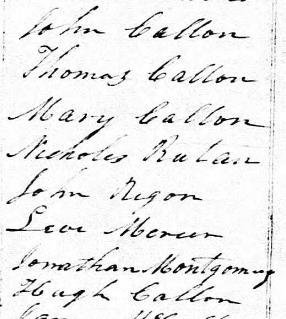
And if you look again at that detail from the 1830 Census above, you can see a Jonathan Montgomery and a Levi Mercer listed above Hugh Callin. Coincidentally, Benjamin Montgomery and Sarah Mercer named their first child Levi M (for "Mercer"?) Montgomery.

Also, Olive Montgomery was married twice: once in 1812 to John Farrell, and again in 1843, to Boston Burget--quite possibly the same Boston Burget I theorized was a brother of Nancy Burget, the wife of Thomas Callin.

So, What Now?

If you happen to be a descendant of Caleb Montgomery and Elizabeth Callen, you might be able to help me prove our family connection with DNA. I am on FTDNA, and you can find my family tree here. Same goes for any Iowa descendants of these missing Callin boys, or their Rayburn cousins!

And, of course, you can always subscribe to this blog, or join our Callin Family History Facebook group if you want to be updated as I go.

Happy Hunting!

Friday, February 14, 2020

Here We Go Again

Happy Valentine's Day, cousins!

Well, I have another breakthrough to announce -

If you've followed this blog for a while, you may have noticed some patterns emerging around the two Callin families who settled in Richland County, Ohio. I've noticed them, too. The same names keep popping up in the records and local histories, and while they never quite give me all of the details I would need to paint a complete picture, they give me an outline that I try to fill in.

The Callin brothers, James and John, settled in Milton Township, Ohio, in 1810 and 1816, respectively, and while neither man lived very long, their families became part of the growing community.

Their children and their neighbors probably attended the same church. The Hopewell Presbyterian congregation organized in 1817 and among several others, listed James's widow, Mary Callen, as a member. That church also elected Abraham Doty, who appeared on the same 1820 Census record as the Callin brothers, as an elder.

Benjamin Montgomery established the village of Olvesburg in 1816, naming it after his daughter. Benjamin and his wife, Nancy, later deeded the property to the village for building a school, a church, and a cemetery - the Old Olivesburg Cemetery, in which so many of our Callin descendants are buried.

Elections in 1817 made Benjamin Montgomery a township trustee and John Ferrell "an appraiser of property"; and by 1821, several businesses were established:

Benjamin Montgomery kept a tavern, Abel Montgomery [Benjamin's son], a blacksmith shop; John Gun, a tailor shop; Thomas Beach, a cabinet shop, and Joseph Burget, a tannery. The town is on the left bank of the Whetstone creek, about two miles north of its junction with the Blackfork of the Mohican. (from Baughman's History of Richland County, Ohio, page 417)

You should recall that Benjamin's son, Caleb, married Elizabeth Callin, who I believe to be the daughter of James and Mary Callin. I made my case for that assumption in 2018, and we just finished cataloging their descendants this month. Benjamin's daughter, Olive, for whom the village of Olivesburg was named, was married twice: first to a John Ferrell (possibly the "appraiser of property" mentioned above?), and later to a Boston Burget. Elizabeth's brother, Thomas Callin, married a Nancy Burget in 1823, and Elizabeth's daughter, Mary, married a James Ferrell in Fulton County, Indiana, in 1843.

Because of the implications of these relationships, I started digging to find out more about the Montgomery, Ferrell, and Burget families in Milton Township. While I was digging, I found an obituary for Jonathan Montgomery, another of Benjamin's sons, posted on Find-A-Grave:

Jonathan MONTGOMERY was born in Jefferson county, Ohio, October 5, 1801, when that now great and populous state was still a territory and when the public highways were only Indian paths. He lived with his parents in Jefferson county until he was fourteen years old when they moved to Richland county, Ohio, and settled in the woods, five miles from any neighbor and sixteen miles from a mill and store. There he grew up with the country and in 1824 married Miss Sarah CALLIN. Three daughters were born as a result of that union...

This is far from concrete proof, but I think I know who this Sarah Callin is!
detail from 1830 Census
Milton Township, Richland County, OH

Sarah Montgomery was buried in (where else?) Old Olivesburg Cemetery, and her headstone reports that her date of death is 31 December 1830, "aged 23 years, 8 months, 7 days." This puts her birth date on 24 April 1807 - which is precisely in the age range of the remaining unidentified female in James Callin's 1820 household.

Coincidentally, Jonathan Montgomery also happens to be one of the names listed as one of Milton Township heads-of-household in 1830 - on the same page as several Callin families: John (Sarah's uncle), Thomas (her brother), Mary (her widowed mother), and Hugh (another brother).

I have yet to uncover a marriage record or any documents from before 1830 that affirmatively tie Sarah to our Callin family, but if we accept that Elizabeth and Hugh are children of James and Mary, then that means that every record we have found and every Callin name mentioned in the local histories to this point has turned out to be someone related to one of the two Callin brothers. The fact that the only remaining "unknown daughter" has a convenient birth date suggests very strongly that Sarah is that person.

Just to sum up, this is all the evidence I have for this theory:

  • one mention of her maiden name in her husband's obituary
  • a birthdate calculated from her headstone
  • the Indiana death certificate for Sarah's daughter (Mrs. Huldah Walker), which gives Huldah's mother's maiden name as "Sarah Callin" and birthplace as "Ohio."
  • the circumstantial evidence of a girl of this age living in the household of James Callin in 1820.

I have a lot of work to do to, tracing the descendants of her three daughters, but if you come back next week, we'll get started on them!

- -- --- -- -
Yes, this discovery will delay the book, as adding one more person to that early generation will throw off the outline - but I think you'll agree, it's worth it to have a more complete picture in the end! The good news is that if my reasoning is sound, this should be the last child of James or John Callin left out there to find.

Time will tell.

As always, if you've found one or more of your relatives mentioned in this blog, please get in touch. You can comment below (anonymous comments are usually not as helpful), or email "mightieracorns" at Gmail.com.

We have many ways to get in touch:

a Facebook page - https://www.facebook.com/MightierAcorns/
a Twitter feed - https://twitter.com/MightierAcorns
a Ko-Fi cup - https://ko-fi.com/mightieracorns


...and if you prefer a private group, we still have the Callin Family History group on Facebook for "cousins only" (there will be a question about how you're related to the family before you can join).

Until next time... Happy Hunting!

Tuesday, October 3, 2017

Update: Tragic Thomas Callin

In another stunning example of how helpful strangers on the internet can be, we just received several photos from a Find A Grave user, Names In Stone, settling a number of questions from one of my first Callin Family History posts, Tragic Thomas.

All of these graves are located in the Old Olivesburg Cemetery in Weller Township, Richland County, Ohio. I'm not sure, but it looks like some of these photos might have been taken during or after a restoration project, judging by the water lines.

Friday, July 31, 2015

The Brothers Callin of Ohio

Fraulein Maria famously sang in the Sound of Music, "Let's start at the very beginning/a very good place to start!"

We don't actually know much about the "very beginning" of our story, but there are some clues, and a handful of records to work with.

And based on what I have, it starts with two brothers...

I can't prove that James and John were the sons of James Callin. If they were, then their father was the Revolutionary War soldier found in the earlier post, Lafayette on the Brandywine, and their sister (or sisters) experienced the events related in The Perils of Polly (or Margaret). Here is what John's grandson, George, tells us in his Callin Family History in 1911:

James 2nd, with his family moved from Penn. to Ashland Co. and located on a farm about the year 1810. He was killed in an altercation with a man named Fowler who struck him over the head with a rifle, this occurred about the year 1820. He was buried in Oliversburg Cemetery.

The family of James 2nd described here would have included his wife, Mary, and at least three very young sons: Thomas (b. 1801), Alec (b. 1808), and James (b. 1810). As imprecise as our information is, all three boys might have been born in Pennsylvania, though little James might have been born in - or on the way to - Ohio.

John Callin, 2nd son of James 1st, emigrated with his family from Westmoreland Co., Penn., to Ashland County in 1816 and settled on 60 acres of his brother James' farm who gave him a life lease of it. He lived the remainder of his life on the same farm, dying in 1835 of tuberculosis and buried in Oliversburg Cemetery; his wife, Elizabeth, born Nov. 1780, died Nov., 1864, and buried near Auburn, Ind.; John, eldest son, died at 22, unmarried.

John's family in 1816 would have been his wife, Elizabeth (nee Simon), four young sons (John, b. 1802; George, b. 1804; William, b. 1813; and James, b. 1815) and three daughters (Ann, b. 1806; Sarah, b. 1808; and Eliza, b. 1811).

I have yet to find any evidence showing where these brothers actually came from. George says Westmoreland County, PA, but I haven't found any records to show these two families in that county. There were people named James and John Callen living in that general area (mostly in nearby Armstrong County), but it seems pretty clear from the evidence that those individuals stayed put, died in, and left descendants in, Pennsylvania without venturing westward.

Wherever our James and John were from, the brothers arrived in Ohio in the years just before the Panic of 1819. James Madison was President of the United States, and the country had just finished a second war with Britain that had started in 1812. Ohio was still considered "the frontier," but it had been a state long enough for there to be some infrastructure - mills and markets, roads and mail. The easy credit and land speculation (which led to the Panic) and the pressures to move away from the original colonies (recent war, and growing numbers of immigrants) obviously made it a popular place to go.

Click for full size
Ashland County wasn't formed until February 24, 1846, from portions of Huron, Lorain, Richland, and Wayne counties, so when George talks about places and events in Ashland county before that date, he's usually talking about Richland county. This map shows the modern boundaries of Richland county, and the pin shows the location of Olivesburg (Oliversburg is probably a typo in George's original text).

Milton township was organized in 1816, just in time for John's arrival, and it makes up a roughly rectangular area between Richland County and Ashland city, with Olivesburg near the top and Pavonia near the bottom corner.

The reason I mention Milton is because the 1820 Federal Census for Milton, Richland County, has the earliest record of James and John that I can find - in fact, it's the only record I can find that shows them both. Since George Callin, compiling his book in 1911, would not have had access to any but the earliest of the U.S. Census records, any similarities between George's account and the official records can probably be considered independent verification.

This detail from the census record shows John and James "Calan" - as well as a neighbor named Sutton Fowler. There are also two neighbors named Burget - Thomas and Boston. All of these are clues that help match this record to our Callin Family History.

George's tale of James's demise at the hands of a "man named Fowler" is lent some credibility here, though there is no way to tell for certain whether this is the same Fowler.

There isn't a lot of information in the first few Census counts beyond the names of the heads of each household. Each member of the household gets counted and reported by some standard demographics - male/female, and rough age groups. It takes some analysis and guesswork to pull any kind of story out of it, so having George's names and ages to compare to makes the job a bit easier.

John's family, as listed in George's book, matches up with this census count almost perfectly. A few of the ages that George reports don't quite add up, but they are close - and every individual we know about is accounted for.

Here's the breakdown, with the names and birth-dates provided by George:

Males <10: 3
  • Hugh (b. 1817 - 3)
  • James (b. 1815 - 5)
  • William (b. 1813 - 7)
Males 10-15: 2
  • George (b. 1804 - 16)
  • John (b. 1802 - 18) 

Males 45+: 1
  • John (b. 1780 - 40)

Females <10: 2
  • Margaret (b. 1819 - 1)
  • Eliza (b. 1811 - 9)
Females 10-15: 1
  • Sarah (b. 1808 - 12)
Females 16-25: 1
  • Ann (b. 1806 - 14)

Females 26-44: 1
  • Elizabeth (b. 1780 - 40)

James's family is also close enough for me to be convinced that it's the same family, but the census includes two boys and two girls that George's book does not list.

Males - Under 10: 1
  • James (b. 1810 - 10)
Males - 10 thru 15: 1
  • Alec (b. 1808 - 12)
Males - 16 thru 18: 1
  • Unknown
Males - 16 thru 25: 2
  • Thomas (b. 1801 - 19)
  • Unknown
Males - 45 and over: 1

  • James (b. 1779 - 41)
Females - 10 thru 15: 1
  • Unknown daughter
Females - 16 thru 25: 1
  • Unknown daughter
Females - 45 and over : 1
  • Mary (b. 1768 - 52)

These unknown kids could mean there were people in the household who were not family, but I'm not entirely convinced that's the case, because of what we find in 1830. I think it's more likely that because John is George's grandfather, George had better information about who his aunts and uncles were. It's entirely possible that some combination of frontier tragedy and poor bookkeeping kept him from learning the names of all of his 1st cousins, once removed.

That 1820 Census was enumerated on August 7, and it's probably a safe bet that James and Mr. Fowler had their altercation sometime after that. James's eldest son, Thomas, married a Nancy Burget in 1822; Nancy may be one of the females who is listed in the household of Thomas Burget in 1820. A death and marriage in the 1820s ought to show up in the following census, and sure enough, in 1830 things seem to have adjusted as you would expect.

John is there in Milton Township, with young, newly-wed nephew Thomas listed below him, and James's widow, Mary, listed below him. Unexpectedly, though, the name Hugh Callon appears further down the page!

This Hugh could be completely unrelated to the family, of course, but remember there were two boys listed* in the 1820 census that weren't in the Callin Family History; there is a good chance that this is one of those young men. In 1830, he seems to have a wife, they are counted in the "20 to 29" age group, and they seem to have a son and daughter each under the age of 5.

* Update (7/30/2018): if you look again, there is actually only one extra boy there; for some reason, the census counted the same boy twice; once in the "16-18" box, and again in the "16-25" box. I'm reasonably sure that Hugh is that extra boy.

John's family matches up once again, though the census lists one daughter fewer than the number he should have in the household. The widow Mary has two young men in her household, most likely Alec and James.

After John's death in 1835 of tuberculosis, the two families he and his brother had brought to Ohio begin to spread out. Daughters and sons marry and strike out on their own, and in the coming weeks, I'll explore what happens to their descendants. John's widow, Elizabeth, eventually moved to Auburn, DeKalb County, Indiana where she lived out her days with daughter Eliza Ferguson.

We saw what happened to James's sons, Alec and James, and their mother, Mary, in the earlier post, The Pull of the West. The mysterious Hugh from the 1830 Census will remain a mystery, for now; he doesn't appear to be in Ohio in 1840, but there is a Hugh Callen of the right age in Louisa, Iowa territory. Perhaps we'll learn more about him during our search for more records on Alec?

James and Mary's eldest son Thomas will remain in Ohio with Nancy until.... but perhaps we should talk about their family next time?

Friday, August 14, 2015

Jeff the Shoemaker

Jeff Callin grew up on his family's Ohio farm in Weller township, either in or near the young town of Olivesburg. Born in 1827, his parents named him after the third U.S. president, Thomas Jefferson, and it seems he was called by his middle name to differentiate him from his father. (I can relate to that! #genealogypuns)

His childhood in the 1830s and 1840s would have found him surrounded by a lot of cousins, uncles, and aunts. His father, Thomas, was one of 17 cousins to grow up on that same Richland county farm land, and Jeff had two big brothers, George and James, close to his own age.

Jeff would have been about 8 years old when his great-uncle John died of tuberculosis, and he lost at least one infant brother a few years later, and possibly a sister or two, most likely to the diseases that would have raged through a close community like the one around Olivesburg. I don't mean to downplay the tragedy of these losses, but a boy in that time wouldn't have had a lot of time to dwell on them. I expect that the rhythm of farm life and the support from family and neighbors that we look back on so nostalgically today would have done their part to soften the blows.

In Jeff's teenage years, around 1841 or 43, his father also died. Then over the next couple of years, the rest of Jeff's uncles began to leave Ohio and strike out further West. By this time, Ohio was no longer the "frontier", and there were even newer states hoping to attract settlers. Jeff's uncle Alec took his family, and Jeff's grandmother, Mary, to set off for Iowa; his uncle James, after marrying great-uncle John's youngest daughter, Margaret, would have followed Alec a year or two later in 1844.

Early shoemaking shop, Maine State Museum IMG 2020.JPG
"Early shoemaking shop, Maine State Museum" by Billy Hathorn - 
Licensed under CC BY-SA 3.0 via Wikimedia Commons.
Young Thomas Jefferson Callin grew up, learned the trade of a shoemaker, and in about 1848, he married a Susan Egner, according to our favorite book, the 1911 Callin Family History (or the "CFH", for short). When we find the newlyweds in the 1850 Census, they are living next door (or are at least listed in the household above) Jeff's mother Nancy, who is in turn listed above a Joseph Burget - possibly an uncle or cousin to Nancy.

Jeff and Susan's household at that time also lists an Eliza M Egner, age 17. I think it is likely that this is Susan's sister. In spite of the fact that there are several Egner families in and around Richland county at that time who might be the girls' relatives, I have no solid evidence to show who Susan's parents were - but I suspect that her (and Eliza's) parents were Eli Egner and his second wife, Dorcas Sowerbeck. (see comments below for an update on this section)

Jeff and Susan began working on a family of their own, but they were struck by an early tragedy when their first infant, a daughter named Alice, died at one month of age in 1850. Again, we don't know the cause of death, but I suspect one of the infamous childhood diseases of the time - like those that possibly claimed so many of Jeff's younger siblings. Whatever the cause, a young couple in those days had little choice but to recover and move on. Over the next decade they went on to have more children: Mary E (1851), Martin (1853), Clara (1856), and Fred (1858).

The family seemed to be doing well in 1860. The census reports Jeff as having $850 in real estate and personal assets, and there are two young men lodging with the family - a blacksmith named Hiram France and a shopkeeper the transcriber saw as "Munfer Callan", age 27. It isn't gold-plated proof, but this could well be a record of Jeff's younger brother, whom the CFH refers to as "Marquis". The lesson here is to read every record carefully, just in case! (It would be nice to be able to figure out where this "Munfer" was in 1850, but if this is our Marquis, he would have been in his early teens, and might have been sent to live with relatives, or apprenticed to someone to learn a trade of his own.)

The 1860s brought the family joy and sorrow, as you would expect during the decade of the Civil War. In November 1860, Jeff and Susan had another son, George, but in 1861 they lost 10-year-old Mary to unknown causes. 1863 brought their son Delbert into the world, but also saw Jeff receive his draft notice. He was fortunate enough not to go to war himself; he may have been deferred for the sake of his wife and young children, or due to the fact that his unmarried older brother George and unmarried younger brother Elliott both enlisted. Sadly, both brothers were lost in 1865: George to a rebel sharpshooter just weeks before the end of the war; and Elliott, who survived battles through the Cumberland, the Battle of Shiloh, and duty in both New Orleans and San Antonio, died in the hospital at Columbus, Ohio.

In 1870 the family still lived a mere two households up the Census page from Jeff's brother James and mother Nancy. I said last time that I wished I knew more about what Nancy was like; I imagine that living near her grandchildren these 20 years must have been a source of joy. I like to imagine that she had to be tough to keep her family together through all of these common tragedies and I have a picture of her in my head - almost as if my own wife were there in that time, telling everyone "come on, we'll sleep when we're dead" as she bustles around tidying, feeding everyone, and getting things done. But even the tough can't last forever, and Nancy died in 1871.

By now, Jeff and Susan's kids were coming of age. Clara married her own Civil War soldier, Jacob Mohn, in 1875. A couple of years later, Martin married Mary Elizabeth Rearick and set himself up as a dry goods merchant in Blooming Grove. The 1880 Census lists Jeff, Susan, Delbert, and another young daughter, Minnie (born 1873) in Olivesburgh - by now more than just a post office. Further down the same page there is a Benjamin H Egner, 55, blacksmith with two of his children; if Susan is the daughter of Eli and Dorcas, then Benjamin would be her half-brother - the son of Eli and his first wife, Hattie Hoover. I don't know where Fred was that year, but 19-year-old George is employed as a servant in the home of a farmer named Cyrus Rebman in Weller Township.

An example of a wagon built in the 1880s,
this one by H. Barkow Co,, Milwaukee, WI
In 1884, Fred married Priscilla Creveling and settled in Mansfield, where he worked as a laborer and a driver. A few years later, in 1889, his brother George married Katie Imhoff and also moved his young family to Mansfield to work as a driver.

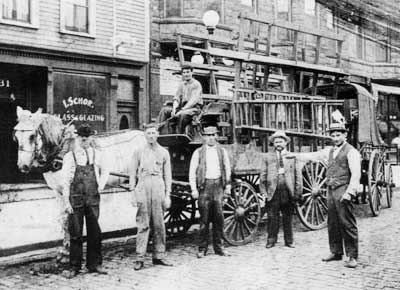
It's worth taking a moment and reminding a modern audience that when we say "driver" we are not talking about the modern delivery truck, yet. These men would have been actual teamsters. The first "horseless" trucks would start appearing on the scene in another 25 years, but it's likely that living with or near blacksmiths for most of their lives, the boys would have been very familiar with the business of tending horses and maintaining a wagon. As Ohio rapidly developed from the frontier of their father's childhood into the well-settled (and populated!) center of a United States, their skills would have been in high demand. So it's no surprise that Fred and George, and their sons, worked mainly as drivers in the busy and increasingly metropolitan town of Mansfield.

Their older brother, Martin, seemed to be doing well for himself in another related business. As a dry goods merchant, he would have depended on the services of drivers like his brothers for his success. He also took on the postmaster job, first in Olivesburg, and then after 1884, in Tiro, a town about 20 miles due west of Olivesburg. Sadly, in February 1889, he was killed when he and a business partner were struck by a train while crossing the tracks in their sleigh.

This newspaper clipping says a lot about the time - not only in the florid language used, but in the small emphases on technology (like the telephone) and the almost clinical physical details:
A common sight before the day of the automobile.

FRIGHTFUL
Martin L Callin and Jacob H Bloom hurled into Eternity Without any Warning
A T. & O. C. GONDOLA DOING THE FATAL WORK -- FURTHER PARTICULARS

News reached this place last Wednesday afternoon by telephone that Martin L. Callin and Jacob H. Bloom, both of Tiro, were killed at 11:30, a. m., the same day on Plymouth street at Bucyrus while crossing the T. & O. C. track in a sleigh. The news, after further inquiry, proved only too true, and their homes which they left bright and cheerful, hale and hearty in the morning turned to be homes of mourning and sorrow at night.
The yard engine with three gondolas attached had gone north and was returning at a rapid rate of speed, the gondolas preceding the engine, when the fatal accident occurred at the crossing. The gondola farthest from the engine struck the sleigh and reduced that vehicle to a mass of ruins as well as inflicting the fatal injuries to its occupants. 
Mr. Callin was thrown a distance of about 60 feet, sustaining a dislocated neck, four or five broken ribs together with other injuries. His pulse beat for a short time after the crash but life was soon extinct. On his person were found $400, and a gold watch. 
Mr. Bloom was thrown on the cattle guard and sustained a dislocated neck and hip, a broken back, broken legs and inferior maxillary crushed. Death resulted instantaneously. A watch chain was found on his person but the watch could nowhere be found. The horses which were hitched to the sleigh were unhurt. 
Coroner Thoman held an inquest in which testimony was given by various parties who witnessed the awful accident. After the inquest the remains were taken in charge by an undertaker and after proper preparation were sent to the respective homes of the deceased parties at Tiro; arriving at that place at about 10 p. m. 
Mr. Callin leaves a wife and four small children to mourn his sudden departure. He was for a number of years a successful and one of the most prominent business men at Tiro.

(I left out a longer paragraph detailing Mr. Bloom's injuries for the sake of space, but if any are interested, I found the text in Martin's Find-a-Grave entry. -T.C.)

Martin's widow, Mary, soon remarried; to Harry Carlisle in 1890. Their four small children were Pearl (1877), Ben Frank (1878), William Jefferson (1885), and Gaston (1888). Records do not show where the Carlisles lived, but they appear to have remained in Ohio.

Jeff and Susan's later years were far more bucolic. The rest of their children grew up and moved away, but not far. Delbert married Mary Coleman in 1892, and Minnie married Wilson Urich (in 1890, if you believe the Census; in 1900 if you go with the CFH). The Mansfield News was more likely to print these types of notices than anything tragic:

"Dell Callin and family, from Adario, and Wilson Urich [Minnie's husband] and family visited their parents, Mr. and Mrs. T.J. Callin, Sunday."

and

"Arthur, Mabel and Fred Mohn [Clara's children], of near Tiro, were the guests of their grandparents, Mr. and Mrs. T.J.Callin a few days last week."

or

"Arthur Mohn and sister, Miss Mable, of Amey, visited their grandparents, Mr. and Mrs. T.J. Callin, recently."

(All of the above just from the 7 September 1900 edition of the Mansfield News, page 4, col 1 & 2)

In 1902, a 74-year-old Thomas Jefferson Callin died in Olivesburg, probably in the same street where he was born. Susan stayed in their home, at least for a few years, frequently visited by her children until some time before her 81st year, when she seems to have quietly died and slipped away, leaving no record - at least not that I have found, yet - just a legacy of children and grand-children.

Updates: Refined some of the location information thanks to some helpful feedback.

Monday, December 21, 2020

CFH First Draft: Margaret Callin

This post is part of an ongoing series, sharing the first draft of my Revised Callin Family History

Margaret Callin is the 17th person in a descendant report beginning with the earliest known ancestor of our Callin family, (1.) James Callin. This descendant report uses the Register Style of the New England Historic and Genealogical Society. 

Please use the Contact Form (at right) to send questions or corrections.

Friday, August 10, 2018

The Montgomery Connection

As preparations to publish the Callin Family History revision continue, we have a new branch to consider. The evidence I outlined in Echoes & Rhymes that connects Elizabeth Callin to the James Callin named in the CFH appears to be at least as strong as the evidence that connects James and his brother John to James "1st" Callin; so in that spirit, I'm going to include her descendants in our family tree while I search for more concrete proof. My hope is to find a descendant of Elizabeth and Caleb Montgomery with DNA that matches mine.

To that end, I have begun researching their descendants.

Elizabeth Callin (1798-1834) was born in Pennsylvania, and if she was the daughter of James and Mary Callin, moved with her family from Westmoreland County, PA, to Richland County, Ohio, when she was twelve years old. On 13 August 1822, she married Caleb Montgomery (1799–1872) in Richland County.

According to the Fulton County, Indiana Handbook, published by Tombaugh House, Caleb was born 23 June 1799 in Virginia to Benjamin and Nancy Montgomery, the family who originally settled in Milton Township and established the town of Olivesburg, in Weller Township, which was named for Caleb's sister, Olive Montgomery. The History of Richland County says that Benjamin built the first grist-mill in the township on the Whetstone, at Olivesburg, in 1817. That book also describes the town in 1821:

"The village of Olivesburg was laid out by Benjamin Montgomery in the year 1816, and called Olivesburg in honor of his oldest daughter, Olive. In 1821, the village contained one tavern, kept by Benjamin Montgomery; one blacksmith-shop, by Abel Montgomery; one tailor-shop, by John Grum; one cabinet-shop, by Thomas Beach; one tannery, by Joseph Burget; one horse-mill and water-mill, by Jonathan Montgomery; one wheelwright-shop, by William Lee, or James Hall, and about the usual per cent of loafers."

Caleb and Elizabeth had five children in Olivesburg between their marriage and 1829. When Elizabeth died on 5 November 1834, she was buried in the Olivesburg Cemetery on land deeded to the town by the Montgomery family.

With five young children to care for, Caleb quickly remarried; he and his second wife,
Sarah Mercer (1812–1877), had ten children; the first, Levi, being born in 1835. In 1837, Caleb moved his family to Fulton County, Indiana, where Levi would grow up to become sheriff.

The five children of Caleb and Elizabeth are as follows:

     1. Mary Montgomery married a James Ferrell on 23 March 1843, according to Fulton County, Indiana, marriage records. I have not found any records to indicate when either of them died, but there is a Sarah Ferrell in the household of Mary's sister and brother-in-law in 1850 and 1860.

     2. Sarah Montgomery (1824–1918) was born 27 December 1824 in Olivesburg. She and Henry Davidson (1818–1894) were married on 22 April 1841 in Fulton County, Indiana. They had six children; three sons and three daughters. Henry and Sarah took their family west on the Oregon trail in 1852.

     3. Theodore Montgomery (1826–1904) was born 12 September 1826 in Richland County, Ohio. He enlisted and served a year in the Mexican American War. He later returned to Fulton County, Indiana, and married Margaret Wilson (1831–1916) on 11 March 1849. They had four sons and a daughter.

     4. Porter Montgomery (abt. 1828) died in Vicksburg, presumably during the Civil War, but records have not been found to support that.

     5. Callin "Cal" Montgomery (1829–1912) was born in October 1829 and headed for California to become a gold miner. He lived in El Dorado County for many years and died in Napa in 1912. As far as I can tell, he left no family behind.

In coming weeks, we'll look at the descendants of Mary, Sarah, and Theodore.

As always, if you're a descendant of any of these folks, I'd love to hear from you. You can reach me at callintad (@gmail.com), post a comment below, or ask to join the Callin Family History group on Facebook.