Thursday, February 25, 2016

Bathroom Break

Dear Reader,

I'm afraid I have to hit pause on Mightier Acorns for a short while.

We have been preparing to demolish and remodel our bathroom for some time, now, and it happens that the demolition is going to be more extensive than we first thought. Also, the bathroom is directly above my computer desk.

There are roughly two dozen readers following my progress as I go through the descendants of James Callin, and I don't want you to think I don't appreciate you. I've been encouraged by the attention you've been giving to this project, and I hope to get back to it as soon as I can.

In the meantime, watch for announcements about the release of my book, Tad's Happy Funtime, which is based on a collection of posts from my other blog.

Here's hoping we can get this building project done without too much destruction!

Friday, February 19, 2016

The Reubenites, part I

George Washington McNabb was born to Reuben and Mary (Ferguson) McNabb on 19 September 1855 in Jackson township, DeKalb county, Indiana. His father was a carpenter.

By 1860, George had a little brother, James M., born 2 June 1858, and a little sister, Eliza J. born 5 April 1860 (just a couple of months before the Census enumerator came around in June of that year). They were lucky in that their father did not go off to enlist in the War Between the States that broke out the following year; instead, another brother came along: William C., born 21 November 1861. During the War, in December 1863, John Goldsmith McNabb was born; he was the last of the McNabb children born in Indiana.

After the War, Reuben moved the family 100 miles due north from the Auburn area in DeKalb county to Chester township, Eaton county, Michigan, where he found work as an engineer in the saw mill there. Around 1866, he and Mary had another daughter, Ellen, and on 17 October 1867, their twins were born: Marcus Ebenezer and Martha Jane McNabb. A few years later, in February 1871, they had another daughter, Mary E., and on 19 April 1874, their youngest son, Oliver Otis McNabb was born.

George was 19 years old when his youngest brother was born, and may have already moved back to Indiana by that point. Records show a George McNabb marrying Alice Mapps (or Mopps) on 5 December 1874 in Vigo county, Indiana.

What I find odd is that I can't find any of these folks in the 1880 Census; I don't see George and Alice in either Indiana or Michigan (or anywhere else, for that matter), and I don't see Reuben with any combination of these children. There was one odd anomaly one of the records for Oliver Otis: his mother's name was listed as "Rebecca" and not Mary. Since I couldn't find any records for a Rebecca McNabb that fit with this family, either, and since that was an index record (which means I didn't see a scan of the original) I will have to leave that mystery for later.

Gaps in the records leave only outlines of stories for most of these McNabb children. While there are records supporting the facts in the rest of this post, please understand that in some cases I don't have a 100% certainty that the records I found are a match for the person in question.

George, for example, seems to vanish for nearly twenty years after the two Indiana Marriage Index records for his marriage to Alice; and that is assuming that the "Geo W McNabb" shown in those records is the same person as our George W. McNabb. (The Callin Family History only names him as "Washington" and gives no other identifying information.) It is apparent from the U.S. City Directories from the 1890s that Reuben and his other sons remained in Grand Rapids, but George is not there. It may be that George and Alice settled in Indiana and had a family; it is equally possible that they had no children.

I do see a 1901 record in the Indiana Marriage Index of a George W. McNabb in DeKalb county marrying "Phoobe Snaghy Knox" - and I assume this is a corruption of the name "Phoebe" - then another record from showing a George W. McNabb marrying Nancy A. Simmons in Daviess county on 24 August 1907. That George shows up in the 1910 Census in Spice Valley, Lawrence, Indiana, living with Nancy and her mother, Jane Simmons; in 1920, Nancy has died and George and Jane Simmons live in Halbert, Martin county.

James M. McNabb was a bit easier to study. He married Hattie E Sider (1864–1930) on 4 January 1887 in Grandville, Kent, Michigan. They lived in Grand Rapids, where James made a living over the years working as a teamster or a pipe fitter. In 1900, the couple lived with Hattie's parents, Johnas and Mary (Buxton) Sider.

We have a pretty good record of where James and his family lived in Grand Rapids from 1889 on from the U.S. City Directories. We also know that they took in their teen aged nieces, Dorothy and Dolores, as the girls were both listed in the household in 1920; Dorothy was still in the household in 1930. James and Hattie were living on Buffalo Avenue NE in 1930 when Hattie died, and James was still living there when he died in 1938.

James and Hattie had two daughters:

     i. Amy E McNabb (1888–aft 1954) married Roy William Pierce (1887–aft 1954) on 12 March 1913. I have not been able to establish when they died, though there are Social Security Life Claim applications for both. They appear in Grand Rapids U.S. City Directories as recently as 1954. They had one daughter, Louise M Pierce (1915–1963) who married Lawrence Everett Barcroft (1918–1989); I have not found any evidence that they had children.

     ii. Mary Mable Mcnabb (1895–1963) was 18 when her sister married and left home, and Mabel stayed with her parents, working as a clerk and later as a dressmaker. She married Clarence Henry Hyde (1879–1968) when she was 28; he was a 44-year-old bachelor farmer. They lived in her parents' home, and kept that house after James's death in 1938. They had two sons (now deceased) and a daughter (still living).

     a. James Richard Hyde (1925–2005) joined the Army Air Corps in 1943 and later earned a Masters in Business Administration from Ohio State University. He began his military career as a flight navigator on B-29 bombers in World War II, flying missions over Japan, Singapore, Burma and China.He flew 225 Vietnam Missions as commander of AC-47 Dragonship squadrons out of BienHoa and Nha Trang, and served as Chief of the Manpower and Organization Division at the Air Force Systems Command's Aeronautical Systems Division at Wright-Patterson AFB, Ohio.

Colonel Hyde retired from the Air Force to live in San Antonio with his beloved wife, Celeste Harding Hyde, in 1975. After her death in 1987 he dedicated himself to serving his community. He is survived by his son and his sister.

     b. Clarence David Hyde (1936–2003) passed away unexpectedly Tuesday, 18 February 2003. He had lived his whole life in Grand Rapids, Michigan, and was buried in Fairplains Cemetery next to his mother and father.


We'll pick up with brothers William C. and John Goldsmith McNabb, the twins, Marcus and Martha, and Mary and Oliver next week in Part II...

Friday, February 12, 2016

The Mysterious McNabbs

Normally, I like to tell you what I know in these posts, but today I'm going to talk about how much I don't know. Hopefully, you'll understand why by the end. We'll take a look at two of the Ferguson daughters - Mary (1833-1895) and Elizabeth (1835–1898) - and the very confusing family they married into.

But first, a few words about research!

There are three "eras" into which the majority of my research seems to fit: the "Old Books" era, the "Census" era, and the "Google" era.

The Census Era is pretty straightforward. When I'm looking for people born before 1940, or people who would have been in their parents' home after 1850, I can usually find them in the U.S. Census and tease out the clues I need to develop their story. With people who appear on the Census, I usually get enough data points to start matching them up with other kinds of records; if I have a name, birth date, and place of birth, I consider that to be good enough to call it a "match." (There are exceptions, of course.)

People who were born after 1940 won't appear in the Census; until 2020 when the 1950 Census is released, I have to rely on the kinds of records that I can dig up on Google to develop my leads. Usually, this involves finding someone who died recently enough to have an obituary online. If they died after the late 1990s, I tend to have decent luck finding obits on the wild internet; before that, I use Newspapers.com (and hope they don't have what I need locked up behind their paywall). That puts these more recent folks in the Google Era.

Then there are the pioneers who settled the U.S. Midwest; those are the folks who I hope to find in the "Old Books." There are a few resources for this kind of research. Heritage Quest is free and available online with my library card (they also provide access to Census records); Google Books has a lot of old public domain local histories available; and the Internet Archive has a similar collection.

Reuben McNabb (1829–1911) is one of those people who almost falls into the cracks between the two earlier eras. Born before 1830, he is grown and out of his parents's home by 1850; and that makes him too young to be considered an "early settler" in the eyes of the people writing the old local histories. It was a real challenge to track him down.

Considering that the Callin Family History only names him as "R. McNabb," I was lucky to find a marriage record listed in the Indiana Marriage Index documenting his marriage to Mary Ferguson that gave his full name. (It's only an Index record, so I still really should find the original at some point.) From there, I had to chip away at the databases looking for matches, because he and his family were never quite where I thought they were going to be. But, thanks to some luck, persistence, and a combination of clues found in the Old Books and the Census, I think I can safely claim to know a bit more about his family history than Cousin George gave us in the CFH.

John McNabb was born in Pennsylvania in 1792, making him about the same age as the United States Postal Service. He married Mary Young about 1815, and according to one Old Book, they moved their large, young family from Centre county, Pennsylvania, to Ashland county, Ohio, in the year 1833. The McNabbs remained in that county until around 1845, when a number of them moved again to De Kalb county, Indiana. John and Mary remained in Vermillion, Ashland county, which is where John died in 1860.

The family of James L. and Eliza (Callin) Ferguson, as we saw in last week's post, made their move from Ashland county to De Kalb county around 1849; depending on when the McNabbs left on their journey to Indiana, the Fergusons may have gone with them. Their oldest daughter, Mary Ferguson, would have been about 17 when they left Ohio; and the youngest of John and Mary McNabb's children, Reuben, would have been about 21.

For the longest time, I only had circumstantial evidence tying Reuben to John and Mary McNabb, but John's 1860 will, registered in Ashland county, named his ten children: "John McNabb, the heirs of Margaret Shrader, William McNabb, Nancy Dunfee, the heirs of my son James McNabb, Mary Ann McNabb, David McNabb, Ebenezer McNabb, Robert McNabb, Reuben McNabb."

I haven't proven this out completely, but based on the birthdates for these individuals that I have been able to find, this list seems to put the ten McNabbs in order from oldest to youngest; and I have to assume that two of them - Margaret Shrader and James McNabb - were deceased, as John left his estate "to the heirs of" those two. (That assumption may be important in a few paragraphs!)

Reuben married Mary Ferguson in DeKalb county on 16 November 1854, and they, too, had ten children:


  1. George Washington McNabb (1855–1922)
  2. James M. McNabb (1859–1938)
  3. Eliza J McNabb (1860–1869)
  4. William C McNabb (1861–1918)
  5. John Goldsmith McNabb (1864–1943)
  6. Ellen McNabb (1866–1891)
  7. Martha Jane McNabb (1868–1891)
  8. Marcus Ebenezer McNabb (1868–1937)
  9. Mary E McNabb (1871–1911)
  10. Oliver Otis McNabb (1874–1931)


After his father's death in 1860, and after the end of the Civil War, Reuben packed up his young family, and moved from Indiana to Eaton county, Michigan around 1865. Reuben worked as an engineer in the saw mill, and he and Mary put their children through the local school. Once in Michigan, they had their daughter, Ellen, and the twins, Martha Jane and Marcus Ebenezer - the latter likely named for Reuben's successful older brother. According to the Callin Family History, a fire took the life of Eliza in 1869, when she was only nine years old. The couple had two more children.

Reuben continued to work, as a painter and a carpenter; as his sons grew up, they were listed in the city directories, usually boarding at the same address as Reuben. Mary Ferguson McNabb died around 1895; after that, Reuben seems to have fallen on hard times, appearing in the 1910 Census living in the poor house in Reeder, Missaukee county, Michigan, and dying on 5 April 1911.

Now, while that is certainly a lot of good information to know, there are two rather large mysteries that came up while I was trying to put it all together:

     Mystery #1: There are two residents of Grand Rapids, Michigan named "John McNabb," and I don't know for sure which one is the son of Reuben McNabb. Both men left behind documentation indicating they had parents named Reuben McNabb and Mary Ferguson.

One is a John C McNabb who married Inez M. Atkins in 1912 and moved to Battle Creek, Michigan some time before 1918; he died there in 1932. Their marriage record lists the names of both of their parents. When John died, Inez provided the information that appeared on his Michigan death certificate, and that included his birth date (September 1860, in Indiana) and the names and birthplaces of his parents (Rubin McNabb, Glasgow, Scotland and Mary Ferguson, County Clair, Ireland). There are some discrepancies here. Obviously, we know that Reuben and Mary were not born in Scotland or Ireland; but Inez may not have known that, as Reuben and Mary were deceased when she married John. But there are several records that list John's birth date in 1871 - the 1920 and 1930 Census records, and (most compelling) the marriage record from 1912. (Making things even more complicated: I believe Inez was this John McNabb's second wife, and that he had several children by a first wife - but I can't confirm that at this point.)

The other is John Goldsmith McNabb, born 24 December 1864 in Auburn, De Kalb, Indiana. He married Ida Ann Sack (1872–1953) in 1894, and they had four children - the first in Wisconsin, and then the others in Michigan - before heading out to California in about 1905. They had two more children after settling in Chico, California, both of whom died in infancy (one in 1907, one in 1912). The couple then divorced in the 1920s. Eventually, John applied for a life claim on his Social Security in January 1943, and died that December in Alturas, Modoc county, California. His Social Security application lists his parents: Ruben McNabb and Mary Furgson.

I am inclined to believe that the second of these - John Goldsmith McNabb - is the actual son of Reuben and Mary McNabb, based on the birth dates. There is a 6-year-old John McNabb listed in Reuben and Mary's family in 1870, and the strongest evidence says that he would be that John McNabb. However, we still have the mystery of who John C McNabb is, who his real parents are, and why does he claim to be Reuben's son?

     Mystery #2: Mary Ferguson's sister, Elizabeth (1835-1898) also married a McNabb. The Indiana Marriage Index helpfully tells us that a James McNabb and Elizabeth B. Ferguson were married in DeKalb county on 8 February 1858. The CFH tells us that they had six children:


  • Ella McNabb 1859–
  • Margret McNabb
  • Mary McNabb
  • Charles McNabb
  • Eliza McNabb
  • Emma McNabb
But... after finding what I believe to be the only appearance of this family in the 1860 Census (with James, Elizabeth, and 1-year-old Ella), they seem to fall between all of the cracks in the databases. I have not been able to find them in 1870 or 1880, even with very broad searches. Here's what I know:

1. This James McNabb is NOT Reuben's brother. I base this on the assumption that the Indiana Marriage Index and the 1860 Census are showing us the right James and Elizabeth - meaning that James is alive in 1860, his birth date is around 1834, and since the couple will have five more children, that this James McNabb will survive through the 1860s. Reuben's brother was mentioned in John McNabb's 1860 will, but the estate was willed to "the heirs of" James McNabb, suggesting that Reuben's brother had died before 1860.

UPDATE! See The First Life of Mrs. Reed for details, but we now know that James McNabb died in 1860, probably in Cedar Creek, Allen County, Indiana, and that the children listed after Ella McNabb are the children from Elizabeth's second marriage to George W. Reed. There is not enough information to determine whether this means James might be Reuben's brother.

2. This James McNabb MIGHT be Reuben's nephew. Again, if the James McNabb married to Elizabeth in the 1860 Census is our guy, he's only about 5 years younger than Reuben. He's living in the household of a William McNabb who I believe to be Reuben's older brother. William is not this James McNabb's father, either. William's son, William James, is listed in the same household on the 1860 by the name James - as confusing as that is, it's a mercy to be able to rule him out!

Here's a quick table to illustrate how ridiculous this puzzle is:

Reuben's brothers:                            Their sons named James:
Rev. John McNabb (1811-1889)            James, born 1842
William C McNabb (c. 1814-1876)       William James (1846–1924)
James McNabb (c. 1815-c. 1859)          (Haven't found any information about his heirs, yet.)
David McNabb (1819-1887)                  James, born 1844
Ebenezer McNabb (1823-1902)             James J, born 1847
Robert McNabb (1826-1893)                 (No son named James.)

Just based on their birth dates, I would rule out these nephews, leaving the most likely possibility that he is the son of Reuben's brother James McNabb who was deceased before 1860. Failing that, he could well be a cousin from family left behind in Pennsylvania - but that's just groundless speculation.

As I said, I cannot find an 1870 or 1880 record for James, Elizabeth, and the children listed in the CFH. But if you refer to last week's post, you will note that James Ferguson's will refers to Elizabeth as "Elizabeth Reed." The CFH tells us that Elizabeth's second marriage was to a Mr. Reid, and that they had one son; James Ferguson's will, dated 1885, would indicate that Elizabeth married Mr. Reid in the early 1880s at the latest. I have found no records to pin any of this down, either.

Ella McNabb, the daughter of James and Elizabeth listed above, grew up to become the mother of an Alta McCorse, according to the CFH, but I have not been able to find any records with these names, either.

So, I am left with a lot of information, but no conclusion. I don't know who James McNabb was, nor do I know much about the fate of Elizabeth Ferguson or her children. As new databases come online, and new information (hopefully) comes to light, perhaps these mysteries might be solved one day.

But we do know enough about Reuben and Mary Ferguson McNabb's children to tell you a few more stories, starting next week. As always, if you have any information that can help sort out some of these Mysterious McNabbs, please drop a note in the comments below!

Friday, February 5, 2016

The Rise of the Fergusons

Welcome back to Milton township, Ohio. 

The year is 1835, and the younger of the Brothers Callin of Ohio, John Callin, has just died of tuberculosis. While the farm where John's children and nephews grew up must have begun to feel crowded by the end of the 1820s, during the 1830s and 1840s these children began to grow up and set off on their own. 

Indeed, at least the older of John's children would have been married by the time of his death. His son, George Callin, was married though he may not have moved out to Huron county, yet. His daughter, Ann Callin Campbell, had certainly struck out on her own with Henry Campbell. And we have discussed how his nephew Alec Callin will soon embark on his journey to Iowa, taking wife and children with him, as well as his widowed mother (John's sister-in-law).

The Callin Family History (or CFH) is not very elaborate when it comes to conveying all of this activity and motion. It tends to compact a great deal of an individual's history into very little text. For example, the book has two lines about John's next two eldest daughters which seem to say very similar things, but which have very different stories to tell:

Sarah, born 1808, married John Scott, moved to Ills. About 1840.
Eliza, born 1811, married Jas. Ferguson, moved to Ind. 1851.

This doesn't specify when Sarah and John were married, though it might be safe to guess that it was probably within a year or two of 1830; Sarah would have been in her early twenties, then. But the real tragedy is that we know nothing else about this couple - because none of their children are named in the CFH, and we have no idea where in Illinois they might have gone. There is a couple named Scott, John and Sarah, listed in the 1860 Census living in Mission, LaSalle county, Illinois, but if this is our couple, their children have clearly grown and left home, so there is no other lead information to work with. (My hunch is that this is most likely our John and Sarah Scott; Sarah's age is right, and her birthplace is listed as Ohio, while Sarah Callin was actually born in Pennsylvania, but I could chalk that up to a mistake on the enumerator's part.)

Perhaps someday, we'll learn enough about the Scott family to say more than that, in contrast, we have a great deal more information about Eliza (1811-1870) and her husband, James L. Ferguson (1810-1886).

It does help considerably that the CFH recorded many of their descendants. We know, thanks to their appearance in Jackson township, De Kalb county, Indiana, in 1850 that the CFH is slightly off about when they made their move; but we also know that it correctly records the ten children they had in Ohio prior to their big move. After they settled in Jackson township, they had one more daughter to make a nice, round eleven children:

  1. Mary Ferguson (1833–1895)
  2. Elizabeth Ferguson (1835–1898)
  3. Mildred Ferguson (1837–1910)
  4. George T Ferguson (1838–1865)
  5. Margaret Jane Ferguson (1839–1901)
  6. James L. Ferguson (1841–1907)
  7. Nicholas P. Ferguson (1843–1912)
  8. Sarah Ferguson (1846–1934)
  9. Eliza Ferguson (1847–1920)
  10. John D Ferguson (1848–1922)
  11. Minerva J Ferguson (1854–1881)
James Ferguson was a farmer, as you might have come to expect of the men of this generation. Since we don't know where they were living while they were still in Ohio, it may or may not be safe to assume that they were near the rest of the Callin family farms. There is a James Ferguson listed in 1840 living in Brown township, Delaware county, 133 miles to the west of Milton township; this James Ferguson had children of ages that match our James Ferguson. The important thing for us is that we have them placed in Indiana in 1850.

By 1860, Eliza's mother, Elizabeth Simon Callin, was living in the Ferguson household on James's forty acre farm near Auburn in De Kalb county. I don't have a lot of documentation on her story, but she does appear on the 1860 Census, and the CFH says that she died in November 1864 and was buried in Auburn. It could be that she moved to Indiana with James and Eliza, or she followed along during the 1850s. She certainly got to spend her last few years with her smaller grandchildren.

Of the eleven Ferguson children, only George died without leaving behind a family of his own. According to the CFH, he was twenty-seven years old when he was "Killed in battle on the Potomac, Feb., 1865." If our George is the George Ferguson who enlisted in the 13th Regiment of the Indiana Infantry, they would have been some 380 miles south of the Potomac in February 1865, engaged in operations around Wilmington, North Carolina. George may well have enlisted in another state, though, as many young men did if they could not find a regiment in their home state. If that was the case, he might well have been killed on the Potomac.

Eliza Callin Ferguson followed a few years after George on 17 November 1870, and was buried in the Evergreen Cemetery in Auburn. If I'm interpreting the evidence right, it would seem that James stayed in the house with their youngest son, John D. Ferguson, and soon, with John's family.

John married his wife, Lovina Reed (1853-1925) on 9 November 1871, and he brought his young wife home to live with him and his father. The young couple dealt with a tragedy that first year, when they had twins that died in February 1872, Albert Allen and Alberta Alice Ferguson. The following year, they had their daughter, Dora E. Ferguson (1873–1908), and a few years later, Mary Jane Ferguson (1876–1879), who only survived three years.

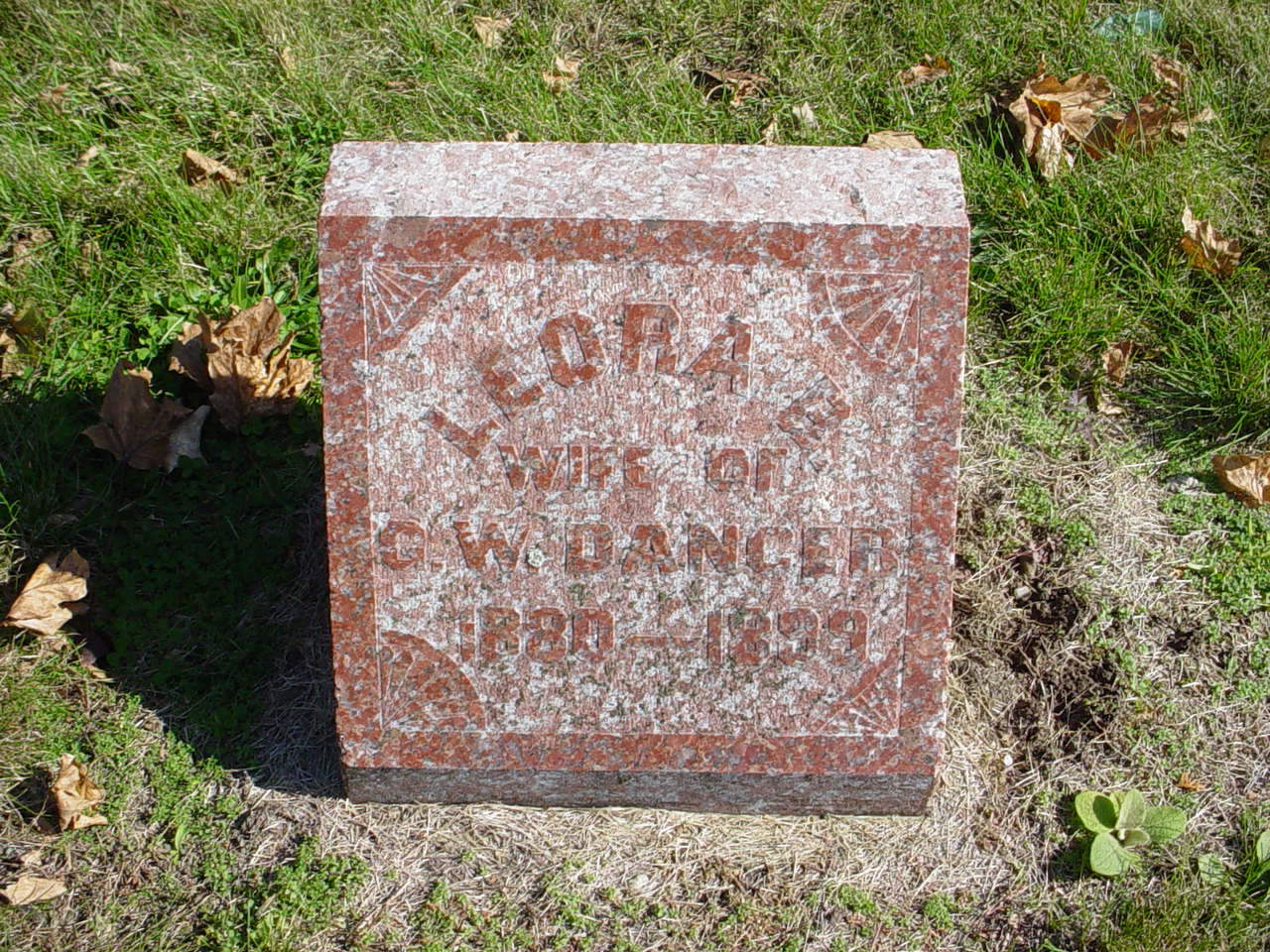
The 1880 Census shows James, John and Lovina, and Dora living in De Kalb county, with James and John listed as farmers. Later that year, Leora B. Ferguson (1880–1899) was born (the CFH calls her "Aola"), followed by Catherine M. "Kate" Ferguson (1882–1951).

Then, in 1885, James seems to have grown ill, and he updated his will accordingly (transcribed by me - consider all of the spelling irregularities to be part of the original):

Know all by these presents that I James L. Fergeson son of Jackson township in DeKalb Couty State of Indiana being of sound mind and memory do make and publish this my last will and testament, revoking all former wills by me made; that is to say


First--I give and devise unto Six daughters Mary McNabb Elizabeth Reed Mildred Ettinger Margaret J. Gallaher Sarah Myers and Eliza Myers in equal portion all my household goods of every name and character to be by them divided


Second--To my Son John D. Furgeson I devIse the entire use and possession of the forty acres of land I own in said township for the term of two years from my death upon the express condition that he pay or cause to be paid all my debts; expenses of my last illness and funeral and the taxes on said land for the two years


Third--All the balance and residue of my estate real and personal I devise (except as Stated above) unto my three Sons James L Furgeson Jun- Nicholas Perrine Furgeson and John D. Furgeson in equal portions and Shares- provided that they shall and will pay or cause to be paid within three year from my death the sum of Four hundred and twenty (420) dollars - that is to Say - that they Shall pay to each of my above named daughters the Sun of Sixty (60) dollars and to said John D Furgeson who has purchased the interest of Clarissa J Copp daughter of my daughter Minerva Copp deceased in my estate the further Sun of Sixty (60) dollars, Interest is to be charged on said. Four hundred and twenty dollars if not paid within Said three years


Fourth- I name and advise that my Son John D Furgeson act as the Executor of this will.


In witness whereof I hereunto Subscribe my name and affix my seal this 12th day of December 1885
After James died in 1886, John and Lovina had one more child, Oscar Dale Ferguson (1890–1891) who only survived a year. It isn't clear when, but probably after his two year lease on the forty acre farm expired, John seems to have sold the property and moved his family to Milford in Lagrange county. That is where he and Lovina were living with Kate in 1900.

Dora had married Charles Frederick Kinsey (1870–1949) on 13 December 1890, and they lived in Union township in De Kalb county, where Charles was the proprietor of his own shop. They had two children before Dora's untimely death in 1908; Charles then remarried Sophia M Kiner in 1910, and she helped him raise the children.

     1. Gladys F Kinsey (b. 1893) attended Auburn High School, Class of 1913, and from there I have not been able to determine where she went.

     2. Keith Harlan Kinsey (1905–1958) married Thelma M Schlegel (1906–2001) in 1924, and they had a son; but for whatever reason, they did not stay together for long. In 1930, Thelma and her 4-year-old son were living with her parents. She remarried, and presumably raised the boy. Keith married Garnet Geneva (Lewis) Sprowl (1905-1995) about 1939, and while there are places where the records could indicate that they may have separated at times in the next twenty years, they are buried together in the La Fontaine IOOF* Cemetery in Wabash county.

Keith served as a corporal in an Indiana field artillery unit during World War II.

     a. Keith Charles Kinsey (1925–2003) grew up in Indiana and attended Purdue University where he was the President of the Purdue Aero Club in 1948. He accepted a commission in the U.S. Air Force in September 1949, and served in Korea and Vietnam, rising to the rank of Lieutenant Colonel. He lived in San Diego in the 1990s, died in Kirkland, Washington, in 2003, and he is buried in the Fort Rosecrans National Cemetery in San Diego, California.

I have not found any information indicating that he married or had any children.

Leora married George Dancer (b. 1877) in January 1899, but she died by the end of the same year. He remarried in 1902 to Carrie Belle Reed (1879-1924), and they had one son - but it is not clear whether Carrie might have been otherwise related to Leora's mother.

Kate, the last surviving daughter of John and Lovina Ferguson, stayed at home and single until she was 35. She worked as a photographer in a studio in Auburn, and married Ora E. Martz (1881–1944) on Boxing Day, 26 December 1917. In 1920, the couple was living with John and Lovina, and may have stayed with them until John died (in 1922) and Lovina died (in 1925). They had no children of their own.

And with that, we begin the saga of the Ferguson descendants of James Callin. It may take us a couple of months to go through and tell the stories of James and Eliza's other nine children and the dizzying array of surnames we'll be looking at may seem overwhelming.

As always, please let me know if you're related to any of these folks, and especially let me know if I missed anyone or got anything wrong.

* IOOF = Independent Order of Odd Fellows

Friday, January 29, 2016

Update: Hattie Hess

Along with the Photo Feature from this morning, I have a special treat this week:

If you recall what I said back in August about the eldest daughter of Jessie Alverda Mohn Hess, you can skip down past this quote; otherwise, just to refresh your memory:

Hattie Helen Hess is a mystery to me. Though she appears in the 1900, 1910, and 1920 Census records in her parents' home in Jackson township, Richland county, I have not been able to scratch out any other records that match her. There is another Helen Hess of precisely the same age living in Richland county at the same time....
(Any further information about Hattie Helen's fate would be greatly appreciated.)

Well, there is more information, now - thanks in part to the recent availability of the U.S. Social Security Applications database on Ancestry.com - so here is an update on her family:

Hattie Helen Hess (1898–1961) grew up in Jackson township, Richland county, Ohio, and married Wilbur Albert Kirkendall (1900–1963) on 23 March 1922.

Albert was born and raised in Plymouth, Richland county. His parents were William A Kirkendall (1854–1941), also a native of Plymouth and a farmer of that post-Civil War generation, and Jennie Amanda Adams Stine (1871–1948). Jennie was not related to Franklin Pierce Stine (from last week's post, A Real Hoot), as far as I can tell. His father's name was Leonard, and I could not find any record tying his father to her father, Henry D Stine.

Albert had four younger siblings, and two older half-siblings from Jennie's first marriage. Albert and Helen had two children, a daughter and a son about eleven years apart, in age. In the 1940 Census, Albert's occupation is listed as "ferryman." Their son is still living.

Their daughter was Kennagene Lucille Kirkendall (1924–2001), and she married Harold Raymond Day (1919–2010) on 10 August 1943 in Cumberland, North Carolina. Harold does not appear to be related to the Day family mentioned in two earlier posts (The Distance of Close Connections or It's a Glyde Day), but I know there is another link to that family still ahead of us, so I'm sure we'll come back and take another look.

The son of  Gabriel Day (1881–1949) and Beatrice "Bessie" Holycross (1898–1978), Harold graduated from Shelby High School, class of 1940.

He served in the U.S. Army during World War II, fighting in both the Battle of the Bulge and the Invasion of Normandy. He received the Purple Heart and the Bronze Star medal, along with the Normandy Invasion and Service Medals with four Bronze Stars and one Bronze Arrowhead.

After his military service, he worked at the Wilkins Air Force Depot and Shelby Cycle. He and Kennagene raised one son together, and they left behind a large number of great- and great-great grandchildren.


Photo Feature: Callin Family Reunion 1900

1900 Callin family reunion - at the home of William and Ellen (Channing) Callin, Richmond township


Welcome to the family reunion! I hope you brought a magnifying glass and some reference material! (Clicking on the photo ought to expand it to original size, if that helps.)

The photo above came to me from cousin Megan (Ancestry user meganoneill10), and I think we can identify a few of the people in it. The house (as the caption reports) is the home of William and Ellen (Channing) Callin, from the post "The Girl From England."  

The couple in the center - the man seated in the grey suit and the lady to his right (your left) - is almost certainly John H Callin and Amanda Lydia Walker. They are my 2nd-great grandparents, and I wrote about their family last January in "20th Century Callin Clan."

The man two seats to the right of John (your right, John's left) in the black suit--he appears to be William H Callin, owner of the house. I suspect that since these two men are cousins (John's father and William's father were brothers), the people in this picture are probably all people who have been or will be featured in this blog at some point.

Megan also has these photos, which none of us are sharp-eyed or knowledgeable enough to identify.  Take a look, and if you recognize anyone, you should definitely say something!

Happy hunting!


Friday, January 22, 2016

A Real Hoot

Nathan Hoot came from Pennsylvania and settled on a farm near Reedsburg, Ohio, probably during the 1830s. He later moved to Ashland with his brother and they ran a shoe business for several years before selling their interests. Nathan relocated to Galion, set up shop there, and worked at making shoes the remainder of his life.

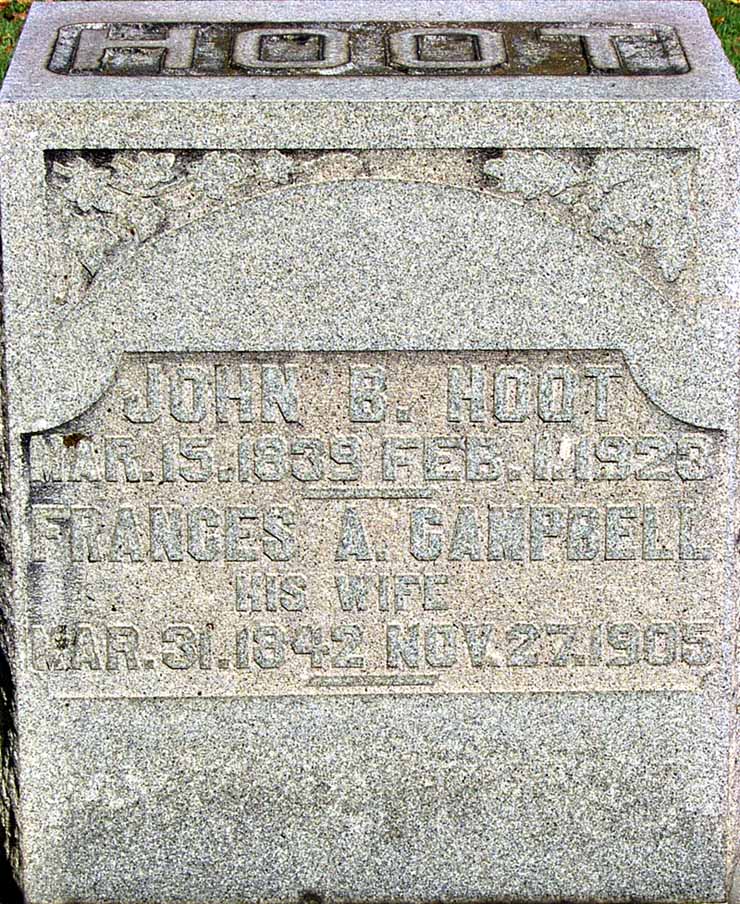
John B. Hoot, his son, was born in Reedsburg in March 1839. After finishing his schooling he was apprenticed to William Ilger to learn harness and saddlery. Upon becoming a journeyman saddler, he entered the Union army, serving in the 196th Regiment, Ohio Infantry.

The Regiment was organized at Camp Chase, Ohio, and mustered in March 25, 1865. They left the state for Winchester, Virginia, on March 26, when they were assigned to 2nd Brigade, 2nd Provisional Division, Army of the Shenandoah. In July they were moved to Baltimore, Maryland, and  held garrison duty there and at Fort Delaware till September. They mustered out on September 11, 1865.

John and Frances (Campbell) Hoot
Frances A. Campbell married John B. Hoot (1839–1911) on 20 February 1862. She was the younger, surviving daughter of Henry and Ann (Callin) Campbell, and the sister of Cyrus and Harrison Campbell, the subjects of our last two posts. Harrison, you might recall, married John Hoot's sister, Catherine Hoot.

Frances was born in Montgomery county, Ohio, on 30 March 1842, and grew up on her father's farm. She married John when she was twenty, and over the following twenty-six years, they had eight children together; two sons and six daughters.

After the war, John moved with his family to Orange, where he rented a saddlery shop for many years, often employing as many as seven men. He was acknowledged throughout the county as being unsurpassed as a saddler and harness maker. His work was reportedly shipped to all parts of the United States. Upon leaving Orange, he removed to Mt. Vernon where he was foreman of a saddlery shop for ten years. In 1903 he retired and moved to Columbus, Ohio, where the family lived on Wisconsin Ave.

Frances died in 1905 at the age of 62, only two years after John retired, and he died in 1923. They were buried together in the Nankin cemetery, Ashland county, Ohio.

1. Agnes Cornelia Hoot (1863–1906)

The eldest daughter, she preferred to go by the name Cornelia, married John Byron Barrick (1858–1935) in 1880. John was a teamster in the Cleveland area for many years. They had a son and a daughter before Cornelia died unexpectedly in 1906 at the age of 43, while visiting in Athens, Georgia. After burying his wife, John moved in with his son, Adelbert, in Ashland, where he lived until his death in 1935.

     a. Adelbert Earl Barrick (1885–1964) worked as a machinist and skilled laborer most of his life. He married Minnie May Mcmurray (1878–1953) on 12 March 1904, and they had four sons. According to his World War I draft registration, Adelbert lost his left leg above the knee in March 1908. The couple remained in Ashland all their lives. Minnie died in 1953 at the age of 75, and Adelbert at 79 years, in 1964. They were buried in the Ashland cemetery.

     i. Charles A Barrick (1908–1969) was a core maker and foundry worker throughout his adult life. He married Velma A Mawhorr (1908–1976) around 1927. Their son, Charles Gaylord Barrick, (1928–2003) was retired pastor of the Sullivan Congregational Church and had taught eighth- and ninth-grade English in the Cloverleaf School District, Lodi, for 30 years.

     ii. Clyde Earl Barrick (1912–1966) was married to Charlotte, though they seem to have been estranged in the 1950s; they had one son and one daughter.

     iii. Ernest Benton Barrick (1920–1977) enlisted in the National Guard on 15 October 1940. He was still living with his parents at that point, but by 1945, he was married to Betty Marken (1918-2014) and living at 30 W Walnut, in Ashtabula. They had four children: three daughters who are still alive, and a son, David Joel Barrick (1951-2013).  David was a U.S. Army veteran and served in the Vietnam Conflict. He and his wife had four daughters.

     iv. Albert Ellis Barrick (1922–1979) was a World War II veteran who served from 26 October 1942 until 15 February 1946. He worked in assembly plants, and never married. He was 57 years old when he died in Ashland.

     b. Rea Barrick (b. May 1890) made one appearance in the 1900 Census, but sadly seems to have disappeared after that. It is possible that after her mother's death in 1906 that Rea might have gone to live with relatives, or gotten married before 1910.

2. Ida N. Hoot (1865–1947) 

Ida was the second daughter of John and Frances (Campbell) Hoot. She married Franklin Pierce Stine (1861–1931) in 1886. Frank was a farmer in Ashland county, and he and Ida had three sons and a daughter.

     a. Leonard Benton Stine (1889–1969), who preferred to be called "Leon," married Norah Wanda Ward (1891-1978). They were a farm family, and lived in Sullivan their entire lives. In 1930, their farm was next door to Leon's brother, Evan's farm. There are no records showing that they had any children of their own.

     b. Evan Francis Stine (1891–1944) married Mary Margaret Gill (1893–1973) around 1918, and began farming in Ashland county. The had seven children (i-vii); four daughters and three sons. Evan died at the age of 53, and Mary at 79.

     i. Mary Lucille Stine (1919–2004) married Paul Eichelberger (1911–1974), and they have four children who are still living: two sons and two daughters, and four grandchildren. Paul and Mary also had twins: a son and daughter born in 1950. The little girl, Carolyn, only lived a couple of weeks, but Carl Harold Eichelberger (1950-2014) was a machinist, like his father, who lived his whole life in Ashland county. Carl left a wife and three daughters.

     ii. Donald F Stine (1921) was born on 30 January and died 7 July 1921. He is buried in the Southview Cemetery in Sullivan township, Ohio.

     iii. Luella Irene Stine (1922–1999) married Donald E Heifner (1911–1960), a farmer from Montgomery township. Don died very young, at 49. Their only child was Kenneth Richard Heifner (1949–1969), a U.S. Marine killed in action in Viet Nam when he was only twenty.

     iv. Walter E Stine (1924–1997) married Mary Ellen Morr (1924–2008) on 13 June 1943, and they had two sons who are still living.

     v. Helen Pauline Stine (1928–1999) was married twice; first to Richard Dale Boales (1927–2009) and then in 1954 to Forrest Milton Fellenbaum (1918–1988).

     vi. Harold Evan Stine (1928–1986) married Martha Irene Johnson (1930–2015) on 25 March 1950. They lost their first two babies at birth (Larry Richard Stine b. 1950 and Stephen Eugene Stine b. 1951), but had a daughter and two more sons, and 36 years together before Harold died at 57. Martha only died last year at 84, having spent her time surrounded by grandchildren and great-grandchildren.

     vii. Phyllis A Stine (1935–1997) married Harold Max Lamb (1934–1992) in 1952, right after she graduated high school. They had a daughter, Mary May Lamb (1953-2003) who married Larry J "Jay" Matthews (1953–2010); the Matthews had three sons, who are still living.

Phyllis and Harold divorced in the early 1960s, and while he remarried later, Phyllis lived out her days in Ashland.

     c. Mary Estella (Stella) Stine (b. 1896), the only daughter of Frank and Ida (Hoot) Stine, grew up on the farm, but in 1920 was living out on her own. She was a factory worker in Ashland, rooming in the home of Rebecca Wood. After 1920, there are no more clues to her whereabouts. I assume she got married and I simply haven't tracked down the record, yet.

     d. Alva Sylvester Stine (1900–1966) grew up farming like his father and brothers, but in 1923 he graduated Ashland University where he was Vice President of his senior class, and he went on to become a school superintendent and administrator. Known as "Alva" throughout his youth, he preferred to be called "Sylvester" later on.

By 1927, Sylvester had married Mary I. Ferrel (1899-1999), and was a principal at a school in Wayne county. Two years after his father died, Sylvester and Mary had their daughter, Miriam Elaine Stine (1933–2000). Miriam grew up in Canton, Ohio, where she married Mr. Cross in 1952. They all relocated to Cass county, Michigan, where Sylvester died in 1966. Miriam was an elementary school teacher there for many years, and she and her husband also had a daughter and two sons who are still with us.

3. Byron A Hoot (1867–1942) 

Byron was one of the leading barbers of Ashland, conducting "a large and elegantly appointed shop" there for many years.

At the age of thirteen years, Byron was apprenticed to a barber. Later he traveled for three years, working as a journeyman in various cities, finally returning to Ashland in 1885, where he opened a shop in the National Bank building. He remained there for eighteen years, becoming popular for his high-class work. After that he relocated to Main street, the third door below Orange street, where he employed three men.

In 1891 Mr. Hoot was united in marriage to Ida Mae Brubaker (1874–1944), daughter of John W. Brubaker and Eliza Barr. Byron and Mae had one daughter and one son.

     a. Glorene Frances Hoot (1895–1977) was the victim of many misspellings in the historical record - "Lorene," "Glarence," and (my least favorite) "Glovine" being just three. She married Harry Eugene Matthews (1895–1976) on 5 October 1916. (He was no relation to the Larry Jay Matthews who married Mary May Lamb as mentioned above.)

Harry was a salesman, worked for a time as a produce manager, and then as an insurance salesman. The couple raised two children:

     i. Rexford Eugene Matthews (1919–2002) enlisted in the U.S. Navy in 1939, and served throughout the war, being discharged in 1946. He married his wife, Virginia Louise Page, in 1948. They had at least one daughter and a son who are still living. Rex worked as a salesman in a shoe store, until he landed a job with the State Highway department; Virginia worked in a pastry shop. They were together for 31 years, until they divorced in 1979, and Rex moved down to Sarasota, Florida. There he remained until his death in 2002.

     ii. Patricia Mae Matthews (1925–2012) was a professional Girl Scout and camp director, then a physical education teacher. Pat also had a beautiful soprano voice, and was a soloist in the Ashland College Choir, as well as a member of the Cleveland Orchestra Chorus in the days of Robert Shaw and George Szell. She performed with that group on the stage of Carnegie Hall.

In 1983 Pat received the "Individual Better Life Award" from the Ohio House of Representatives for being a "remarkable individual, combining humanitarian concern and commitment with selfless initiative to become a dynamic force in behalf of the aged." In 1985, she relocated to Sarasota, Florida - that may have been why her brother moved there, as well.  In Sarasota she volunteered in nursing homes and sang in the Key Chorale for 16 years.

     b. John Weldon Hoot (1902–1950) was a professor who married Evelyn Marie (1902-1969) in Ohio, and took his wife to Upper Darby, Pennsylvania, in the 1930s. After his death at 48 years of age, in Philadelphia, Dr. J. Weldon Hoot was buried back home in Ashland, but Evelyn and their teen aged daughter remained in Pennsylvania. Their daughter is still living in that state, as far as I know.

4. Clara Hoot (1869–1916) 

Clara married Philip Kirsh (also seen as "Kirsch") some time around 1888, and they had three children before Philip's death a decade later. Despite leaving few records behind, it is safe to guess that he died between 1895 and 1900.

     a. Helen G Kirsh (b. 1889) appeared on the 1900 Census in the Mount Vernon, Knox county, Ohio household of her widowed mother. There is a marriage record from Chicago in 1908 showing a Helen Kirsh marrying Harry Schmitz, but the details about her in their 1910 Census record (in Chicago) do not indicate that this Helen came from Ohio, so I can't say for certain that this is our Helen Kirsh.

     b. Arlina A Kirsh (1892–1963) married Ora James Bemiller (1888–1939) in 1910, and moved in with his family. Ora grew up a farmer, then worked for a time as a tobacconist, as a firefighter, and later as a metal worker in Shelby, Ohio. James took ill and died about a month after he and Arlina moved to the Galion area. They had one daughter.

     i. Eva Glorine Bemiller (1913-1956) was partly named after her mother's cousin, Glorene Hoot. She married Daughn D Clow (1913-1987) in Ohio county, West Virginia, in 1936. Some time after Eva's death in 1956, the rest of the family relocated to Florence, South Carolina, where Daughn died in 1987. Daughn and Eva had a son and a daughter, and many grandchildren.

     c. William Frederick Kirsh (1895–1958) married Goldie M Hall (1896–1982) on 30 April 1917. William was a restaurant manager most of his career. He died at home in 1958 at the age of 63. Goldie remained in Ashland the rest of her life.

     i. William Frederick Kirsh Jr (1918–1981) was a stock clerk in Cleveland married to Kathleen Corrine Vessels (1920–2002) when he enlisted in the Army in 1943. After the war, they raised eight children, two of whom have died: William Patrick Kirsh (1953-2000) and Frederick "Fritz" W. Kirsh (1946-2008). Still living are three sons and three daughters.

     ii. Philip Leroy Kirsh (1920–1982) took a engineering degree in metallurgy at Ohio State University in 1941, and a commission in the U.S. Navy, where he rose to the rank of Lieutenant Commander. He was discharged in 1946, and married Elizabeth Axham Keene (1918–2003). They lived for years in Rochester, New York, and retired to Canandaigua in the late 1970s. Their daughter was the late Susan Jean Kirsh Anzalone (1951–2001).

     iii. Jack Loren Kirsh (1927–1973) graduated high school in the class of 1946 and went on to become an educator. He married in 1957 while teaching in Florida, where he was principal of the Greenville Elementary School in 1960. He eventually relocated to Ann Arbor, Michigan, where he died in 1973.

Clara Hoot Kirsh remarried after 1900 to William M Litt (1872–1937), and they had three children in the next few years. Sadly, Clara died in 1916, and William remarried a widow named Edith. (Note: while William's name is clearly spelled "Litt" on his headstone, his sons spelled the name "Lett" - I will leave it to the family to sort that out!)

     d. Benton D Lett (1902–1967) was a fireman in Columbus, Ohio. He married a school teacher named Eva D Eyster (1905–1952) around 1928, and they had one child, Eugene Clay Lett (1929-1995).

     e. Milo F Lett (1905–1967) worked as a truck driver and laborer around Berlin, Knox county, where he grew up. in 1942, he enlisted in the Army and served throughout the war in the 1136 School Squadron. I know from notes in his records that he was divorced, but I have no information about any wife or children.

     f. Catherine Litt (b. 1906) is another mystery - after appearing on the 1910 Census with her family, she is not in the household in 1920. There is an Ohio birth index record, but beyond that, I don't know any more about her.

5. Hattie J. Hoot (1870–1924)

At nineteen, Hattie married Alpheus C. Hamman (1867–c. 1935), and they had one daughter. After Hattie's death at the age of 53, Alpheus seems to have been on his own. His grave marker remains undated.

     a. Emma D Hamman (1905-1985) married Leon Clarence Osborne (1892–1975) on 20 September 1915, and the following year, they went to China as independent missionaries. In 1919, they joined the Church of the Nazarene and served its church at Chao Cheng, Shantung, until 1942.
Leon was detained by the Nationalists in 1928 near the beginning of the Chinese Civil War.

 Found on Newspapers.com

Leon was released, and the couple continued their work in the country until 1942. He published a book about the work in China, Christ at the Bamboo Curtain, (Beacon Hill Press, 1956).

6. Abbey I Hoot (1875–1940)

Abbey stayed in the home of her parents until John's death in 1923, at the age of 83. After that, Abbey took in lodgers at the house on Wisconsin Avenue for a few years, with the help of her niece, Leota Roseberry (Zelpha's elder daughter). Sadly, by 1935, she was unable to continue taking care of herself, and spent the last few years of her life committed to the Columbus State Hospital for the Insane.

7. Zelpha L. Hoot (1877–1951)

Born in Nankin, Zelpha probably met William Crawford Welch (1875-1917) when her father retired and moved the family to Columbus in 1903. Zelpha and William were married about 1906, and had two young daughters when he died at 42. I could not find an explanation of how he died, but he was a railroad man, and he would not be the first person in this family to be killed on the railroad.

Zelpha supported herself by as a dressmaker, and evidence says she married a Mr. Kramer (or Kraner) at some point. While she or her daughters took possession of the house on Wisconsin Ave, Zelpha eventually relocated permanently to San Diego, California, where she died in 1951.

     a. Leota E Welch (1906–1998) married Walter William Roseberry (1904–1990) in 1928, but in 1930, she was still living in the home of her aunt Abbey (see above). It may be that the arrival of their son in 1932 meant that Leota was not able to care for Abbey, and that could be what led to sending Abbey to the state hospital in Columbus.

Walter and Leota did not stay together after their son grew up; Leota remarried Ernest Hamlin (1913-1990) in 1972, and they moved down to Manatee, Florida, where they lived out their retirement.

     i. Kenneth William Roseberry (1932–1991) was an electrician in Columbus, Ohio. He was married in the 1950s, but also divorced by the late 1960s. His wife remarried in 1972. Kenny died the year after his father, and they were buried in the Obetz Cemetery in Franklin county. I do not know whether he left any children behind.

     b. Frances Dana Welch (1909–1963) remained with her mother until she was in her early thirties, accompanying Zelpha as she moved between San Diego and Columbus. Eventually, she seems to have married, probably in the 1950s. She is buried in Union Cemetery under the name Frances Dana Gilmore.

8. Walton Wesley Hoot (1879–1951)

Walton was a barber, like his older brother, and around the time the rest of the Hoot family moved to Columbus, he married Effie Mae Snook (1879–1938) and resided with her family in Ashland. They raised one son, and lived out their days in Ashland.

     a. Forest Emery Hoot (1906–1999) married Helen Louise Pancoast (1906-1993) during the 1930s. Forest was working as a salesman. I have not found any information about this couple to indicate what their business was or whether they had children, but they did leave behind an endowment for a scholarship at Ashland University, so they must have been successful.

-------

And that, good friends, brings us to the end of a very long post about people surnamed Hoot. It also brings us to the end of the descendants of Ann Callin Campbell. I have to say, these last three posts were quite an exercise of my researching abilities, and I am not entirely sure I've done these people justice.

As always, if you are related to any of these families, and can help me identify and fix any mistakes I have made, please do reach out through the comments below, or through my email address, callintad at gmail dot com; there were at least two examples during the preparation of this post that I did "one last search" and found out something revelatory - like a couple I had thought had three children actually had eight children. Or I found an article that revealed a daughter I hadn't known about.

But I'm not complaining. I enjoy the thrill of the hunt, and I love knowing that I've tied together whatever I can for posterity. In fact, for all of the extra work that went into this post, it was, for me...

...a real hoot.