Friday, October 30, 2015

The Girl from England

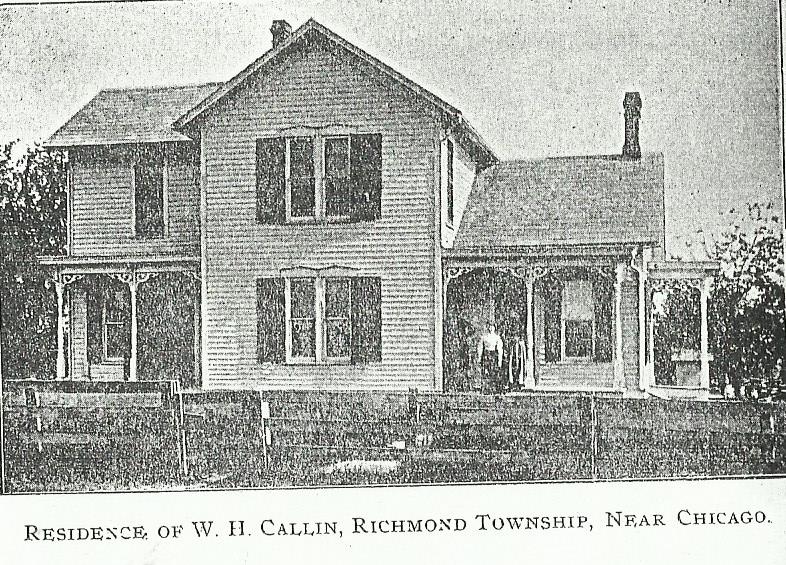
William is the son of George Callin
For the next several weeks, we're going to be talking about daughters.

If you've been following this blog from its beginning, you know I feel strongly about remembering Where the Women Folk Are. The very name of this blog is meant to turn the Great Man Theory of history on its head - and one major influence on history that Theory ignores is the importance of (and often, the existence of) women. This line of James Callin's descendants will demonstrate how much you lose when you ignore women.

William H. Callin (1834-1919) was the younger son of George Callin. His older brother, John, had one son, one grandson who did not have any children, and three grand-daughters. William, as we will discuss today, had four daughters; and the rest of George's children were girls. So, while we're still going to be talking about descendants of James 1st, we will be talking less about people with the surname Callin - and thanks to our patriarchal system, the sheer number of surnames involved is going to explode.

Let's begin in England:

Ellen C. Channing (1838 – 1916) was born in Isle Abbots, Somerset, England on the 24th of November 1838. Her father was Joseph Channing, born May 29, 1807 in Curry Mallet, Somerset, England.

Joseph Channing
(1807-1889)
Charlotte Fox
Channing
(1811-1901)
Joseph was one of nine children with a widowed mother, so at the age of nine he was apprenticed to a neighboring farmer until he was twenty-one. At the age of 24 he married Rhoda Mounter, and though they had three children, two died in infancy. Rhoda died after only four years; the surviving child grew up to become Mrs. Mary Matilda Gommer.1

On June 29, 1835, Joseph married Charlotte Fox, the daughter of Daniel Fox and Susannah Stroud. Charlotte was born in 1811 in Fivehead, Somerset. In May 1819, when she was eight years old, her father was convicted of some undetermined crime and shipped off aboard a ship called the Caledonia in 1820 to land in Hobarts Town, Tasmania.

Joseph continued to farm in Somerset county until May 3, 1851, when he embarked with his wife and five children - the youngest but three months old - for America. They arrived in New York, and immediately headed west, where they settled in Greenfield township, Huron county. Joseph and Charlotte lived there five years, and had two more children. He then purchased a farm in Richmond township where he resided until the spring of 1884.

Ellen Channing - c1856
(daguerrotype)
Ellen, at 13, would have been the oldest of the five children who came to America with her father and mother in 1851. The daguerrotype to the right shows her from about the time her father moved the family to Richmond township.

William H. Callin was born 4 March 1834, and grew up on his father's farm in Peru township. He most likely worked on the farm with his father and brother until he was ready to marry and set out on his own, as many young farmers of that time and place did.

The Channing family arrived in Huron county when William was 16, and their first farm in Greenfield township would have only been a few miles south of the Callin farm in Peru township. I imagine that to an Ohio farm boy, this girl from England must have seemed exotic and well-traveled; though the families seem to have been devout and humble people as a rule. It's hard to say how many years they knew each other, but even after the Channings moved to Richmond township, they weren't far away - just on the far side of Chicago Junction2. We can certainly imagine social events and holidays when the young couple might have met in town, or at church functions.

William married Ellen Channing on 8 March 1860 in Sandusky, and they started a home next door to his parents. William registered for the draft in 1863, but being married probably reduced his chances of being selected.

By the time of the 1870 Census, William and Ellen were living in Richmond township, with their three small daughters, Lillian Florence (1861 – 1936), Anna (1865 – 1908), and Lydia Minerva Callin (1869 – 1943). These sisters were all still at home in 1880, when their littlest sister, Grace M (1880 – 1978) came along. We'll talk about each of their families over the next few weeks.

William's farm was one of those selected for the 1880 non-population schedule of the Census, which means we get a rare glimpse at some of the details of his farm's activity. In that year, he cultivated one 333 acre field, and kept 10 acres of woodland on his property. The property itself, including the buildings, equipment, and $250 of livestock was valued at about $2,400. William paid out $20 in wages for 4 weeks of labor in 1879, and estimated his farm's total production that year at $410. He kept 2 horses, 3 "milch cows", 1 "other" (neither a milk cow or a "working ox"), about 5 sheep, 7 swine, and 25 chickens. The farm produced 300 pounds of butter, 5 fleeces (for 25 pounds of wool), and 80 eggs; there were 2 calves born, and 8 lambs. William planted 4 acres of "Indian corn" and harvested 160 bushels; 5 acres of oats for 180 bushels; and 7 acres of wheat for 140 bushels. A quarter acre of potatoes produced 25 bushels, and one acre with 20 apple trees produced a bushel of apples. His 10 acres of woodland produced 10 cords of firewood, valued at $10.

In 1884, Joseph and Charlotte sold the family farm to their son, William G. Channing, and moved to Norwalk until the following fall, when they moved back to Chicago Junction2, where Joseph died on 5 December 1889. Charlotte spent two years in Chicago Junction before moving in with her daughter, Mrs. Lydia Lloyd, and the with Ellen and William Callin.

Ellen C. Callin
(1838-1916)
William H Callin
(1834-1919)
In 1900, Grace was the only child left in the home (though at 20, she was only a year away from being married by then), and her grandmother Charlotte was listed in the household. Interestingly, Ellen's brother, William G. Channing, was the Census enumerator for the township that year. By this time, of course, he owned the Channing family farm. Charlotte would often visit, and on one such visit, she grew ill; she died there on 4 April 1901.

The 1910 Census shows William Channing's household just a few lines down the page from William and Ellen Callin, which indicates how close the family farms probably were to each other.

William and Ellen seem to have lived out their days on their farm, Ellen passing in May 1916 at 78 years of age, and William in November 1919 at 85. If there are obituaries or records of their deaths beyond their grave markers, I have not found them. This would seem to indicate what kind of modest people they were. They led a simple life by modern standards, raised a close family, and as we'll see in coming weeks, they left their legacy behind  in their children.

1 - Mary Gommer remained in England when her father emigrated; she was most likely married to Mr. Gommer by that time.

2 - Chicago, and later Chicago Junction, was often confused for Chicago , Illinois by train passengers, and in 1917 the name of the town was changed to Willard.

3 - The entry is hard to read; it looks like the enumerator wrote "43", then wrote over the "4" with a "3".

Photos posted with permission of Ancestry user meganoneill10.

Friday, October 23, 2015

The Short Line of John Callin (1832-1906)

John is the eldest son of George Callin
John Callin was the eldest son of George Callin, whose farm in Peru township (Huron county) was reportedly a waypoint for escapees on the Underground Railroad. He was born in 1832, and he was probably named for his grandfather, the John Callin who settled in Ohio from Pennsylvania in 1816. He could have also been named for an uncle who died in 1825.

As a young man, he farmed with his father, and in 1854, according to the Callin Family History (CFH), he married Helen Minor . Helen was born in New York in about 1836. The Minor family came to Ohio from New York between 1839 and 1843, judging from the ages and birthplaces of Helen's siblings reported on the 1850 Census.

John and Helen had two children on their new farm in Peru township; James was born in September 1855 and Jennie (or Jane, depending on the sparse records) born in 1857. I'm not sure when Helen died, but by 1870, she was not in the household. John is listed as a "speculator" by then, and he has two hired women in the household - Mary Stebbing, housekeeping; and Mary Anderson, "domestic".

I'm not sure that anyone knows what happened to Jennie, exactly. She is about 14 in 1870, and the only record I've located after that is an 1895 Iowa Census record for a Jennie Callin in Benton (Ringgold county) who is 38 years old, and lists her birthplace as Ohio. I can't say for sure that this is our Jennie, as there is a 1900 record in Benton for a Jennie Callen married to an Alva Callen, which would probably not be the same person.

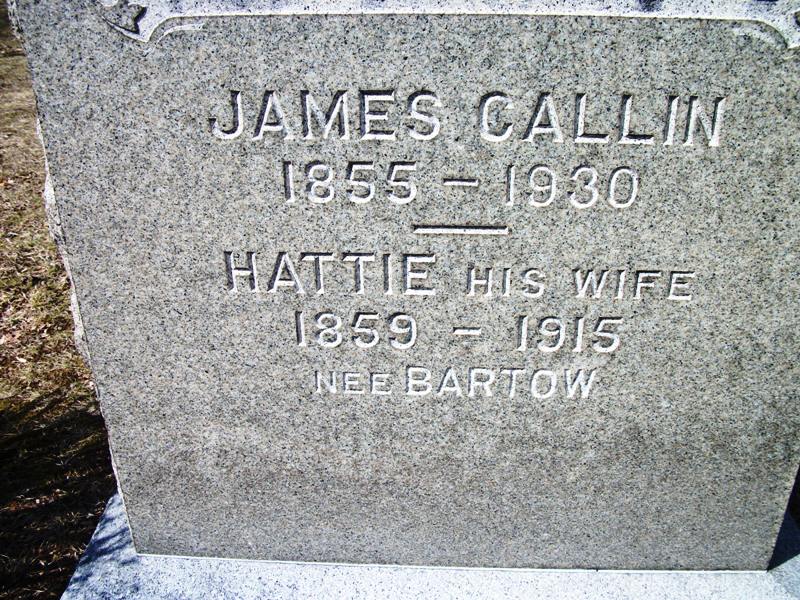
Riverside cemetery, Erie county, Ohio
James grew up in Monroeville, and married Hattie Bartow in 1876, according to the 1900 Census. They each appear in the 1880 as single, however, boarding with other households in Norwalk. James was working as a laborer and Hattie as a milliner. (I have to wonder if James joked about "Hattie the hat-maker" as I would have done?)

In 1900, the family lived in Huron Village, Erie county, with James's widowed father. John died in 1906, 74 years old, and probably surrounded by his grandchildren and great-grandchild.

James and Hattie had four children, the eldest being named after James's aunt Jennie (the mysterious one whose fate we don't know).

1. Jennie Callin (1879 – 1979) was born 28 September 1879 in Norwalk, Huron county. In 1898 she married Harry Clinton Toomey (1878 – 1944), and they had a daughter, Pearl U Toomey (1899-1971). By 1909, they were living in Cleveland, and in the first half of the 1920s Pearl worked as a clerk for different companies in Cleveland while living at home. I was stumped for a while about Pearl's fate after 1923, but then I found Harry's 1942 World War II Draft Registration card - he was 64, remember - on which he listed his nearest relative as one Mrs. Pearl Kappy. Harry died two years later.

As it turns out, sometime between 1923 and 1930 Pearl married Fred Kappy. Fred's parents were from Czechoslovakia, and he worked as an enameler in a stove foundry in 1930. By 1940, his occupation was listed as "own man," indicating that he probably retired; by 1960, Pearl was listed as his widow. They never had children, so when Pearl died in 1971, that was the end of the line for this branch of the family. Jennie survived, and outlived them all, living to be 99 years - missing 100 by seven months.

2. Arthur James Callin was born 4 September 1883 in Sandusky. He married Mabel Ethel Nolan (1887 – 1967) in 1907, but they divorced before the 1910 Census. In that year, he was listed living with his parents and sister in Chicago, working as an office worker for a railroad. His mother, Hattie, died in 1915, and on his Draft registration card in 1917 he listed his father as his nearest relative, both living at 126 S. Sacramento street in Chicago.

There are two records stating that Arthur married Mabel Siewe (b. 1890) in November 1919, but he was listed as single in 1920 and 1930 Census records. Interestingly enough, James shows up on the 1920 Census living with Arthur in Chicago (enumerated 5 January) AND living in Elkhart, Indiana, with his daughter, Ada, and her husband (enumerated 4 February). That could mean that James moved to Indiana that month.

Arthur was still living in Chicago in 1930, but according to his 1942 Draft Card he was living in Detroit, working at the "Hamburger Barr." He listed Mrs. R.L. Ladd, also of Detroit, as his nearest relative. (This is his sister, Helen, as you will see below.) He was 59 in 1942, and after that, I have not been able to find any more records to tell me his fate.

3. Ada Cecilia Callin (1884–1967) was born in November 1884. She married Albert Sydney Forgey (1883–1974) on 11 July 1906 in Elkhart, Indiana, and the couple lived in Chicago, Illinois, for a little while. Albert worked as a machinist in a roundhouse while they lived there, but by 1912 they were back in Elkhart.

As we noted above, Ada's widowed father, James, was listed in their household on the 1920 Census. The following year saw Ada and Albert living in Jacksonville, Florida, where they spent the 1920s. There is a pretty good record of where they were in the U.S. City Directories database, but unfortunately, James does not appear to be listed in any of them. When he died, in 1930, he may have been living with Ada and Albert in Miami, but I have not seen any records to prove this. In fact, in 1929 and 1931, the couple are in Miami, but in 1930, the City Directories record places them in Birmingham, Alabama.

Regardless, this couple never had children, and they both died in Miami - Ada in May 1967; Albert in December 1974.

4. Helen G Callin (1892–1953) was the youngest of the four by eight years, and was named after her paternal grandmother (Helen Minor). She married a young pharmacist named Roscoe L. Ladd (1888–1972) ....twice, if the records are right.

There is a June 1909 marriage record in St. Joseph, Michigan, which listed the bride and groom as residents of Chicago; this would have been before Helen's 17th birthday, which tells us this may have been an elopement. Helen does appear in her parents's household on the 1910 Census, and she is listed as "married" - though her surname is still "Callin".

City Directories show Roscoe as a pharmacist in Detroit in 1916 and 1918; but on his World War I Draft registration in 1917, he lists his address and employer in Chicago. There are also two records in two different Cook County, Illinois, Marriage indexes showing Roscoe Ladd and Helen Callin being married in 1917.

Whatever the source of the conflicting information in these records, the couple seems to have settled in Detroit by 1920, where they lived until at least 1942. They removed to Royal Oak by 1950. While the couple never appears to have had children of their own, their 1920 household includes two small children, a brother and sister named Bernie and Hehtahn Davigenon.

Helen died in 1953, at the age of 61; Roscoe survived until 1972, and both were buried in the White Chapel Memorial Park Cemetery in Troy, Michigan.

And with that, we come to the end of this John Callin's line - we will examine his siblings' families in the coming weeks, of course. But unless we find a trace of his daughter, Jennie, there are no more descendants to discover.

When I began writing this post, I found that I had a lot of questions that did not have satisfactory answers. Most of these individuals had missing or incorrect information, and I learned (again) the important lesson of double-checking one's sources.

For example, Pearl Toomey simply "disappeared" around 1923, based on the information I had when I started writing. None of the usual tricks for teasing out a marriage record or Social Security application worked for her - that evidence may not exist, or at least may not exist in digital form that Ancestry can provide, yet. But following the lead in her father's draft registration pointed me to Pearl and her husband.

I also had several records for Helen and Roscoe that turned out not to be the same couple that I was researching. Roscoe was frequently listed as "R.L. Ladd" in documents, and when a search result showed "Helen and R.J. Ladd" listed in a 1960 Michigan U.S. City Directory, I added it without checking the details, at first. It turned out that "Raymond J." and this Helen Ladd were not the same people at all, once I clicked through to the scan of the original document.

Doing this research requires a certain amount of leeway; "R.L." could easily be mis-transcribed as "R.J." during the digitization and scanning process, but it always pays to examine a record thoroughly before either accepting it or writing it off. Careful, patient examination of those details can often raise important questions that lead to an answer.

So, for the sake of Jennie Callin, who disappeared after 1870, and for Arthur Callin, whose death remains an open question, we should keep an open mind and a careful eye out for more evidence.

Friday, October 16, 2015

Uncle George and the Underground Railroad

In a memoir she wrote in 19731, Rosemary Callin recalled as much as she could about her grandmother, Elizabeth Berlin Callin. Rosemary's father was the George W. Callin who compiled the Callin Family History in 1911 (which I refer to as the "CFH"). At one point, Rosemary says:

"Father said they were warned not to say nothing at school about it, but their cabin was a station on the Underground Railway. I don't know whether it was William or Elizabeth, probably the latter, who awakened them softly in the middle of the night and led them to the window. The moon flashed out and they saw a white man, maybe William, leading a string of blacks through the clearing around their cabin and into the woods. They were on their way to Great Uncle George's barn. From there he would take them onto the next stop."
George's tree
(click for a closer look)

This Great Uncle George was most probably the second eldest child of Elizabeth Simon2 and John Callin, born in Pennsylvania in 1804. When he was 12 years old, his father moved the family from Pennsylvania to settle on the farm of George's uncle James in Milton township, Ohio. His older brother, John, would have been 14. I imagine that this would have been high adventure for boys that age; even though the 1812 Battle of Tippecanoe effectively ended the last organized resistance of Native Americans to the westward settlement of Ohio, there was still very real danger of attack, in addition to the usual dangers of making a long journey with three smaller sisters and two infant boys.

George Callin (c. 1870s)
George grew up on that farm in Milton township, and married Mary Ann "Polly" Lewis, probably before 1832, when he was 28 years old. Their first child was a son born in 1832, whom they named John - after both George's father and his late brother.

Judging from the 1850 Census, which places George and Polly in Peru township, 100 miles west of Milton township, he probably relocated with his family some time before then. (There is a George Callen listed in Butler township in Darke county in the 1840 Census, but our George's children were younger than those listed there.) His son, John, is 18 on the 1850 Census, and the record notes that he is a farmer, and that he attended school in the previous year.

As we have seen in several earlier posts on this blog, that period from 1835 to around 1845 seems to have been a time of dispersal for this group of cousins and siblings who had made the move to Ohio just two decades before. 1835 is when George's father, John, died of tuberculosis, 1845 is when George's younger brother, William, retrieved their youngest sister, Margret, from Iowa.3  In between, we saw George's cousins, Alec and James, leave for Iowa (taking their widowed mother, Mary, with them); in coming weeks we will see George's sisters marry and leave for Illinois and Indiana (possibly taking George's mother, Elizabeth, to Indiana); and as we explore the rest of the family, it will be interesting to note who stayed in Milton township.
Mary Ann Lews (c.1870s)

But for all of that movement and activity, we are only guessing when George's family moved to Peru township. We can only say for certain that they were there in 1850.

William - George's brother, and the grandfather that Rosemary writes about above - was still in Milton in 1840, but he also relocated with his family to Peru township in 1849. The youngest of William's surviving sons was born in 1850, so Rosemary's story probably took place in the 1850s in Peru township.

What "the next stop" from Great Uncle George's barn might have been is hard to say. When I searched for sites in Peru township, the National Park Service site gave me the Reuben Benedict house. However, that is about 65 miles south of Ridgefield in Peru township, which is the town nearest to William's farm in the 1850s. I suspect that someone with more familiarity with the geography of Ohio and the locations of the Underground Railroad sites may be able to help me puzzle this out later.

George and Polly were described by descendants who remember as "very proper and Victorian", as well as "very Presbyterian". George's property values doubled between 1850 and 1860, indicating that he was successful and industrious. By 1870, he and Polly would have been in their 60's, and they appear to have moved into town, being listed in Monroeville. Their daughter-in-law, John's wife, Helen, died around that year, and after George's death in 1879, Polly and John are listed together on the 1880 Census. Polly died in February 1884, having survived her three youngest daughters.

Earlier "Mightier Acorns" posts referenced above:
1 see Silk or Satin
2 see Who Was Great Grandma Callin?
3 see The Distance of Close Connections

Photos posted with permission of Ancestry user meganoneill10.

Friday, October 9, 2015

Who Was Great Grandma Callin?

Elizabeth Simon was born in Pennsylvania in November of 1780. The colonies were three years away from winning independence from Great Britain. It was a leap year.

When she was 21, in 1801, Elizabeth married John Callin, a son of a Revolutionary War solider named James Callin. Thomas Jefferson won election as the third U.S. President and succeeded John Adams.

15 years later, in 1816, John moved the family from Pennsylvania to Ohio, where he "settled on 60 acres of his brother James' farm who gave him a life lease of it." John and Elizabeth had 7 children by this point, and one on the way - a boy they would name Hugh, possibly to honor the Hugh Callen who later founded Callensburg, Pennsylvania in what is now Clarion county. James Monroe won election as the 5th President of the United States that year; it was also a leap year.

After 19 years on the farm in Milton township, Ohio, John died of tuberculosis in 1835. In January, the first assassination attempt against a U.S. President failed, and Andrew Jackson remained the 7th U.S. President. Mark Twain was born on 30 November of that year.

In 1860 a widowed and elderly Elizabeth lived with her daughter, Eliza Ferguson, in Auburn, Indiana. It was another leap year. Abraham Lincoln won the Presidency that November, and the following April saw the beginnings of a War that threatened to end a country that was three years younger than Elizabeth herself. She watched many grandsons and grandnephews leave to fight that War, and she died before it was over.

Elizabeth Callin died in Auburn, Indiana in November of 1864. The Union was half a year away from winning surrender from the Confederate states. Would you believe it was a leap year, too?

When you have so little information about a person, it helps to look at what went on around them. To see events that they saw, and think about how they might have felt about those events. We see wars that must have seemed endless and hopeless end; we see Presidents run for election; we are shocked by attempted assassinations, and dismayed by the brutality of politics. We see things built and things torn down. We see people die and people born.

We know as much as we do about Elizabeth because her name is recorded in the Callin Family History, and because she appears in that 1860 Census. Those two documents told us or confirmed every fact about Elizabeth that you see here - but there is so much we don't know.

We don't know where in Pennsylvania she was born, or who her parents were. We don't know where she went after John died in 1835; I haven't found her in the 1840 or 1850 Census records, so I don't know: was she in Ohio when her daughter Margret returned from Iowa, widowed and with two small sons? Did she follow her daughter Eliza when she and her husband, John Ferguson, moved to Indiana?

We do know that she and John were married in 1801, and that their son John was born in 1802. They had a child every even numbered year that they lived in Pennsylvania - John (1802), George (1804), Ann (1806), and Sarah (1808). We know from the stories about the Brothers Callin that this group moved to Milton township, Ohio, in 1816, following John's brother who moved in 1810. After 1810, the couple had a child in each odd-numbered year: Eliza (1811), William (1813), James (1815), Hugh (1817), and Margret (1819). (Margret's story was posted last week.)

We know that they lost their son, John, in 1825, but we don't know what caused his death.

There is a great deal I would love to learn about Elizabeth Simon Callin. I hold out some hope that somewhere in America, there is a box full of old papers that has letters to or from her children in Ohio and Illinois, or to her family back in Pennsylvania.

But until something like that surfaces, this is the best we can understand from two documents.

Friday, October 2, 2015

The Distance of Close Connections

For the last couple of months, we've explored the descendants of the man I called Tragic Thomas. Thomas was the son of James, elder of the two Brothers Callin of Ohio, and grandson of the man referred to in the Callin Family History (or CFH) as "James 1st".

I told you what little I know about Thomas's brother, Alec Callin, who felt The Pull of the West and moved further, from Ohio to Iowa. Just to refresh you on the details, the CFH says this of Alec:
"Married and moved with his family and mother to Iowa about the year of 1840. The mother referred to was 'Aunt Mary', wife of James 2nd who was killed with a gun. She sold the farm and went with Alec to Iowa where she died some years later. Nothing has been heard from that branch of the family since 1845."
There are several records of land grants to an Alexander Callin, one identifying him as a resident of Muscatine, Iowa in July 1854, and showing that he purchased a plots of land in the young state. There is also a Mary Callin buried in a Muscatine county cemetery, having died in 1846 at age 77.

Following behind Alec by a year or two, his younger brother, James (3rd), also moved to Iowa. Per the CFH, again:
"James Callin with his wife and baby moved to Iowa where he died in 1844. William Callin, brother of Margret, went to Iowa and brought her and the two above named children home to Ashland Co. after her husband's death." 
The "above named children" are William and Warren on the following chart, which shows the lineage of their parents:

Because it's such a taboo, I hesitate to come out and say plainly that James and Margret were 1st cousins, but clearly, they were. James was the youngest son of James, the brother of John, whose youngest daughter was Margret. 

I don't have any way of knowing what the family might have thought about this arrangement, either. Both fathers were long dead by the time the couple was wed in 1841. Alec had already moved west by this point, taking his and James's mother, Mary, with him; and if Margret's mother, Elizabeth, disapproved of their wedding, it may explain why they decided to make the journey described here. Even today, traveling 435 miles (by modern route estimates) from the frontier of Ohio to the even newer frontier of Muscatine, Iowa with an infant wouldn't be ideal!

But the truth is that we can't know the Truth(tm) - the best we can do is look at what we do know, and try to fill in the blank spots as best we can. We can't know what the people were thinking or what motivated their choices, but we can at least hazard a guess as to what those choices were.

We already know from reading about Tragic Thomas's life that James and Margret were two of at least 13 cousins (including Thomas himself) who grew up together on the farm that their fathers had settled in Milton township. 

We know that when James died (1844), Margret was left with Warren, about age 2, and she was almost certainly pregnant with little William (b. 1845). Since Margret's brother - my own 3rd great grandfather, William - is the one who made the ~870 mile round trip to Iowa to bring Margret back to Ohio, we can assume that Margret either did not want to remain in Iowa or could not, for some reason. Alec had only purchased the first of three recorded properties that we know of, and we have no idea who his wife was or how many children they had; clearing a farm and providing for a large family would have been daunting.

Since "Aunt Mary" (James and Alec's mother) died a year later, perhaps we can guess that she was in poor health. It could be that with her husband dead, Margret simply wanted to return to where she grew up.

Once back in Ohio, Margret herself died in 1847. It is telling that her two small sons - 5 and 3 by that time - were not taken in by any of her siblings' or cousin's families on the 1850 Census. As we will see, at least one of the boys was fostered with a family in New London, Huron county. Of course, for the size of her extended family, Margret's options for finding someone to raise her sons were more limited than you might think.

Consider that Thomas, her cousin/brother-in-law had likely died in 1843, just before she came back from Iowa. His widow, Nancy, had several small ones of her own, two of whom she would lose after 1850; her household may have been stricken with any number of disease outbreaks common at the time, and possibly couldn't have handled the two boys.

Margret's own siblings all had their hands full. The oldest brother, John, died young (23 years old) in 1825, but of the rest:
  • Her oldest brother, George, had six children under 12 in his home; 2 boys, and 4 girls. (The youngest of those, Sabra Ann, was born in 1843 and died in 1849.)
  • Her sister Ann Campbell also had 5 who were 10 and under; 2 boys and 3 girls.
  • Her sister Sarah married John Scott in 1835 and they had moved to Illinois around 1840.
  • Sister Eliza Ferguson and family lived in Auburn, Indiana.
  • Her brother William's third child, a son name James, was born in 1844, and his fourth, George (who grew up to compile the Callin Family History) was born in 1846. The births of these boys bookended his trip to Iowa to fetch Margret, Warren, and little William.
  • Her next eldest brother, James, had two daughters - the younger of whom (born in 1841, and called Sabra Ann) was blind, and likely needed special attention that her parents couldn't spare.
  • And lastly, Hugh had just married Barbara Matthews, and they had a newborn in 1846.
Certainly, each of these families had their own hardships to face, so it wouldn't be charitable to draw any conclusions about them or their sister from the fact that none of them seemed to have room for Warren or William - even William's likely namesake, his uncle.

Wherever he ended up going to live as a boy, we know what eventually happened to Warren:
"Warren enlisted in the spring of 1861 in 25th Regiment O.V.I., and died on Cheat Mt., West Va. Had been on a scout; only sick one hour. It is supposed he died from drinking poisoned milk. He was a musician, and wherever he went his violin went, and when in camp he drew crowds to hear him play. It is said no man in the regiment equaled him in strength, his soldierly qualities won the confidence of his colonel and he was made Scout. His kind heart and sweet disposition endeared him to all his comrades. The whole regiment mourned his death." (CFH - record of Margret, his mother)
As for young William, his first cousin, George, happened to be the author of the CFH, and had this to say:
"Andersonville Prison" by John L. Ransom 
"William Callin was left an orphan in childhood about the age of 3. Was adopted by and raised by a family named Day near New London, O. At eighteen he enlisted in Co. E, 55th Regt. O.V.V.I., was in all of the battles of his Reg't. till captured on Sherman's Atlanta Campaign and remained in Andersonville prison till close of war. He escaped from prison three times but was each time traced by bloodhounds, captured and returned. His prison life resulted in curvature of the spine and he was badly crippled during later life, enduring much suffering and finally death, for the services he rendered his country, to which he gave the full measure of his devotion." (CFH)

I still don't know for certain who the "family named Day" was, though I have a hunch; I will continue that hunt and keep you updated.

After the war, William married Theodocia Johnson (1843 – 1899) 9 August 1868 at age 23, and they had one daughter, Edith May Callin (1872 – 1967). It isn't clear what William did for a living; by the 1900 Census, he was 55 and listed as a "pentioner" (I assume that's just a spelling mistake by the enumerator). Theodocia died in May 1899, and Edith appeared with William on the Census, which says she worked as a seamstress, probably supporting her father.

Just over a year after the death of her mother, Edith married Oley Ray Hanley (1876 – 1953) on 16 August 1900; they had one son: Lyle Elliott Hanley (1902 – 1935). William likely lived with them, until his death in 1907. His brief death notice in the newspaper simply mourns the passing of an "old resident and soldier," and he was buried on a Friday.

Edith divorced Ray around 1912, and moved with 10-year-old Lyle to Toledo. Lyle lived with his mother through the 1920s, and was employed as a clerk, and as a time-keeper by the American Can Co. Lyle died on May 10 1935 in Toledo. He was survived by his young widow, Marie, whom he married around 1930. His obituary did not mention any children.

Edith outlived her son by 32 years. She seems to have made a living taking in boarders, as she did in 1940, judging by the Census, and she died in May 1967 at the age of 94. It's impossible to know whether she ever knew her Callin cousins who also lived in Toledo; Ben Frank and Daisy would have been living there at least until his death in 1953. But it may be that after three somewhat tragic and lonely generations, Edith may not have been interested in her family connections. 

And with that, unless we discover something new, I believe we have officially covered everyone on the "James 2nd" side of the family - from here on, we will look at the descendants of his brother (my 4th great grandfather), John.

Friday, September 25, 2015

Problematic: Between History and Gossip

When I first started trying to ask my grandmother for stories about the members of our family that I never knew, she became very uncomfortable. At first, I couldn't understand why, but she tried to explain to me that collecting stories about the family seemed like the sin of Gossip to her. I learned to back off and let her tell me what she was comfortable sharing, but it could be frustrating to see the way she held back from saying anything she thought was negative.

Personally, I'm not as interested in salacious details as I am in finding out what people were like and what they might have thought about the world around them. Unfortunately, most things that we might find interesting or adventurous - or simply "human" - tend to be very close to Gossip. When I find a story that seems tawdry, shocking, or potentially embarrassing, I think about grandma, and try to use her sensibilities as a guide between recording history as it happened and simply sharing a juicy story.

Today we have something of an update on someone who was included in the previous post, The Sons of the Shoemaker. In case you don't want to click back to re-read it, here is our relevant relative:
William Jefferson Callin was born in Tiro, Crawford county, 17 May 1885. His father's dry goods business was doing well, and the family had relocated to a larger city, where Martin served as postmaster. William would be four years old when his father was killed [in a collision with a train], and he was likely raised in his step-father's home. According to the CFH, he married Elizabeth Ziters in 1907, and they had two children: Joseph (b. 1909) and Virginia Alice (b. 1911).
This marriage would not last, though, and in 1916, Elizabeth remarried to a Carl D Lindsey, who appears to have adopted Joseph and Virginia, as they are listed in 1920 with his surname - not Callin. I can confirm that the Ohio birth index lists both children as being born with the name Callin, and both records show "Additional information" indicating that their mothers' maiden name was "Zeiters." I lost track of Joseph after that 1920 Census, though a Social Security Index for Joseph Lindsey matching his birth date indicates that he most likely died in 1983. Virginia married John H Davis around 1931, and they had two daughters.
As for William, he was married to another woman named Pleassia1, according to his World War I draft registration card, and the 1920 Census, but after that, he stayed single, and went from living with Pearl and Robert Todd (1930) to renting a room on South Broadway in Shelby (1940), to listing his address as the County Home in Richland county (WWII draft registration). He died in 1949.
As it happens, the first sentence of that second paragraph is a bit of an understatement - "This marriage would not last..." - and this excerpt from a 13 July 1910 story in the Mansfield News should make it clear what I mean:
"Elizabeth Callin, of Shelby, has filed an action in probate court against William Callin and Mrs. Harrison Carlisle, in which she asks that she be decreed reasonable alimony and an allowance for the support of her child, also that she be awarded the custody of the child.
"The parties were married Sept. 4, 1907, and have one son, Joseph.
"The petitioner says that her husband has been guilty of habitual drunkenness covering substantially the whole period of their married life; that during the times he was drinking he was neglectful of his duties toward her in that he remained out late at night and repeatedly ordered her to leave their home.
"She says that for some time he has caused her to live in the same house with his mother, Mrs. Harrison Carlisle, who has urged and increased the trouble between them...
"The plaintiff says that she is now living with her father and mother and by reason of her present physical condition is unable to maintain herself and child."

To be honest, I suspected from some of the clues we already had (the traumatic childhood event, the abrupt ending of a young marriage, prolonged bachelorhood, and apparent decline) that William had some problems, probably related to alcohol. This newspaper story seems to confirm that, but you will note that I didn't speculate about any of this until I had seen the clipping.

So, there are a couple of potentially scandalous details in this story; the first being Elizabeth's accusations of William's abusive behavior. Second, because of the timing of the events - July of 1910 - and Virginia's subsequent birth date of February 1911, I have to wonder if the "present physical condition" the plaintiff cites is not Elizabeth's second pregnancy. If it is, this would have complicated Elizabeth's suit for divorce; knowing what little I know about the laws surrounding marriage and divorce, a pregnancy could have been used to argue that William was evidently not "neglectful of his duties" - but now I am speculating and possibly reading too much into a newspaper article. Clearly, the court found for the plaintiff, and from what I can tell from the records, Elizabeth remarried to Carl Lindsey in 1916, and he adopted Joseph and Virginia. 

On the surface, the article tells us some facts, but there are a lot of ways these facts could be interpreted. The accusatory nature of an alimony suit may prejudice us to form a picture of William's mother that is quite uncharitable; or one could turn the story around and look at Elizabeth from Mrs. Carlisle's point of view to see an angry 20-year-old exaggerating her son's faults and trying to take away her grandchildren and as much money as she could. Perhaps if we heard from William, he might argue that he did not have any such problem, and who are we to judge? It would be understandable for the rest of the family to refrain from talking about this, especially if they maintained contact with both parties.

The problem for a family historian in this situation is twofold: How do you know which version of the story is "true"; and how do you record it in a way that won't offend or hurt any of the survivors?

In this story, all of the primary characters are long dead. William in 1949; Elizabeth in 1970; Joseph likely died in 1983; Virginia in 1993. I don't know if Joseph had a family of his own, or how they would feel about this description of their biological ancestor. Virginia had two daughters, both of whom have died; but I don't know whether they had families who might be trying to trace their ancestry. And really, unless they knew the individuals personally, I don't know many people who would be more scandalized than curious find out what kind of person a long-dead grandparent really was.

My personal feeling is that the truth is important. I don't think you can, or should, hide it because it usually comes out in some form, anyway. And having lied about it can make it take a "bad bounce" when it eventually does pop up - a lesson that 50+ years of television comedy has labored to teach us.

So, on the off chance that someone would be hurt by the airing of Gossip, I try to stick as closely to the facts as possible, leave room for the living to preserve their dignity and privacy, and avoid treating any of the parties involved as though they were in a reality show sideshow.

This family obviously had its problems. William's mother tried to look out for him after his father died, and his siblings clearly tried to help by letting him live with them when mother was gone. His young, angry bride seems justified - they married when she was 16, and the abuse she describes combined with the pressures of caring for two small children are problems we see people struggling with to this day. 

I don't think it is too biased of an opinion to say that I'm glad Elizabeth had the courage to get out of a bad situation and make her life - and her children's lives - better.

1 UPDATE: Just found this on Newspapers.com this morning (19/8/2015):

Found on Newspapers.com

Friday, September 18, 2015

The Sons of the Shoemaker

Thomas Jefferson Callin, who featured in the earlier post, Jeff the Shoemaker, and his wife Susan Egner Callin had five small children in their household at the end of the Civil War. They had also buried two young girls before that war - infant Alice in 1850 and 10-year-old Mary in 1861. After the war, in 1872, they had their last child, a daughter they named Minnie. So far, we've only really looked at the children of their daughter, Clara, in any great detail.

This week, we'll do a run down of the rest of their descendants. There are a number of them, but see if you don't notice a shocking fact by the end of this piece!

Martin L. Callin (1853 – 1889)  would have been the oldest son, and after Mary's death when he was eight years old, he was the oldest child in the family. As we saw in the earlier post, he died abruptly in a traffic accident in 1889. On 24 May 1890 the Perrysburg Journal reported that the Toledo and Ohio Central Railroad were handed a verdict rewarding Martin's family with $4,000 for his death.

His four children were still young, and his wife, Mary Elizabeth, soon remarried to Harry Carlisle, according to the Callin Family History (CFH). I have found little to corroborate the details provided by the CFH account, but there is a Find-a-Grave memorial for a Mary E. Carlisle (1854-1913) is linked to her son, who the site lists as "Genastion Callin". (It's supposed to be Gaston, but legion are the ways to misspell this poor man's name.)

1. Martin and Mary's eldest child was their only daughter, Pearl Blanche Callin, born 16 February 1877, in Weller township. She married Robert L. Todd on 5 November 1899, according to the CFH; and we learn from subsequent Census records that he was a high school teacher, then later a superintendent of schools, and eventually a justice of the peace. They lived in Deshler village, Bartlow township (1910), Bucyrus, Crawford county (1920), and the village of Put-in-Bay, Ottawa county (1930). They appear not to have had any children of their own.

Pearl died at age 74 in 1951 in Lakeside, also in Ottawa county, and while her obituary indicates that her husband (then 78) survived her, I have been unable to find any further records about him.

2. Benjamin Franklin Callin - more commonly referred to as "Ben Frank" or simply Ben - was born 8 October 1878 in Weller township. He enlisted in the Ohio National Guard in 1899. By 1904 he was living in Toledo, and working as a travel agent for L.S. Baumgardner & Co. The CFH says he married Virginia Daisy White in June 1905. Their daughter, Virginia Lee Callin (1911-1999) married Hamer C Knepper (1910-1990) about 1935, and they had a son and a daughter. Ben and Daisy lived at 2228 Rosewood Ave. in Toledo at least until 1942, and probably until his death in 1951. Daisy followed in 1966, having spent the end of her days in the Long Term Care Facilities in Hamilton, Ohio.

3. William Jefferson Callin was born in Tiro, Crawford county, 17 May 1885. His father's dry goods business was doing well, and the family had relocated to a larger city, where Martin served as postmaster. William would be four years old when his father was killed, and he was likely raised in his step-father's home. According to the CFH, he married Elizabeth Ziters in 1907, and they had two children: Joseph (b. 1909) and Virginia Alice (b. 1911).

This marriage would not last, though, and in 1916, Elizabeth remarried to a Carl D Lindsey, who appears to have adopted Joseph and Virginia, as they are listed in 1920 with his surname - not Callin. I can confirm that the Ohio birth index lists both children as being born with the name Callin, and both records show "Additional information" indicating that their mothers' maiden name was "Zeiters." I lost track of Joseph after that 1920 Census, though a Social Security Index for Joseph Lindsey matching his birth date indicates that he most likely died in 1983. Virginia married John H Davis around 1931, and they had two daughters.

As for William, he was married to another woman named Pleassia, according to his World War I draft registration card, and the 1920 Census, but after that, he stayed single, and went from living with Pearl and Robert Todd (1930) to renting a room on South Broadway in Shelby (1940), to listing his address as the County Home in Richland county (WWII draft registration). He died in 1949.

4. And finally, Gaston N Callin was born 15 May 1888 in Dallas Township, Crawford county. Despite the radically different renderings of his name in some otherwise reputable records - he is "Gharton" on his World War I registration card and "Genastian" in the Ohio Births and Christenings database - I tend to think the CFH is right, though, and prefer "Gaston". Though his WWI registration says that he was married at the time, I have not been able to find any other record that would indicate who his wife was or how long they were married.

Gaston died at his home in Plattsburg, New York on a Tuesday night in November 1925. His body was returned to Ohio and taken to the home of his brother, William, then living at 79 West Smiley Ave. His obituary says nothing about a wife or children.

Clara A Callin (1856 – 1924) was Martin's next-eldest sibling, and the past several posts detailed her descendants, starting with Clara and Her Soldier.

Frederick A. Callin (1858 – 1920) was born and raised in Olivesburg, and in 1884 he married Priscilla Creveling (1864–1954). They lived in Mansfield, where Fred was a driver and laborer. When Priscilla died at 90 years of age, she had outlived all three of her children.

1. Reid Adrian Callin (1887–1935) was a lifelong bachelor, and lived in his parents' home at 32 Henry St. He worked as a chauffeur, and later on as an auto mechanic.

2. Russell Bernard Callin (1894–1950) married Dorothy Ladonna Yohn (1905–?) and they had one daughter, Betty June Callin (1926–2005). Betty married twice, first to Frank G Meininger (1910–1977) whom she married in 1945, when she was 19 years old, and divorced in 1967. According to their divorce records, they had one minor child after 17 years of marriage. Betty also married Pearley Lester Satterfield (1922–1978) in 1969 and moved to Pearisburg, Virginia, but also divorced him in 1975 and moved back to Mansfield.

3. Madeline L Callin (1896–1942) married Howard George Clark (1888–1923) in February 1919. (I referred to this family briefly a few months ago in a post called Those Darned Clarks.) Howard worked in the tire factory in Mansfield, and had enlisted as a corporal in the 325 Fire & Guard Co. of the Ohio Guard (as near as I could tell from the application for a military headstone).

Howard and Madeline had a son, Donald Clark (1920), who died as an infant. Their daughter, Margaret Naomi Clark (1923–2014) married Harold A. Teeter (1919–1951), and they had two daughters, still living. Their second son, Jack Clark (1924–2000), married Ruby Thelma McKinley (1919–2007), and they had a daughter and two sons who are still living.

Howard died awfully young, at 35; and Madeline at only 46. I don't have any information beyond the obituary for Madeline, which says she died "after an illness of two weeks."

George L Callin (1860 – 1917) married Catherine Bell Imhoff (1868–1941), and like his brother, Fred, worked as a driver in Mansfield. In 1900 he was a milk dealer, and in 1910, his occupation was listed as "teamster". George and Katie had five children, whom they raised at 26 Pleasant Avenue, just a mile and a half north of his brother's family on Henry street. After George died, Katie remarried to Harry Gettleman, and he moved in with the family on Pleasant Avenue.

1. Perry G. Callin (1888–1899) - while there are records establishing Perry's birth that confirm this information from the CFH, I have not found any records of the boy's death outside of that book - but he is not listed in the 1900 Census with the rest of the children.

2. Named for his grandfather, Thomas Jefferson Callin (1890–?) also seemed to prefer to use his middle name, going by "Jeffry" or "Jefferson". He remained single and living at home at least until after his mother's death in 1941, when her obituary mentions him as one of her survivors. After that, there are no more records to determine his fate; even his Social Security Application fails to include his death date. I can only assume that if he were still alive, Al Roker would have made sure we knew about it!

3. Trell Thornton Callin (1892–1935) was born and raised in Mansfield, and was employed at the Empire Sheet and Tin Plate company. He married Myrtle Wiegand (1890 – 1936), probably in 1915 - but I have not been able to confirm that date. Trell died in 1935 "after an illness of several months", and Myrtle followed in 1936 "after a lingering illness." His obituary did not mention any children, but Myrtle's listed a daughter, "Mrs. William Vaughn." More information will be needed to determine her identity.

4. The records for Leo Homer Callin (1893–1958) tell a confusing and tragic tale. He started out as another Callin working as a driver in Mansfield. In September of 1910, his horse became unmanageable, and Leo was thrown from his wagon into the street. After that, his occupation was listed as grocery clerk - not driver.

A few years later, in 1915, his engagement to Mildred M. Apgar was announced. In 1917, his draft card claims an exemption so he can support his wife and one child, and Mildred and Evelyn (1915-2002) appear with him in the 1920 Census in Mansfield. But, in 1925, there is a marriage record for Leo and a Mildred Hartman.

Judging from the City Directories database records I have found, it would appear that Mildred (Apger) Callin ran the Callin Beauty Shop at 11 E. 4th St, and lived there with Evelyn after parting from Leo. Mildred M. re-married someone named Smith around 1931, and Evelyn married Charles Swanger (or Swander) in 1936.

Leo divorced the second Mildred in 1937, after she apparently left him and moved to New York City. Leo's situation deteriorated after that. He was admitted to the hospital in 1939, and in 1940 the Census listed him in the "paupers infirmary" in Richland county. He died in 1958 in the Central Ohio Psychiatric Hospital in Columbus.

5. Ruth A Callin (1896–1987) stayed with her parents at 26 Pleasant Ave. until her mother's death in 1941. She worked as a candymaker during the 1920s, and married Virgil Rufus Ward (1895 – 1958) sometime in the 1940s.

Delbert Dean Callin (1863 – 1934) married Mary E Coleman (1872 – 1962) in 1892, and they had three children in the following decade. In 1910, they lived in Shelby village, where Dell worked as a blacksmith. The couple separated, probably around 1915 or so; in 1919, the Ashland city directory shows Dell rooming at 200 W Walnut, while Mary and the children are each listed at 419 Arthur. Around 1920, the siblings had relocated to Akron, Ohio, where the brothers worked as clerks for the Day Drug Co and Ruby worked as a stenographer for the Akron City Club. By 1924, Mary had moved with the children to Akron.

Dell died of unknown causes in Ashland in 1934, having worked as a laborer, doing odd jobs to support himself. Mary lived out her days in Akron, and died at home in March 1962.

1. Ruby M Callin (1892 – 1984) remained single and likely remained with her mother, Mary, died in 1962. She began working as a bookkeeper for the electric company in Shelby in 1910, and seems to have supported herself with clerical work most of her life. In 1955, the Salem News of Salem, Ohio, listed her as executive housekeeper on the staff of the city hospital; but at some point she seems to have followed her brother to New Mexico, where she died in 1984 at the age of 91.

2. Martin Sylvester Callin (1894 – 1976) enlisted (or was drafted) in the Army in May 1918, and was honorably discharged in January 1919 as a Private. In June 1928, Martin married Irene Vandepolder (1904 – 1931) the widow of Douglas Mills Cranmer (1905 – 1925), and took in her son, Douglas J Cranmer (1924 – 2001). Martin and Irene had a daughter, Vivian Ruth Callin (1926 – 2009), who married at least twice and had children - but I don't have enough information about her husbands or children to guarantee the privacy of anyone still living.

Irene died when Vivian and Douglas were still very small (5 and 7 years old, respectively), and it seems Martin moved to Akron; in 1940, he and Vivian were living in the same household as Mary and Ruby. There is very little to say whether he married again, but like his sister, he died in New Mexico.
Paul Callin is listed among the dead on page two

3. Paul Olin Callin (1902 – 1930) grew up in Ashland, and was there at least until 1921, when he was listed in the city directory, working as a druggist clerk. He then moved to Akron, but during the latter half of the 1920s, his life took a mysterious turn.

He seems to have married, as the 1930 Census reports his marital status as "divorced" - but by then, he is also listed as an inmate in the state penitentiary. It is not clear whether he was married for long or whether there were any children from the marriage.

I have not been able to discover why he was in prison, but a mere few days after that census was taken in April 1930, Paul was killed in a terrible fire at the penitentiary that claimed a total of 317 people.


Minnie A. Callin (1872 – 1954) married Wilson C Urich
(1860 – 1962) in 1890. (The CFH lists only his surname, and misspells it as "Ulrich.") Wilson was a farmer, and retired from farming in 1937; he made the newspapers in 1960 for Centennial, and died at the age of 102.

1. Vera B Urich (1890 – 1971) married Edwin Pollock (1883 – 1952) in February 1911, and they remained in Richland county throughout their lives. Edwin was a delivery driver and drayman. They had no children of their own.

2. Christina Agnes Urich (1903 – 1998) was a flower girl at her sister's wedding, and grew up to marry Lester Dale Reynolds (1900 - 1988), who served 24 years as a teacher and administrator in the Richland County School System and the Shelby Public Schools. He later became affiliated with the First National Bank of Shelby from which he retired as cashier in Dec. of 1965 after 23 yrs.of service.  Christina was a teacher in the Richland County School System and also the Shelby Public Schools. Later she became affiliated with the former Shelby Mutual Insurance Co. from which she retired in 1965. She died of a heart attack at the age of 94.

The couple had two daughters, one of whom is still living. The eldest, JoAnn Reynolds (1924-2001), married Laurence Leroy Faulkner (1924 – 2002), and they had a son and a daughter.


So, did you notice the Very Shocking Fact? For all of the people descended from Jeff and Susan Callin, 23 people in two generations, there is not one remaining descendant with the surname Callin! To me, this emphasizes the importance of paying attention to the women in the family.

This group also shows several examples of people who lived and died in a variety of circumstances without having children at all. While documenting that sort of thing is one of the main goals of a family history, I think it is worth pointing out that not everyone decides to have children - and that there is nothing wrong with that. Whether their stories were tragic and their end sudden, or whether they had happy, quiet fulfilling lives, everyone deserves to be remembered and celebrated for what they were.

It's even more important that we remember them, though, since they didn't leave anyone else behind to do it for us.