Hello, regular readers.
I have a few projects going on concurrently, and I ran into some trouble with the next couple of families. Either I'm having trouble with the New Ancestry, or they were just particularly private, but I've decided to take a couple of weeks to do the research and get caught up.
Look for Mightier Acorns to start growing again in the New Year!
And thanks for staying with the family!
Thursday, December 10, 2015

Friday, December 4, 2015
A Tragic Beauty
 |
| George's tree (click for a closer look) |
Next we looked at the family of his eldest son, John Callin (1832–1906), and his second son, William H Callin (1834–1919), followed by four weeks of posts covering each of William's daughters and their families.
George and Polly also had four daughters:
- Minerva Callin (1836–1911)
- Lavina* Callin (1839–1877)
- Sabra Ann Callin (1837–1849)
- Amelia A Callin (1849–1899)
While their birth and death dates are recorded in the Callin Family History, some of the information there is wrong or missing. The CFH does not have Minerva's date of death, for example; it just says "died," and since it was published in 1911, we have to guess that she died before then. It also lists Lovina's* death date as "July, 1880" and Amelia's as "Nov., 1875," both of which turn out to be incorrect.
Sabra Ann's short life was apparently not as short as the CFH would have us believe. While Find A Grave does confirm the date of her death as February 11, 1849, her headstone gives her age as "12y 1m" making her birth date January 1837.
Minerva's story is harder to tell, as the CFH gives us surprisingly little to go on. That book tells us that she married a "John Smith," and lists four children, two of whom it says "died," leaving us to assume their deaths occurred some time before 1911. Their names were given as Frank (died), Flora, Willie, and Helen (died).
There is a record in the 1860 Federal Census for a family that fits this limited information rather well. They were listed in the village of Harrison, Winnebago county, Illinois. The head of the household is a blacksmith (aptly named) John N. Smith, age 28, born in Ohio. His 26 year old wife, Minerva, and 4 year old son, Frank, were also born in Ohio; 3 year old William J and 1 year old Hellen A were born in Illinois.
Thanks to the detailed enlistment records kept by Illinois, we know that John enlisted in the 74th Regiment of the Illinois Infantry, Company A, in September of 1862. That record confirms his name and middle initial, his occupation, and his 1860 residence, and it describes him as being 5'6", with black eyes, black hair, and a "dark" complexion. He mustered out of the unit in Nashville in 1865.
Unfortunately for us, in 1870 and 1880, the only John Smith family listed in Harrison, Winnebago county, is that of an English husband and wife, Mary, with children who are decidedly not named Frank, Willie, Helen, or Flora. Searches for each of the people we know to be in our John Smith's family turn up very little convincing evidence. There is a 1900 Census record in Columbia, Whitley county, Indiana which lists a Helen Hudson, living with her husband and children, and her mother: one Minerva Smith. Sadly, there are enough "Minerva Smiths" in the United States during the late 19th Century that without more clues, I can't say for sure that this is the same one.
The name "Smith" is far too common, even when paired with the other details we have, to zero in on the clues we would need to say anything more certain about Minerva and her family.
Lavina married Edward C. Rickey (1831–1896) on 24 October 1855, when she was only 16 years old. Ed was a farmer by trade, born in New Jersey to John and Bertha (Howell) Rickey. His family had moved to Ohio around 1845 and settled in Huron county. Ed enlisted in the 192nd Regiment, Ohio Infantry, in 1865 spending the final six months of the war on duty in the Shenandoah Valley.
We know from Ed's obituary that the couple had a daughter who died in infancy, and three sons; the youngest of those also died in infancy. We do not know the cause of Lavina's death, but she died in July 1877, only a month after the birth of that youngest son. She was 38 years old. Two months later the baby died, too.
Ed remarried to Anna Salome Tessler, on 8 May 1879; they had a daughter they named Florence (1884-1969). Ed died 23 October 1896, and was buried next to Lavina in the Cogswell Cemetery in Bridgewater Twp, Williams county, Ohio.
1. Clayton E Rickey (1858–1930) was eighteen when his mother died in 1877. He left Ohio, worked as a farm laborer for a time in Michigan, and then married Sadie Taylor (?–1892) on 1 October 1887 in Fort Wayne, Indiana. In 1888, they had a son, Roscoe; but Sadie died in 1892 leaving Clayton and four year old Roscoe on their own. After Sadie died, Clayton married Ellen Teeple (1866–1934), and they had five more children.
The records tell an unusual story, because while the Census records show Clayton and his family living in Indiana, most of his children's birth records placed them in Williams county, Ohio. The two places were about 80 miles apart, and it may simply be that Clayton's family remained close to the rest of the Rickeys living in Ohio; I suppose that could account for a family traveling 80 miles each time they have a baby.
We know that Clayton died some time before 1930, but I have been unable to find any records or memorials to provide more detail. Part of the problem lies in the fact that he tended to use his initials, "C.E." on most official records, and part of the problem lies in the bewildering variety of ways the records list Ellen's name; Ellen, Ella, Lydia E., and Temple, Tebel, or Topple, just to name a few.
a. Roscoe Leroy Rickey (1888–1917) grew up in his father's household with his step-mother and half-siblings, and they were living in Elkhart, Indiana, in 1900. There is a death record for a Roscoe Rickey who died in Detroit, Michigan, in 1917, and while there is a Roscoe Ritchey in Kokomo, Indiana in 1910 with a wife, Lizzie, it is not certain that our Roscoe Rickey had a family of his own when he died.
b. Marguerite Rickey (1893–??) married William Harry Heidrick, Jr. on 28 August 1915, and the license was recorded in Hillsdale, Michigan. They lived in Fort Wayne at first, and apparently moved with their two young daughters (Alice V., b. 1917 and Jeanette M., b. 1918) to Sioux Falls, South Dakota, by 1920. After that, I have been unable to find any further records.
There are numerous records for different spellings of "Marguerite Heidrick" - Margaret, and Headrick being most common - but where they list a husband, the names do not match. As with the Smith family above, we will have to keep hunting to find these descendants.
c. Paul Edward Rickey (1897–1940) fought in World War I, and served in the 81st Company of the Transportation Corps in 1918 & 1919. His residence was listed on his draft registration as Stutsman, North Dakota, where he was employed as a farm laborer. After the war, there are several records in the 1920s listing his address in Indianapolis, and in 1930, the Census shows him in Marion, Grant county, Indiana. That Census record says he is married, though that is the only record that says so.
Paul was buried with military honors in Portland, Oregon, after he died there on 25 October 1940.
d. Hugh Rickey (1899–1904) five-year-old Hugh died in December 1904, almost a year after the birth of his sister, Florence. He died in Indiana, and was buried in the Riverside Cemetery in Montpelier, Ohio.
e. Florence Anola Rickey (1904–1923) may have been named after her father's half-sister, who would have been twenty years old in 1904. Florence Anola married Leonard Christian Roebel (1901–1970) on 11 August 1923, but was taken by typhoid fever in November that year.
f. Arlo R Rickey (1905–1988) was born on September 20, 1905. He married Fayma Kleber (1909 - 1980) on 27 June 1936, and they lived most of their lives in Fort Wayne, Indiana. He was 37 years old when he enlisted in the U.S. Army after the beginning of World War II.
Fayma died in 1980, and Arlo died on June 13, 1988 at age 82. They were both buried in St Joseph's Catholic Church & Cemetery in Marion Township, Indiana.
2. Willis L Rickey (1864–1935) married Cora Shoffer (1865–1903) in 1888. She died when their son was only eight years old, and Willis remarried Hannah Drusilla Crouse (1872–1938). Drusilla was the recent widow of Ambrose Stroh (1863–1903), and Willis adopted her four-year-old daughter, Vera I Stroh (1900–1973).
Willis was the proprietor of hardware stores in the towns the family lived in. Over the years, they lived in Madison, Ohio (1900), Wilmington, Indiana (1910), and Detroit, Michigan (1920). Willis died in Parker City, Indiana, in February 1935.
a. Earl Glenn Rickey, Sr. (1895–1959) married Alma Miller (1897–1983) on 5 May 1914. They had one son, Earl G Rickey Jr. (1915–1986), a lifelong resident of Fort Wayne, Indiana, who served in World War II.

Amelia was the youngest daughter of George and Polly Callin. She was born at their home in Monroeville on 16 March 1849. She married Mr. Charles Henry Horton on 8 November 1875, when she was 26 years old, and they lived in Wellington for 20 years before moving to Painesville.
Charles was born in Holley, Orleans county New York, on 25 April 1845, to Chauncey and Nancy (Masten) Horton. He served as a sergeant in the 55th Ohio Volunteer Infantry for the four years of the Civil War. According to his biographical sketch in the Commemorative Biographical Record of the Counties of Huron and Lorain, Ohio, he "was in the battles of Chattanooga and Buzzard's Roost, and was severely wounded at Resaca, but [after] recovering rapidly rejoined his company, and was with Sherman on his march to the sea." After the war, he invented a threshing machine and a brick making machine, which made his fortune.
The Hortons did not have children of their own, likely owing to Amelia's delicate health. She was known to have a chronic digestive disorder, and her obituary noted that her health prevented her from participating in church activities.
On 3 December 1899, after recovering from a severe attack of typhoid fever, she died from that chronic digestive disorder.
This was a difficult post to write, as you can probably imagine. It is rare to find so much information about a family and still be left with so much untimely death and so many loose ends. I hate having to leave loose ends. Usually, the untimely deaths keep us from having the loose ends, but this family was special!
I will, of course, keep looking for more clues to finish the story, but for now, aside from the seven or so great-grandchildren of George and Polly whose fates we do not know, this is all there is. Arlo and Fayma may have had some children we did not discover; Paul may have had a family in the twenty years between Indiana and Oregon; and the Smiths and the Heidricks may yet turn up in some unexpected place.
Until they do, we will have these stories of lives lived with their tragic beauty in the middle of America.
*Note that the CFH spells Lavina/Lovina with both spellings in different places; her husband's obituary spells it "Lavina" but her headstone spells it "Lovina."
Portrait of Amelia Callin Horton is of unknown origin, and is assumed to be in the public domain.
For more information about the Rickey family, visit the Rickey Family Association's Rickey Database (rickeyfamily.org).
 |
| Sabry A. Callin (memorial on Find A Grave) |
Minerva's story is harder to tell, as the CFH gives us surprisingly little to go on. That book tells us that she married a "John Smith," and lists four children, two of whom it says "died," leaving us to assume their deaths occurred some time before 1911. Their names were given as Frank (died), Flora, Willie, and Helen (died).
There is a record in the 1860 Federal Census for a family that fits this limited information rather well. They were listed in the village of Harrison, Winnebago county, Illinois. The head of the household is a blacksmith (aptly named) John N. Smith, age 28, born in Ohio. His 26 year old wife, Minerva, and 4 year old son, Frank, were also born in Ohio; 3 year old William J and 1 year old Hellen A were born in Illinois.
Thanks to the detailed enlistment records kept by Illinois, we know that John enlisted in the 74th Regiment of the Illinois Infantry, Company A, in September of 1862. That record confirms his name and middle initial, his occupation, and his 1860 residence, and it describes him as being 5'6", with black eyes, black hair, and a "dark" complexion. He mustered out of the unit in Nashville in 1865.
Unfortunately for us, in 1870 and 1880, the only John Smith family listed in Harrison, Winnebago county, is that of an English husband and wife, Mary, with children who are decidedly not named Frank, Willie, Helen, or Flora. Searches for each of the people we know to be in our John Smith's family turn up very little convincing evidence. There is a 1900 Census record in Columbia, Whitley county, Indiana which lists a Helen Hudson, living with her husband and children, and her mother: one Minerva Smith. Sadly, there are enough "Minerva Smiths" in the United States during the late 19th Century that without more clues, I can't say for sure that this is the same one.
The name "Smith" is far too common, even when paired with the other details we have, to zero in on the clues we would need to say anything more certain about Minerva and her family.
Lavina married Edward C. Rickey (1831–1896) on 24 October 1855, when she was only 16 years old. Ed was a farmer by trade, born in New Jersey to John and Bertha (Howell) Rickey. His family had moved to Ohio around 1845 and settled in Huron county. Ed enlisted in the 192nd Regiment, Ohio Infantry, in 1865 spending the final six months of the war on duty in the Shenandoah Valley.
We know from Ed's obituary that the couple had a daughter who died in infancy, and three sons; the youngest of those also died in infancy. We do not know the cause of Lavina's death, but she died in July 1877, only a month after the birth of that youngest son. She was 38 years old. Two months later the baby died, too.
Ed remarried to Anna Salome Tessler, on 8 May 1879; they had a daughter they named Florence (1884-1969). Ed died 23 October 1896, and was buried next to Lavina in the Cogswell Cemetery in Bridgewater Twp, Williams county, Ohio.
1. Clayton E Rickey (1858–1930) was eighteen when his mother died in 1877. He left Ohio, worked as a farm laborer for a time in Michigan, and then married Sadie Taylor (?–1892) on 1 October 1887 in Fort Wayne, Indiana. In 1888, they had a son, Roscoe; but Sadie died in 1892 leaving Clayton and four year old Roscoe on their own. After Sadie died, Clayton married Ellen Teeple (1866–1934), and they had five more children.
The records tell an unusual story, because while the Census records show Clayton and his family living in Indiana, most of his children's birth records placed them in Williams county, Ohio. The two places were about 80 miles apart, and it may simply be that Clayton's family remained close to the rest of the Rickeys living in Ohio; I suppose that could account for a family traveling 80 miles each time they have a baby.
We know that Clayton died some time before 1930, but I have been unable to find any records or memorials to provide more detail. Part of the problem lies in the fact that he tended to use his initials, "C.E." on most official records, and part of the problem lies in the bewildering variety of ways the records list Ellen's name; Ellen, Ella, Lydia E., and Temple, Tebel, or Topple, just to name a few.
a. Roscoe Leroy Rickey (1888–1917) grew up in his father's household with his step-mother and half-siblings, and they were living in Elkhart, Indiana, in 1900. There is a death record for a Roscoe Rickey who died in Detroit, Michigan, in 1917, and while there is a Roscoe Ritchey in Kokomo, Indiana in 1910 with a wife, Lizzie, it is not certain that our Roscoe Rickey had a family of his own when he died.
b. Marguerite Rickey (1893–??) married William Harry Heidrick, Jr. on 28 August 1915, and the license was recorded in Hillsdale, Michigan. They lived in Fort Wayne at first, and apparently moved with their two young daughters (Alice V., b. 1917 and Jeanette M., b. 1918) to Sioux Falls, South Dakota, by 1920. After that, I have been unable to find any further records.
There are numerous records for different spellings of "Marguerite Heidrick" - Margaret, and Headrick being most common - but where they list a husband, the names do not match. As with the Smith family above, we will have to keep hunting to find these descendants.
c. Paul Edward Rickey (1897–1940) fought in World War I, and served in the 81st Company of the Transportation Corps in 1918 & 1919. His residence was listed on his draft registration as Stutsman, North Dakota, where he was employed as a farm laborer. After the war, there are several records in the 1920s listing his address in Indianapolis, and in 1930, the Census shows him in Marion, Grant county, Indiana. That Census record says he is married, though that is the only record that says so.
Paul was buried with military honors in Portland, Oregon, after he died there on 25 October 1940.
d. Hugh Rickey (1899–1904) five-year-old Hugh died in December 1904, almost a year after the birth of his sister, Florence. He died in Indiana, and was buried in the Riverside Cemetery in Montpelier, Ohio.
e. Florence Anola Rickey (1904–1923) may have been named after her father's half-sister, who would have been twenty years old in 1904. Florence Anola married Leonard Christian Roebel (1901–1970) on 11 August 1923, but was taken by typhoid fever in November that year.
f. Arlo R Rickey (1905–1988) was born on September 20, 1905. He married Fayma Kleber (1909 - 1980) on 27 June 1936, and they lived most of their lives in Fort Wayne, Indiana. He was 37 years old when he enlisted in the U.S. Army after the beginning of World War II.
Fayma died in 1980, and Arlo died on June 13, 1988 at age 82. They were both buried in St Joseph's Catholic Church & Cemetery in Marion Township, Indiana.
2. Willis L Rickey (1864–1935) married Cora Shoffer (1865–1903) in 1888. She died when their son was only eight years old, and Willis remarried Hannah Drusilla Crouse (1872–1938). Drusilla was the recent widow of Ambrose Stroh (1863–1903), and Willis adopted her four-year-old daughter, Vera I Stroh (1900–1973).
Willis was the proprietor of hardware stores in the towns the family lived in. Over the years, they lived in Madison, Ohio (1900), Wilmington, Indiana (1910), and Detroit, Michigan (1920). Willis died in Parker City, Indiana, in February 1935.
a. Earl Glenn Rickey, Sr. (1895–1959) married Alma Miller (1897–1983) on 5 May 1914. They had one son, Earl G Rickey Jr. (1915–1986), a lifelong resident of Fort Wayne, Indiana, who served in World War II.

Amelia was the youngest daughter of George and Polly Callin. She was born at their home in Monroeville on 16 March 1849. She married Mr. Charles Henry Horton on 8 November 1875, when she was 26 years old, and they lived in Wellington for 20 years before moving to Painesville.
Charles was born in Holley, Orleans county New York, on 25 April 1845, to Chauncey and Nancy (Masten) Horton. He served as a sergeant in the 55th Ohio Volunteer Infantry for the four years of the Civil War. According to his biographical sketch in the Commemorative Biographical Record of the Counties of Huron and Lorain, Ohio, he "was in the battles of Chattanooga and Buzzard's Roost, and was severely wounded at Resaca, but [after] recovering rapidly rejoined his company, and was with Sherman on his march to the sea." After the war, he invented a threshing machine and a brick making machine, which made his fortune.
The Hortons did not have children of their own, likely owing to Amelia's delicate health. She was known to have a chronic digestive disorder, and her obituary noted that her health prevented her from participating in church activities.
On 3 December 1899, after recovering from a severe attack of typhoid fever, she died from that chronic digestive disorder.
-- --- --
This was a difficult post to write, as you can probably imagine. It is rare to find so much information about a family and still be left with so much untimely death and so many loose ends. I hate having to leave loose ends. Usually, the untimely deaths keep us from having the loose ends, but this family was special!
I will, of course, keep looking for more clues to finish the story, but for now, aside from the seven or so great-grandchildren of George and Polly whose fates we do not know, this is all there is. Arlo and Fayma may have had some children we did not discover; Paul may have had a family in the twenty years between Indiana and Oregon; and the Smiths and the Heidricks may yet turn up in some unexpected place.
Until they do, we will have these stories of lives lived with their tragic beauty in the middle of America.
-- --- --
Portrait of Amelia Callin Horton is of unknown origin, and is assumed to be in the public domain.
For more information about the Rickey family, visit the Rickey Family Association's Rickey Database (rickeyfamily.org).
Friday, November 27, 2015
Putting On the Ritz
 |
| Grace Callin Ritz's family tree |
Twenty-five years is a big gap, but the story of these German immigrants is not completely unknowable. We know that after the Revolution, German immigration to America grew steadily; and after the War of 1812, life in Ohio was definitely safer for settlers and land could be had if one was industrious. We also know that life in the German states during that time was difficult. Economies were wracked by shifting borders, wars, and religious strife. America's First Amendment created a place where one no longer had to worry which side of the Schism the current leaders were on, where one could worship as one pleased, or not at all, without fear of being arrested or killed for it.
We don't know how many of those pressures affected the Ritz and Freimuth families, but whatever their motivation, they came. The records for William Ritz's family that are available on Ancestry aren't as complete as they are for many of the people I research. They must have arrived in Ohio by the mid-1840s, but William and his family don't appear in the Federal Census records where I would expect them to in 1850, 1860, or 1870. Instead, he shows up in alternate enumerations like the Non-Population Schedules or the Indexed County Land Owner Maps. They show a "Wm. Ritz" in Norwalk Township, Huron County, Ohio. Naturally, they spell his name with a bewildering variety: Reitz, Retz, and Ritts among the alternatives.
William and Catherine had a son right on schedule in September of 1847 (almost exactly nine months after their wedding!) and named him George William Ritz. They would also have at least three daughters, though with the gaps in the records, they might have had more children than that. Catherine died at the age of 64, and was buried in the Trinity Lutheran Cemetery in Willard; William lived another 16 years, and died in George's home in 1906 after a two month illness. He was known as "Grandpa Ritz" in Willard.
George worked as a farmer in Huron county, as his father had before him; and like his father, he was married on 31 December. George married Mary Ann Resh (1849 – 1883) at the very end of 1871 and in 1873 they had their first child: a son they named William Henry. Over the next ten years, the couple had three more sons and two daughters. The last of these, a baby girl they named Amy Catherine, only lived a couple of weeks, and died in October 1882. Mary Ann followed in July 1883.
Widowed and with five children aged ten and under, George married Johanna Kleinknecht the following year; they had three more children together between 1885 and 1900.
 |
| The Callin sisters (from left): Lydia, Lillian, Anna, Grace (in back) |
Grace was born 5 January 1880 on the Callin farm in Richmond township, so it would stand to reason that she and her future husband might have seen each other around Willard, as both families attended churches in town. The Ritz family were members of the Trinity Lutheran Church, and the Callin family were likely members of the United Brethren Church.
William and Grace raised two daughters, who were born almost eight years apart.
William died in 1952, having retired from farming. His death certificate (witnessed by R.V. Conkle) attributed his death to "chronic myocarditis." Grace died 4 February 1978 and was buried in the Trinity Lutheran Cemetery in Willard, next to her husband.
1. Gertrude Louisa Ritz (1905 – 1995) grew up on the family farm, and on 12 June 1922 she married Wade Monroe Smeltz (1901 – 1960). Wade was a plumber, employed at Hunter Hardware Store for 35 years. They lived on Park street in Willard, where they raised their only daughter.
Wade died of a heart attack at only 58; Gertrude survived him by 35 years, and survived their daughter, as well. Gertrude and Wade were buried in the Trinity Lutheran Cemetery in Willard.
a. Marjorie J Smeltz (1923 – 1994) married Leland E. Stein (1923 – 1987) and they had 5 daughters and a son. Two of their daughters died in 2004 and 2005, at 52 and 45 years of age, respectively; their other children and grandchildren are still alive.
2. Vera Lucille Ritz (1913 – 1998) married Richard Vance Conkle (1911 – 1990) in about 1931. Vance was from DeKalb county, Indiana; the son of Frank P Conkle (1884 – 1964) and Goldie Kelham (1887 – 1971).
Vera and Vance had three children; their elder daughter is still living, but their younger daughter and son are not.
b. Janice Arlene Conkle (1935 – 2000) married in August 1951, but later divorced. She then married Robert Charles Remmy (1940-1996).
c. William Frank Conkle (1940 – 1998) graduated from Willard High School, Class of 1958 and attended Capital University for two years. He married before 1965, and his wife is still living as of this writing. They had two sons who are still living, and a daughter, Jennifer Leigh Steingass, who died in 2009 from malignant melanoma. Jennifer left behind a husband and two sons.
Bill served in the Army Reserves, and was employed as an offset artworker by R.R. Donnelley and Sons for 37 years. He retired in 1997 after a stroke, and died the following year at 58 years of age.
* * *
That's actually a large part of why I am putting all of these blog posts together here. I hope that one day we (and I say "we" because there is no way I'll have the time or energy to do it by myself) will be able to find and contact all of these family members, and show them what we know about our shared history.
My hope is that when I am done running down the list of descendants of James Callin that I will be able to include more of the living people who are hidden from view, and share their stories. Whenever I do hear from a cousin, however distant, they always bring their grandparents and parents to life in a way that I can't, just relying on records and newspapers.
But whatever may come, and however long it takes, I'm enjoying this process. So, on we press!
Next week, we'll begin with the Daughters of Great Uncle George!
Photos posted with permission of Ancestry user meganoneill10.
Friday, November 20, 2015
A Visit To the Clark Family
 |
| Lydia Callin Clark's family tree |
Alexander Clark was born in Pennsylvania about 1827, the son of James and Mary Clark. With names as common as "James" and "Mary" (let alone the ubiquitous "Clark"), it's hard to say for certain which records we can rely on to tell us their story. According to their Find a Grave entries, James Clark was born in Pennsylvania in 1780, and Mary Loughbridge was also born in Pennsylvania in 1783.
Find a Grave information is provided by other researchers, so until I can confirm those birth dates and places with independent records, I don't know for certain that James isn't one of the many people named James Clark who came to Pennsylvania or New York from England and Ireland during that time. But for now, the fact that they were buried in the Mansfield (Ohio) Cemetery is the most concrete claim I can make.
We can estimate that James brought his family to Ohio some time during the 1830s, or at least between Alexander's 1827 birth and James's 1840 appearance in Madison Township, Richland county, on the 1840 Census. James died in 1846, so the 1850 Census has Mary listed in the Madison Township household of a younger James Clark (28 years old, presumably her son), with two girls: Jane (b. 1823) and Sarah (b. 1826); these are likely her daughters. Alexander appears in another household in Madison Township with Mary (b. 1825, I am guessing his sister) and a Peter Went (b. 1825 - no known relation). Since the 1850 Census does not tell us the relationships of any of these people to each other, it is very hard to say for certain whether these are Alexander's siblings.
 |
| Charles Lincoln Clark c. 1889, student at OH Normal |
None of this rules out the possibility that George Clark and James Clark might have been brothers, assuming the information we have indicating that they were both born in Pennsylvania is correct. If they were, that would make Alexander and Almira first cousins - but without any information about either George's or James's parents, that would be pure speculation.
From here, we are on more certain footing.
After marrying, Alexander and Almira relocated to Huron county, and they lived in Richmond Township for a number of years. Between 1856 and 1872, they had at least 7 sons and 1 daughter, including the aforementioned Charles Lincoln Clark, who was born in 1866. Alexander registered for the Civil War draft in 1863, but does not appear to have been enlisted. Charles went to school at Oberlin then Ohio Northern and taught school for a while.
 |
| Lydia Minerva Callin about 1885 |
Charles settled his family on a "very nice farm" as his daughter Mildred would later relate to her nieces and nephews. Charles supported the family with farming, mostly, and they raised specialized cattle. He also served as a postal clerk and worked for a time as a carpenter.
He and Lydia had six children - one on each odd-numbered year from 1891 to 1899, plus a tiny bonus (Mildred) in 1906. They were a well read family; family activities involved reading the bible out loud together. The table was always set with nice linen and dinners were formal, and of course they didn't drink.
1. Boyd Harold Clark (1891 – 1979) married Lelah C Reed (1892 – 1969) about 1912, and took up farming in Huron county.
After their daughters were raised and out on their own, probably around 1958, Boyd and Lelah retired from farming and moved down to Lakeland, Polk county, Florida. Boyd ran "Clark's Awning Service" there in 1959 and 60.
When Lelah died in 1969, and Boyd ten years later, they were brought back to New Haven, Ohio, and buried in the Maple Grove Cemetery.
a. Irene L Clark (1913-2006) married Harry Dickinson (1911-1971) in the late 1930s. She was working as a waitress in 1940, and Harry as a service manager in an auto repair shop. They were living in Harry's hometown of Lorain, Ohio. After Harry died, Irene moved to Mount Vernon, where she died at 92 years of age.
b. Kathryn Florine Clark (1914 – 2002) married Willard O. Baxter (1914 – 2006) in the late 1930s. Willard was a farmer and lifelong resident of Willard, Ohio.
They had a daughter who is still living, and two sons: David Eugene Baxter (1938 – 1994) and Frederic Alan "Fred" Baxter (1942 – 2004). According to Willard's obituary, he was survived by "15 grandchildren, many great grandchildren"; it went on to say that he was preceded in death by "two grandchildren, Greg Baxter and Christine Baxter; two great grandchildren, Tyler Bores and Chase Baxter." Fred's obituary only claimed 3 children and 3 step-children for him, so there are still many Baxter descendants among David's and his sister's children still out there to find, someday!
c. Trinna Louise Clark (1919 – 2003) married Robert Dale Vogel (1919 – 1990) some time in the early 1940s. We know their families knew each other socially from a 1936 newspaper item about a summer boat ride featuring a number of Trinna's aunts and uncles, as well as the Vogels (and son). In the 1980s the couple relocated from their long time home in New Haven to Newark, in Licking county, where Robert died in 1990.
 |
| Raymon and Evelyn (Clark) Wheeler, 1914 |
2. Evelyn M Clark (1893 – 1940) married Raymon Allen Wheeler (1894 – 1979) on 17 May 1919, ten days after his honorable discharge from the Army. He served in the American Expeditionary Forces as a Musician 3rd Class after enlisting in August 1918. Raymon worked as a car salesman, and Evelyn kept house. In 1930 the family was living with Raymon's mother, Mary; they were still living at her house on Pearl street in 1940, when Evelyn died at only 47 years of age.
a. Mary Louise Wheeler (1922 – 2005) was a rarity among the other World War II veterans in the family, earning a commission in the U.S. Army. Her headstone identifies her as a 2nd Lieutenant. After the war, she married James Myron Jump (1923 – 1989) on 15 April 1946. James also served in the U.S. Army Air Corps.
3. Ethel May Clark (1895 – 1972) was remembered by her granddaughter as being tall, thin, and refined. People in town would remark to the younger members of the family, as a trolley driver did to Ethel's daughter in one story, "those Clark girls were the town beauties." Ethel's great sorrow was she didn't go to college like her sisters and brothers (she was ill and missed 11th grade). But then she married Robert Volka Smith (1894 – 1978) on 24 January 1917.
Bob was a Methodist, and in contrast to the Presbyterian Clark family, that made him more "earthy." He is remembered as the most enigmatic member of the family; a magnificent tinker, outdoors man, the closest thing to a person who could be called "his own man" today. He was beloved by all of his grandchildren, told them old stories and when they visited Ohio, they recalled visiting farms of "really old people" ... one of whom had a father who fought in the Civil War.
Bob owned an electrical shop downtown, which he ran for more than 20 years. He called it the 'blueroom', and he kept his civil war relics there, such as a McClellan saddle, and cavalry boots. He kept hounds and pigeons in that shack and single-handedly stopped the development of the downtown by refusing to sell his "blueroom" shack to developers. (Ethel never went in, of course... it was dirty!)
Together, they raised three daughters:
a. Betty Jeanette Smith (1917 – 1999) was a 1936 graduate New Haven High School and graduate of Kent State University. She married Richard Allen Helman (1918 – 2003) after his enlistment ended with World War II. They had two daughters in the 1950s, and as of Betty's death in 1999, they had six grandchildren.
b. Ruth Josephine Smith (1921 – 2009) married Albert John "Bugs" Reed (1921-1978), and they had five children together: three sons and two daughters, all still living. Later, she married Addison Hawley (1922-2010) and lived with him in Prescott, Arizona, until her death in 2009.
c. Roberta Ann Smith (1922 – 2008) was a 1944 graduate of Miami University, graduating with highest honors. She went on to receive a teaching degree in English and a Masters Degree in Gerontology from University of Southern California. She became a high school English teacher who developed, implemented and directed the program for older adults in the LA Unified School system.
Roberta married Richard William O'Neill (1922 – 1999) on 23 February 1946. Dick served with the U.S. Marine Corps in the South Pacific in World War II, and worked for the National Cash Register Company for 35 years. He and Roberta lived in Los Angeles for 20 of those years, raising their son and four daughters, all of whom are still living either in California or Ohio.
4, Charles Raymond Clark (1897 – 1966) married Florence B Wilson (1898 – 1936) between 1920 and 1924. Florence was an art teacher in the public schools, and a member of the Board of Education. Sadly, Florence died at the early age of 38 years a week after an operation. When Raymond remarried, before 1940, he wed a girl named Marion who was eighteen years his junior (b. 1916).
a. Ruth Elaine Clark (1924 – 2011) married in 1941, and her husband survives her today, as do their son and four daughters. Her married name was King, and she died in Plant City, Hillsborough county, Florida. Three of her daughters still reside there. When she died, she left behind "11 grandchildren; and numerous great-grandchildren."
b. Lyla Lou Clark (1926 – 2009) married Roy Edward Duffy (1924 – 2003) in Willard, Ohio, on 5 July 1946. They had one son who died in infancy: Thomas Michael Duffy (1950). Their three surviving sons were all born before 1960.
5. Edith M Clark (1899 – 1972) was a teacher who moved out to the Los Angeles area in the early 1930s. She taught for many years, and served as head of the Los Angeles City College. In the 1950s she moved to Palm Springs, near her sister, Mildred, where she died in 1972.
6. Mildred Jeannette Clark (1906 – 1994) was, like her elder sister, a lifelong professional educator, serving as school principal in Ohio district schools by the 1960s. She married Charles B. Crouch (1903 – 1971) who served as superintendent of the Hamilton county schools in Cincinnati for 14 years, until 1962, when he accepted a job with a west coast university. They seem not to have had children of their own, and Charles died in Palm Springs, California in 1971. Mildred died in Prescott, Arizona in 1994.
All six of Charles and Lydia's children grew up with their grandmother in the home. Almira lived until 1913, not long after Charles moved the family into Willard, and she was buried in Maple Grove cemetery in New Haven with Alexander.
Lydia kept a diary and she remained very close to the other Callin girls and her relatives. They had regular reunions, and even kept a log book of who came and from where. She deeply mourned the loss of her sister Anna, who died in 1908; the log book reportedly stops after 1910.
Roberta Smith, their granddaughter, recalled visiting Charles and Lydia quite often while growing up. She described them as very proper and formal; children simply did not misbehave there. According to one family anecdote passed down to Roberta, the daughters (of Charles and Lydia) were never allowed to go near the barn as animal 'activities' were not for their eyes...in other words, animal husbandry.
Found on Newspapers.com
1 Edward Clark biographical sketch, pg. 455, History of Monona County, Iowa (1890) (Google Books)
Photos posted with permission of Ancestry user meganoneill10.
Friday, November 13, 2015
Walter and Anna Callin Williams
 |
| Anna Callin Williams's family tree |
Joshua was a farmer who was born in Licking county, Ohio, and married his first wife in 1838. Her name was Susanna, and we can be reasonably certain that she died between the 1850 Census and Joshua's second marriage to Hannah in 1852. Susanna and Joshua had at least five children between 1838 and 1848 (4 sons and 1 daughter); and Walter was one of six sons that Hannah and Joshua had between 1852 and 1872. There is some disagreement between the 1860 and 1870 Census records about the birth dates of three more daughters, who could have been born to either Susanna or Hannah. (If you go by the 1870 birth dates, they are all born after 1852, so they would be Hannah's daughters. I think that is the more likely case.)
Joshua was 49 years old when Walter was born in 1860, and 50 when the Civil War broke out the following year. Joshua's eldest son, William A. Williams, served in Co. G of the 24th Ohio Volunteer Infantry (one of more than 150 Ohioans of that name who served) and his second eldest, Hulbert, served in Co. M of the 1st Regiment, Ohio Heavy Artillery. The third brother, John, was likely one of the three John Williams who enlisted from Huron county (my guess would be the one who enlisted in New Haven, where the family lived in 1870); and Charles, the youngest of Susanna's sons, may have enlisted later in the war, being just barely old enough.
Walter grew up in this large family, with brothers who were soldiers in the War that shaped his entire childhood. He was a farmer in a time when rapid advances in science and technology were happening - from innovations in machinery to vaccines to telephones and photography. In his 20s, the Ohio oil boom was in full swing after the discovery of oil fields in nearby Wood county, which meant he was coming of age in a very exciting economic time.
 |
| Miss Anna Callin about 1885 |
Walter and Anna were married for 19 years, and raised four children of their own before Anna's death in 1908. While the older children were almost adults by then, the youngest, Eva, was only 7. Walter re-married, probably the following year, to his second wife, Clara, and moved his two younger children and his new wife to Kansas City, Missouri.
1. Mabel M Williams (1889 – 1964) was born in New Haven, and when her mother died, she was 19 years old. At some point she married the mysterious Mr. Weinbroer, who left her widowed by 1920. She lived in the Akron area working as a bookkeeper or in other clerical positions, and died two days before Christmas in 1964 at the age of 75.
2. Clare Corvin Williams (1891 – 1915) was 17 when his mother died. When his father moved to Missouri, he stayed with his uncle Burtes and aunt Minnie (Walter's youngest brother and his wife). According to the 1910 Census, Clare was a clerk for the railroad.
On 24 October 1915 at age 24 Clare took his own life, and was buried in New Haven.
3. Howard W Williams (1894 – 1941) was born in Willard (the former Chicago Junction), and at 16 found himself living in Kansas City with his father, sister, and step-mother. By the time Howard registered for the World War I draft in 1917, he was married to Hazel Soll and living in Chicago Junction (I imagine he listed it that way because he worked for the railroad). They already had their son, Robert. When Robert was 14, in 1930, the family lived in Cleveland, and his parents also had a daughter. That daughter is still living today - normally that means I have more information that I'm not sharing in order to protect her privacy, but beyond her name and approximate birth year, I really don't know any more about her.
In 1940 Hazel and the two children are listed in Shelby, with Hazel as the married head of the household; but it is not clear where Howard is at this time. Howard died in 1941, in Los Angeles, California, and was buried in New Haven cemetery, Ohio.
There is a Howard Williams listed in California in the 1940 Census, and his birthplace is listed as Ohio; but he is a prisoner in the Lincoln Heights jail, and his marital status is "single". The 1940 Census also lists where a person was in 1935, and this Howard was in this jail then, too. I would like to find more concrete evidence before suggesting that this is our Howard, though the facts do seem to fit.
a. Robert H Williams (1916 – 1991) grew up in Shelby, and married Betty Louise Nothacker (1918 – 2005). They had two children, one son and one daughter who are still living; in 2005, they had four grandchildren. Robert and Louise ran the L & K Motel in Willard for many years, according to her obituary.
4. Eva Williams (1901 – 1988) moved back to New Haven some time after 1910 with her father and step-mother, which is where they were in 1920. By 1922, she had married Charles Boone Tillery (1893 – 1985). Charles worked as a brakeman on the railroad. He was from Kentucky, but in 1917, when he registered for the WWI draft, he was living in Toledo.
Charles and Eva had four children, and lived out their lives in Hamilton, Butler county, Ohio, where they died in 1985 and 1988, respectively.
a. Kathryn Jean Tillery (1922 – 1987), who preferred to be called "Jean", married William Marvin Pettit and they lived in Fairfield, Butler county. They had at least one daughter who is still living.
b. Charles B Tillery, Jr. (1923 – 1983) enlisted in the U.S. Army in 1943, and served out the duration of World War II. He married Janette A Gabriel (1926 – 2010) around 1950, and they had one son (still living), two grand-daughters, and as of 2010, two great-granddaughters.
c. John Walter Tillery (1924 – 2009) enlisted in the Army Air Corps on January 6, 1943. He was a Tail Gunner on a B-24 bomber and discharged in April of 1946 with a rank of Buck Sergeant. He married Millie Lou Wolfe (1924-1999) on 13 October 1945, and they had four children - two sons and two daughters.
d. Dana Lee Tillery (1927 – 2011) married Arthur William Pfirrman, Jr. (1926 – 2011) in the 1950s. They had two sons, and by 2011, two grand-children.
Walter Williams survived until 1949, outliving both of his sons, but seeing all of his grand-children grow to adulthood. Clara lived another 20 years, dying in 1969 at the age of 85. She buried Walter with Anna in the Maple Grove Cemetery in New Haven, near where she herself was later buried.
And so the Williams and Tillery families continue on - I wonder how many of them know they can claim James Callin in their family tree?
Photos posted with permission of Ancestry user meganoneill10.
Friday, November 6, 2015
Richard Richards's Many Richards
 |
| Lillian Florence Callin's tree |
Of Richard's remaining two sons, one was also named Richard. He married Nancy Newton and raised a family of fourteen children in Newport, Herkimer county, New York. They named their fifth child Richard upon his birth on 18 December 1819. At the age of eighteen he went to Joliet, Illinois, where he engaged in farming for almost two years before returning to New York. Then, in October 1839, he purchased ninety-nine acres of uncleared Ohio woodland, which he cleared and cultivated; later this acreage comprised almost the entire village of Chicago Junction.
Richard and Mariah had three children who either died in infancy or immediately after birth, then in 1850, a daughter they named Avis. They had a son, John H. (b. 1853), who married Emma Fry, but he died on 9 July 1875 not long after they were wed. His younger brother, Charles (b. 1855), married the newly widowed Mrs Emma Richards. Frank (b. 1858) and Aaron (1860) were the youngest of the group.
Mariah Richards died 4 May 1874 of apoplexy. The Richards had been members of the Methodist Episcopal Church in Richmond township, and Mr Richards remained a member there until June 1878, when for convenience, he withdrew by letter and united with the United Brethren Church at Chicago Junction, which you will recall had been built largely on his acreage.
|
| The Callin sisters (from left): Lydia, Lillian, Anna, Grace (in back) |
Growing up, Lillian's parents seem to have called her by her second name - Florence. At least, that is how her name appears in the 1870 and 1880 Census records. But she seems to have preferred to be called Lillian, on her marriage record and after. And so, Florence married her farmer, Aaron, and became Lillian F. Richards.
They had six children over the following two decades, five of whom would survive to adulthood:
1. Edith Richards (1883 – 1951) married Edwin Hayes Ferris (1880 – 1959) in December 1908, and they lived for a while in Columbus before relocating to Cleveland around 1917, where they lived out their days. Edwin was in publishing, and served as the president of his company in 1930.
a. Marian Virginia Ferris (1908 – 1972) married John Pennington Knight (1905 – 1979) in 1936, and they lived in Springfield, Ohio, through the 1960s before relocating to North Carolina, where Marian died in 1972. John died in Naples, Florida, seven years later.
b. Richard Erwin Ferris (1910 – 1976) married Jean Bradley (1914 – 1976) in the 1940s; she had been married to Kenneth R English in the 1930s, but they divorced in 1940. Richard was still single when he enlisted in the Army on 2 October 1942, and likely married Jean after the war. They died in Ft. Myers, Florida, just a couple of weeks apart in May 1976.
2. Royden Richards (1885) died at one month.
3. Willard R Richards (1889 – 1952) was not intentionally name for the town where he was born. At the time of his birth, it was known as "Chicago", and was only renamed "Willard" in 1917. He grew up in New Haven, and married Lizzie Trimmer (1890 – 1988) on 17 November 1909, and lived with her parents for a short time. Willard worked in a grain elevator for the 1910s, then began working as a contractor building roads in the 1930s and 1940s.
a. Charles Aaron Richards (1910 – 1968) married Edna Mae Williams (1910 – 2001) on 17 May 1936, and they had five daughters, all of whom are still living. Charles and Edna divorced, and he remarried to Eloise, about whom I have found very little information.
4. Fay Richards (1892 – 1965) married Erven Hezakiah Harrigar (1893 – 1991). They had no children of their own, but they took in and raised Erven's niece. The couple spent the 1930s and 1940s in Garret, Indiana, and retired to Florida.
5. Grace C. Richards (1896 – 1970) married Charles K Conklin (1888 – 1944) on 24 January 1917, and they had one daughter. They lived in Fostoria, where Charles worked as a purchasing agent for the National Carbon Co. until he died in 1944.
a. Kathryn Jean Conklin (1919 – 2006) married Clarence LaVerne "Jakie" Jacob (1917 – 2002) on 13 July 1940 at St. Wendelin's Rectory in Fostoria, Ohio. They had three children who are still living: one son and two daughters, and eight grandchildren. Jean was a business teacher in the Fostoria City School System for more than 20 years; Jakie was U.S. Navy WWII veteran, and a city auditor for Fostoria, retired in 1986.
6. Virgil Aaron Richards (1899 – 1948) enlisted to be a soldier in World War I, serving from October to December of 1918, when he was honorably discharged. He married Marie Kathryn Miller (1897 – 1979) on 8 February 1921, and they had five children: three sons and two daughters, three of whom are still living. Virgil worked as a general contractor, and later as a superintendent.
Aaron and Lillian remained in New Haven, and saw all of their children married and on their own before Aaron's death 4 November 1923 at the age of 63. Lillian stayed in the house on Laurel Street another 13 years before she followed him in 1936.
1 - See the previous post, The Girl From England
Photos posted with permission of Ancestry user meganoneill10.
Friday, October 30, 2015
The Girl from England
 |
| William is the son of George Callin |
If you've been following this blog from its beginning, you know I feel strongly about remembering Where the Women Folk Are. The very name of this blog is meant to turn the Great Man Theory of history on its head - and one major influence on history that Theory ignores is the importance of (and often, the existence of) women. This line of James Callin's descendants will demonstrate how much you lose when you ignore women.
William H. Callin (1834-1919) was the younger son of George Callin. His older brother, John, had one son, one grandson who did not have any children, and three grand-daughters. William, as we will discuss today, had four daughters; and the rest of George's children were girls. So, while we're still going to be talking about descendants of James 1st, we will be talking less about people with the surname Callin - and thanks to our patriarchal system, the sheer number of surnames involved is going to explode.
Let's begin in England:
Ellen C. Channing (1838 – 1916) was born in Isle Abbots, Somerset, England on the 24th of November 1838. Her father was Joseph Channing, born May 29, 1807 in Curry Mallet, Somerset, England.
 |
| Joseph Channing (1807-1889) |
 |
| Charlotte Fox Channing (1811-1901) |
On June 29, 1835, Joseph married Charlotte Fox, the daughter of Daniel Fox and Susannah Stroud. Charlotte was born in 1811 in Fivehead, Somerset. In May 1819, when she was eight years old, her father was convicted of some undetermined crime and shipped off aboard a ship called the Caledonia in 1820 to land in Hobarts Town, Tasmania.
Joseph continued to farm in Somerset county until May 3, 1851, when he embarked with his wife and five children - the youngest but three months old - for America. They arrived in New York, and immediately headed west, where they settled in Greenfield township, Huron county. Joseph and Charlotte lived there five years, and had two more children. He then purchased a farm in Richmond township where he resided until the spring of 1884.
 |
| Ellen Channing - c1856 (daguerrotype) |
William H. Callin was born 4 March 1834, and grew up on his father's farm in Peru township. He most likely worked on the farm with his father and brother until he was ready to marry and set out on his own, as many young farmers of that time and place did.
The Channing family arrived in Huron county when William was 16, and their first farm in Greenfield township would have only been a few miles south of the Callin farm in Peru township. I imagine that to an Ohio farm boy, this girl from England must have seemed exotic and well-traveled; though the families seem to have been devout and humble people as a rule. It's hard to say how many years they knew each other, but even after the Channings moved to Richmond township, they weren't far away - just on the far side of Chicago Junction2. We can certainly imagine social events and holidays when the young couple might have met in town, or at church functions.
William married Ellen Channing on 8 March 1860 in Sandusky, and they started a home next door to his parents. William registered for the draft in 1863, but being married probably reduced his chances of being selected.
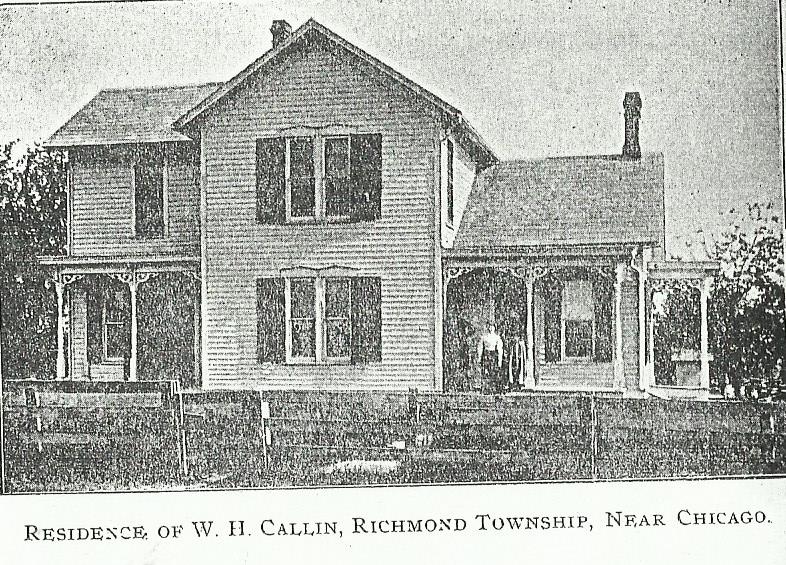 By the time of the 1870 Census, William and Ellen were living in Richmond township, with their three small daughters, Lillian Florence (1861 – 1936), Anna (1865 – 1908), and Lydia Minerva Callin (1869 – 1943). These sisters were all still at home in 1880, when their littlest sister, Grace M (1880 – 1978) came along. We'll talk about each of their families over the next few weeks.
William's farm was one of those selected for the 1880 non-population schedule of the Census, which means we get a rare glimpse at some of the details of his farm's activity. In that year, he cultivated one 333 acre field, and kept 10 acres of woodland on his property. The property itself, including the buildings, equipment, and $250 of livestock was valued at about $2,400. William paid out $20 in wages for 4 weeks of labor in 1879, and estimated his farm's total production that year at $410. He kept 2 horses, 3 "milch cows", 1 "other" (neither a milk cow or a "working ox"), about 5 sheep, 7 swine, and 25 chickens. The farm produced 300 pounds of butter, 5 fleeces (for 25 pounds of wool), and 80 eggs; there were 2 calves born, and 8 lambs. William planted 4 acres of "Indian corn" and harvested 160 bushels; 5 acres of oats for 180 bushels; and 7 acres of wheat for 140 bushels. A quarter acre of potatoes produced 25 bushels, and one acre with 20 apple trees produced a bushel of apples. His 10 acres of woodland produced 10 cords of firewood, valued at $10.
In 1884, Joseph and Charlotte sold the family farm to their son, William G. Channing, and moved to Norwalk until the following fall, when they moved back to Chicago Junction2, where Joseph died on 5 December 1889. Charlotte spent two years in Chicago Junction before moving in with her daughter, Mrs. Lydia Lloyd, and the with Ellen and William Callin.
 |
| Ellen C. Callin (1838-1916) |
 |
| William H Callin (1834-1919) |
The 1910 Census shows William Channing's household just a few lines down the page from William and Ellen Callin, which indicates how close the family farms probably were to each other.
William and Ellen seem to have lived out their days on their farm, Ellen passing in May 1916 at 78 years of age, and William in November 1919 at 85. If there are obituaries or records of their deaths beyond their grave markers, I have not found them. This would seem to indicate what kind of modest people they were. They led a simple life by modern standards, raised a close family, and as we'll see in coming weeks, they left their legacy behind in their children.
1 - Mary Gommer remained in England when her father emigrated; she was most likely married to Mr. Gommer by that time.
2 - Chicago, and later Chicago Junction, was often confused for Chicago , Illinois by train passengers, and in 1917 the name of the town was changed to Willard.
3 - The entry is hard to read; it looks like the enumerator wrote "43", then wrote over the "4" with a "3".
Photos posted with permission of Ancestry user meganoneill10.
Subscribe to:
Posts (Atom)