Friday, August 28, 2015

A Garden of Loose Ends: The Hess Descendants

Our story, so far:
We've reached a point where, if I am going to avoid violating the privacy of living people, I will have to abandon the effort to weave a narrative. Because of that, and because I am still missing a lot of detailed records about these folks, this post will necessarily leave a lot of loose ends.

I'm also more likely to get caught making mistakes, since some of the people I am writing about were known and remembered by people who are still alive. I always make mistakes; some are minor, some frustratingly major. I will remind any new relatives that catch these mistakes that I am putting this out here to show what I have, and to ask for help fixing it before putting it in a book!

So, if you are one of the living relatives who recognizes these people I'm writing about, I'd love to hear from you; either to help me fix mistakes, or tell me to include stories about them that you want to remember.

Clara and Jacob's oldest daughter, Jessie Alverda Mohn, married Thomas William Hess 22 July 1897, and they had the first of their eight children, a daughter, in April 1898. The first six were listed in the Callin Family History.

1. Hattie Helen Hess is a mystery to me. Though she appears in the 1900, 1910, and 1920 Census records in her parents' home in Jackson township, Richland county, I have not been able to scratch out any other records that match her. There is another Helen Hess of precisely the same age living in Richland county at the same time, which stands as an example of why this kind of research is so challenging, why one has to be skeptical of the evidence, and why one can end up going down so many rabbit-holes.

The other Helen married Delbert Pittinger in 1914, so she is listed in his household in January 1920, while our Helen is listed in Jackson township in July 1920 - with a marital status of "widow" just to make things more tantalizing. But while I suspected that Mrs. Helen Pittinger was not the same person as Hattie Helen Hess, I couldn't find definite proof until I had spent a day on researching the Pittinger family. I finally found Mrs. Pittinger's obituary at Newspapers.com, which named her mother, "Mrs. Hayden Hess," and a brother who was not related to our Hattie Helen. Between that obituary and the birth and census records that confirmed it, I could finally prove that her father's name was John Hayden Hess, not Thomas William - but that also means that I don't know any more about our Helen than I did before I started down the rabbit hole.

(Any further information about Hattie Helen's fate would be greatly appreciated. N.B.: Update: Hattie Hess)

2. William and Jessie's second daughter, Rhea Ruby Hess, came along in April 1899, and also appears on the same Census records as her older sister. In 1920, though, she is listed in her parents' home as Rhea Tucker, along with a musically named daughter born around 1919. (I will have to spare you the variety of spellings of her name, as she is still alive somewhere in the world!) I have found no marriage records or anything indicating the fate of Mr. Tucker; however, by 1924 Rhea was married to Howard Wirick (another surname that pops up in the Callin family tree later on - also with a variety of spellings). Howard and Rhea had a son, Clarence Dean, born 30 April 1924.

Clarence, who went by the nickname "Moe" left the planet in 2008 leaving behind five children who are currently about my parents' ages. According to his obituary, he "served with the United States Army Air Corps during World War Two as a crewmember on a B17 bomber. Clarence was the last surviving member of the flight crew."

3. Clayton Clifford Hess was born in November 1900 - and as a parent of closely spaced siblings, let me express some sympathy for Jessie at this point for the sleep deprivation she must have surely been experiencing! Clayton grew up in Richland county, married Blanche Gregg around 1924, and worked as a "heater" in the steel mill in Canton, Ohio, during the 1930s. It looks like after he retired, they moved to Albuquerque, New Mexico, where Blanche died in 1965 and Clayton died in 1969.

They had four children who were all born within six years - two boys and two girls. Glenn Orlo (1924) was a World War II U.S. Navy veteran who died in 1983 in New Mexico. I have no records of him raising a family of his own. His brother, James Thomas (1926), also served in the Navy in WWII, and died in Huron county, Ohio, in 1993. He and his wife had nine children, including a son named James Jay (1954-1988) who worked in a printing shop, and a daughter, Pat Montgomery (b. 1955) who died unexpectedly in January 2015.

Clayton and Blanche's third child was Darlene (1928-2010) who married Noel "Buzz" Zimmerman (1925-2009); they have seven surviving children. Darlene worked in food services, retiring from KFC in 2009, and Buzz was a U.S. Navy veteran (like his brothers) who worked for Bill Harris Auto before his retirement. And the youngest of the four, Maxine Alice Hess, was born 15 February 1931. She had three sons, one of whom, Gregory "Tiny" Hess, passed away in 2013 at 63. Maxine died in 2004.

4. Esther Eleanor Hess was born 15 November 1904 and married Ray Carlton Oberlin in 1923. They had two sons, and she died relatively young in 1953; Ray followed in 1967.

5. Geraldine Hess, born 28 February 1908, married Lester Lee Keller when she was 16 years old, in 1924. They had a son, but soon they divorced, and Geraldine was listed in her parents household with her young son in 1930. Lester died in 1973; I don't know whether he remarried or had more children. Geraldine remarried George Williams in 1935, and they had a son, also. George died in 1946, and she remarried in 1948 - this time to Harold Doerr, and they were together until he died in 1982. Geraldine died in 1997 in Mansfield, Richland county.

6. William W. was the last of the Hess children listed in his mother's record in the Callin Family History. He was born 1 April 1910, and he married Bertha Pauline Deppe around 1935. They had one child, a little girl they named Shirley Ann who died in 1940 at the age of four. William enlisted to fight in the Second World War in 1943, and he died in Cleveland in 1976; Bertha lived until 1992 and died in Mansfield.

7. Byrl B Hess was born 30 December 1911 and married Herbert Zimmerman (1890-1968), who happened to be the father of Noel Zimmerman (1925-2009), the eventual husband of Byrl's niece, Darlene, mentioned above. Noel was one of four sons of Herbert's first wife, Clara Gleason, who died in 1936. Byrl and Herb had two sons together: Marty (b. 1930) and Herb, Jr. (b. 1933).

(Of course, all six of these young men were close in age and raised as brothers, and the records and obituaries made it hard to sort out which boy belonged to which mother - my apologies if I got any of this wrong!)

The Zimmermans operated a grocery store during the Depression, and Marty Zimmerman worked as a distributor for Pepsi-Cola until 1962, when he moved his family to Wooster and opened a Hammond Organ Studios. He and his wife, who survives him, had four daughters; he died in March 2015. His brother, Herb Jr., was a staff commander in the U.S. Navy during the Korean War, and worked in the automotive industry. When he died in 2011, he left a wife, a daughter, two grandchildren, and three great-grandchildren.

 8. Jessie and William's youngest child was Dean D Hess, born 22 December 1913. (If you were keeping track, that is 8 children in 15 years.) He and his first wife had one son and one daughter before 1940; after that, I have found very little information. He married his second wife, Doris Lindenbolt, in 1951, according to an unconfirmed detail on his Find-a-Grave profile; she died in 1972, and he followed a few years later in 1979.

A Guide For New Cousins


I know this gets complicated, but if you happen to be one of the living descendants of any of these folks, here is a guide to figuring out how we are related. Our common ancestor, of course, is James Callin, the Revolutionary War soldier who I believe to be the father of James and John Callin of Milton township.

Jessie Mohn is my 4th cousin, 2x removed; her children are my 5th cousins, 1x removed, and her grandchildren are my 6th cousins. Each generation after her grandchildren would also be 6th cousins, starting with her great-grandchildren, the "removed" part starts counting up from "1x removed." So, for one example, Marty Zimmerman was my 6th cousin; his daughters are my 6th cousines*, 1x removed; and their kids are my 6th cousins, 2x removed.

Of course, I can't keep all of that straight without the computer, so you're all simply "cousins" to me!

Hope you are all well, and hope to hear from you in the comments (or email...or Twitter... or... you get the idea).


*Yes, "cousines" is the feminine plural of "cousins". 

Updates: Refined some of the location information thanks to some helpful feedback.

Friday, August 21, 2015

Clara and her Soldier

Tecumseh's War.png
Licensed under CC BY-SA 3.0 via Wikimedia Commons.
Milton township in Richland county, Ohio, sits in the center of the northern third of the State of Ohio. It is just to the east of what was considered by Tecumseh's Confederacy to belong to the Native American tribes (and to the west of Mansfield, which is shown on this map of Tecumseh's War). Until the defeat of Tecumseh during the War of 1812, there was real danger from raiding parties; some motivated by French or British destabilization efforts, and some motivated by anger over the encroachment of the settlers. It isn't beyond reason to consider future President William Henry Harrison's victory over Tecumseh at the Battle of Tippecanoe to be the point at which settling in Ohio became "safe" for U.S. settlers, and by 1843, the last of the Native Americans who had been living in Ohio were gone.

Clara Callin was the daughter of  Jeff Callin, the shoemaker, and the granddaughter of the tragic Thomas Callin. Thomas's own father, you might recall, was one of those U.S. settlers in the 1810s; and Thomas, who likely died around 1843, would have spent his entire life in an Ohio that believed itself to be under the threat of attack from those remaining indigenous people. But Clara, born in 1855, would have been among that first generation of Ohio Callins who did not grow up in a place where such an attack was a realistic threat. Her generation was marked by a profoundly different threat.

To say that Clara grew up in a "tumultuous time" is too easy. On the other side of the frontier from the "Indian Wars", the decades before Clara's birth were known as the Second Great Awakening, which saw the growth of Protestant churches through revivals and "camp meetings" and saw the creation of new denominations like Churches of Christ, The Church of Jesus Christ of Latter-day Saints (nicknamed the Mormons), and the Seventh-day Adventist Church. In addition to the religious movement, other reform movements such as temperance, abolition, and women's rights also became prominent that period.

Ohio played a huge part in the history of the abolition movement that emerged in the North from that Great Awakening. Abolitionist newspapers were printed in the 1810/1820s, and over time, many Ohio Quakers became active participants in the Underground Railroad. The Fugitive Slave Act of 1850 put these Ohioans on the wrong side of the law, but as the popular reception of Ohio abolitionist Harriet Beecher Stowe's book Uncle Tom's Cabin demonstrated, this didn't derail that railroad. Not everyone believed in the abolitionist cause, of course. Many people feared the end of slavery, believing that African Americans would flee the South and come North, to take jobs away from white Ohioans. Even some abolitionists who abhorred the moral evil of slavery were also racists who feared the soon-to-be-former slaves; if you'll forgive the pun, this issue was far from black and white - and that complicated feelings in both Free and Slave states.

Being six years old at the start of the Civil War, Clara would grow up in an America that had faced down its own demise, torn itself apart from within, and begun trying to put it back together. Clara and her brothers would have been too young too understand how many of their uncles and cousins were "off to war" and only the older ones, like 10-year-old Clara herself, might have understood who was missing after 1865.

Despite all of that heavy background, Clara's youth in 1870s Ohio was probably quite exciting in comparison to her predecessors. The discovery of oil in Ohio before the War meant more wealth and more growth in what had been sleepy little farming communities enlivened by the occasional camp meeting. Her brother Martin certainly benefited from the economic booms, building his dry goods business; and we know from numerous newspaper accounts that there were always church and civic social events going on, often being run by the circle of family and neighbors Clara belonged to.

Somewhere in the booms, busts, banquets and church picnics, she met her soldier. His name was Jacob Mohn, and he was 10 years her senior. Born in Derry, Pennsylvania, Jacob's parents, Leonard Mohn and Nancy Bach, had relocated their family to Ohio some time during the 1850s and settled in the township of Blooming Grove in Richland county. He was only just 18 years old in May 1864, when he mustered in with the 163rd Ohio Infantry at Camp Chase. His unit spent six months guarding Washington, reconnoitering the canal and turnpike to Richmond, and repairing defenses at Fort Pocahontas before heading back to Columbus and mustering out in September. They only lost 29 enlisted men to disease, and no reported combat deaths.

In 1870, young Jacob was listed as a farm laborer in the household of Christopher Hons. He seems to have been rather well off, having $300 in personal assets; and in 1875 married Clara Callin. By 1880, they lived in Olivesburg, where Jacob worked as a butcher and Clara raised their first two children, Alveranda Jesse (1875) and Arthur Jefferson (February 1880).

Sadly, life was not perfect for the young couple; the George Callin Family History (CFH) says they had another son named Earnest in 1879 who only lived two years. There are no records or gravestones to corroborate this, but at least if true, this was their only such loss.

By 1900 the family had relocated to Vernon township in Crawford county, where Jacob ran a farm. In the intervening years, they had Mabel (1882), Fred Harrison (1888), Susan A "Susie" (1891), and little Evangeline (1899).

By this time, Alveranda was also married to Tom Hess, and had her first two children (of an eventual total of eight). They married in 1897, and while most of the records before her marriage list her with different spellings and variations (Aloerda, Alverda, Alverdia), after that she seems to prefer Jessie. I can't say I blame her.

Mabel was the next to marry, wedding Edwin Henry Trauger in 1902. The CFH misspells their surname as "Tranger," but when we see the couple in the 1910 Census with their first two (of four) children, Clara M (1903) and Henry Mohn Trauger (1908), the transcriber lists Ed's surname as "Franger," so I'm happy not to be too critical of cousin George.

In 1910, everyone was living back in Richland county. Jessie and Tom Hess were in Jackson township; Mabel and Ed Trauger were in the town of Plymouth; and Clara and Jacob were in Cass township with the four remaining siblings - Arthur working as a farm hand, Fred and Susie presumably finishing school, and Evangeline (11) probably also in school - and certainly already acquainted with the Lautermilch family listed only a few households down the same Census page from her own.

Susie married Gloyd W. Backensto - an unusual name you might recall from an earlier post - in September 1911, just a few months after the 5 April birth of their son, Lloyd Jacque (or Jack, depending on the record). They also had their second son in May 1912, and named him for Susie's brother and father: Fred Jacob Backensto.

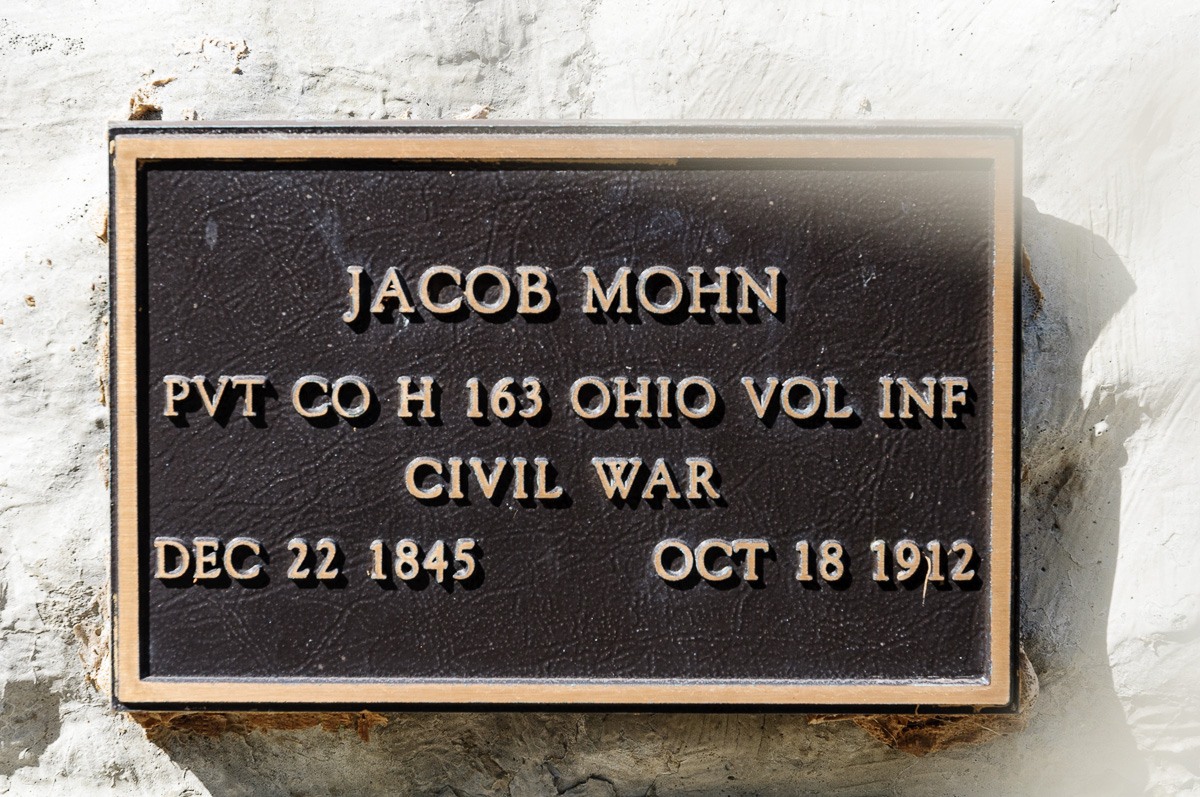
Find-a-Grave memorial - photo by Jill & Ron Weikle
But some time in 1912, Jacob Mohn left his farm to stay with Jessie and Tom in Jackson, and in October, they recorded his death in that town. The following year would see his sons marry women from two prominent Richland county families.

Arthur married Orpha Lybarger, and they settled in Shelby; Fred married Frances Pittenger, and they moved to Franklin. In 1915, each couple added a grandson to Clara's growing legacy. Arthur and Orpha had Reno Juston Mohn; Fred and Frances had Arthur Wilson Mohn.

And so, in 1920, only Clara and Evangeline remained in a home in Blooming Grove township. Based on what we can see in the newspapers, they devoted their energy to many of the same activities that Clara had spent her time on in her own girlhood. They entertained visiting relatives, organized community events, and almost certainly lost count of the growing number of Clara's grandchildren.

Then, in 1922, Evangeline married Loree John Lautermilch, the son of George and Della, the Mohn family's long-time neighbors. They remained in Richland county, and though they never had children of their own, they stayed together for the next 50 years. Evangeline died in 1972, followed by Loree John in 1979.

Clara herself died 19 August 1924, have seen the birth of all but one of her 23 grandchildren. She missed Arthur and Orpha's youngest son, Jeffray Arthur, by only 5 years. To Clara, the world that began with the Civil War (and survived) ended with The War to End All Wars (and survived) - and it survived without taking any of her children. That had to be worth something to the family.

Being born as the threats of frontier life receded, marrying her soldier home safe from war, and seeing terrifyingly incredible changes in America during her lifetime, we can only hope that Clara enjoyed her life. In many ways, it can seem almost idyllic from our point of view, knowing the events that lie ahead for her children and grandchildren.

It's easy to see the appeal of nostalgia.

Updates: Refined some of the location information thanks to some helpful feedback.

Friday, August 14, 2015

Jeff the Shoemaker

Jeff Callin grew up on his family's Ohio farm in Weller township, either in or near the young town of Olivesburg. Born in 1827, his parents named him after the third U.S. president, Thomas Jefferson, and it seems he was called by his middle name to differentiate him from his father. (I can relate to that! #genealogypuns)

His childhood in the 1830s and 1840s would have found him surrounded by a lot of cousins, uncles, and aunts. His father, Thomas, was one of 17 cousins to grow up on that same Richland county farm land, and Jeff had two big brothers, George and James, close to his own age.

Jeff would have been about 8 years old when his great-uncle John died of tuberculosis, and he lost at least one infant brother a few years later, and possibly a sister or two, most likely to the diseases that would have raged through a close community like the one around Olivesburg. I don't mean to downplay the tragedy of these losses, but a boy in that time wouldn't have had a lot of time to dwell on them. I expect that the rhythm of farm life and the support from family and neighbors that we look back on so nostalgically today would have done their part to soften the blows.

In Jeff's teenage years, around 1841 or 43, his father also died. Then over the next couple of years, the rest of Jeff's uncles began to leave Ohio and strike out further West. By this time, Ohio was no longer the "frontier", and there were even newer states hoping to attract settlers. Jeff's uncle Alec took his family, and Jeff's grandmother, Mary, to set off for Iowa; his uncle James, after marrying great-uncle John's youngest daughter, Margaret, would have followed Alec a year or two later in 1844.

Early shoemaking shop, Maine State Museum IMG 2020.JPG
"Early shoemaking shop, Maine State Museum" by Billy Hathorn - 
Licensed under CC BY-SA 3.0 via Wikimedia Commons.
Young Thomas Jefferson Callin grew up, learned the trade of a shoemaker, and in about 1848, he married a Susan Egner, according to our favorite book, the 1911 Callin Family History (or the "CFH", for short). When we find the newlyweds in the 1850 Census, they are living next door (or are at least listed in the household above) Jeff's mother Nancy, who is in turn listed above a Joseph Burget - possibly an uncle or cousin to Nancy.

Jeff and Susan's household at that time also lists an Eliza M Egner, age 17. I think it is likely that this is Susan's sister. In spite of the fact that there are several Egner families in and around Richland county at that time who might be the girls' relatives, I have no solid evidence to show who Susan's parents were - but I suspect that her (and Eliza's) parents were Eli Egner and his second wife, Dorcas Sowerbeck. (see comments below for an update on this section)

Jeff and Susan began working on a family of their own, but they were struck by an early tragedy when their first infant, a daughter named Alice, died at one month of age in 1850. Again, we don't know the cause of death, but I suspect one of the infamous childhood diseases of the time - like those that possibly claimed so many of Jeff's younger siblings. Whatever the cause, a young couple in those days had little choice but to recover and move on. Over the next decade they went on to have more children: Mary E (1851), Martin (1853), Clara (1856), and Fred (1858).

The family seemed to be doing well in 1860. The census reports Jeff as having $850 in real estate and personal assets, and there are two young men lodging with the family - a blacksmith named Hiram France and a shopkeeper the transcriber saw as "Munfer Callan", age 27. It isn't gold-plated proof, but this could well be a record of Jeff's younger brother, whom the CFH refers to as "Marquis". The lesson here is to read every record carefully, just in case! (It would be nice to be able to figure out where this "Munfer" was in 1850, but if this is our Marquis, he would have been in his early teens, and might have been sent to live with relatives, or apprenticed to someone to learn a trade of his own.)

The 1860s brought the family joy and sorrow, as you would expect during the decade of the Civil War. In November 1860, Jeff and Susan had another son, George, but in 1861 they lost 10-year-old Mary to unknown causes. 1863 brought their son Delbert into the world, but also saw Jeff receive his draft notice. He was fortunate enough not to go to war himself; he may have been deferred for the sake of his wife and young children, or due to the fact that his unmarried older brother George and unmarried younger brother Elliott both enlisted. Sadly, both brothers were lost in 1865: George to a rebel sharpshooter just weeks before the end of the war; and Elliott, who survived battles through the Cumberland, the Battle of Shiloh, and duty in both New Orleans and San Antonio, died in the hospital at Columbus, Ohio.

In 1870 the family still lived a mere two households up the Census page from Jeff's brother James and mother Nancy. I said last time that I wished I knew more about what Nancy was like; I imagine that living near her grandchildren these 20 years must have been a source of joy. I like to imagine that she had to be tough to keep her family together through all of these common tragedies and I have a picture of her in my head - almost as if my own wife were there in that time, telling everyone "come on, we'll sleep when we're dead" as she bustles around tidying, feeding everyone, and getting things done. But even the tough can't last forever, and Nancy died in 1871.

By now, Jeff and Susan's kids were coming of age. Clara married her own Civil War soldier, Jacob Mohn, in 1875. A couple of years later, Martin married Mary Elizabeth Rearick and set himself up as a dry goods merchant in Blooming Grove. The 1880 Census lists Jeff, Susan, Delbert, and another young daughter, Minnie (born 1873) in Olivesburgh - by now more than just a post office. Further down the same page there is a Benjamin H Egner, 55, blacksmith with two of his children; if Susan is the daughter of Eli and Dorcas, then Benjamin would be her half-brother - the son of Eli and his first wife, Hattie Hoover. I don't know where Fred was that year, but 19-year-old George is employed as a servant in the home of a farmer named Cyrus Rebman in Weller Township.

An example of a wagon built in the 1880s,
this one by H. Barkow Co,, Milwaukee, WI
In 1884, Fred married Priscilla Creveling and settled in Mansfield, where he worked as a laborer and a driver. A few years later, in 1889, his brother George married Katie Imhoff and also moved his young family to Mansfield to work as a driver.

It's worth taking a moment and reminding a modern audience that when we say "driver" we are not talking about the modern delivery truck, yet. These men would have been actual teamsters. The first "horseless" trucks would start appearing on the scene in another 25 years, but it's likely that living with or near blacksmiths for most of their lives, the boys would have been very familiar with the business of tending horses and maintaining a wagon. As Ohio rapidly developed from the frontier of their father's childhood into the well-settled (and populated!) center of a United States, their skills would have been in high demand. So it's no surprise that Fred and George, and their sons, worked mainly as drivers in the busy and increasingly metropolitan town of Mansfield.

Their older brother, Martin, seemed to be doing well for himself in another related business. As a dry goods merchant, he would have depended on the services of drivers like his brothers for his success. He also took on the postmaster job, first in Olivesburg, and then after 1884, in Tiro, a town about 20 miles due west of Olivesburg. Sadly, in February 1889, he was killed when he and a business partner were struck by a train while crossing the tracks in their sleigh.

This newspaper clipping says a lot about the time - not only in the florid language used, but in the small emphases on technology (like the telephone) and the almost clinical physical details:
A common sight before the day of the automobile.

FRIGHTFUL
Martin L Callin and Jacob H Bloom hurled into Eternity Without any Warning
A T. & O. C. GONDOLA DOING THE FATAL WORK -- FURTHER PARTICULARS

News reached this place last Wednesday afternoon by telephone that Martin L. Callin and Jacob H. Bloom, both of Tiro, were killed at 11:30, a. m., the same day on Plymouth street at Bucyrus while crossing the T. & O. C. track in a sleigh. The news, after further inquiry, proved only too true, and their homes which they left bright and cheerful, hale and hearty in the morning turned to be homes of mourning and sorrow at night.
The yard engine with three gondolas attached had gone north and was returning at a rapid rate of speed, the gondolas preceding the engine, when the fatal accident occurred at the crossing. The gondola farthest from the engine struck the sleigh and reduced that vehicle to a mass of ruins as well as inflicting the fatal injuries to its occupants. 
Mr. Callin was thrown a distance of about 60 feet, sustaining a dislocated neck, four or five broken ribs together with other injuries. His pulse beat for a short time after the crash but life was soon extinct. On his person were found $400, and a gold watch. 
Mr. Bloom was thrown on the cattle guard and sustained a dislocated neck and hip, a broken back, broken legs and inferior maxillary crushed. Death resulted instantaneously. A watch chain was found on his person but the watch could nowhere be found. The horses which were hitched to the sleigh were unhurt. 
Coroner Thoman held an inquest in which testimony was given by various parties who witnessed the awful accident. After the inquest the remains were taken in charge by an undertaker and after proper preparation were sent to the respective homes of the deceased parties at Tiro; arriving at that place at about 10 p. m. 
Mr. Callin leaves a wife and four small children to mourn his sudden departure. He was for a number of years a successful and one of the most prominent business men at Tiro.

(I left out a longer paragraph detailing Mr. Bloom's injuries for the sake of space, but if any are interested, I found the text in Martin's Find-a-Grave entry. -T.C.)

Martin's widow, Mary, soon remarried; to Harry Carlisle in 1890. Their four small children were Pearl (1877), Ben Frank (1878), William Jefferson (1885), and Gaston (1888). Records do not show where the Carlisles lived, but they appear to have remained in Ohio.

Jeff and Susan's later years were far more bucolic. The rest of their children grew up and moved away, but not far. Delbert married Mary Coleman in 1892, and Minnie married Wilson Urich (in 1890, if you believe the Census; in 1900 if you go with the CFH). The Mansfield News was more likely to print these types of notices than anything tragic:

"Dell Callin and family, from Adario, and Wilson Urich [Minnie's husband] and family visited their parents, Mr. and Mrs. T.J. Callin, Sunday."

and

"Arthur, Mabel and Fred Mohn [Clara's children], of near Tiro, were the guests of their grandparents, Mr. and Mrs. T.J.Callin a few days last week."

or

"Arthur Mohn and sister, Miss Mable, of Amey, visited their grandparents, Mr. and Mrs. T.J. Callin, recently."

(All of the above just from the 7 September 1900 edition of the Mansfield News, page 4, col 1 & 2)

In 1902, a 74-year-old Thomas Jefferson Callin died in Olivesburg, probably in the same street where he was born. Susan stayed in their home, at least for a few years, frequently visited by her children until some time before her 81st year, when she seems to have quietly died and slipped away, leaving no record - at least not that I have found, yet - just a legacy of children and grand-children.

Updates: Refined some of the location information thanks to some helpful feedback.
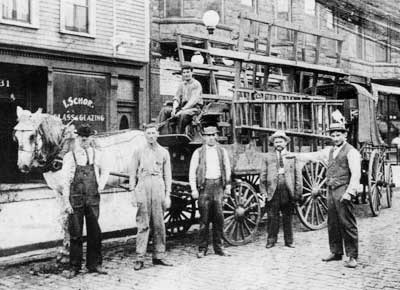
Sunday, August 9, 2015

Behind the Scenes: Pushing Down Field

Bowling Green High School
football squad, 1911
To continue the football metaphors (see On the Moving of Goal Posts), I spent May through July pretty intently focused on simply "doing more research," hoping to get closer to the goal of getting the revised Callin Family History published in 2015. It took me a solid four months to do a "first round" - starting with James 1st, and taking a hard look at each of his descendants to make sure I know everything I can know before moving on to the next.

Now I'm about halfway through the "second round".

My original plan was for this book to come about in four phases:

  1. The Gathering phase - researching any missing facts in the individual records (primarily using Ancestry tools, but also simply Googling for info), and bringing the tree as up to date as legally/ethically possible.
  2. The Editorial phase - generating the text of the book with Family Tree Maker, and systematically going through that, looking for typographical, layout, and minor factual errors.
  3. The Marketing phase - where I focus on reaching out to all of the living family members to let them know a book exists.
  4. The Correction phase - where I gather all of the helpful feedback on the inevitable mistakes I will make in the first two phases, and fix them in future editions for as long as necessary.


I expected to be done with the Gathering phase in April, but here we are. There is a lot more family to gather than I anticipated, and as I get better at finding puzzle pieces to put together, the puzzle gets larger and larger. Just to illustrate how much larger, here is a snapshot from last night, when I synced my Ancestry tree with Family Tree Maker for the first time since the end of May:

From 27 May to 8 August 2015

(If you're interested in exploring this tree while I build it, you should be able to access the public view on Ancestry: Callin Family History - G.W. Callin 1911. I have the privacy settings enabled so that you shouldn't be able to see records for any living people.)

A lot of this information won't likely end up in the book. As I've stated elsewhere, my goal is to report every descendant of James Callin, every spouse, and every spouse's parents - but in order to prove who the spouses' parents are in many cases, I end up adding parents, grandparents, and siblings to the tree. So where you may have a dozen or more individuals in the tree, only three will end up in the book.

I know that sounds like a lot of extra work, but I've committed to doing it because not maintaining that standard is one of the major ways I've found that women end up getting erased from our histories. It is a lot of extra work, but not doing it means that the women in our genealogies end up having too little documented information in the final works for researchers to connect their birth families to their married families. I see it all the time - I honestly don't know who most of my earliest grandmothers are, simply because I don't have any more than their maiden names (and in some cases, I don't even have that much information).

So, that's why I keep pressing on. And I'm hoping that as I post more stories about the people in this family history, you, dear readers, will help me with the "Correction phase" by asking questions, catching mistakes, and reining in my imagination if I project too much.

Eventually, this is going to get published. But first - I have to finish Gathering.

Friday, August 7, 2015

Tragic Thomas

Thomas Callin is, to me, the first of many firsts.

As near as we can tell, he was the eldest son of an eldest son, and he is the earliest of these ancestors to leave behind multiple records. He had to be a survivor - that much is evident in his story. But thanks to war, disease, and the other dangers of frontier life, he came close to leaving no legacy at all.

I'm sure I'm projecting a bit, but the Callin men in my contemporary branch of the family tend to be a bit clumsy. For us, it's not usually fatal - it often leads to minor injuries and embarrassingly preventable consequences. Most of our misfortunes are small enough to be laughed off (and maybe bandaged up), but Thomas's life, with its many tragedies, seems to have been plagued with the kinds of misfortunes that are harder to laugh off.

Born in Pennsylvania in 1801, Thomas would have been just old enough during the War of 1812 to have been aware of his family's vulnerable position as a farm in the middle of a growing American frontier. If his father, James (from our previous post, The Brothers Callin of Ohio) did have a sister carried off during a raid on their settlement (see The Perils of Polly (or Margaret) for that story), then Thomas would have grown up hearing that harrowing adventure around the fire, and experiencing the dread of attack from his earliest memories.

Thomas would have been about 9 years old when the family relocated to the new state of Ohio - a state younger than Thomas himself! - and there are some resources available if you want to learn more about what that would have been like. (I found a quaint book, and linked to it at the bottom of this post if you're interested - "Philip Seymour, or Pioneer Life in Richland County"written in 1858 and set in 1812.)

There is a lot we don't know about that time on the Callin farm. Thomas's uncle, John, arrived in 1816, about six years after Thomas's father did. I like to think adding seven cousins to the farm lessened the work load, and spread out the chores. According to the 1820 Census for Milton township, Thomas had four brothers and two sisters, and his aunt and uncle had added two more to their brood, bringing the total for both families to 17 cousins!

Sadly, this is when the first real tragedy struck, as sometime around 1820, James got involved in an altercation with a man named Fowler, who hit him in the head with a rifle and killed him. (The census does show a neighbor named Sutton Fowler, but without any documentation, there is no way to tell if that is the same person.)

Milton Township, Richland county, 1820
We don't have any evidence outside of George Callin's Family History, but according to him, Thomas married Nancy Burget in 1822.

The 1820 Census did show two households headed by Burgets - one named Thomas and one named Boston. From looking at the ages of the people in each of those households, I've concluded that it's most likely that Thomas and Boston could be Nancy's brothers, and that if she was living in either household in 1820, it might have been the one headed by Thomas Burget.

Marrying Nancy and setting up his own home on or near the family farm ought to have been a happy occasion for Thomas. I like to think of everyone getting along and working together, making a life like that you might have seen on Little House on the Prairie. But it can't have been without its share of heartbreak. The picture we have is murky, as the facts in our different sources don't paint a complete picture. But we'll do the best we can to piece together the family of Thomas and Nancy Callin.

The George Callin Family History (which I'm going to refer to as the "CFH") tells us that Thomas and Nancy's eldest child was a girl named Jane, born in 1823. But, there is no girl of that age listed in the 1830 or 1840 census, and even though George's account says she lived until 1879, unmarried, there is no Jane Callin listed in any of the subsequent census records for this family - nor is there such a person listed in Ohio for any of those dates. There is, however, a James of about the right age (born 1826) listed in the 1850, 1860, and 1870 census records, living with his mother, Nancy. I suspect the CFH simply got that one little fact wrong.

Their second child, George, was born in 1825. (I guess that would make him the eldest, if my Jane/James theory is correct.) There is a boy the right age to be George in the 1830 and 1840 Census records, and while he is nowhere to be found in 1850, there is a George Callan the right age in nearby Vermillion, Ashland county, in the 1860 census, living with a family called Boyd. Military records support the CFH account that says he was killed at the end of the Civil War in 1865. He enlisted in Company G, Ohio 178th Infantry Regiment on 23 Sep 1864, and though the records say he mustered out on 26 March 1865, his unit was in North Carolina at that time, and counted 2 of their members as Killed at the end of the war. The CFH says he was shot by a rebel sharpshooter while on "pickete duty".

Both of these eldest sons died unmarried, according to all of the sources I have; their third son will be the subject of next week's tale: Thomas Jefferson Callin, born 1827. "Jeff" survived, thrived, and raised a large family of his own.

After him, depending on the source, there were two more boys and three girls; this is where things get both sad and hard to confirm. In the CFH, there are several children of Thomas and Nancy that are listed with the ominous note, "All died young." Mary Ann, Caroline, Emiline, Sally, Abel, and one unnamed.

We know that Mary Ann and Emiline survived until at least 1850, when they were 14 and 11 years old, respectively. The 1840 census shows two girls under 5, and one between 5 and 9 years of age. Mary Ann (1836) and Emiline (1839) and either Caroline or Sally could be those girls. The 1840 census also shows two boys between 5 and 9, but it isn't clear who they might be. Find-a-Grave says that Abel lived from 1838-1839, and the other boys mentioned in The Callin Family History are younger than that. While we have no record to indicate what their fate might have been. I would suggest that one of the many outbreaks of yellow fever or cholera which were known to occur at the time claimed at least some of these children.

Thomas himself seems to have died when he was right around the age that I am now - somewhere around 42. His family is listed in 1840 Milton township under his name, but in the enumeration, there is no male his age counted. There are the five boys under twenty, and three young girls, with one female (Nancy, most likely) between 30 and 39. Thomas's actual date of death is still a mystery; Find-a-Grave says 1861, but I would expect to have seen him in the 1850 and 1860 census if that were true. I tend to think that he probably died right around when his youngest son was born (Elliott, b. 1841 or 43).

The next child listed in the CFH is a boy named Marquis born in 1840. (If you're like me, you will always wonder if that is pronounced like "Marcus" or like the French "mar-KEE". Wonder on, American dreamer.) The book goes on to have Marquis marry Pauline Snyder, have two sons - Fred and John (b. 1871) - and die in Chicago, Illinois, presumably before the 1911 publication of the CFH. I have not been able to find a single record to support any of this. If Marquis has descendants out there, they remain a mystery.

(UPDATE: While putting the post for next week together, I ran across a 27-year-old "Munfer Callan" living in the 1860 Weller township household of Thomas J and Susan Callan - which is just close enough to what the CFH says about Marquis that this might be an elusive record of his life! The hunt continues... -T.C.)

The 1850 Census finds Nancy Callon in Weller Township, Richland county, with her son, the aforementioned James, two daughters, Mary Ann and Emiline, and the last of her sons listed in the Callin Family History: Elliott, whose birth date is either 1843 (per the CFH) or 1841 (per the Census). Interestingly enough, Nancy's 1850 household is listed on the page in between a Jefferson Callin (a newly wed Thomas Jefferson) and a Joseph Burget (no known relationship, but another tantalizing hint that Nancy's family is still nearby). In 1860, she is down to James and Elliott; and in 1870, only James remains.

Elliott appears to have enlisted in the 26th Ohio Regiment in 1861, which saw action at the Battle of Shiloh, and was deployed at the end of the war to New Orleans, and then San Antonio. Elliott died in 1865, at the hospital in Columbus, Ohio - never married.

I would love to learn more about Nancy; I know that she died in 1871, having outlived her husband and all but three of her children. Of those eleven children, after losing two to the war, and several more very likely to disease, only two survived to have families of their own. She must have been tough, but if we make a few reasonable guesses from what we see in the records, it's not too difficult to believe she had more family around her - between her brothers and in-laws, and what I hope was a close and supportive town.

But however quaint and romanticized the stories you read about the early days of America and life in 1800s Ohio might be, it's worth remembering just how steep a toll that life could take on those who survived it.


Friday, July 31, 2015

The Brothers Callin of Ohio

Fraulein Maria famously sang in the Sound of Music, "Let's start at the very beginning/a very good place to start!"

We don't actually know much about the "very beginning" of our story, but there are some clues, and a handful of records to work with.

And based on what I have, it starts with two brothers...

I can't prove that James and John were the sons of James Callin. If they were, then their father was the Revolutionary War soldier found in the earlier post, Lafayette on the Brandywine, and their sister (or sisters) experienced the events related in The Perils of Polly (or Margaret). Here is what John's grandson, George, tells us in his Callin Family History in 1911:

James 2nd, with his family moved from Penn. to Ashland Co. and located on a farm about the year 1810. He was killed in an altercation with a man named Fowler who struck him over the head with a rifle, this occurred about the year 1820. He was buried in Oliversburg Cemetery.

The family of James 2nd described here would have included his wife, Mary, and at least three very young sons: Thomas (b. 1801), Alec (b. 1808), and James (b. 1810). As imprecise as our information is, all three boys might have been born in Pennsylvania, though little James might have been born in - or on the way to - Ohio.

John Callin, 2nd son of James 1st, emigrated with his family from Westmoreland Co., Penn., to Ashland County in 1816 and settled on 60 acres of his brother James' farm who gave him a life lease of it. He lived the remainder of his life on the same farm, dying in 1835 of tuberculosis and buried in Oliversburg Cemetery; his wife, Elizabeth, born Nov. 1780, died Nov., 1864, and buried near Auburn, Ind.; John, eldest son, died at 22, unmarried.

John's family in 1816 would have been his wife, Elizabeth (nee Simon), four young sons (John, b. 1802; George, b. 1804; William, b. 1813; and James, b. 1815) and three daughters (Ann, b. 1806; Sarah, b. 1808; and Eliza, b. 1811).

I have yet to find any evidence showing where these brothers actually came from. George says Westmoreland County, PA, but I haven't found any records to show these two families in that county. There were people named James and John Callen living in that general area (mostly in nearby Armstrong County), but it seems pretty clear from the evidence that those individuals stayed put, died in, and left descendants in, Pennsylvania without venturing westward.

Wherever our James and John were from, the brothers arrived in Ohio in the years just before the Panic of 1819. James Madison was President of the United States, and the country had just finished a second war with Britain that had started in 1812. Ohio was still considered "the frontier," but it had been a state long enough for there to be some infrastructure - mills and markets, roads and mail. The easy credit and land speculation (which led to the Panic) and the pressures to move away from the original colonies (recent war, and growing numbers of immigrants) obviously made it a popular place to go.

Click for full size
Ashland County wasn't formed until February 24, 1846, from portions of Huron, Lorain, Richland, and Wayne counties, so when George talks about places and events in Ashland county before that date, he's usually talking about Richland county. This map shows the modern boundaries of Richland county, and the pin shows the location of Olivesburg (Oliversburg is probably a typo in George's original text).

Milton township was organized in 1816, just in time for John's arrival, and it makes up a roughly rectangular area between Richland County and Ashland city, with Olivesburg near the top and Pavonia near the bottom corner.

The reason I mention Milton is because the 1820 Federal Census for Milton, Richland County, has the earliest record of James and John that I can find - in fact, it's the only record I can find that shows them both. Since George Callin, compiling his book in 1911, would not have had access to any but the earliest of the U.S. Census records, any similarities between George's account and the official records can probably be considered independent verification.

This detail from the census record shows John and James "Calan" - as well as a neighbor named Sutton Fowler. There are also two neighbors named Burget - Thomas and Boston. All of these are clues that help match this record to our Callin Family History.

George's tale of James's demise at the hands of a "man named Fowler" is lent some credibility here, though there is no way to tell for certain whether this is the same Fowler.

There isn't a lot of information in the first few Census counts beyond the names of the heads of each household. Each member of the household gets counted and reported by some standard demographics - male/female, and rough age groups. It takes some analysis and guesswork to pull any kind of story out of it, so having George's names and ages to compare to makes the job a bit easier.

John's family, as listed in George's book, matches up with this census count almost perfectly. A few of the ages that George reports don't quite add up, but they are close - and every individual we know about is accounted for.

Here's the breakdown, with the names and birth-dates provided by George:

Males <10: 3
  • Hugh (b. 1817 - 3)
  • James (b. 1815 - 5)
  • William (b. 1813 - 7)
Males 10-15: 2
  • George (b. 1804 - 16)
  • John (b. 1802 - 18) 

Males 45+: 1
  • John (b. 1780 - 40)

Females <10: 2
  • Margaret (b. 1819 - 1)
  • Eliza (b. 1811 - 9)
Females 10-15: 1
  • Sarah (b. 1808 - 12)
Females 16-25: 1
  • Ann (b. 1806 - 14)

Females 26-44: 1
  • Elizabeth (b. 1780 - 40)

James's family is also close enough for me to be convinced that it's the same family, but the census includes two boys and two girls that George's book does not list.

Males - Under 10: 1
  • James (b. 1810 - 10)
Males - 10 thru 15: 1
  • Alec (b. 1808 - 12)
Males - 16 thru 18: 1
  • Unknown
Males - 16 thru 25: 2
  • Thomas (b. 1801 - 19)
  • Unknown
Males - 45 and over: 1

  • James (b. 1779 - 41)
Females - 10 thru 15: 1
  • Unknown daughter
Females - 16 thru 25: 1
  • Unknown daughter
Females - 45 and over : 1
  • Mary (b. 1768 - 52)

These unknown kids could mean there were people in the household who were not family, but I'm not entirely convinced that's the case, because of what we find in 1830. I think it's more likely that because John is George's grandfather, George had better information about who his aunts and uncles were. It's entirely possible that some combination of frontier tragedy and poor bookkeeping kept him from learning the names of all of his 1st cousins, once removed.

That 1820 Census was enumerated on August 7, and it's probably a safe bet that James and Mr. Fowler had their altercation sometime after that. James's eldest son, Thomas, married a Nancy Burget in 1822; Nancy may be one of the females who is listed in the household of Thomas Burget in 1820. A death and marriage in the 1820s ought to show up in the following census, and sure enough, in 1830 things seem to have adjusted as you would expect.

John is there in Milton Township, with young, newly-wed nephew Thomas listed below him, and James's widow, Mary, listed below him. Unexpectedly, though, the name Hugh Callon appears further down the page!

This Hugh could be completely unrelated to the family, of course, but remember there were two boys listed* in the 1820 census that weren't in the Callin Family History; there is a good chance that this is one of those young men. In 1830, he seems to have a wife, they are counted in the "20 to 29" age group, and they seem to have a son and daughter each under the age of 5.

* Update (7/30/2018): if you look again, there is actually only one extra boy there; for some reason, the census counted the same boy twice; once in the "16-18" box, and again in the "16-25" box. I'm reasonably sure that Hugh is that extra boy.

John's family matches up once again, though the census lists one daughter fewer than the number he should have in the household. The widow Mary has two young men in her household, most likely Alec and James.

After John's death in 1835 of tuberculosis, the two families he and his brother had brought to Ohio begin to spread out. Daughters and sons marry and strike out on their own, and in the coming weeks, I'll explore what happens to their descendants. John's widow, Elizabeth, eventually moved to Auburn, DeKalb County, Indiana where she lived out her days with daughter Eliza Ferguson.

We saw what happened to James's sons, Alec and James, and their mother, Mary, in the earlier post, The Pull of the West. The mysterious Hugh from the 1830 Census will remain a mystery, for now; he doesn't appear to be in Ohio in 1840, but there is a Hugh Callen of the right age in Louisa, Iowa territory. Perhaps we'll learn more about him during our search for more records on Alec?

James and Mary's eldest son Thomas will remain in Ohio with Nancy until.... but perhaps we should talk about their family next time?

Sunday, July 12, 2015

On the Moving of Goal Posts

When I began this blog, I wasn't entirely sure what I wanted to get out of it. I knew I had some stories to tell, and I knew that researching and writing those stories would lead me to others. I knew that doing this would motivate me to try bigger things - and that is what happened!

My plan at the end of last year was to re-publish the original George Callin Family History (that links to the hard cover edition), then to gather the notes and research I had already done over the previous couple of decades and publish a revision - possibly during the summer months. Now, having devoted almost all of my efforts to getting that revision ready since March, I can see that this was too ambitious a goal.

In my head, it seemed pretty straightforward: once the hard research is done, I know I can draft up a narrative story (like the ones posted here) in a few hours. Using Ancestry and Google, I've been able to get most of the hard research done very quickly, so spending six or eight months on the revision seemed like a reasonable time budget. But that only really accounted for the number of families and individuals listed in Great Uncle George's book - which was around 350 families.

Starting just before Christmas 2014, I began "Round 1" of creating a public Ancestry tree: Callin Family History - G.W. Callin 1911. All I did for several months was enter information that I already had from George's book, and review the Ancestry record hints that popped up along the way. I finished Round 1 in March, just before our vacation to Arizona to visit my still-living family, and immediately went back to the "top" of the tree - James 1st - and started Round 2.

At the end of Round 1, I had expanded the known descendants of James to about 1100 families. Remember, I had budgeted time for about 33% of that number. And I knew from the skills I had picked up and tricks I had learned doing Round 1 that there were a lot of people that I simply hadn't found, yet. So I already know that if I'm planning to publish a fully fleshed out narrative for each family, it will take me another year or two - just to write up the families I've already found!

As of this post, I'm only just reaching the final stretch of Round 2 of my research phase, and there are more than 5,000 individuals in the tree. Many of those are NOT direct descendants of James 1, but my best guess is that about 3,500 individuals from that tree will be included in the final report.

There is a good reason for those numbers. One of the standards I decided on at the beginning this project at the beginning was that I would include the names of both parents of each spouse. To find that information, I've often had to look for the spouse's grandparents and siblings in order to figure out mothers' maiden names and piece together the origins of orphans. I'm committed to doing this, partly because it makes the eventual stories I have to tell richer and more complete, and partly to look for relationships between the "allied families" - the family groups that seem to intermarry more than once with my cousins. I also am learning just how badly our culture has mishandled the way we record the lives of our mothers, sisters, and wives, and I am determined to correct that by including as much information about the women in my book as I can find.

Obviously, there are costs involved in the standards I'm choosing to maintain. In order to push through the Round 2 research phase, I made a choice to suspend the writing I was doing in this blog. That clearly isn't enough to make my original vision for this book a reality - certainly not this summer as I had originally hoped. Probably not by the end of 2015.

So I'm moving the goal posts. Here's my new plan:

Finish the Research phase, and publish this as a slim volume - James Callin Descendant Report, 2015. I believe I can get this done by the end of the year, and I plan to put it up on Lulu.com as I did the Callin Family History - 1911 volume.

Starting soon (probably in the early fall), begin posting weekly stories about the families in the Descendant Report here on Mightier Acorns.

This will be useful in two ways. Most obviously, it gives me motivation to draft and edit the stories in a regular and timely manner; but it should also work as an outreach tool - as I work my way forward in time, I expect that I will be finding living relatives who will be able to help me spot errors, fix mistakes, and maybe even collect more of the kinds of stories that can't really be picked out of the records.

Doing this on a weekly schedule should also allow me to budget my time so that I can pay attention to my non-Callin ancestors. Eventually, the weekly Callin descendant posts will be ready to publish - but writing about them all will take years. I don't want to ignore everyone else while I'm doing that!

Once I know how long it is really going to take, I will begin planning a complete re-publication of the Callin Family History. I expect that future volume to include a section that captures Great Uncle George's work, my James Callin Descendant Report, all of the family-focused blog posts, and a few other ideas that I hadn't originally intended to include because I was aiming for an over-ambitious deadline of Summer 2015. (Like a roll-call of all Callin family veterans, and some sections describing the major areas where Callin descendants lived - especially central Ohio and DeKalb County, Indiana.)

If you've been one of the loyal, regular readers of this blog over the past year, I want you to know I appreciate you. I hope you'll be patient with me as I get my feet back under in July and August, and when I really get started posting again, I hope you'll spread the word - especially if we're related!

As always, I welcome questions, corrections, and encourage contributions - if you are a cousin who will turn up in this book, there are a lot of ways you can help me make it better. My Gmail address is "callintad" at gmail.com - that's the best way to get in touch with me.

And even if you aren't an Ancestry member, you should be able to explore the public Callin Family History - G.W. Callin 1911 tree.

Thanks again! We'll be in touch...